How Much Does Content Repurposing Cost
Discover how much does content repurposing cost in 2026. Explore pricing for DIY, freelancers, agencies, and done-for-you services to find the ROI for your

DIY can be free in cash, but it usually costs 10 to 16 hours per recording and roughly $500 to $800 in hidden labor per recording as an illustrative calculation. Software tools usually run about $20 to $100 per month plus your own hours, freelancers often charge about $300 to $800 per recording, and traditional agencies commonly sit around $3,000 to $10,000 per month. The actual cost is never just the invoice. It includes the time a founder, marketer, or podcaster burns getting content ready to publish.
That's the part most pricing pages hide.
A cheap workflow isn't cheap if it steals half a day after every podcast, interview, keynote, or sales call. And an expensive-looking service can be the better buy if it turns one recording into a month of finished content without adding another management task to the week.
Busy B2B teams already paid for the hard part. They paid for the speaker's time, prep, recording, and promotion. Repurposing is the cost of making that original investment keep working.
How Much Does Content Repurposing Cost?
How much does content repurposing cost depends on the model chosen. The market runs from $0 in direct cash for DIY to $10,000+ for full-service support, but the honest number is the total cost of ownership, not the sticker price.

The market ranges at a glance
Here's the practical breakdown most buyers compare:
- DIY yourself. No outside cash spend. Highest time cost.
- DIY with software tools. Roughly $20 to $100 per month, plus editing, reviewing, rewriting, and publishing time.
- Freelancers. Roughly $300 to $800 per recording. Good for one-off help, less predictable for repeat output.
- Traditional agencies. Roughly $3,000 to $10,000 per month. More support, but more overhead and slower feedback loops.
- Productized done-for-you services. Usually priced on a monthly package or recording volume. The key question is cost per finished asset and how little client time they require.
That's why the smartest buyers stop asking, “What's cheapest?” and start asking, “What gets publish-ready content out the door with the least internal drag?”
Practical rule: Compare every option using two numbers only. Your cash outlay and your hours lost per recording.
Why the cheap option often isn't the cheap option
A founder's hour is expensive. A senior marketer's hour is expensive. Even when payroll doesn't show up as a line item on a repurposing invoice, the business still pays for that time.
That's especially true when one long-form recording should become a full distribution set. According to this content repurposing guide, the whole point is to get more output from work already done. The pricing question only makes sense when measured against that output.
If one recording becomes a few rushed clips, the economics look weak. If one recording becomes a coordinated package of clips, posts, graphics, carousels, and a blog article, the cost per asset changes fast.
The Hidden Cost of DIY and Software Tools
DIY looks cheap because the invoice is tiny. The calendar tells a different story.
A recording has to be watched, clipped, cleaned up, rewritten, designed, approved, and published. Even with AI support, human review still does the heavy lifting on quality, tone, and accuracy.
What the manual workflow really looks like
A realistic workflow for one podcast, keynote, interview, or sales call often looks like this:
- Review the recording and mark key moments. Usually 1 to 2 hours.
- Generate and clean the transcript. Usually 1 to 2 hours, especially if names or technical terms need fixing.
- Clip short-form videos or audiograms. Usually 2 to 3 hours.
- Write LinkedIn posts, captions, and hooks. Usually 2 to 3 hours.
- Create quote graphics or carousels. Usually 2 to 3 hours.
- Final review, brand alignment, export, and scheduling. Usually 2 to 3 hours.
That lands in the familiar 10 to 16 hour range per recording used in this article's pricing framework.
For a time-poor founder or senior marketer, that “free” option often carries an illustrative hidden labor cost of about $500 to $800 per recording. Even without overcomplicating the math, the point is simple. DIY only looks cheap when personal time is treated as worthless.
Why AI tools don't remove the bottleneck
AI can speed up first drafts. It rarely removes final editing.
Kaltura's analysis of AI repurposing notes that tools may cost $15 to $97 per month, but users still spend 20% of their time on final editing and brand alignment, creating $300 to $800 per month in internal labor for a solo creator or small team. It also notes that 10 to 20 hours of post-production per podcast episode is typical for B2B teams, and that the primary issue is time-to-publish, not tool price (Kaltura on AI repurposing costs).
Cheap software lowers cash spend. It doesn't remove judgment, taste, or approval cycles.
That's the trap. A team buys Descript, CapCut, Canva, ChatGPT, or another stack and expects speed. Instead, someone still has to decide which moments matter, rewrite robotic copy, fix captions, and make everything sound like the brand.
The DIY decision test
DIY with tools can still make sense in a few cases:
- Early-stage teams with more time than budget
- Creators publishing casually rather than consistently
- Teams that already have an in-house editor and writer
- Low-stakes content where polish doesn't matter much
It tends to fail when:
- A founder is doing the work personally
- The team needs weekly output
- Brand voice matters
- Publishing consistency affects pipeline
For buyers evaluating software-first workflows, these cheap video repurposing tools can help frame the cash side. They just shouldn't be mistaken for the total cost.
Pricing for Freelancers and Traditional Agencies
Once DIY starts eating too much time, organizations often look at freelancers or agencies. That's where the cash spend rises, but the internal burden doesn't always disappear.
Freelancers can be cost-effective, but management is the tax
A freelancer charging about $300 to $800 per recording can be a solid option for a founder who only needs occasional support. A good editor can cut clips. A good writer can turn a transcript into a blog post. A good designer can build quote graphics.
The problem is that content repurposing is rarely one skill.
One recording often needs clipping, transcript cleanup, copywriting, visual design, formatting, and channel adaptation. Hiring one person for all of that is difficult. Hiring several people creates a mini production system someone still has to manage.
That management work doesn't vanish. It moves in-house.
Agencies reduce execution work, but retainers climb fast
Traditional agencies usually package strategy, creative, and project management together. That convenience is why rates often land around $3,000 to $10,000 per month in the market.
That can be reasonable for larger teams. It can also be overkill if the main need is simple and repeatable. One recording in, a full set of assets out.
Cloud Present's review of repurposing economics cites Semrush's Content Marketing Survey 2024 and reports that companies using strategic repurposing workflows saw a 62% reduction in content creation costs and 180% higher engagement rates. The same analysis says repurposing a single 45-minute recording can produce 8 to 12 short-form clips, 6 to 8 visual posts, and SEO-ready blog content, while saving 10 to 19 hours of team labor per episode. At an average U.S. agency rate of $150 per hour, that equals $1,500 to $2,850 in avoided labor per asset cycle. It also notes that marginal cost can fall to as little as $14 per derivative asset in a productized service model (Cloud Present on repurposing agency economics).
Agency pricing makes sense when the service replaces real internal work, not when it adds another layer of review and delay.
What to watch for before paying anyone
Use this checklist before hiring a freelancer or agency:
- Scope clarity. Does the package include clips, posts, graphics, captions, and the blog, or just one piece?
- Revision process. Who fixes tone, factual errors, and brand language?
- Turnaround speed. Does the content arrive while the recording is still relevant?
- Ownership. Does the client keep all assets outright?
- Consistency. Can the provider do this every week without output drifting?
For teams comparing outside help, this overview of a content repurposing agency is useful because it frames the strategic trade-off clearly. Buyers aren't paying only for production. They're paying to remove bottlenecks.
A Full Comparison of Content Repurposing Options
Most pricing guides compare invoices. They should compare ownership cost.
That means putting cash, time, output, and consistency in one place.

The honest comparison table
| Option | Cash cost | Your hours per recording | Assets produced | Consistency | Total cost of ownership |
|---|---|---|---|---|---|
| DIY tools | Roughly $20 to $100 per month | Typically 4 to 6 hours even with AI tools. Often more for full repurposing workflows | Varies widely | Low to medium | Lowest cash cost, highest personal time cost |
| Freelancer | Roughly $300 to $800 per recording | Moderate. Briefing, reviewing, chasing revisions | Usually partial unless scope is tightly defined | Variable | Moderate cash cost plus management overhead |
| Agency | Roughly $3,000 to $10,000 per month | Lower than freelance, but still requires approvals and coordination | Broad output possible | Usually high | High cash cost, lower execution burden |
| Productized service | Monthly package pricing varies by volume | Very low. Best-fit model keeps client involvement minimal | Predictable volume from each recording | High | Balanced cash spend with the lowest time burden |
What this table usually reveals
The cheapest line item is often DIY tools. The cheapest business decision usually isn't.
A senior marketer spending 4 to 6 hours per recording every week is effectively doing part-time post-production. That time has a real opportunity cost. It could have gone into pipeline work, campaign strategy, customer calls, or sales enablement.
A freelancer lowers execution time but adds handoff risk. An agency can improve consistency but may cost more than the workload justifies. A productized done-for-you model works best when a team values speed, repeatability, and low-touch execution.
Buyers doing pricing research should compare cost per published asset, not cost per subscription.
The Done-For-You Service Alternative
The strongest done-for-you model removes the hidden tax. It doesn't ask a founder to become an editor, a writer, and a project manager after hitting stop on a recording.

What the workflow looks like
The practical version is simple.
Step 1. Send one recording. That can be a podcast, webinar, keynote, interview, meeting recording, sales call, livestream, or course session.
Step 2. The service team handles the transcript, selection, clipping, writing, design, formatting, and packaging.
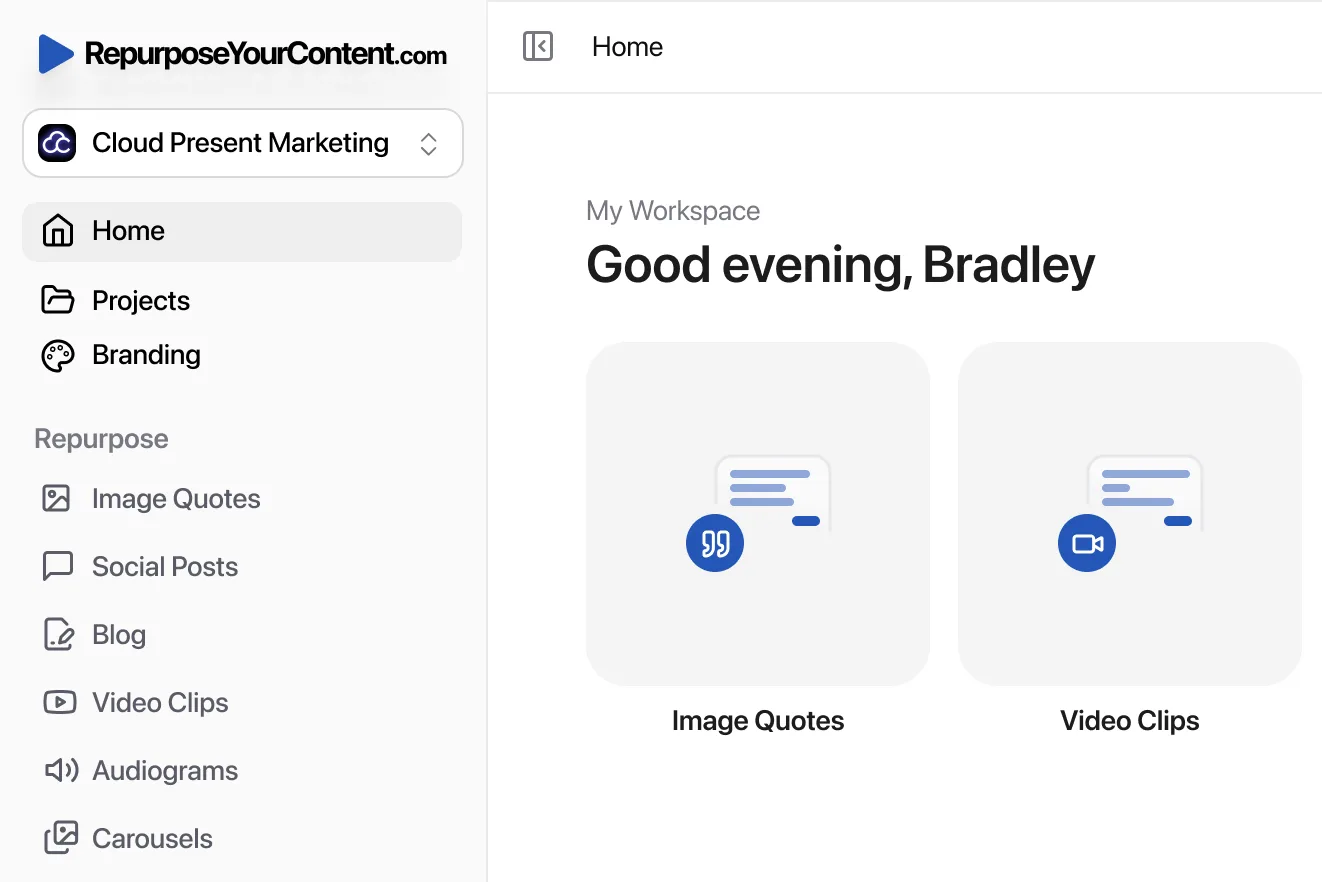
Step 3. Receive 20 to 30 ready-to-publish assets in 72 hours. That includes video clips, LinkedIn posts, quote graphics, carousels, audiograms, and a blog post, all in the client's brand voice, with unlimited revisions.
Step 4. Publish the content across the month instead of scrambling to create new assets from scratch.
The client time is about 15 minutes. That's the point.
Why this model changes the economics
This approach works because the input is fixed and the output is repeatable. One 45-minute recording becomes 30 assets. The work gets priced around the system, not around a pile of ad hoc tasks.
That's also why the economics improve with volume. More recordings create more assets without forcing the buyer to rebuild a process every week.
A well-run service should also offer a firm turnaround. If the provider promises 72 hours or the client doesn't pay, that removes a major risk buyers usually carry with freelancers and agencies.
For teams wanting a closer look at what this category includes, this page on content repurposing services gives the useful framing. The best service isn't the one with the most features. It's the one that reliably ships finished content.
A short walkthrough helps make the model concrete:
What buyers should expect
A serious done-for-you service should deliver:
- Clear asset volume. For example, 20 to 30 assets from one recording.
- Fast turnaround. The content should arrive while the topic is still usable.
- Brand voice handling. The copy should sound human, not autogenerated.
- Unlimited revisions. Buyers shouldn't have to accept first-pass content that misses the mark.
- Predictable economics. Strong services can reach from $14 per finished asset at the right volume.
That's not software. That's outsourced execution without the usual chaos.
How to Calculate Your Content Repurposing ROI
A buyer doesn't need a complicated model to justify repurposing. Two benchmarks usually settle the question.

Benchmark one is the time it replaces
Start with the internal hours a recording would consume if handled in-house.
If the workflow eats 4 to 6 hours per recording in a lighter AI-assisted model, or much more in a fully manual one, those hours already have a loaded salary cost. If the service costs less than the value of those hours, the business case is already strong.
That's the plain-language test non-marketers understand. The company already paid for the recording. Repurposing is the cost of not wasting that investment.
Benchmark two is the asset volume produced
Next, compare the service cost to buying those outputs one by one.
If one recording produces 20 to 30 publish-ready assets, compare that with paying separately for clips, social posts, quote graphics, carousels, and a blog article. The more complete the asset set, the better the economics usually get.
Tofu HQ's 2024 analysis says content repurposing can reduce production expenses by 60 to 70% versus creating net-new content for every channel. The same analysis says 73% of B2B marketers identify recordings as their primary source of quality leads, and that turning a single 45-minute recording into 20 to 30 platform-ready assets can drive a 3x increase in leads per asset while lowering the broader content budget (Tofu HQ on AI content repurposing economics).
The best ROI case is often simple. Reuse the thing the business already paid to create.
A practical ROI workflow
Use this quick test:
- Count the hours saved from not doing repurposing internally.
- Estimate the replacement cost of producing the same asset volume another way.
- Check consistency value. Regular publishing usually matters more than occasional bursts.
- Judge speed to publish. Slow content loses value fast.
- Compare against pipeline impact, not vanity output.
For teams tracking this seriously, this guide to content marketing ROI measurement is the right next read.
A good repurposing service is usually cheaper than hiring a part-time content role, easier than managing several freelancers, and far more reliable than promising the internal team they'll “definitely get to it later.”
If the question is how much does content repurposing cost, the answer is this. The invoice can range from almost nothing to well over five figures, but the biggest line item is often the buyer's own time. For founders, podcasters, and B2B marketers with recordings worth publishing, DIY is rarely the cheapest option once that time is priced accurately.
For a faster answer based on recording volume, asset needs, and turnaround, book a call or request a sample through the pricing page.
Tags: