How to Repurpose Meeting Recordings for Marketing
Learn how to repurpose meeting recordings for marketing. Turn your internal Zoom, Teams, and Google Meet calls into weeks of authentic B2B content.

Most marketing teams already have the raw material. It's sitting in Google Meet, Microsoft Teams, and Zoom folders, untouched. Customer calls, internal AMAs, training sessions, demo walkthroughs, and post-mortems get recorded once, then ignored.
That's expensive in a different way. The team keeps asking for fresh content while the most useful insights are trapped in conversations that already happened. For how to repurpose meeting recordings for marketing, the shift is simple. Stop treating internal recordings as admin artefacts. Start treating them as source material.
Your Untapped Content Goldmine
A polished webinar sounds safe. An unscripted meeting often sounds more believable.
That matters because buyers respond to specific language, real objections, and plain answers. Internal recordings contain all three. A customer success call can reveal the exact phrase a client used to describe a problem. A product AMA can surface objections the sales team hears every week. A post-mortem can show how your team thinks, fixes issues, and explains trade-offs.
In the UK, adults spent an average of 4 hours 20 minutes online per day in 2024, which makes multi-format distribution far more practical than relying on one live session or one content type alone, as noted in this repurposing analysis.

What internal recordings usually contain
The value is often underestimated because the content doesn't look finished. That's the wrong filter. Finished content is the output, not the input.
Useful recordings usually include:
- Customer language: How prospects and customers describe pain, urgency, blockers, and desired outcomes.
- Expert explanations: Subject matter experts tend to explain things more clearly when they're answering real questions.
- Proof points: Not hard metrics every time, but practical examples, before-and-after situations, and decision logic.
- Objections: Sales and customer success calls reveal what needs content support right now.
- Questions worth scaling: If one person asked it live, more people will search for it later.
Internal meetings often sound less polished than webinars. They also sound more like the market.
Teams that already achieve B2B growth through webinars usually understand the core idea. One recorded session can feed multiple channels. The same principle applies to internal recordings, often with stronger source material because the discussion is less scripted.
A practical way to think about it is content multiplication. One raw recording becomes one transcript, several clips, a blog article, a short email, a few social posts, and a reusable FAQ asset. This content multiplication framework is a better fit for time-poor teams than chasing net-new content every week.
Why this works better than starting from scratch
Creating from zero is slow. Editing from existing expertise is faster.
Internal recordings already contain topic selection, audience questions, and speaker input. The hard part has happened. What's missing is extraction. Once marketing teams recognise that, meeting archives stop looking like storage problems and start looking like backlog reduction.
Identifying Repurposing-Ready Meetings
Not every recording deserves a public audience. Some meetings are pure logistics. Some are too sensitive. Some are too rambling to justify the clean-up.
The good candidates share one trait. They contain reusable insight that helps a buyer, user, or stakeholder understand a problem better.
The broader market has already normalised this approach. Recorded sessions became routine during the post-2020 shift to virtual events, and organisers began turning them into blog posts, e-books, and social updates through a repeatable process of record, transcribe, summarise, clip, and redistribute, as described in Wistia's coverage of repurposing event content.
Meetings worth pulling into marketing
A simple filter helps. Ask three questions.
- Does this recording contain a real question buyers ask?
- Did someone explain something clearly enough to stand alone?
- Can sensitive details be removed without losing the point?
If the answer is yes to all three, it's usually worth reviewing.
| Meeting Type | Primary Content Goal | Best Content Formats |
|---|---|---|
| Customer success story | Social proof and problem-solution narrative | Case-study blog, quote cards, short clips, newsletter snippet |
| Expert AMA | Thought leadership and objection handling | FAQ page, LinkedIn clips, transcript-led article |
| Product demo | Education and activation | Feature clips, how-to article, onboarding email content |
| Internal enablement session | Clarify positioning and messaging | Sales FAQ, social posts, blog draft, carousel |
| Post-mortem | Show lessons and process maturity | Behind-the-scenes article, leadership post, framework carousel |
| Customer interview | Voice-of-customer insight | Testimonial clips, article, image quotes, sales collateral |
What should stay internal
Some recordings should never leave the company, even with edits.
Avoid repurposing when the meeting includes:
- Confidential data: Pricing details, roadmap commitments, legal issues, or account-specific information.
- Private staff matters: Performance discussions, hiring decisions, or internal conflict.
- No clear consent: If speakers didn't agree to recording use beyond the meeting, pause.
- Weak signal: Long recordings with little insight aren't hidden gold. They're just long.
Practical rule: Don't ask, “Can this be published?” Ask, “Would this still be useful after the risky parts are removed?”
Compliance and consent come first
This is a key requirement. If a customer appears in a call, the team needs permission before using their words, image, or audio in marketing. If the recording includes sensitive information, marketing needs a review process before anyone starts clipping.
A workable approval path is usually light:
- Marketing reviews the transcript first
- Legal or compliance checks flagged sections when needed
- Sales or customer success confirms context
- The external speaker approves final excerpts if they are identifiable
That process is easier when recordings are imported cleanly from the original platform with timestamps intact. Teams handling Google Meet recordings can streamline that part with this guide on how to import and repurpose Google Meet recordings.
A quick priority order
If the backlog is large, start here:
- First: Customer calls with strong outcomes or sharp problem statements
- Second: Expert AMAs with useful audience questions
- Third: Product demos that answer repeated objections
- Last: Internal update meetings unless they contain a clear external lesson
That order usually produces usable content faster and with less rewriting.
The Transcript-First Repurposing Workflow
Watching recordings from start to finish is a poor use of marketing time. Reading is faster. Skimming is faster still.
That's why the most reliable workflow starts with text. Transcript-first editing turns an unruly recording into searchable source material. It also makes approvals easier, because stakeholders can review words on a page instead of scrubbing through video.
The method is widely recommended by repurposing guides from Univid and Wistia. They advise teams to transcribe recordings, identify key takeaways, and split them into standalone assets such as blog posts, social videos, and FAQ pages in a transcript-led workflow outlined in Univid's repurposing guide.
A simple visual makes the process easier to operationalise.

The five working steps
Centralise the recording
Pull the file into one folder or system. Keep the original title, meeting date, speaker names, and source platform.Generate a clean transcript
Accuracy matters because bad transcripts create bad clips, weak summaries, and approval issues.Mark usable moments
Look for strong answers, recurring objections, customer language, and anything that sounds quotable without extra explanation.Group by content angle
Don't organise by chronology. Organise by topic. One call may contain content for onboarding, demand generation, product marketing, and customer proof.Produce assets by channel
Turn each grouped section into the format that matches the platform, not the other way round.
A useful primer on the mechanics is this walkthrough on how to transcribe video automatically.
A before-and-after example
Take a recorded customer success call. The recording includes a customer explaining why onboarding had stalled, what changed, and which feature finally fixed the issue.
That single call can become:
- One blog post built around the customer's original problem and resolution
- Three short clips answering a specific objection each
- Two image quotes using the customer's plain-language phrasing
- One FAQ entry extracted from the implementation questions
- One email summarising the lesson for similar accounts
The transcript does most of the work. Marketing doesn't need to “create” the angle. The angle is already in the call.
Later in the process, video and audio become useful for packaging and distribution.
What works and what usually fails
The workflow works when editors keep context attached to each excerpt. A strong clip needs a complete thought, not just a dramatic sentence.
It fails when teams do one of these:
- Clip first, think later: That produces disconnected soundbites.
- Ignore speaker setup: A quote often needs one line of framing to make sense.
- Treat every moment equally: Most recordings contain a few strong points, not endless assets.
- Skip transcript review: Editing from video alone makes approvals slower and misses text-led opportunities like blog posts and FAQs.
Good repurposing starts with selection, not volume.
How RepurposeYourContent Automates This Process
Manual transcript review works. It also eats time fast.
Once recordings are centralised and approved, the next bottleneck is production. Marketers still need clips, blog drafts, social posts, quote graphics, and email copy. That's where software becomes useful, especially if the team is handling recordings from several platforms every week.
Wistia reports that almost 90% of marketers reuse webinar content, and one-third of webinars are still getting plays three months after the live event, which supports a practical model of preserving the full replay while atomising shorter assets for ongoing distribution in Wistia's webinar repurposing report.

Where automation helps most
The manual workflow has four friction points. Importing, transcribing, selecting, and formatting.
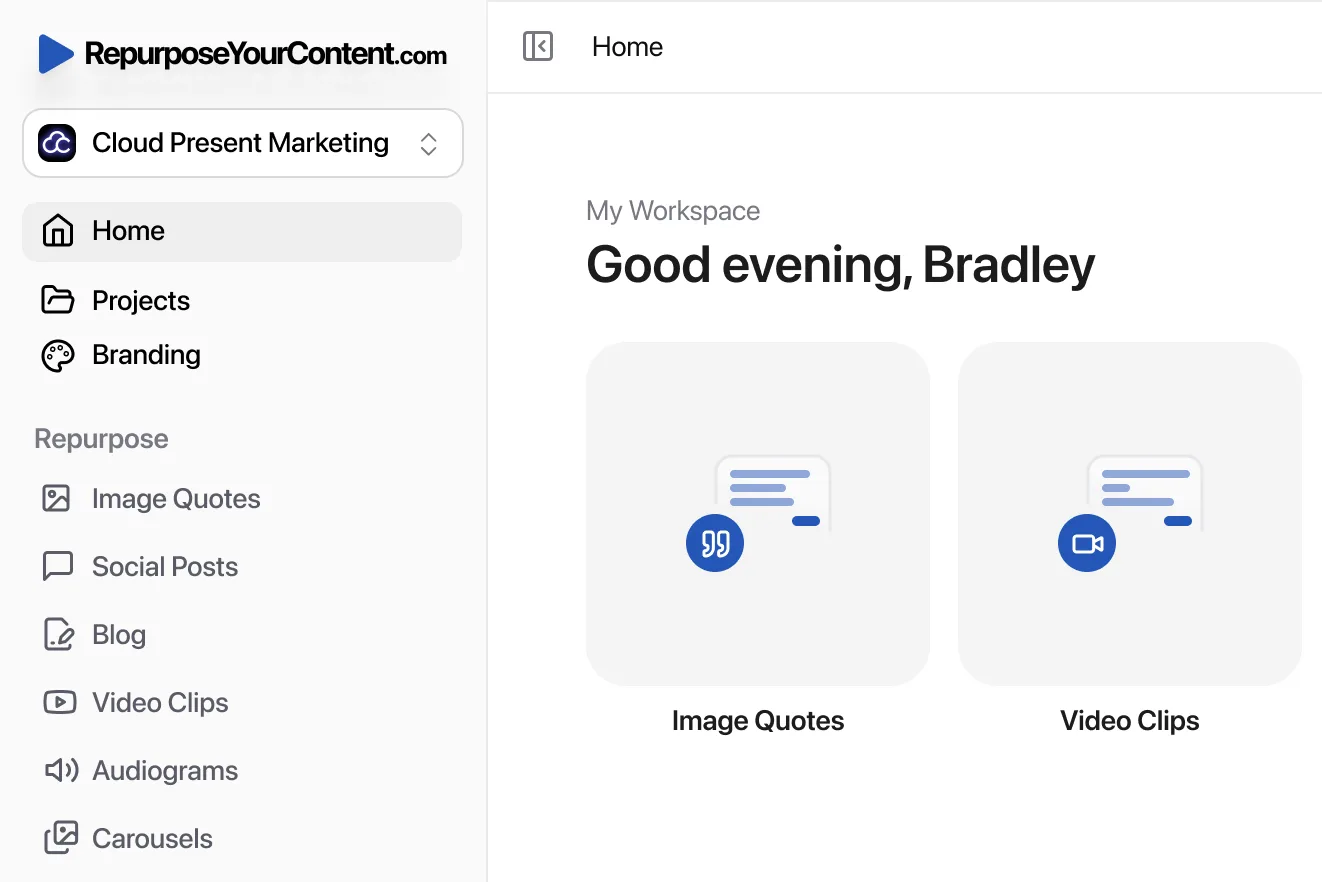
RepurposeYourContent handles that flow by taking a recording from platforms such as Google Meet, Microsoft Teams, or Zoom, generating a transcript, extracting usable moments, and turning them into assets such as video clips, blog posts, social posts, audiograms, image quotes, newsletters, LinkedIn carousels, and timestamped highlights.
That matters because the work usually breaks down in the middle. Teams can record meetings. Teams can also publish content. The delay sits between those two steps.
A practical feature-to-task match
Here's how the common manual tasks map to automation:
- Transcript creation: Instead of exporting audio and fixing text manually, the system generates a transcript with timestamps.
- Highlight selection: Instead of reviewing the whole call line by line, marketers can start from suggested takeaways and key excerpts.
- Asset production: Instead of moving between design tools, docs, and editing software, the content gets produced in the output formats already needed by the team.
- Channel adaptation: Instead of rewriting the same insight for several destinations, the system prepares different content types from the same source.
A broader explanation of that operating model is covered in this article on automated webinar repurposing.
Software doesn't replace editorial judgement. It removes the repetitive production steps that stop good source material from getting published.
The trade-off to manage
Automation speeds up packaging. It doesn't remove the need for review.
Teams still need someone to check context, remove sensitive details, and decide what should remain internal. The gain is that review happens on prepared assets instead of raw recordings. That's a much faster place to make decisions.
Distributing and Measuring Your Repurposed Content
Publishing everything at once wastes the backlog. Better results usually come from spacing one recording across several weeks.
The goal isn't to flood every channel. The goal is to match each extracted format to the place where it makes sense. A transcript-led article works differently from a short clip. A customer quote belongs in a different part of the funnel from a product walkthrough.
For UK B2B teams, transcripts matter for both accessibility and SEO. They also help search engines understand video content, and that's a practical reason to publish transcript-backed assets rather than a video file alone, as discussed in this guide on converting conference calls into content.
A simple distribution rhythm
One recording can support a staggered schedule like this:
- Week one: Publish the full replay or core article on a landing page
- Week two: Share short clips on LinkedIn tied to one specific objection each
- Week three: Send a newsletter using the strongest takeaway
- Week four: Publish an FAQ or carousel built from recurring questions
That cadence keeps one source alive longer and reduces the pressure to produce something new every few days.
A more detailed planning model sits inside these content distribution strategies.
Keep approvals small and predictable
Approvals kill speed when too many people review too much material.
A cleaner model is to assign each role one job:
- Marketing owner: Chooses excerpts and destination formats
- Subject matter expert: Checks technical accuracy only
- Legal or compliance reviewer: Looks only at flagged claims or sensitive passages
- Sales or CS lead: Confirms customer context and tone
That's better than circulating every draft to every stakeholder.
Measure by format, not by recording
A meeting recording can create several assets with different jobs. Measure each one by the action it was meant to drive.
Useful checks include:
- Transcript-derived articles: Organic visits, page engagement, assisted conversions
- Video clips: Views, saves, comments, and clicks to the fuller asset
- Newsletter snippets: Click-throughs to replay pages or articles
- FAQ pages: Search visibility for specific informational queries and support deflection signals
Teams that need a broader measurement framework can use this guide on how to evaluate digital marketing performance and adapt it to repurposed assets.
Don't report on “the meeting”. Report on the assets the meeting produced and the job each asset did.
Common Questions About Repurposing Meetings
What if the recording includes sensitive information
That's normal. Most useful recordings include at least one section that shouldn't go public.
The fix is selective extraction, not full abandonment. Work from the transcript, remove confidential details, anonymise where needed, and only publish sections that stand on their own safely. If the value depends on private context, keep it internal and use the idea to brief a fresh asset instead.
How do teams get buy-in from sales or customer success
Make the ask smaller. Don't ask them to create content. Ask them to keep recording conversations they already have and flag the useful ones.
It helps to show examples of what comes out the other side. One customer call can become a case-study article, a few clips for LinkedIn, and proof points for the sales team. That usually feels more credible to internal teams than abstract “content strategy” talk.
Does rough meeting footage look too unpolished for marketing
Sometimes yes. Often no.
For social clips, FAQ content, and expert commentary, standard Zoom or Teams footage is usually acceptable if the audio is clear and the point is strong. Buyers care more about whether the answer is useful than whether the background looks like a studio. When production quality does matter, the transcript still gives the team enough raw material to rewrite the insight into a cleaner format.
The mistake isn't using imperfect footage. It's ignoring authentic source material because it doesn't look finished.
If the team is sitting on hours of calls, demos, and internal sessions, the backlog already exists. The faster route is to turn those recordings into publishable assets instead of waiting for new ideas to appear. Try RepurposeYourContent to turn meeting recordings into clips, posts, transcripts, and campaigns without rebuilding the workflow by hand.
Tags: