How to Turn Webinar QA Into Blog and Social Content
Learn how to turn webinar qa into blog and social content with our step-by-step 2026 guide. Maximize your content's reach & SEO impact. Don't waste valuable

Most advice about webinars gets one thing wrong. It treats the replay as the asset and the Q&A as the leftovers.
That's backwards.
If a team wants to learn how to turn webinar QA into blog and social content, the best place to start isn't the polished presentation. It's the messy, specific, high-intent audience questions at the end. Those questions contain the exact wording buyers use when they're confused, comparing options, or trying to solve a problem now.
That makes webinar Q&A unusually valuable. It isn't guessed keyword research. It's language handed over by real prospects, in context, with urgency built in.
Why Your Webinar Q&A Is a Content Goldmine You Are Ignoring
The replay usually gets treated as the asset. In practice, the Q&A is often the part with the highest content value.
That is where prospects stop listening passively and start exposing what they need help with. The deck shows what the team planned to say. The questions show where the market is still confused, skeptical, comparing options, or trying to apply the advice to a real buying situation.
The value of Q&A is that it surfaces buyer language without brand polish. That makes it useful in a different way than the presentation itself. A polished webinar can explain a category well and still miss the exact phrasing a prospect would type into search, send to sales, or post in a LinkedIn comment. Q&A closes that gap.
It also gives content teams something they rarely get from a standard campaign brief. Pre-qualified topics.
A live question is not a guessed keyword or an internal brainstorm. Someone took time to ask it in front of peers. That usually signals urgency, friction, or purchase intent. Even basic questions have value because they reveal terminology gaps the brand may be skipping past too quickly.
Practical rule: If a prospect asked it live, other buyers are likely asking sales the same thing, searching for it, or stalling on it.
This is why Q&A often produces better downstream content than the strongest slide in the deck. It surfaces objections, implementation concerns, edge cases, and buying-stage nuance. Those inputs turn into useful FAQ posts, sharper social clips, better nurture emails, and stronger sales enablement content with less guesswork.
There is also a workflow advantage. Teams do not need to invent a fresh angle after every event. The angle is already sitting in the transcript, phrased by the audience. For teams looking for more webinar content ideas after an event, Q&A is usually the fastest place to find content that maps to real demand instead of generic awareness topics.
A simple shift helps:
- The deck is planned content
- The Q&A is audience research
- The transcript is a working source file for future assets
Teams that treat Q&A this way get more than repurposed content. They get a repeatable way to capture customer language, prioritise high-intent topics, and publish answers buyers already told them they want.
A Step-by-Step Workflow for Extracting Q&A Content
The manual process works. It just takes discipline.

Start with a clean transcript
Export the full webinar transcript first. If the platform transcript is rough, clean speaker labels and obvious errors before doing anything else. Bad transcript hygiene creates bad outputs later.
Then isolate the Q&A section. Don't scan the whole webinar in one pass. Cut the transcript into two working documents:
- Presentation section
- Q&A section
That split keeps the extraction process focused. The goal isn't to summarise the event. The goal is to mine questions and answers.
Pull every standalone question
Read the Q&A transcript line by line and extract every audience question into a sheet or doc. Rewrite only when needed for clarity. Keep the original language as close as possible.
At this stage, the team should also note:
- Repeated wording
- Similar questions from different attendees
- Questions that reveal confusion
- Questions that imply a buying objection
- Questions the speaker answered especially well
A simple spreadsheet works. One row per question. Add columns for topic, persona, funnel stage, urgency, and content format potential.
Questions with awkward phrasing still matter. The phrasing is often the signal.
Cluster questions into themes
Single questions are useful. Grouped questions are where scale starts.
Put related questions under one parent theme. For example, several attendee questions about pricing objections, implementation timing, and internal buy-in may all belong to one commercial-intent cluster. That cluster can become a blog post, a carousel, a social thread, and a sales enablement note.
This is also the point where a team can use a content repurposing workflow diagram template to map one question cluster to multiple outputs and owners.
A practical clustering model usually includes:
| Field | What to capture |
|---|---|
| Theme | Broad topic the questions belong to |
| Search intent | Informational, comparative, objection-led, or action-led |
| Audience | Buyer, user, champion, or internal stakeholder |
| Best format | FAQ post, single social post, carousel, clip, email |
Score answers for social versus long-form
Not every good answer makes a good post.
One expert workflow recommends a scorecard based on standalone clarity, specificity, hook strength, relevance, and emotion, with 8–10 treated as “must-clip” and under-6 left for long-form use rather than social (PostQuick scoring workflow for webinar clips and quotes).
That scoring method is useful because it prevents a common mistake. Teams often post answers that needed the original webinar context to make sense. Those pieces flop because the audience sees a fragment, not a complete thought.
Use the score this way:
- High score. Strong for quote graphics, social captions, short clips, and carousels.
- Mid score. Better inside a blog section or newsletter where there's room for context.
- Low score. Still valuable as research input, not as a standalone asset.
How to Turn Webinar Q&A Into Blog and Social Content
Once the questions are tagged and clustered, the essential work starts. At this stage, one audience question becomes several publishable assets.

Experts recommend expanding attendee questions into separate articles or an FAQ hub, then reusing the strongest answers as social captions, quote cards, or short clips from the same transcript (Univid webinar repurposing workflow). That's the right model because it turns one transcript into a connected set of assets instead of a one-off recap.
Turn clusters into FAQ blog posts
If five attendees asked variations of the same thing, don't write five small posts. Build one strong FAQ-style article around the theme.
A good Q&A-derived blog post usually has:
- A plain-English headline based on the actual concern
- Question-led subheadings taken from attendee language
- Short direct answers first
- Expanded context underneath
- Internal links to product, category, or pillar pages
This format works well for long-tail queries because it mirrors how buyers ask. It also lends itself to FAQ schema when the page uses question-and-answer formatting.
A practical example:
| Webinar question | Best content output |
|---|---|
| “How detailed should webinar follow-up content be?” | FAQ blog post answering depth, format, and timing |
| “Can one webinar become multiple LinkedIn posts?” | Social post plus carousel on content breakdown |
| “What should be done with repeated attendee questions?” | “People Also Ask” style pillar section or FAQ hub entry |
Turn one answer into several social assets
A strong answer should rarely stay in one format.
Take an attendee question such as: “What should be done with repeated audience questions after a webinar?”
That can become:
A LinkedIn text post Hook on the mistake. Repeated questions are often overlooked when they should be treated as content demand.
An image quote
Pull the sharpest line from the speaker's answer.A LinkedIn carousel
Slide one asks the original question. The next slides break down the workflow.A short follow-up email
Answer the live question, then add one related question that didn't get airtime.
Repeated questions are editorial signals. They don't belong in a notes folder. They belong in the content queue.
For teams building a broader operating system, the ShortsNinja blog on content optimization is a useful companion read because it frames repurposing around packaging and distribution rather than simple reposting.
Build People Also Ask style pillars
Some questions are too narrow for a standalone blog post and too valuable to discard. Bundle them into a structured pillar page.
This works especially well when the Q&A reveals adjacent concerns around one topic. Instead of forcing each into a separate article, create a hub with short answers and links to deeper pieces. That gives search engines clear relevance signals and gives readers a clean path from broad topic to specific answer.
A good structure looks like this:
- Core topic page
- Grouped sub-questions
- Brief answers
- Links to deeper resources
- Social cutdowns for each sub-question
Teams already doing webinar to blog post workflows can slot this approach into the same system. The difference is that the Q&A provides the subheadings.
Don't skip the unanswered questions
Webinars always leave some questions hanging. Those are still content assets.
Use them for:
- Post-event follow-up emails
- “We didn't get to this live” social posts
- Sales enablement replies
- Future FAQ additions
Sometimes the best post-webinar content comes from the questions that never got answered on air.
Building Your Evergreen Q&A Content Library
The teams that get the most value from webinars do not treat Q&A as post-event cleanup. They treat it as an owned research asset.
A single webinar gives you a handful of usable posts. A Q&A library built across webinars gives you a repeatable source of buyer language, recurring objections, and demand signals that keep paying off. It also gives sales and customer success a faster way to pull approved answers without rewriting the same response every week.
As noted earlier, webinar transcripts and audience questions can feed multiple formats. That only works at scale if every question lands in one system your team can search, sort, and reuse.
What to tag in the library
Keep the setup simple. A spreadsheet, Notion database, Airtable base, or CMS table works fine if the fields stay consistent across events.
Tag each question by:
- Topic such as attribution, onboarding, reporting, budget, or tooling
- Persona such as demand gen lead, content marketer, agency strategist, or operations manager
- Journey stage such as awareness, evaluation, purchase, or adoption
- Format fit such as FAQ article, quote card, social post, clip, or newsletter
- Status such as raw, drafted, approved, published, or refreshed
Add two fields that teams often miss: answer quality and reuse priority. Some questions deserve a polished blog post. Others are better as a quick LinkedIn post, a sales reply template, or a help center entry. If you do not mark that early, the library turns into storage instead of a working editorial tool.
What this changes operationally
A good library changes planning first.
Editorial calendars get sharper because the backlog comes from actual audience questions, not topic guesses. Sales gets faster because common objections already map to a published asset or a draft answer. SEO improves over time because repeated questions across webinars point to durable topics worth building around.
Patterns show up quickly. If five webinars produce versions of the same question, that is not random audience chatter. It is a signal to create a stronger evergreen asset, update an existing page, or build a full cluster around the theme.
That is how a webinar program starts contributing to a wider evergreen content strategy for B2B. The advantage is simple. The source material is already filtered by audience intent.
The trade-off is maintenance. A Q&A library only stays useful if someone owns naming, tagging, and refresh cycles. Without that discipline, you end up with duplicate entries, vague labels, and answers nobody trusts enough to reuse.
How RepurposeYourContent Automates Your Q&A Workflow

The manual workflow is solid. It's also slow.
That's the main bottleneck. Someone still has to review the transcript, identify the strongest questions, map answers to formats, draft the assets, and package them for distribution. MarketingProfs describes a three-hour sprint that can turn one webinar into 30 days of content, including 5–7 clips, a blog outline, and a distribution calendar, while emphasising real-time capture of quotes and audience questions (MarketingProfs webinar repurposing sprint). The process works. Busy teams still need to find those hours.
Where automation helps most
RepurposeYourContent is strongest when the team wants to treat Q&A as a first-class input instead of a manual clean-up task after the event.
It helps by reducing the most repetitive parts of the workflow:
- Question extraction from the webinar recording
- Answer matching so the team can see which response belongs to which question
- Blog generation from Q&A themes and grouped topics
- Social post creation from individual questions or answer snippets
- Timestamp support for clip selection and review
- Multi-format outputs including video clips, blog posts, social posts, audiograms, image quotes, newsletters, and LinkedIn carousels
That matters because the pain usually isn't ideation. It's production.
How the workflow looks in practice
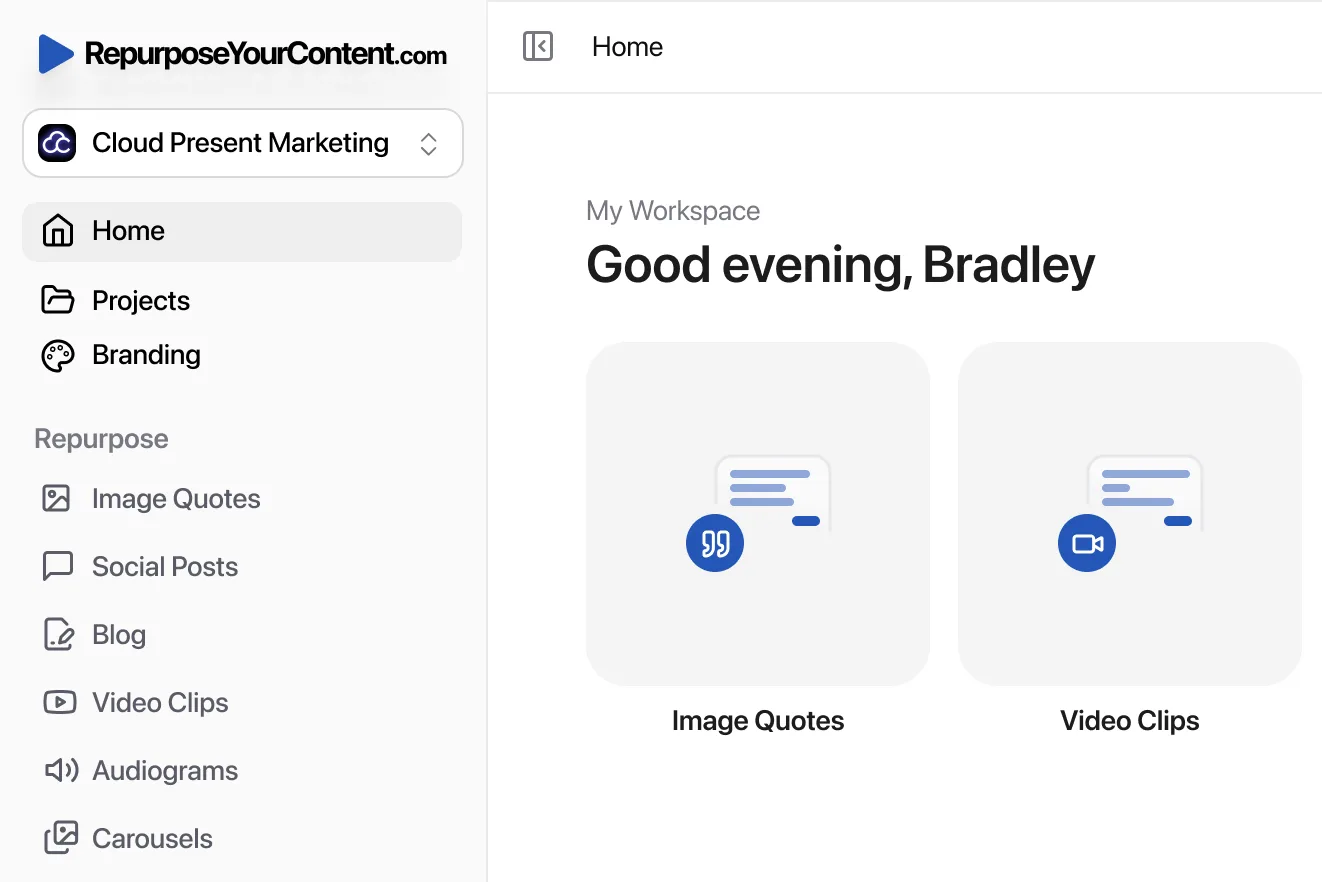
A team can upload a webinar, choose the formats needed, set how many outputs to generate, and review the drafts. For Q&A-heavy sessions, that means the event can feed several channels without another round of interviews or desk research.
For written outputs, the platform can support SEO-driven article production through its blog posts feature. For distribution assets, it can generate channel-ready copy through its social posts feature.
The product walkthrough below shows the platform in action.
The practical benefit isn't just speed. It's consistency. Teams are far more likely to publish Q&A-derived content when the extraction and formatting work doesn't depend on one person doing transcript archaeology late on Friday.
From Audience Questions to Qualified Pipeline
Webinar Q&A content works because it answers declared demand. The audience already told the team what they need help with.
That makes this more than a repurposing tactic. It's a demand generation habit. Every time a team turns a real audience question into a clear article, social post, carousel, or follow-up email, it removes buying friction. It also builds authority in the exact areas prospects care about.
The content that moves pipeline rarely starts with a clever brainstorm. It starts with a real question.
Teams that want better post-event output should stop treating Q&A as an appendix. It's the most commercially useful part of the session. For a broader view of how content supports revenue, this sits neatly inside a demand generation content playbook.
If webinar Q&A keeps getting ignored after every event, try RepurposeYourContent and turn those questions into blog posts, social posts, clips, carousels, newsletters, audiograms, image quotes, and timestamps without the manual grind.
Tags: