Podcast Marketing Services: A Practical Buyer's Guide
Podcast marketing services explained: what each service costs, which fits your bottleneck, and how to vet vendors without wasting budget.

Podcast marketing services matter because podcast advertising has already grown from $1.8 billion in U.S. revenue in 2022 to a projected nearly $4.0 billion by 2025 (IAB U.S. Podcast Advertising Revenue Study). That kind of growth tells you the same thing every week in practice, episode links alone are not marketing. The show needs a distribution system.
Many teams still publish one episode, post one link, and hope the feed does the rest. It doesn't. The shows that grow usually turn one recording into clips, posts, search assets, email content, and paid promotion, so each episode gets repeated exposure instead of a single chance to land.
Why Most Podcasts Stall After Launch
Podcasting has enough reach to matter, but reach does not fix weak distribution. Analysts tracking the category say global podcast listeners reached 584.1 million in 2025, with U.S. monthly podcast consumers rising from 46 million in 2015 to 158 million in later estimates. That should make growth easier. It doesn't, because many shows still stall once the team treats publishing as the finish line.
The hard truth is simple. Recording a strong episode is not the same as building demand for it. A link in a feed is a thin signal. Native clips, quote posts, transcripts, and newsletter excerpts create repeated contact, and repeated contact is what drives discovery.
Practical rule: if an episode only lives as a link, it's under-marketed.
Listener intent matters. Industry summaries show that 46% of podcast listeners bought a product or service after hearing an ad, while 69% said podcasts introduced them to new products. That tells you podcast audiences respond, but only when the episode is packaged in a way people see.
The growth bottleneck is usually not audio quality. It is the missing distribution engine. Episode art and intro music rarely fix that problem. What does move the needle is a post-launch promotion system, plus the discipline to repurpose each episode into assets that keep working after publication. For a practical breakdown of what comes after publishing, see this post-launch podcast promotion guide.
What Podcast Marketing Services Are
Podcast marketing services are the work that happens after recording and before growth. Production ends when the file is clean and published. Marketing starts when someone turns that recording into content people can find, share, search, and act on.
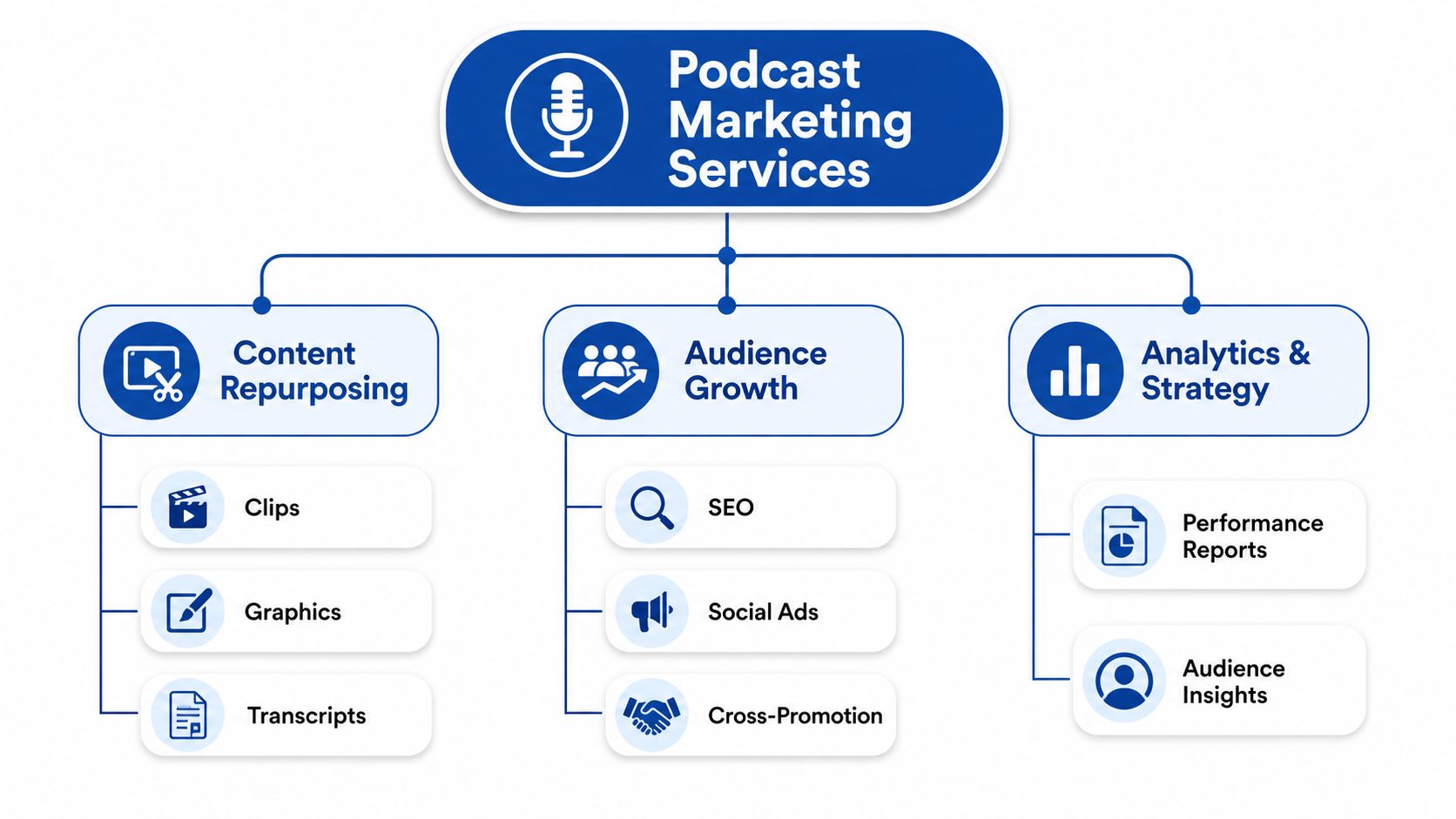
There are six service types that matter in practice. Repurposing and social distribution turns one episode into clips and posts. Podcast SEO makes episode pages searchable. Paid promotion buys reach. PR and guest placement borrow other audiences. Email integration keeps current subscribers engaged. Analytics and attribution show what is working.
The stack that buyers should understand
Buyers should judge the category by output, not by vendor label.
- Content repurposing: Clips, graphics, transcripts, carousels, and blog assets from one recording.
- Audience growth: SEO, social promotion, paid placements, and cross-promotion.
- Analytics and strategy: Clean measurement, attribution, and repeated testing.
The right service depends on the bottleneck. B2B marketing teams need more content without adding headcount. Founders need authority without spending hours in post-production. Agencies need repeatable fulfillment. Creators need a system that turns one recording into a week of usable assets.
A lot of vendors blur those lines and sell everything at once. That sounds useful until the work gets sloppy and the budget gets spread too thin. Strong podcast marketing services fix one problem at a time, and the highest-impact spend usually goes to the service that matches the stage of the show.
If you want a broader map of podcast growth strategy options, that resource is a useful comparison point. The point is simple. A marketing service should solve a specific bottleneck, not just create more activity.
The Six Service Types and What They Cost
The market gets clearer once price is tied to deliverable. If a vendor can't explain what lands in your inbox, the quote isn't useful. Buyers should compare services by what they produce, not by how polished the sales deck looks.
| Service Type | Typical Price Range | Primary Deliverable |
|---|---|---|
| Repurposing and social distribution | $300-$1,500 per episode | 20-30 derivative assets |
| Podcast SEO and discoverability | $500-$2,000 per month | Show notes, transcripts, episode-page optimization |
| Paid promotion | CPM-based, format dependent | Reach, traffic, and response |
| PR and guest placement | $1,500-$10,000 per campaign | Podcast placements, media mentions, guest bookings |
| Email and newsletter integration | $400-$1,500 per month | Recurring episode promotion in owned media |
| Analytics and attribution | $500-$2,000 per month | Server-side log analysis, CRM plumbing, reporting |
Repurposing is the cleanest buy for most shows because the output is obvious. One episode becomes multiple clips, posts, and graphics. If you want a cost benchmark for that lane specifically, the content repurposing pricing guide is the right place to pressure-test a quote.
Paid promotion is different. Mid-roll host-read ads usually cost more than programmatic insertion because the endorsement carries more trust. Benchmark tables report $25-$50 CPM for host-read ads versus $15-$25 CPM for programmatic dynamic insertion, while top-100 shows can reach $60-$120 on host-read inventory. The same source reports aided ad recall of 60%-70% for host-read versus 24%-31% for programmatic, and purchase-intent lift of 28%-34% versus 12%-16% (podcast ad benchmark comparison).
That doesn't mean the expensive option is always the right option. It means format matters. Lower-cost programmatic buys can make sense for reach. Host-read buys make more sense when credibility matters and the audience is already warm. One useful rule holds across most shows, buy the format that matches the funnel stage, then measure with promo codes, pixel tracking, or post-exposure surveys.
Matching Service Type to Your Real Bottleneck
Most buyers pick a service that sounds impressive. That's usually a mistake. The right service depends on what is blocking growth right now.
New shows need positioning, not noise
A show with fewer than 10 episodes usually has a message problem. The premise may be too broad, too generic, or too close to every other show in the category. Before spending much on promotion, the team needs clear audience definition and a premise that's easy to recognize.
Many launches go wrong when they chase growth before the show has a sharp point of view. A better use of budget is positioning, show naming, episode framing, and validation against adjacent shows that already own the space. If the show isn't differentiated, extra promotion just amplifies confusion.
Growth shows need distribution
Once a show has momentum, the bottleneck usually shifts to distribution. For most podcasts under about 50,000 downloads, the biggest lift comes from moving beyond posting episode links. Native short-form clips posted daily give an episode more chances to land in discovery feeds. Links get ignored. Clips get surfaced.
A single recording shouldn't get one chance. It should get many.
This is why repurposing outperforms most other line items for growth-stage shows. It feeds LinkedIn, Instagram, YouTube Shorts, and email without forcing the team to record more often. It also compounds. Each episode becomes a cluster of touchpoints instead of a single file that disappears after launch day.
Established shows need monetization and efficiency
Shows past the early growth stage usually care more about audience quality than raw size. That's where paid promotion and guest placement start to compound. The audience is already there, so the job becomes better targeting, better offers, and better downstream attribution.
For teams comparing in-house execution with outside help, this agency-versus-DIY comparison is worth reading. The core decision stays the same. Spend on the service that fixes the bottleneck, not the one that sounds most advanced.
A Real Workflow From Recording to Published Clips
A podcast marketing service becomes obvious once the workflow is visible. The work is not mysterious. It's just slow when a small team tries to do it all manually.
What the team actually does
- The client sends the recording. That might be a Zoom file, a YouTube link, or a raw audio upload.
- The transcript gets reviewed. Good teams use the transcript to find the strongest soundbites and themes.
- Clips are selected and cut. The best segments become 30-90 second assets with burned-in captions.
- Copy gets written. That includes LinkedIn posts, quote graphics, and a blog summary.
- Brand review happens. The assets get checked against the brand kit before delivery.
A decent DIY version of this work is expensive in time. Clipping takes 2-3 hours per recording. Copywriting takes another 2-3 hours. Design and layout adds 1-2 hours. Scheduling across platforms takes 1 hour. Quality review adds another hour. That puts total DIY time at 7-10 hours per episode.
That's why teams don't keep up. They're not lazy. They're overloaded.
For teams looking for a practical clipping reference, this podcast clip generator guide is useful context. It still doesn't change the labor math. Someone has to pick the right moments, shape the copy, and make the outputs look native to each channel.
A simple workflow example
A 45-minute interview comes in on Monday. By Tuesday, the transcript is marked up. By Wednesday, the strongest segments are clipped. By Thursday, the captions, quote cards, and social copy are checked. By Friday, the assets are ready to publish across the week.
Operational truth: the marketing work starts after recording, not after publishing.
The internal guide on how to repurpose podcast episodes fits neatly with that flow. The point is not to create more editing tasks. The point is to get finished assets out of one recording without burning a full workweek.
Vetting Vendors Without Wasting Budget
The easiest way to waste money is to buy from a vendor that hides the work. Good sales language won't save a weak production process. Buyers need to score vendors on actual operations.
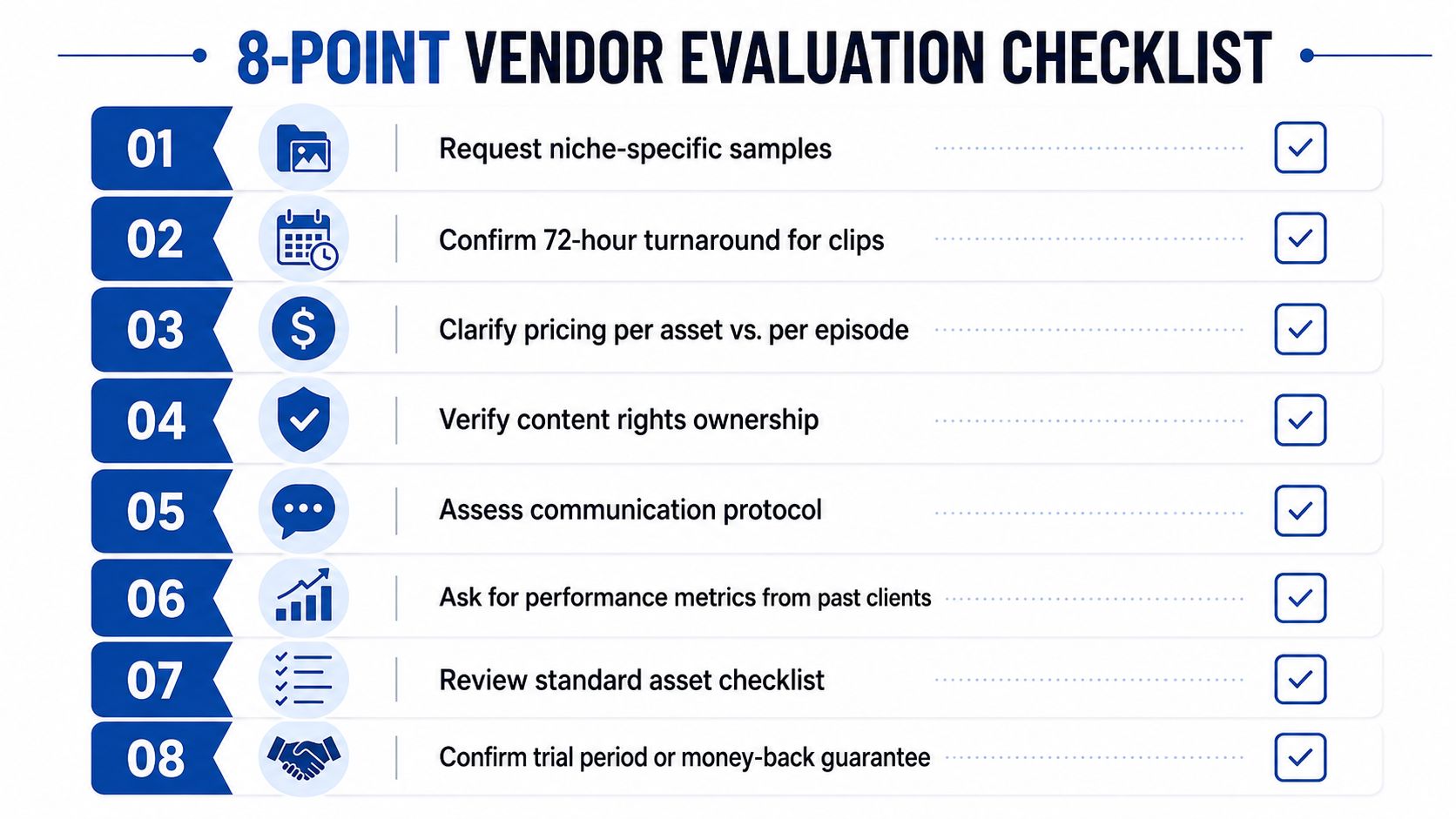
What to verify before signing
- Real niche samples: Ask for deliverables from your category, not just glossy case studies.
- Clear pricing: Confirm whether pricing is per asset, per episode, or quote-only.
- Copy ownership: Ask whether humans write the copy, whether AI is involved, and how it's reviewed.
- Revision policy: Get the revision count in writing.
- Turnaround time: Ask for a promised turnaround window and whether it's guaranteed.
- Asset ownership: Verify there are no watermarks or usage restrictions.
- Brand consistency: Confirm they use a brand kit, not guesswork.
- Posting support: Ask whether they provide a posting playbook or only files.
A useful checklist has to be fast enough to use in a real sales call. If the vendor dodges three of these eight points, that's enough to move on.
For agency teams that need a broader use-case view, this marketing agency solutions page helps frame how content production is usually packaged. The key is still the same. Good vendors make handoff easy and results legible.
Rule of thumb: if the team can't explain revisions, ownership, and turnaround in plain language, the deal isn't ready.
This also ties back to measurement. The IAB's podcast measurement guidance recommends a five-step log-analysis process that filters requests, applies file-threshold logic, identifies uniques, generates metrics, and audits the pipeline, using IP address and user agent together for unique identification (IAB podcast measurement guidelines). That matters because bad ingestion can inflate downloads and distort ROI. Good vendors treat attribution as infrastructure, not an afterthought.
The Done-For-You Alternative
RepurposeYourContent is built for the most common bottleneck, distribution of existing episodes. Clients send one recording, podcast, webinar, keynote, interview, or meeting recording, and get 20-30 ready-to-publish assets in 72 hours, including video clips, LinkedIn posts, quote graphics, carousels, audiograms, and a blog post, all in brand voice with unlimited revisions. The client's time is about 15 minutes per recording.
That matters because the economics are straightforward. Plans run from $999 per month for one recording to $2,499 per month for a weekly content engine with 48-hour priority turnaround, weekly planning, and a monthly strategy call. At the low end, that works out to as little as $14 per finished asset. The service also includes a 72-hour turnaround guarantee, or the client doesn't pay.
The internal breakdown on the podcast repurposing service shows why this model fits time-poor teams. One recording becomes enough content for LinkedIn, YouTube, email, and the blog without forcing the host to manage every edit.
This is the right buy when the show already exists and the problem is publishing enough native content around it. It's not a fit for teams that need a new positioning strategy or a media-buying plan. It is a fit for teams that already have recordings and need them turned into finished assets, fast.
Book a call if the bottleneck is distribution, not recording. Request a sample if the team wants to see exactly how one episode becomes a week of publishable content.
Tags: