How to Choose a Podcast Production Company
Learn what a podcast production company does, typical pricing models, and how to pick the right one for your show. Practical guide for founders and marketers.

A podcast production company handles strategy, recording, editing, publishing, distribution, and often repurposing. Public pricing usually starts around $50 to $150 per episode for editing-only work, rises to $2,000 to $10,000+ per month for full-service retainers, and can reach $3,000 to $15,000 for launch packages.
The market is no longer small enough to treat this as a side expense. One estimate values the podcast production services market at $1.3 billion in 2024, rising to $1.47 billion in 2025 and projected to reach $5.0 billion by 2035, with a 13.1% CAGR across 2025 to 2035 (Wise Guy Reports). Another estimate places the market at $5.8 billion in 2025 and projects $14.2 billion by 2034 at 12.4% CAGR (Wise Guy Reports). That is the signal. Buyers are paying for outsourced operations, not just clean audio.
What a Podcast Production Company Does
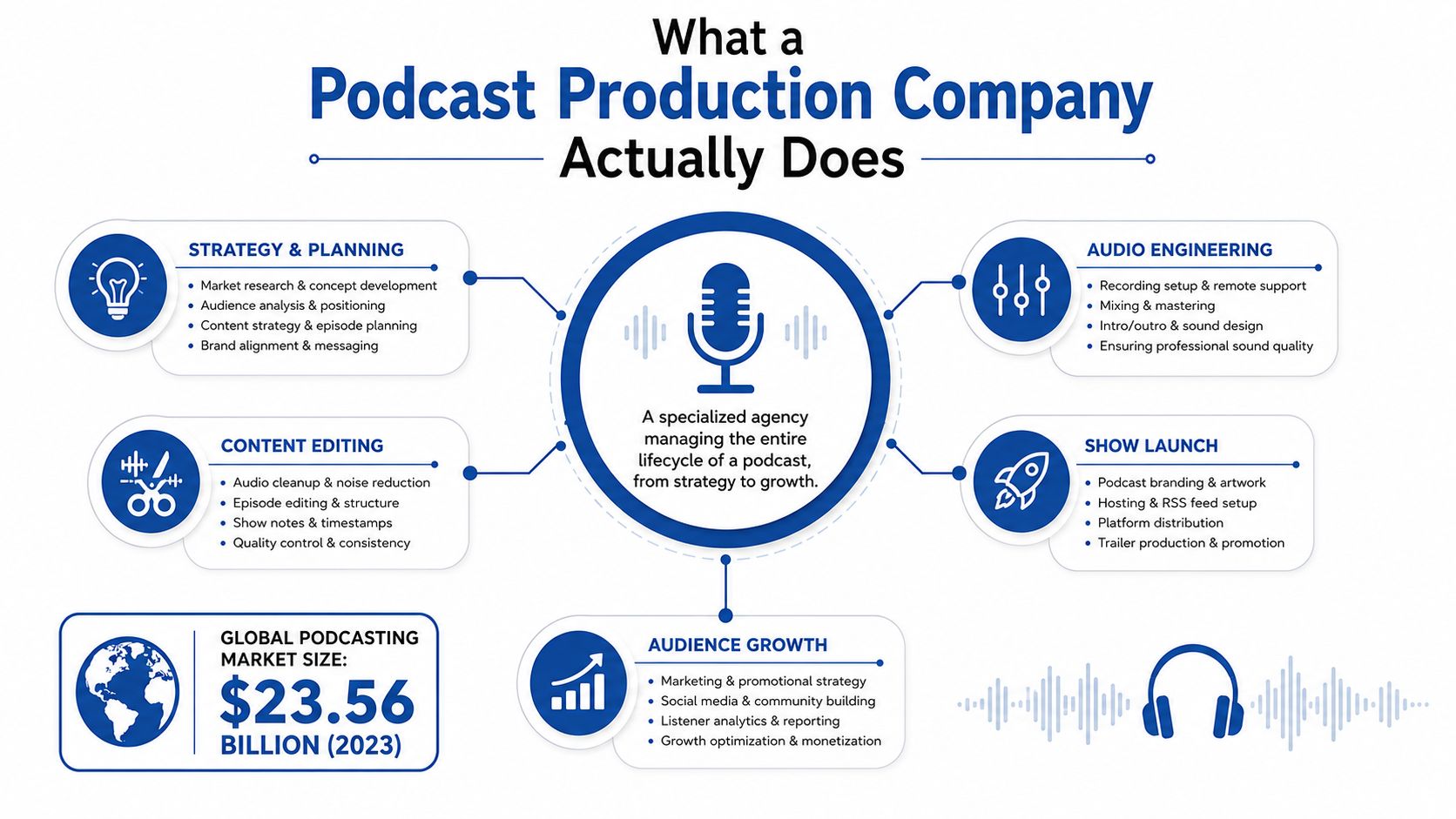
Podcast production sits inside a large, active media economy. Edison Research-based reporting says 73% of Americans age 12+ have consumed a podcast in audio or video form, while another source says 67% of Americans age 12+ listen monthly in 2026, with roughly 158 million to 165 million U.S. monthly listeners overall. That kind of audience density creates room for specialists, and it also punishes sloppy execution.
A podcast production company is a firm that helps a show move from idea to distribution. That usually includes strategy, guest sourcing, recording support, editing, publishing, launch help, and marketing (Auddy). A freelance editor can clean up audio. A production company should run the workflow, or at least take over the parts your team cannot keep up with.
The role is bigger than audio cleanup
The difference matters because most business shows do not fail on microphone quality alone. They fail when no one owns the full path from episode idea to audience growth. Hiring should focus on the company's operating model, not just its demo reel.
A good company should answer simple questions fast. Who books guests, who edits, who publishes, who writes the show notes, and who handles promotion after the episode goes live? If the answer is fuzzy, the service is fuzzy.
Practical rule: if a vendor only talks about “polish,” they are selling a narrow slice of the job.
If a team says it handles the production layer end to end, ask what that means in practice. A real production company should support both the technical work and the promotional work. That includes the messy parts that keep a show from stalling when the host gets busy.
For a tighter definition of editing's place in that workflow, see this podcast editing glossary.
Core Services and Hidden Time Costs
The back end is where most shows break. An industry survey found editing was cited as 13.4% of the top podcasting problems, while scheduling was 9.2% and recording was 8.4% (The Podcast Host). That matches what production teams see every week. Capture is annoying, but the bigger failure point is the work that starts after the mic turns off.
The six layers you are really buying
Pre-production eats time before anyone records a usable minute. Someone has to find guests, draft questions, coordinate calendars, and prep the run-of-show. Recording itself is usually the shortest part, which is why founders and marketers keep underestimating the workload.
Editing is where the first real time sink shows up. Cleanup, pacing, filler removal, and mix decisions all sit on the desk of the person doing the work. Post-production and mastering add another pass, then publishing takes its own block of time, and repurposing takes even more if the goal is assets that can be used across channels.
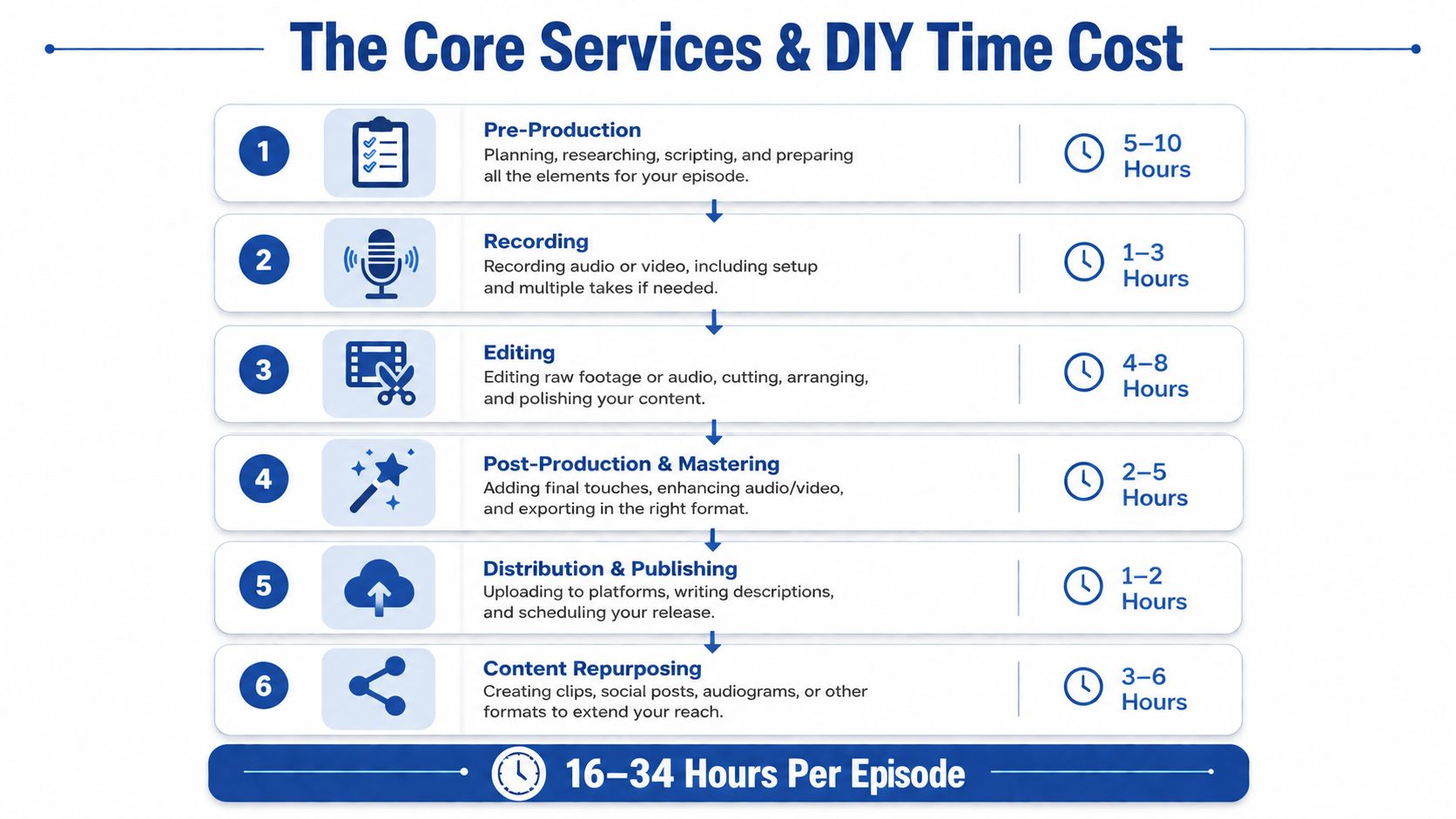
That is why DIY podcasting looks manageable on paper and becomes a drag on the calendar in practice. The invoice for outsourcing often looks high until you compare it with the internal labor, plus the cost of stalled episodes and missed promotion windows.
Simple rule: if an episode sits in a folder for two weeks, the bottleneck was the handoff, not the recording.
Where the hidden time goes
Clipping is not quick. Turning one episode into useful social content can take a real block of focused work, especially if you want clips that support the episode instead of random soundbites that go nowhere. Show notes also take more care than teams expect, because they need to summarize the episode clearly, support search, and give listeners a reason to keep going.
For a practical guide to that step, see creating podcast show notes from recordings.
A production company earns its keep when it removes this drag from the internal team. For B2B marketers and founders, that matters more than polish alone. The episode that gets edited but never distributed, clipped, or summarized well has weak return. The episode that gets turned into show notes, clips, posts, and follow-up assets creates reach after the recording is done.
The point is not that DIY is impossible. The point is that DIY steals attention from the work that drives growth. If your team is already busy, the calendar cost shows up first, and it shows up fast.
Full-Service, Specialized, or In-House
The model you choose should match the amount of operational mess already in the room. A new show usually needs structure from the start. An established show with a steady workflow can fill specific gaps with specialists. A high-volume brand can run things internally, but only if the team has enough headcount and real management discipline to keep the system moving.
Full-service fits when the show needs a system
Full-service agencies handle the most moving parts. They cover strategy, production, publishing, and often repurposing. That fits founders and marketing teams that want the show launched without improvising every step or making internal staff coordinate a dozen handoffs.
Specialized providers are narrower by design. An editing-only vendor works when the format is already set and the internal team handles everything else. Launch-only help makes sense when the show needs a strong start, then the team can carry the weekly workload on its own.
The in-house model gives the most control. It also creates the most management overhead. Someone still has to brief, review, approve, and QA the work. Many teams underestimate that cost and overstate the value of keeping everything inside the company.
The clearest split is operational, not philosophical
Choose full-service when nobody inside the company wants to own the pipeline. Choose a specialized vendor when the show already has clear roles and repeatable inputs. Choose in-house when content volume is high enough that external coordination starts to slow the team down.
If the show is still finding its voice, full-service is the safer call. If the show is stable but the editing queue is the pain point, specialized help is enough. If the brand is publishing across multiple shows and needs a steady repurposing engine, the in-house argument gets stronger. That is where a content repurposing agency guide is useful, because it helps separate production structure from repurposing operations.
A practical way to decide is simple. If the biggest problem is strategy and execution across the whole workflow, go full-service. If the biggest problem is one repeatable task, use a specialist. If the company already has producers, editors, and a manager who can keep everything on schedule, build it internally.
Typical Pricing Models and What You Should Expect to Pay
Public pricing in this space is messy, but the broad ranges are easy enough to respect. Editing-only services often run $50 to $150 per episode. Full-service monthly retainers commonly range from $2,000 to $10,000+. Launch packages for new shows often sit between $3,000 and $15,000 as one-time projects. For a deeper cost breakdown, this content repurposing pricing guide helps frame the back-end layer separately.
The biggest cost driver is not vanity. It is scope. A 20-minute solo show costs less than a 60-minute interview series with guest booking, multi-format publishing, and clips.
What pushes the price up
Turnaround speed matters. More deliverables cost more. Repurposing costs more because it adds writing, design, and format-specific output. Longer episodes also increase labor, especially when the edit is conversation-heavy or the audio needs cleanup.
A vendor that includes clips, newsletters, blog posts, audiograms, and social assets is selling a broader operations function. That is not the same thing as basic editing. Buyers who compare those offers as if they were identical usually make the wrong decision.
| Podcast production pricing at a glance | Typical price range | Best for |
|---|---|---|
| Editing-only | $50 to $150 per episode | Shows with a clear internal workflow |
| Launch package | $3,000 to $15,000 | New shows that need setup and rollout |
| Full-service retainer | $2,000 to $10,000+ per month | Teams that want ongoing production support |
The cheapest option is rarely the cheapest outcome. A low editing fee can still become a high internal cost when someone else has to manage publishing, feedback, and repurposing.
Budget for the workflow, not just the file
That is why finance conversations should not stop at the episode edit. Ask what is included, what is excluded, and what happens when the show needs distribution support. A clean quote without repurposing is only half the equation for most B2B teams.
If the goal is lead generation, the content after the episode matters just as much as the episode itself. That is the number that usually gets missed in procurement discussions.
The Hiring Checklist and Questions Worth Asking
A bad hire for podcast production usually shows up in two places, the budget and the calendar. The show may sound fine on paper, then the client starts chasing edits, approvals, exports, and missing files. Ask whether the company can keep the show moving without turning your team into project managers. The portfolio matters, but process matters more.
A checklist that protects your investment
- Review the portfolio with a producer's ear. Listen for inconsistent audio levels across episodes, abrupt music cuts, noisy room tone, or a guest voice that suddenly sounds like a different show. Check whether guest names are credited the same way every time and whether titles, descriptions, and episode structure stay consistent from one release to the next. A single polished sample proves almost nothing.
- Ask for turnaround in writing. Some vendors can move fast on a launch episode and still miss deadlines once the show is running. Written timing protects launch plans, guest expectations, and ad reads, and it gives you something to hold the vendor to when the workflow gets busy.
- Clarify asset ownership. Raw files, final audio, clip exports, show notes, and written assets should all be spelled out in the contract. If you ever need to switch vendors, you want the files without a fight.
- Find out who does the work. Some agencies sell the work with one senior person and hand it off to a junior editor or contractor. That is where quality slips, especially when the show depends on the same sound, the same naming conventions, and the same release standards.
- Ask how revisions are handled. Unlimited revisions, capped revisions, or a fixed approval round change the actual cost of the relationship. If the answer is vague, assume the bill will grow later.
- Press on repurposing capability. If the answer stops at editing, the company is leaving value on the table. You want a team that can turn the episode into clips, show notes, and distribution-ready assets, not just a finished audio file.
Questions worth asking on the call
- Who edits the show, and do they edit similar formats?
- What is the standard turnaround, and does it change by episode length?
- Who owns the final files and the raw source assets?
- How are clips, show notes, and social assets handled?
- What does the revision process look like after delivery?
- What happens when a guest audio file is weak or incomplete?
The market is crowded enough that pretty websites can hide weak operations. A good call should make the workflow obvious. A bad one hides behind vague answers and brand language.
A company that cannot answer the ownership question cleanly is not ready for serious business clients. A company that cannot explain its revision flow is not built for repeatable work. A company that cannot explain how it supports podcast distribution and repurposing is leaving the biggest part of the return untouched, and the practical playbook for that work is laid out clearly in how to repurpose podcast episodes.
Good sign: the vendor talks about assets, workflow, and deadlines before it talks about “creative magic.”
Why Distribution and Repurposing Determine ROI
A polished episode is a starting point. The return comes from whether that episode keeps working after publish, across channels that matter to revenue.
The audience is already there. U.S. listening is broad, and global listening is large enough to support specialization at scale. That does not guarantee reuse. It only means there are more places for good content to get ignored if the follow-through is weak.
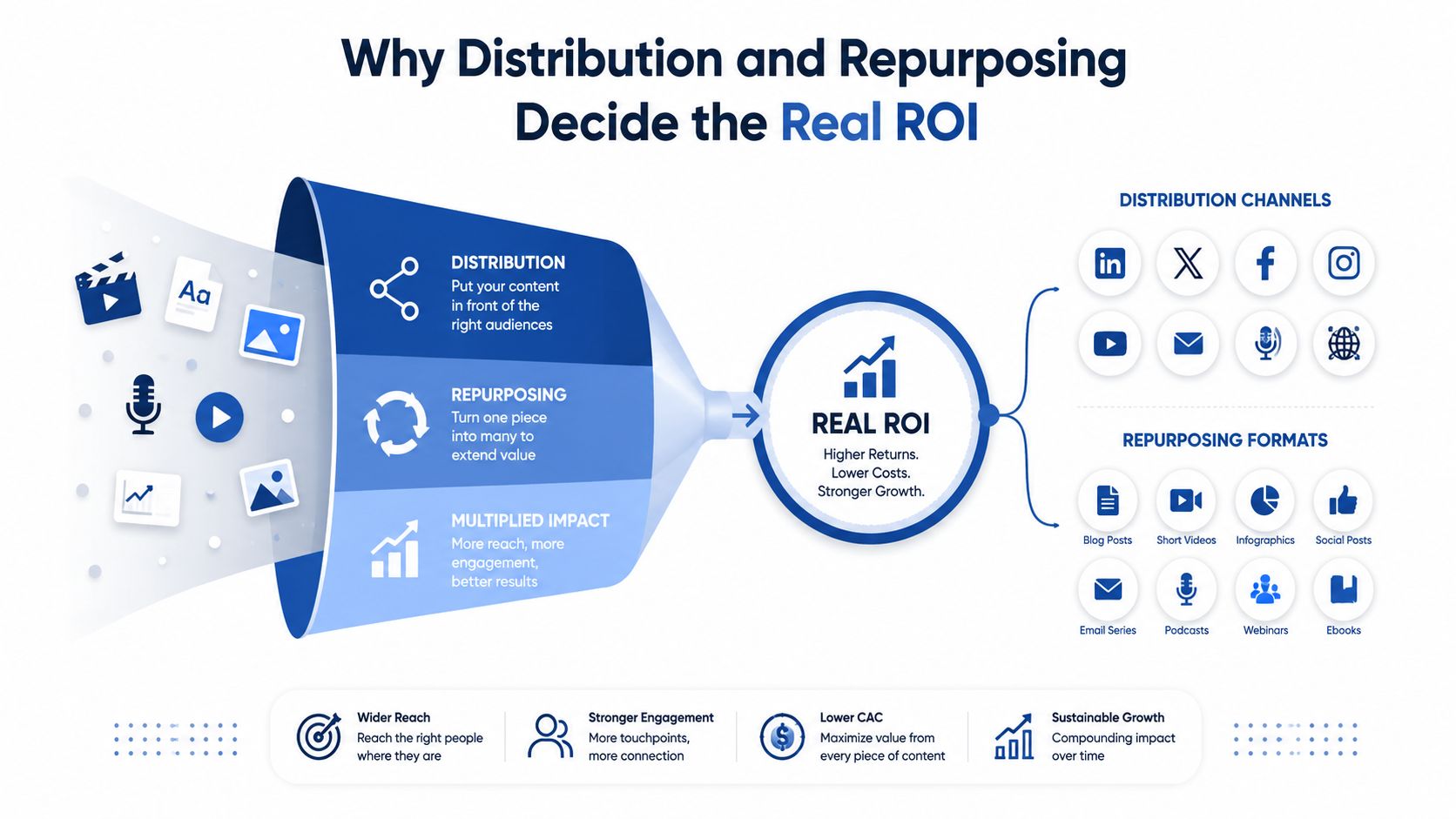
The shows that underperform publish once and stop. The shows that generate value turn one recording into clips, LinkedIn posts, quote graphics, carousels, blog posts, and newsletters. That is the difference between a media file and a marketing system.
The operational gap is obvious. Most hiring content still emphasizes launch support, editing, turnaround time, and who you will work with. It does not spend enough time on distribution and repurposing outcomes, even though that is where the episode keeps producing value, as noted in One Stone Creative and in the practical guidance on how to repurpose podcast episodes.
What business teams should measure
B2B marketers do not need more isolated episodes. They need a repeatable process for turning recordings into usable content. Judge the work by downstream output, not by audio fidelity alone.
Track clip engagement, qualified traffic to episode-linked pages, newsletter click-through from repurposed assets, and lead attribution from content that started as a single recording. If those pieces are not being measured, the show is just publishing. If they are being measured, you can see whether the production setup is feeding pipeline, not just filling a feed.
For teams that want a practical framework, the right question is simple. How many usable assets come from each recording, how often do those assets get published, and which formats bring people back to the brand? A production company that cannot support that workflow leaves too much value on the table.
The Done-For-You Alternative
A strong production setup still leaves the post-production layer to be solved. That is where a separate done-for-you repurposing service fits. One recording comes in, usually a podcast, webinar, keynote, interview, or meeting recording, and the client's job is about 15 minutes of upload and review time.
A typical workflow is simple. Step 1, upload the raw file from Zoom, YouTube, Vimeo, or any file source. Step 2, the team handles moment selection, copywriting, and brand-kit application. Step 3, the client reviews everything in a one-click portal and either approves or sends notes. Step 4, the posting playbook tells the team what to publish, where, and when.
That is the part teams want, because it removes the bottleneck. A single 45-minute recording can become 20 to 30 ready-to-publish assets in 48 to 72 hours, with unlimited revisions and output built in the client's brand voice. A service like RepurposeYourContent sits in that post-production layer, not as a replacement for editing, but as the step that turns finished content into assets.
If the show already exists and the problem is distribution, not recording, that is the cleaner route. The production company handles the episode. The repurposing partner handles the content machine.
Book a call or request a sample if the goal is to turn one recording into a real distribution engine, not another file that gets published once and forgotten.
Tags: