Choosing a Content Repurposing Agency: 2026 Expert Guide
Find the ideal content repurposing agency in 2026. Our guide covers costs, deliverables, & essential questions to ask. Compare agencies, freelancers & tools.

A content repurposing agency takes one long-form recording and turns it into 20 to 30+ finished assets, usually including clips, posts, graphics, carousels, and an article. Costs typically range from roughly $50 to $150 per asset with freelancers, $3,000 to $10,000 per month with traditional agencies, and productized services starting around $999 per month.
That's the practical answer most buyers need.
The bigger issue is this. Recorded content already drives leads for B2B teams, but teams often still fail to use it properly. For B2B marketing teams, 73% of marketers identify recorded content as their primary source of quality leads, yet only one in three teams have a scalable method to consistently repurpose these recordings into new assets according to Cloud Present's analysis of repurposing workflows.
So the hiring decision isn't just about editing. It's about buying back time, building a repeatable output system, and making sure expensive recordings don't die after one post.
What Is a Content Repurposing Agency
A content repurposing agency is a service business that takes one long-form recording, such as a podcast episode, interview, keynote, sales call, livestream, or course module, and turns it into a complete package of ready-to-publish content.
That package should include more than clipped video. A real agency handles editorial judgment, copywriting, design, formatting, and packaging. It should produce assets that fit each channel, not just chop up a transcript and call it done.
What the agency actually does
A serious provider usually sits between raw source material and final publishing. That means the client sends a recording. The agency identifies strong moments, writes supporting copy, creates visuals, and returns finished assets that a team can publish immediately.
That matters because the work is broader than most buyers assume.
- Content extraction: Pulling usable ideas from a long recording
- Editorial shaping: Turning spoken points into clear written posts
- Visual production: Creating clips, branded graphics, and carousel layouts
- Channel adaptation: Making content fit LinkedIn, short-form video, blog, and email use cases
- Quality control: Reviewing voice, pacing, grammar, captions, and brand consistency
A useful primer on the broader process sits in this guide on what content repurposing means in practice.
Practical rule: If a vendor only talks about clipping video, that vendor is selling editing, not repurposing.
What it typically costs
The market splits into three buckets.
Freelancers usually price by output. Traditional agencies usually price by retainer. Productized services usually price by monthly recording volume.
That distinction matters because buyers often compare the wrong things. A cheap clip editor may look affordable until the internal team still has to write posts, design graphics, brief revisions, and manage deadlines.
A proper repurposing agency should remove that work, not create more of it.
Standard Deliverables and Services to Expect
The baseline should be clear. A good agency doesn't send a folder of rough cuts. It sends a publishing package.
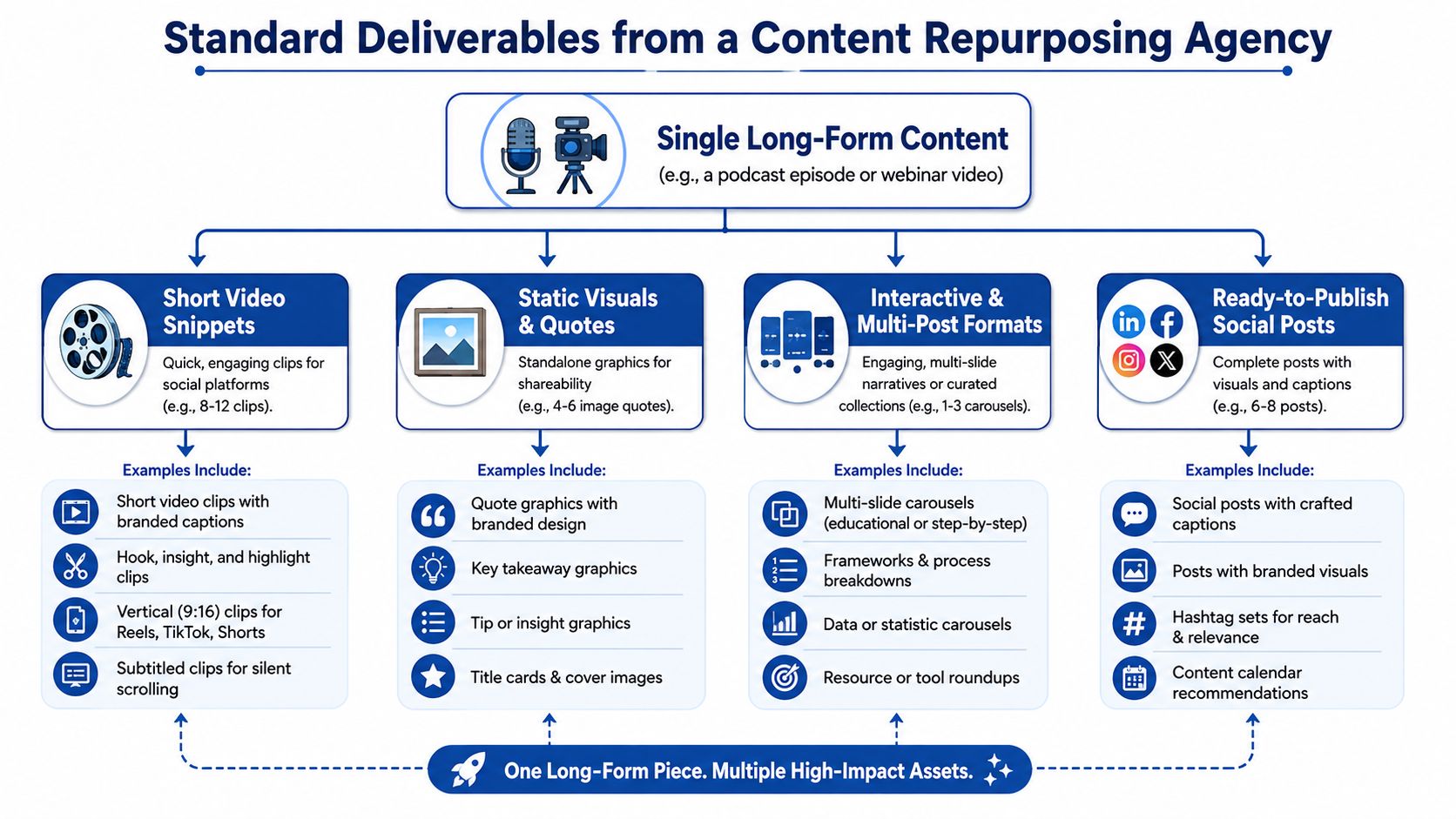
From one long-form recording, a top service should deliver:
- 8 to 12 short clips: Vertical or square video or audio clips with branded captions
- 6 to 8 social posts: Platform-ready copy with matching visuals
- 4 to 6 quote graphics: Clean static assets built from the recording
- 1 to 3 carousels: Multi-slide posts that summarize a core idea
- 1 SEO blog post: A readable article built from the source material
- A posting playbook: Clear guidance on what to post, where, and when
The outputs that matter most
Not every asset has equal value.
Short clips are useful for reach. Social posts are useful for consistency. A blog post is useful because it gives the recording a durable home on the company site. Carousels are useful when the speaker shared a framework or process. Quote graphics are useful for lighter publishing days.
A deeper library of examples appears in these content repurposing examples from one long-form recording.
The service standards buyers should require
The deliverables list is only half the job. The other half is how the service runs.
A top agency should also provide:
- Brand kit alignment: Logos, colors, fonts, and formatting should match the client's standards
- Brand voice capture: Posts shouldn't sound like generic AI filler
- Human review: Every clip, post, and visual should be checked by a person
- Revision coverage: Buyers shouldn't pay extra for small fixes
- File ownership: Final assets should belong to the client
- Distribution guidance: Teams should know what to publish first
One long-form session can go much further than commonly anticipated. According to Captions' breakdown of repurposing output, a single 60-minute webinar can fill two to three weeks of social media content when properly broken down into vertical clips, carousels, and text posts. The same operating logic applies to podcasts, interviews, keynotes, and recorded sales conversations.
The right benchmark isn't “Did they make clips?” It's “Did they give the team a usable content calendar from one recording?”
Comparing Your Options Agency vs Freelancer vs In-House vs Tools
Most buyers compare price. Smart buyers compare total cost of ownership.
That includes money, internal time, feedback cycles, and management overhead. The cheapest option on paper often becomes the most expensive option once a founder or marketing lead has to supervise it every week.
The hidden cost is buyer time
Manual repurposing takes real work.
For one recording, a team usually has to review the source, identify usable moments, clip highlights, write post copy, create visual assets, approve drafts, and organize final files. In practice, that often eats 4 to 6 hours per recording. That estimate matches the common before-state many teams report before switching to a done-for-you service.
Here's the comparison that matters most.
Content Repurposing Options Compared
| Option | Estimated Monthly Cost | Your Weekly Time Investment | Key Trade-off |
|---|---|---|---|
| Freelancer | Roughly $50 to $150 per asset equivalent | Moderate to high | Lower direct spend, but the buyer still manages briefs, edits, and consistency |
| Traditional agency | Roughly $3,000 to $10,000 per month on retainer | Moderate | Stronger support, but often expensive and slower to adapt |
| In-house team | Qualitative only | High | Best internal control, highest management burden |
| DIY tools | Qualitative only | High | Fast drafts, weak polish, heavy buyer involvement |
| Productized service | Starting from $999 per month | Low | Best fit when the buyer wants predictable output and minimal overhead |
Where each option works
Freelancers work when the need is narrow. A buyer may only need clips or only need LinkedIn posts. The problem is coordination. One freelancer edits. Another writes. A designer handles graphics. Somebody inside the company still has to run the process.
Traditional agencies work when a company wants strategy plus production and has budget for a retainer. The problem is bloat. Many are built for large accounts, formal meetings, and longer timelines.
In-house teams work when the company already has an editor, writer, designer, and content manager. If even one of those roles is missing, bottlenecks start fast.
DIY tools help with drafts, transcripts, and rough clipping. They don't remove judgment calls. The buyer still has to choose moments, fix copy, refine visuals, and publish intelligently. That's why most buyers who start with software still end up comparing options against guides to content repurposing tools and where they fall short.
A founder's calendar has a cost. A marketing lead's context switching has a cost. Most “cheap” solutions ignore both.
The blunt recommendation
If the team has excess time and strong production talent, in-house can work.
If the team is time-poor and needs output every week, a productized done-for-you service is usually the cleanest first hire. It reduces moving parts. It also makes quality easier to inspect because the deliverables are defined upfront.
Understanding Content Repurposing Agency Pricing
Pricing in this market looks messy because agencies use different units. Some price per clip. Some price per month. Some quote a project fee. Buyers need to normalize all of it back to one question.
What does one recording produce, and what does each finished asset really cost?
The three models buyers will see
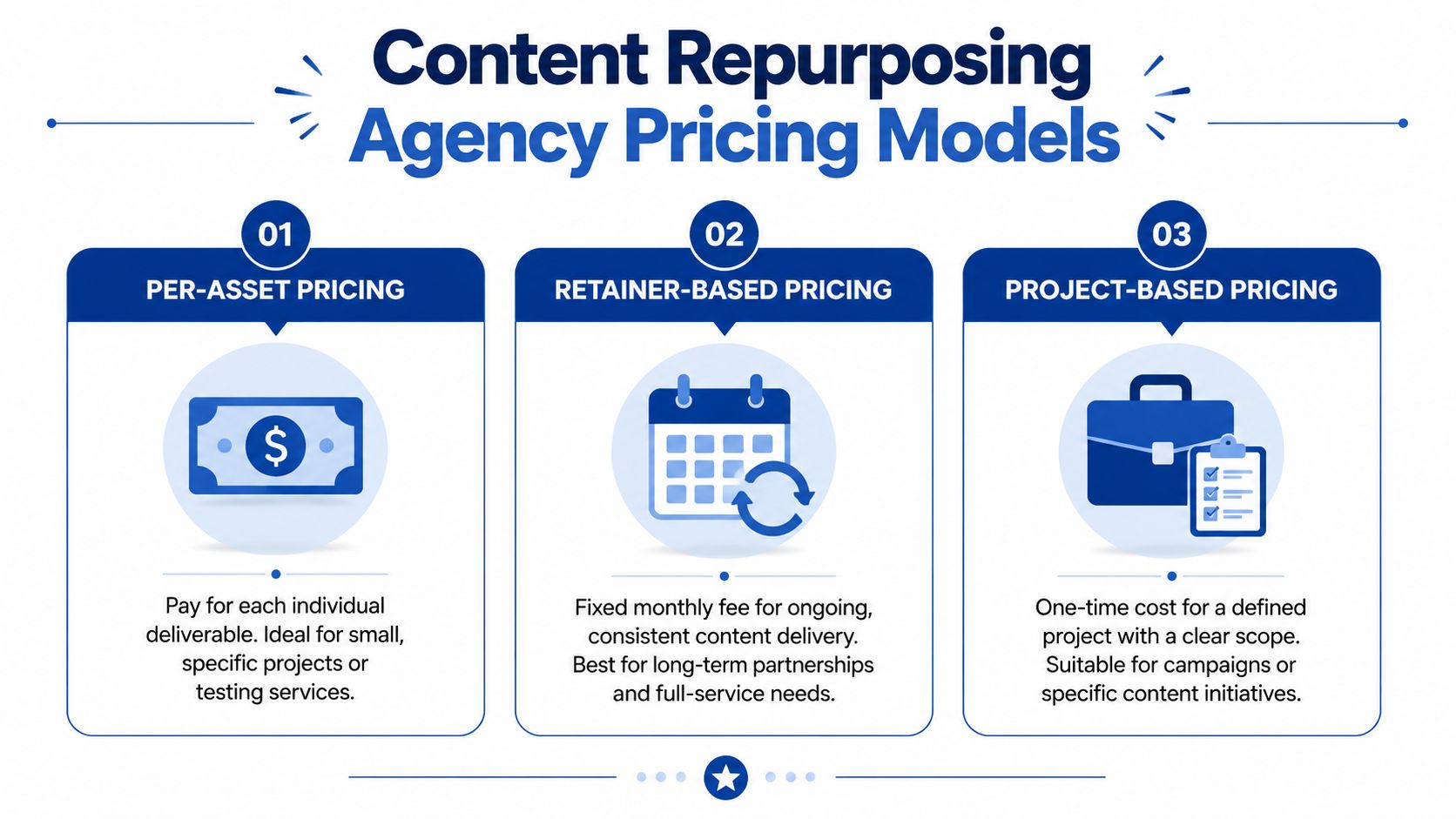
Per-asset pricing is common with freelancers. The benchmark range is roughly $50 to $150 per asset. It sounds flexible, and sometimes it is. But it also creates a bad incentive. Every extra post, graphic, or revision becomes another line item.
Retainer pricing is common with traditional agencies. The benchmark range is roughly $3,000 to $10,000 per month. This can work well when the scope is broad and strategy matters. It can also hide weak accountability if the contract doesn't define exact outputs and turnaround times.
Productized service pricing usually starts around $999 per month and ties pricing to recording volume and output. That model is easier to evaluate because the buyer can compare one recording against the number of assets returned.
What good value looks like
A productized service can be financially efficient when the output is clearly defined. Verified market data shows that repurposing with a productized service delivers assets at a cost of as little as $14 per finished piece, making it a scalable option for teams that need consistency without hiring separate editors, designers, and writers.
That doesn't mean every low price is good value. Cheap is bad if the buyer still has to rewrite posts, request endless fixes, or wait a week for delivery.
A clearer benchmark appears on this content repurposing pricing page, where the model is tied to monthly recording volume instead of hourly labor.
What to ask when reviewing a quote
- Output clarity: How many finished assets come from one recording?
- Turnaround definition: Is the delivery window guaranteed or estimated?
- Revision policy: Are revisions included or charged separately?
- Scope precision: Are blog writing, graphics, and captions included?
- Ownership terms: Does the client own source files and final assets?
The right pricing model isn't the one with the lowest sticker price. It's the one with the clearest link between cost, speed, output, and buyer effort.
The Done-For-You Alternative A Real Workflow
The cleanest model for a first hire is simple. The client sends one recording. The service returns a month of finished content.
That's the point of a productized workflow. It removes project management from the buyer's plate.
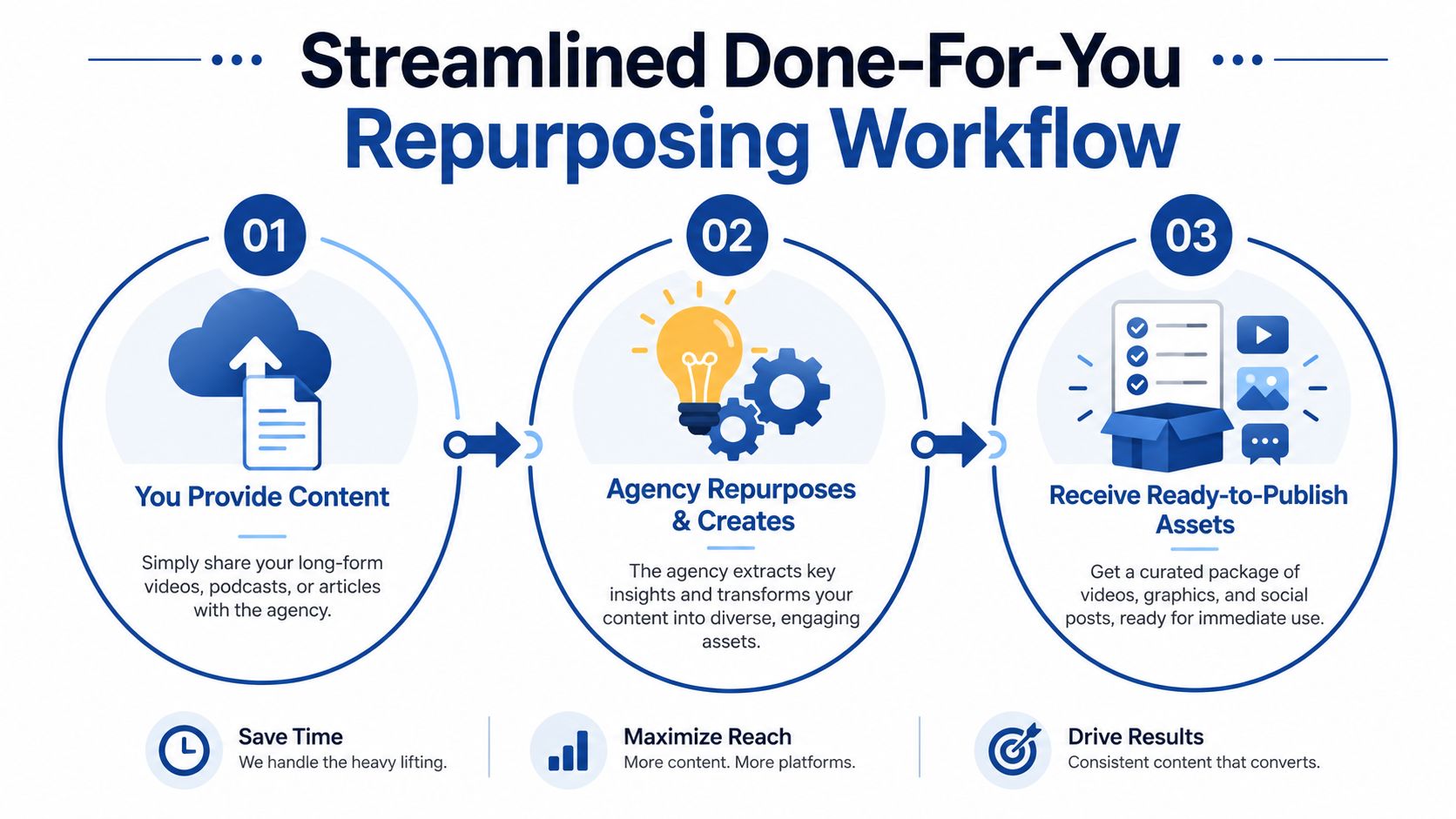
A practical three-step workflow
Step 1: The client sends one recording. That can be a podcast, keynote, interview, sales call, meeting recording, livestream, or course session.
Step 2: The service team reviews the source, selects strong segments, writes copy, designs assets, and formats everything to the client's brand kit.
Step 3: The client receives a finished package for review, then requests edits or approves it.
That's the ideal operating model because the client's time stays low. In a strong done-for-you setup, the total client time is about 15 minutes.
A more detailed operational view appears in this guide to a content repurposing workflow for small teams.
For buyers who want to see the process visually, this walkthrough helps.
A real benchmark buyers can use
The strongest practical benchmark in this category is simple. According to St. Ledger Marketing's repurposing breakdown, recording a single 45-minute podcast episode yields approximately 30 distinct content assets when split into clips, social posts, quote graphics, carousels, audiograms, and a blog post.
That's the benchmark serious buyers should use.
If a service can't turn one 45 to 60 minute recording into a full content package, the buyer is likely paying for fragmentation, not repurposing.
What a strong done-for-you offer should include
A credible model should state the operating terms clearly:
- One recording becomes 20 to 30 assets
- Turnaround is 72 hours
- Unlimited revisions are included
- On time or the client doesn't pay
- Pricing starts from $999 per month
- Assets include clips, posts, graphics, carousels, audiograms, and a blog post
Buyers shouldn't need to guess what arrives, when it arrives, or what happens if the deadline slips.
The Hiring Checklist 7 Questions to Ask Before You Sign
Most buyers ask the wrong first question. They ask price before they ask process.
That's backwards. If the workflow is weak, the quote doesn't matter.
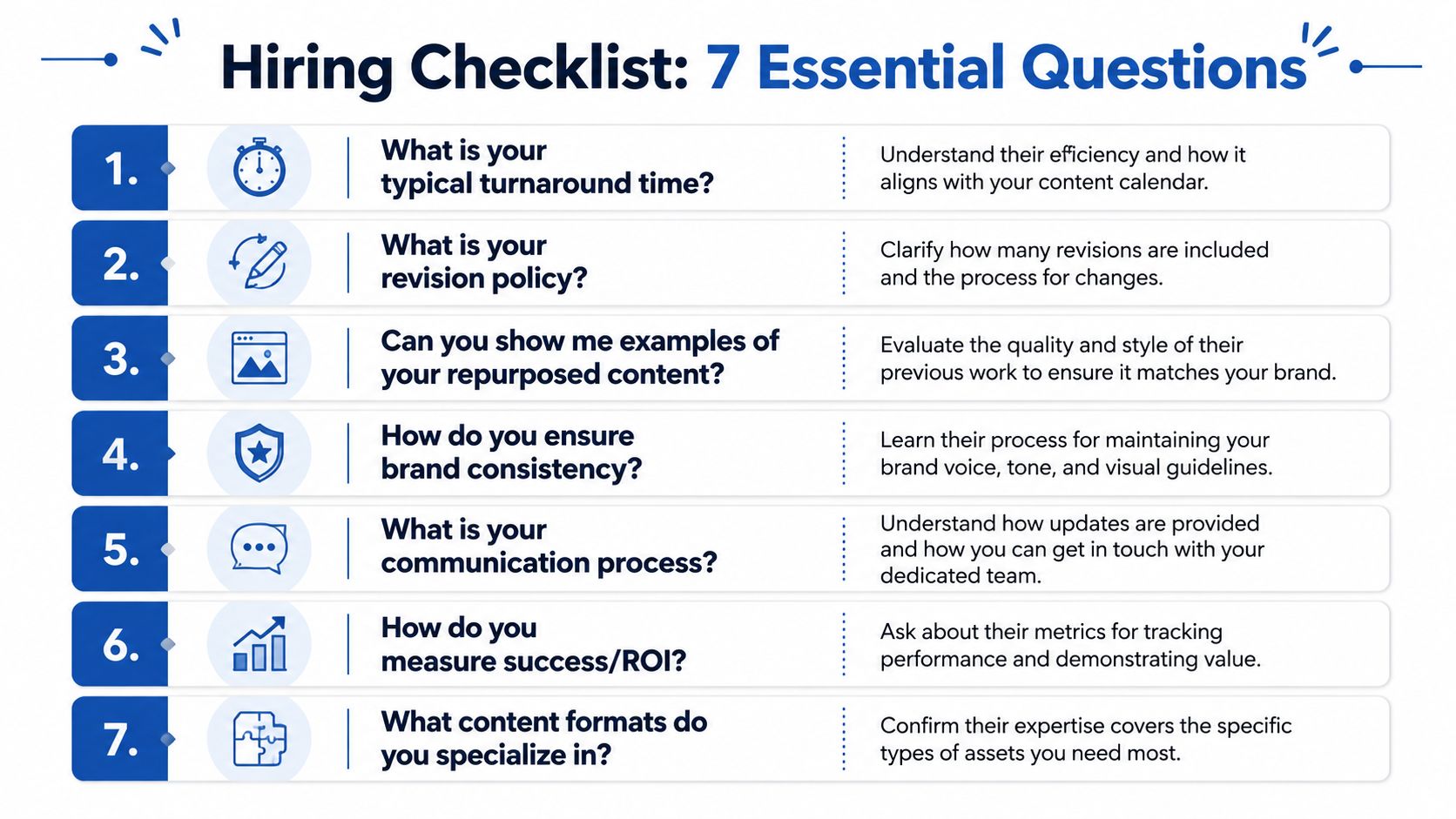
The seven questions that actually matter
What is the guaranteed turnaround time?
“Fast” is not an answer. Buyers need a firm number and a stated consequence if the deadline is missed.What is the revision policy?
Unlimited revisions is clean. Capped revisions often create friction and surprise charges.Who owns the final files?
The client should own all assets outright. No watermarking. No gated exports. No ambiguity.How is brand voice captured?
The provider should ask for past posts, brand guidelines, and preferred tone examples. If the answer is “AI handles that,” expect generic output.What exactly is included from one recording?
Buyers should get a concrete list. Clips, posts, quote graphics, carousels, blog article, and posting guidance.Is there a minimum commitment?
Long contracts protect bad vendors. Short commitments force providers to prove value quickly.What happens if deadlines slip or quality misses the mark?
The contract should define the remedy. Credit, remake, or non-payment. Anything vague is a risk.
Red flags buyers should treat seriously
- Paid revisions: This usually means endless nickel-and-diming.
- No sample work: If the provider can't show examples, the buyer is funding the learning curve.
- No clear owner of the account: Confusion starts immediately.
- Only clip-based deliverables: That's editing, not strategic repurposing.
- Long setup with vague delivery: Buyers shouldn't wait around for “creative exploration.”
- No brand kit process: Expect off-brand visuals and weak copy.
The best agencies answer these questions quickly. The weak ones talk around them.
The benchmark to keep in mind
A strong first vendor should be able to take one recording and return a complete content package without heavy buyer involvement. If the buyer still has to manage strategy, write posts, or clean up captions, the provider hasn't removed the bottleneck.
Get Your Content Working Harder Not Your Team
The wrong way to buy repurposing is to chase the lowest sticker price.
The right way is to protect team time.
A founder doesn't need another editing workflow. A lean marketing team doesn't need more tabs, more freelancers, or more partial drafts. It needs a repeatable system that turns one recording into a month of usable content with almost no internal lift.
That's why productized done-for-you services tend to win the first-hire decision. They're easier to evaluate, easier to manage, and easier to hold accountable. The buyer sends one recording. The service returns 20 to 30 ready-to-publish assets in 72 hours. The buyer spends about 15 minutes, not half a day. For teams that want to scale output without adding headcount, that trade is hard to beat.
For a practical look at that model in action, review the Shopify-focused content examples and this guide on how to scale content production without hiring.
If the goal is to hire the right content repurposing agency the first time, book a call and ask for a sample from one existing recording. That's the fastest way to judge speed, quality, and fit before making a bigger commitment.
Tags: