Discover the Best repurpose.io alternatives 2026
Repurpose.io alternatives 2026 - Find the top repurpose.io alternatives 2026 to optimize your content workflow. Compare features, pricing, and integrations for

Most lists get this wrong. They compare Repurpose.io to other publishing tools. That misses the core problem.
Repurpose.io handles automated distribution. It moves content from one platform to another. It doesn't generate the content B2B teams usually need after a webinar. It won't turn a recording into blog posts, LinkedIn carousels, audiograms, newsletters, image quotes, or timestamped highlights. Teams that want one webinar to become a full campaign need a content generation engine, not a distribution pipe.
That distinction matters more in 2026 because adoption has moved fast. In the UK, 68% of B2B marketers in 2025 reported using AI tools for content repurposing, up from 42% in 2023, according to Genesys Growth's market analysis. Buyers now expect more than auto-posting. They expect content multiplication.
Outrank's content repurposing insights frame the broader shift well. A single source asset should feed multiple channels. For webinar-first teams, that means a system that creates new formats from source material, not one that only republishes the same asset elsewhere.
The shortlist below focuses on repurpose.io alternatives 2026 buyers should care about. These tools either generate new assets, extract usable moments, or help teams edit webinar content into campaign-ready formats.
1. RepurposeYourContent

RepurposeYourContent is the best option here for one reason. It solves the actual job.
If Repurpose.io feels limiting, the problem usually is not distribution. The problem is content production after the webinar ends. B2B teams do not need another pipe that pushes the same video to more channels. They need a system that turns one recording into assets sales and marketing can use all month.
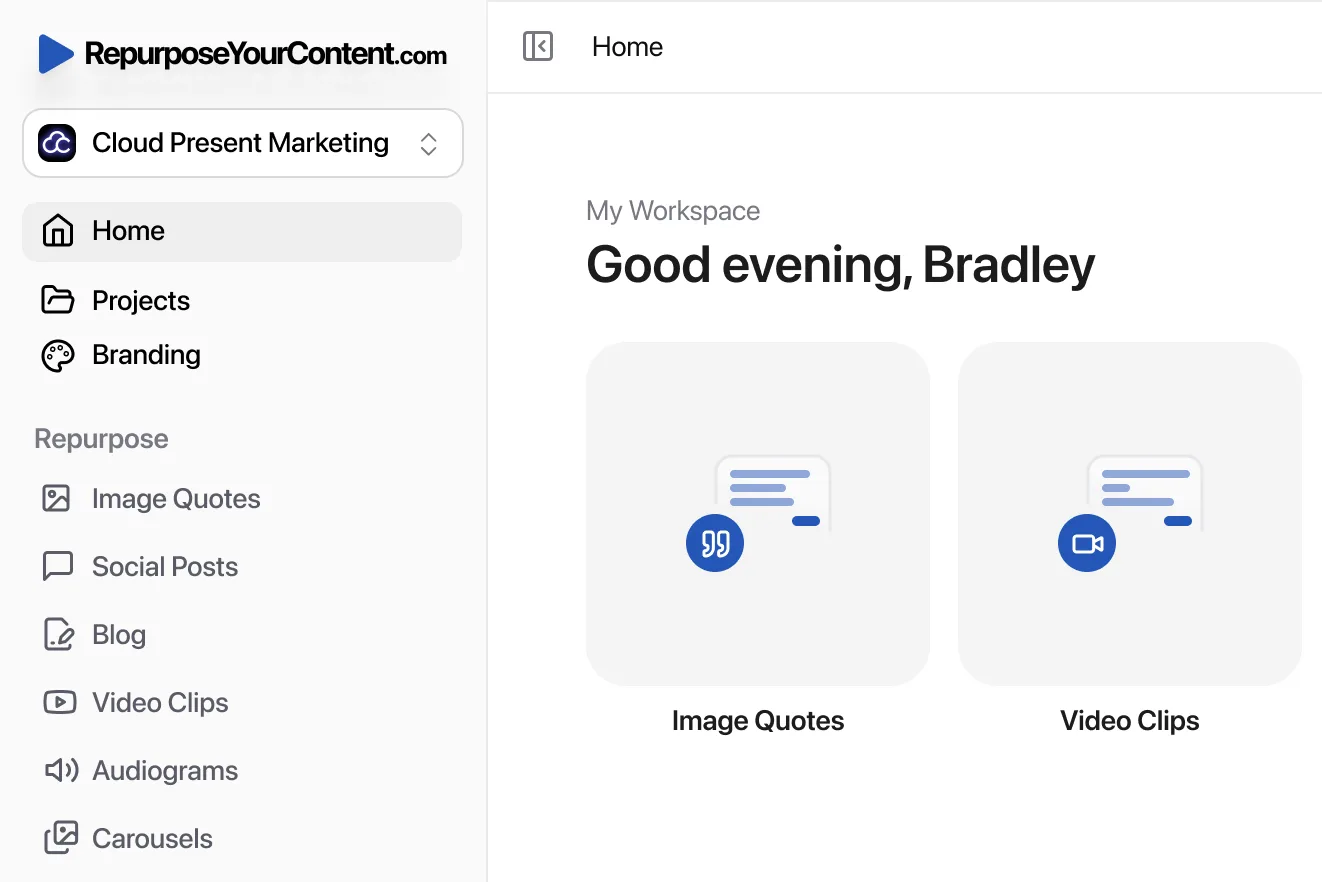
RepurposeYourContent is built for that workflow. You upload a file or paste a webinar link, choose the outputs you want, and generate them from the source recording. That includes short clips, blog posts, social posts, image carousels, email sequences, audiograms, podcast episodes, branded quote images, and timestamps.
Why it beats Repurpose.io
The gap is simple. Repurpose.io republishes. RepurposeYourContent produces.
That changes the day-to-day workflow for a lean team. Instead of exporting a webinar, opening separate tools for clips, copy, email, and design, then stitching everything together by hand, you start with the recording and get campaign assets from one place. Most webinars process quickly, and longer sessions take longer. The outputs are editable before export, which matters if brand, compliance, or speaker approval is part of your process.
Practical rule: If a tool cannot create new assets from the webinar itself, it is not a serious replacement for a webinar repurposing workflow.
Planable's analysis of Repurpose.io alternatives makes the broader point clearly. Buyers are shifting toward tools that generate more content formats, not tools that only automate posting.
What you actually get
The value is not the AI label. It is the volume of usable output.
- Video clips for social, paid retargeting, and speaker promotion
- Blog posts drafted from the webinar narrative
- Social posts for launch, recap, and nurture
- Audiograms for audio-first channels
- Image quotes for branded distribution
- Newsletters and email sequences for follow-up
- LinkedIn carousels built from key points
- Timestamps that make long recordings easier to reuse later
A practical workflow is straightforward:
- Upload the webinar or paste the source link.
- Pick the asset types and quantity.
- Generate, review, edit, and export.
That is the category shift this article is arguing for. Repurpose.io is a distribution tool. RepurposeYourContent is a content engine.
Best fit and trade-offs
This tool fits B2B teams that run webinars often and expect each event to feed a real campaign. It also fits agencies that need repeatable post-webinar production without building a messy stack around basic syndication.
The trade-off is pricing discipline. Credit-based usage works well if your team plans output volume in advance. It is less forgiving if multiple stakeholders generate assets freely without a process.
For teams that already know they need generated assets, not just reposted videos, the side-by-side detail on RepurposeYourContent vs Repurpose.io is the useful place to start.
2. Goldcast Content Lab

Goldcast Content Lab is only a serious option if you already run events in Goldcast. If you do, it removes a lot of post-event friction. If you do not, skip it.
That is the key trade-off.
Goldcast built Content Lab for teams that want recording storage, event ops, and repurposing in one place. You can turn webinar recordings into clips, social copy, and written assets without passing files between separate tools. For a busy B2B team, that means less admin and fewer handoff mistakes after a launch webinar, virtual summit, or customer event.
The limitation is just as clear. Goldcast Content Lab is tied to the Goldcast ecosystem. Repurpose.io is a distribution tool. Goldcast goes a bit further by helping with post-event assets, but it still makes the most sense as an add-on to your event platform, not as a true content engine built to generate campaign-ready output across your full webinar library.
If your team hosts across Zoom, ON24, Vimeo, and other sources, this gets awkward fast. You do not want your repurposing workflow locked to one event platform while the rest of your video pipeline lives elsewhere. Teams in that position should look at tools built specifically for turning webinar recordings into reusable written content, such as this guide to software that converts webinar recordings into blog posts.
Where it fits best
Goldcast Content Lab fits B2B event teams that have already standardised on Goldcast and want faster post-event production inside the same system.
It fits less well if your real problem is content creation volume. In that case, the better question is not "What replaces Repurpose.io?" It is "What will generate enough usable assets from every webinar to feed email, social, blog, and follow-up campaigns?" Goldcast can help within its platform. It is not the clearest answer to that broader need.
Best fit and trade-offs
- Best fit: Goldcast customers who want one platform for events and post-event content work
- Main strength: Keeps recordings and repurposing tasks in the same workflow
- Main limitation: Less useful as a neutral, cross-platform content engine
- Buying caution: Feature access and pricing are not obvious upfront, so confirm what is included before you commit
For teams already committed to Goldcast, Content Lab is a sensible add-on. For teams trying to move beyond distribution and buy a real content generation engine, it is usually too tied to one platform.
3. Parmonic

Parmonic is for serious webinar programs, not general-purpose content teams.
That focus makes it more relevant than Repurpose.io for enterprise B2B marketers running recurring webinars, virtual events, and post-event follow-up at scale. But the bigger point still stands. Parmonic helps you manage and reuse webinar content. It does not solve the broader content engine problem if your team needs blog posts, email copy, social assets, and campaign-ready written output from every recording.
Where Parmonic stands out
Parmonic is strongest on process. It is built for teams that need controls, approvals, webinar-specific workflows, and outputs that fit structured event operations.
You can see the difference in who it suits. A lean demand gen team looking for fast self-serve content production may find it heavy. A larger marketing org with event owners, brand rules, and review steps may see that structure as the reason to buy.
If your main goal is turning webinars into written assets that the rest of marketing can publish, this related guide to software that converts webinar recordings into blog posts is the more useful lens.
Best fit and trade-offs
Parmonic makes sense for enterprise teams that want webinar repurposing wrapped in governance and workflow. It makes less sense for smaller teams trying to replace Repurpose.io with a true content generation engine.
- Best fit: Enterprise event and demand gen teams with repeatable webinar operations
- Main strength: Webinar-specific workflow control and structured post-event production
- Main limitation: Less attractive for teams that want fast, lightweight content creation across channels
- Buying caution: Pricing is not public, so you need a sales conversation before you can judge fit properly
4. Chopcast by Tribetactics

Chopcast is useful for teams that want software and support together. That's its edge.
It offers AI-assisted repurposing for long-form video, including highlight discovery, subtitling, styling, and trimming. It also offers done-for-you services. That hybrid model matters for lean marketing teams that don't just need better tooling. They need fewer production tasks.
Why some teams pick it
A pure DIY platform still assumes someone on the team has time to run it. Chopcast addresses that by mixing self-serve software with managed output. That can be the right move for teams with regular webinars but no spare editor.
This isn't the cleanest switch for someone replacing Repurpose.io directly. It's a better choice for teams replacing both a weak automation tool and manual freelancer coordination.
The trade-off
The managed layer is the appeal and the cost. Services are naturally more expensive than software-only options.
- Use Chopcast when: The team needs repurposing help, not just access to features.
- Skip Chopcast when: The team wants predictable self-serve software costs and full in-house control.
The direct product site is Chopcast.
5. Castmagic

Castmagic makes sense if your bottleneck starts after the webinar ends.
That matters because Repurpose.io solves distribution. It pushes content across channels. It does not give your team a real content engine. Castmagic gets closer by turning spoken content into drafts your team can work with.
Its strength is text output. Upload a webinar, podcast, or interview, and you can generate transcripts, summaries, blog drafts, email copy, show notes, and social posts from the source material. For B2B marketers who leave webinars with good ideas but no time to write, that is a better direction than another posting workflow.
Where Castmagic fits
Castmagic is a good pick for teams that already know what they want to say. They need speed, structure, and a usable first draft.
It is less useful if your main goal is polished video. You will still need other tools for clips, layouts, brand styling, and visual editing. So the choice is simple. If you are replacing Repurpose.io because distribution is no longer the problem, a text-first system is a smarter category to review. If you are evaluating your broader stack, this sits closer to AI tools for content marketing in 2026 than a channel automation tool.
Best fit and trade-offs
Castmagic works best for blog-led and email-led teams. It helps when post-webinar follow-up keeps stalling at the writing stage.
The trade-off is clear. You get draft generation, not finished campaign assets. Human review is still required for positioning, accuracy, brand voice, and compliance. If you want a system built around turning webinars into a repeatable content pipeline, Castmagic is useful, but RepurposeYourContent is the more purpose-built answer.
6. Descript

Descript is a production tool, not a content engine. That distinction matters.
If Repurpose.io feels limiting because it only pushes content out, Descript fixes a different problem. It helps you clean, cut, and package raw webinar footage faster. It does not turn one webinar into a full campaign system on its own.
Why Descript earns a spot
The edit-by-text workflow is still its biggest advantage. Your team can remove rambling sections, tighten speaker delivery, fix awkward pauses, and pull usable clips without living in a timeline editor. For webinar teams, that saves real time.
Descript also combines transcription, screen recording, audio cleanup, and video editing in one workspace. That makes it a practical choice for marketers who want more control over the final asset quality. If your team is comparing the wider editing category, this belongs on the shortlist with other AI video editing tools for marketers.
Best fit and trade-offs
Descript fits teams with someone willing to edit. That usually means in-house marketers, podcast producers, and content teams that care about presentation.
The trade-off is clear. You get better production control, but you still need a person making decisions. You are shaping assets manually, not generating a repeatable post-webinar content machine.
- Best fit: Teams that want to refine recordings and publish cleaner video and audio assets.
- Main strength: Fast transcript-based editing with solid built-in production features.
- Main limitation: It improves raw content. It does not replace a purpose-built system for generating campaign-ready outputs from webinars.
If your bottleneck is editing, Descript is a smart buy. If your bottleneck is turning webinars into blogs, emails, social posts, and follow-up assets at scale, look higher up this list.
7. OpusClip

OpusClip solves a narrower problem than Repurpose.io. It finds short clips from long video and packages them for social. If your team is buried in webinar footage and needs more shorts on LinkedIn, YouTube Shorts, or Reels, that is useful.
It is also a category shift. Repurpose.io is built for distribution. OpusClip is built for clip creation. That makes OpusClip the better pick if your bottleneck is getting usable video snippets out of long recordings fast.
Where it fits
OpusClip works best for teams that already know the output they want. Short clips. Fast turnaround. Minimal editing.
That is a real upgrade over a workflow that only republishes existing assets. But keep the limit in view. OpusClip helps you create clips. It does not turn a webinar into a blog draft, email sequence, sales follow-up, quote cards, and campaign copy. If that is the actual job, you do not need a better distribution tool. You need a content engine.
If you are comparing vendors in the clipping layer, this roundup of the best AI video clipping tools in 2026 is the better comparison set.
Best fit and trade-offs
OpusClip is a strong buy for social-first teams that measure success in clips published per webinar.
- Choose OpusClip if: Your main goal is turning long recordings into short-form video faster.
- Skip OpusClip if: You need webinar content turned into full campaign assets across channels, not just clips.
- Main strength: Fast clip extraction for short-form distribution.
- Main limitation: It stops at the clipping layer.
For B2B marketers, that distinction matters. More clips do not automatically mean more pipeline. If your team needs content generation, not just content slicing, RepurposeYourContent is the better match.
8. VEED.IO

VEED.IO is a broad browser-based AI video suite. That's the attraction and the limitation.
It gives teams online editing, clipping, captions, translations, cleanup, and AI generation tools in one web app. For UK teams, the local footprint may also matter operationally.
Where VEED fits
VEED is a good choice when the team wants a central browser editor with repurposing features built in. It isn't as webinar-specific as purpose-built B2B tools. It is more of an all-purpose online studio.
That makes it useful for mixed content operations. A team creating webinars, promos, customer clips, and social edits from one environment may prefer VEED over a narrower post-webinar tool.
For buyers focused specifically on the clipping layer, the roundup of best AI video clipping tools in 2026 is worth checking alongside VEED.
Best fit and trade-offs
VEED suits teams that want flexibility in a browser-first editor. It is less suited to teams that want webinar-to-campaign generation with minimal setup.
Some AI features are plan-dependent, so buyers should verify clip and credit limits before switching. The direct product site is VEED.IO.
9. Munch

Munch is for teams that want more clips, faster. If your real problem is turning one webinar into a full campaign, Munch will feel too narrow.
It focuses on short-form video extraction and distribution. That makes it a closer match to OpusClip and other clip-first tools than to a true content engine. If you need posts, emails, summaries, and campaign assets from one recording, you need a different category of product. That is the gap Repurpose.io users usually miss. They compare distributors to other distributors, when the better move is often switching to a generator built for webinar content.
Best use case
Munch works for social teams with a steady backlog of webinars, podcasts, or interviews and a simple brief. Pull highlight clips. Format them for channels. Keep publishing.
If that is the job, it can do it well. Teams comparing clip-first options should also review these webinar clipping tools for social media in 2026 and Klap's AI video clipping solution for a side-by-side market view.
Trade-offs
The upside is speed. The downside is ceiling.
- Best fit: Social-first teams that judge output by clip volume.
- Main limitation: Limited value for marketers who need written assets and webinar-to-campaign workflows, not just edited video.
If you are replacing Repurpose.io because distribution alone is no longer enough, skip another distributor and move to a content generation engine. Munch will not solve that problem.
10. Vizard AI

Vizard AI is one of the more practical video-focused options for teams that care about automation and workflow clarity. It combines AI clipping with brand templates, scheduling, Zoom integration, and API access on higher plans.
That mix makes it useful for small teams that want repeatable output and for ops-minded teams that may want to connect repurposing into other systems.
Why it makes the list
Many clip tools do the front-end part well. Fewer think about collaboration, account structure, and automation. Vizard does.
For webinar teams working heavily with recorded meetings and social distribution, it can sit in the middle of the stack cleanly. Teams comparing category options for social repurposing can also review webinar clipping tools for social media in 2026.
Best fit and trade-offs
Vizard is best for teams that want video-focused repurposing with cleaner operational controls. It isn't the strongest option for blog, email, or newsletter generation out of the box.
The direct product site is Vizard AI.
Top 10 Repurpose.io Alternatives Comparison, 2026
| Product | Core features | Formats & breadth | Speed / UX | Pricing & best fit |
|---|---|---|---|---|
| RepurposeYourContent | AI insight extraction, Brand Kit auto-apply, team roles, platform-agnostic uploads, in‑platform edits | 8 formats: video clips, blog posts, social posts, carousels, emails, audiograms, podcasts, image quotes; 15–25 assets/webinar | ~5 min generate time (typical), export‑ready drafts, simple sliders & review flow | Credit‑based plans from $99/mo, Free Basic & 7‑day trial; ideal for marketing teams, agencies, demand‑gen (recommended) |
| Goldcast Content Lab | Event‑native repurposing inside Goldcast, AI highlight detection, central video library | Short clips, social copy, blog‑style writeups (limited compared to dedicated repurposers) | Integrated with Goldcast event workflows; easy if you host in Goldcast | Included in Goldcast tiers (contact sales); best for teams running events in Goldcast |
| Parmonic | Segment/clip extraction, summaries, enterprise governance & workflows | Clips, summaries, social snippets; demand‑gen focused copy | Enterprise workflow & governance; tailored for compliance and scale | Demo/contact sales pricing; suited to enterprise B2B demand‑gen programs |
| Chopcast (Tribetactics) | AI topic discovery, subtitling, styling, trimming; optional white‑glove services | Clips, subtitles, topic suggestions; managed deliverables available | Hybrid self‑serve + done‑for‑you options; managed services speed results | Services are premium; good for lean teams wanting hands‑off repurposing |
| Castmagic | Transcripts, templates, “Magic Chat” interactive prompts, distribution integrations | Strong written outputs: blog drafts, newsletters, social threads, quotes, clip lists | Fast transcript + draft generation; human editing recommended for brand voice | Freemium/paid tiers (check site); ideal when written content/drafts are priority |
| Descript | Text‑based editor, AI co‑editor, Studio Sound, filler removal, clip tools | Transcripts, clips, summaries, podcast/audio edits | All‑in‑one edit‑by‑text workflow; reduces tool switching but has learning curve; AI credits apply | Tiered pricing with credits; best for teams needing deep editing and transcription |
| OpusClip | AI highlight detection, virality scoring, auto‑reframe, animated captions | Short‑form vertical clips optimized for Shorts/Reels/TikTok | Extremely fast, volume‑oriented social workflow; direct publishing | Subscription/credit tiers; best for social‑first short‑form volume creators |
| VEED.IO | Browser editor with AI Clips, subtitles, translations, audio cleanup, T2V tools | Clips, subtitles, translations, simple text‑to‑video assets | End‑to‑end web editor; broad toolset, plan limits on AI features | Tiered plans; good for teams wanting online editor + UK support presence |
| Munch (GetMunch) | Auto clip selection, channel‑tailoring, captions, basic analytics | Multi‑channel short clips with platform formatting & captions | Simple non‑editor UX for fast output; limited written deliverables | Subscription tiers; ideal for creators/marketers scaling short‑form across channels |
| Vizard AI | AI clipping, auto reframing, subtitles/translations, brand templates, API & Zoom app | Video clips, captions, translations, social scheduling support | Clear credit/accounting, multi‑account management, automation via API | Clear credit system; fits teams needing automation and multi‑account workflows |
Your Switching Plan From Repurpose.io to a Content Engine
Stop comparing Repurpose.io to other posting tools. That is the wrong buying decision.
Repurpose.io handles distribution. It moves content from one channel to another. If your team is stuck because webinars are turning into too little usable content, a better pipe will not solve it. You need a system that creates assets your team can publish with minimal cleanup.
Use this filter instead.
The fast decision tree
- Need a full campaign from one webinar? Pick RepurposeYourContent.
- Need short-form clips for social only? Pick OpusClip or Munch.
- Need strong written follow-up more than video output? Pick Castmagic.
- Need hands-on editing and tighter creative control? Pick Descript.
- Already run events inside Goldcast? Pick Goldcast Content Lab.
- Need enterprise webinar operations and governance? Pick Parmonic.
Repurpose.io fits teams that already have content and just need routing. B2B webinar teams usually have the opposite problem. They have recordings, transcripts, and good source material, but not enough finished assets.
The practical switch path
Keep the switch simple. Do three things.
- Export what matters. Save source files, workflow rules, publishing destinations, and account settings from Repurpose.io.
- Choose the outcome before the tool. Decide whether you need campaign generation, clip extraction, written repurposing, or editing.
- Test one real webinar end to end. Use a recent recording. Measure output quality, review time, and how much manual fixing your team still has to do.
That third step decides the purchase.
A real test should show whether the platform gives you publishable clips, blog drafts, social posts, email copy, quote graphics, timestamps, and carousel-ready material. If your team still has to build half the campaign by hand, you did not switch to a content engine. You switched to another assistant tool.
Clear recommendations
For webinar-first B2B teams, RepurposeYourContent is the best upgrade. It aligns with the essential task. Turn one webinar into a campaign, not just a queue of posts. That is the gap Repurpose.io leaves open.
Pick OpusClip if clips are the main output. Pick Castmagic if written assets matter more than video. Pick Descript if your team wants edit control and can handle a more involved workflow.
The rule is simple. If your current frustration is low content output, do not buy another distribution-led tool and expect a different result.
Start with the engine that creates the assets. Use this broader guide if you want a second view on the category stack: Direct AI's guide to streamlining video content with AI.
Tags: