Riverside vs Zoom for Webinar Recording and Repurposing
Choosing between Riverside vs Zoom for webinar recording and repurposing? This practical guide compares quality, cost, and workflows to help you decide.

The webinar ended an hour ago. The team already moved on. The recording sits in a folder, untouched, while content requests keep piling up.
That's where the significant platform choice shows up. Not during the live session. After it.
For teams comparing Riverside vs Zoom for webinar recording and repurposing, the wrong decision creates extra editing, weaker clips, messy transcripts, and more manual clean-up. The right decision gives marketing a usable source file that can feed blog posts, short videos, social posts, quote cards, newsletters, LinkedIn carousels, and timestamped highlights for weeks.
Your Webinar Is Over Now the Real Work Begins
Most webinar teams still buy software for the live event. That's backwards.
The live event lasts an hour. The recording should work for the next month. If the recording isn't usable, the webinar has a very short shelf life. It becomes a replay page and nothing else.
That's why this choice matters. Zoom is the default. Riverside is the specialist. Both can record a webinar. They do not produce the same raw material for content.
What busy marketing teams actually need
A marketing manager doesn't need another file sitting in cloud storage. The team needs source material that can be turned into publishable assets without an editor spending half a day fixing it.
That usually means:
- Clean speaker audio for audiograms and podcast extracts
- Usable video for social clips and paid promotion
- Reliable transcript quality for blog drafts and newsletters
- Speaker separation for quote cards, clips, and clean edits
- Fast handoff into a repurposing workflow
Teams building content for professional networks already know the pressure. One webinar often needs to feed LinkedIn, email, sales enablement, and the blog.
A weak recording slows every one of those outputs down.
Practical rule: If the team plans to publish more than the replay, the recording platform should be chosen by the content team, not only by the events team.
The real comparison
This isn't a generic platform review. It's a downstream workflow decision.
Zoom is usually the better fit for routine webinars, internal sessions, and familiar hosting. Riverside is usually the better fit for teams that treat a webinar like a media asset.
For teams working through what to do after hosting a webinar, that distinction matters more than most software checklists admit.
The Core Difference Local vs Cloud Recording
The biggest difference isn't the interface. It's the recording architecture.
Riverside records each participant locally on their own device, then uploads the files afterwards. Zoom follows a more traditional internet-based recording workflow that captures a compressed stream built for live meeting stability. That difference is what shapes the final file your team has to work with later.

Why local recording matters
When a guest's connection wobbles on Zoom, the problem can end up in the recording itself. That freeze, audio drop, or blurry patch becomes part of the final asset.
Riverside is better suited to repurposing because it records locally on-device and uploads after the session. That preserves quality even if the network degrades during recording. It also supports up to 4K video and 48 kHz audio, while Zoom is typically described as topping out around 1080p for recording, according to Red11 Media's Riverside vs Zoom comparison.
For a live webinar host, that may sound technical. For a content team, it's practical.
What that changes in post-production
A locally captured file gives editors room to work. It holds up better when trimmed into vertical clips, enlarged for social formats, or cut into speaker-focused moments.
A compressed meeting recording doesn't give the same margin. Every crop, caption, and export pushes the file a bit harder.
That's why the recording platform is really the first content decision.
For teams reviewing the role of a recording platform in content repurposing, the simplest way to think about it is this:
- Riverside creates source material for post-production.
- Zoom creates a convenient meeting recording.
- Those are not the same outcome.
A webinar recording is either an asset or an archive. Local recording pushes it towards an asset.
A simple example
Consider a panel webinar with three speakers.
If one speaker has unstable Wi-Fi on Zoom, the final recording may include that instability. Every clip featuring that person becomes harder to use. Captions feel rougher. Visual cuts look less polished. The team starts avoiding those sections.
With Riverside, each participant's file is captured on their own device. That means the best version of each speaker is available later, even if the live session had a few bumps.
That's the difference between “good enough to replay” and “good enough to repurpose.”
A Repurposing Scorecard Riverside vs Zoom
For repurposing, features only matter if they improve the raw material.
The scorecard below keeps the focus where it belongs. Not on meetings. On what happens after the webinar ends.
| Feature | Riverside | Zoom | Why It Matters for Repurposing |
|---|---|---|---|
| Recording quality | Local recording with uncompressed 48kHz WAV audio and up to 4K video | Traditional compressed internet-based workflow, better suited to meetings and standard webinars | Better source quality gives cleaner clips, stronger audio extracts, and more usable visual assets |
| Separate speaker tracks | Yes. Presented as part of content-first recording and post-production workflow | Not positioned as a core advantage in the same way | Separate tracks make it easier to isolate one speaker for clips, quote moments, and audio clean-up |
| Post-production orientation | Built for post-production and content extraction | Built more for live webinars, calls, and internal sessions | Teams repurposing heavily need a platform that starts with editing in mind |
| Built-in repurposing help | Includes short clips and highlights tools | Framed more as a reliable live webinar workhorse | Fewer manual steps means faster handoff to the content team |
| Best fit | Content-first webinars, interviews, podcast-style sessions | Frequent meetings, standard webinars, internal use | Choosing by use case prevents overbuying or under-recording |
The core shift is that Riverside is designed around local recording. Each participant's audio is captured directly on their device at uncompressed 48kHz WAV quality, and video can be recorded at up to 4K. Zoom is described as a more traditional compressed internet-based workflow that is better for meetings, calls, and webinars than content-first repurposing, as explained in Swell AI's Zoom vs Riverside review.
Where Riverside clearly wins
Separate-track recording is the biggest advantage.
That matters because repurposing rarely uses the whole webinar. It uses moments. A sharp answer from the guest. A clean objection-handling segment from sales. A strong point from the host that becomes a quote card or carousel slide.
When each speaker is isolated, editing gets easier. One person's cough, keyboard noise, or overlap doesn't ruin the whole moment.
Decision shortcut: If the team wants clips with one speaker centred and clean audio underneath, Riverside is the stronger input.
Where Zoom still makes sense
Zoom wins on familiarity and convenience.
Many organizations already use it. Guests know it. Internal stakeholders don't need extra onboarding. If the webinar is mainly live delivery and the recording is a secondary asset, that convenience is valuable.
That's why Zoom remains perfectly sensible for low-repurposing workflows.
For teams comparing tools through the lens of the best webinar platform for content repurposing, the scorecard usually lands like this:
- Heavy repurposing planned: Riverside
- Light repurposing planned: Zoom
- Replay only: Zoom is often enough
Which Tool Fits Your Use Case
Software choice gets easier when it's attached to an actual workflow.

Standard internal training webinar
An operations team runs monthly training. The recording goes to staff who missed it. Nobody is cutting trailers from it. Nobody needs speaker-focused social clips. Nobody is turning it into a blog series.
Use Zoom.
It's familiar, dependable, and aligned with this kind of session. Riverside would be overkill here. Better recording quality won't change the outcome enough to justify the workflow shift.
Flagship B2B demand generation webinar
A marketing team hosts a customer-facing webinar with a strong subject-matter expert and a sales follow-up plan. The team wants the replay page, clips for LinkedIn, key insights for the blog, short email copy, and quote-led follow-up content.
Use Riverside if the team is serious about using the webinar as a content source.
The key reason isn't prestige. It's control. Separate tracks make speaker-based clip extraction cleaner. The recording is built for post-production. That helps when the webinar needs to become multiple campaign assets instead of a single replay link.
Video podcast or interview-led show
A brand runs a recurring expert interview series that also doubles as webinar content. The team wants polished clips, reusable audio, and a library of strong guest moments.
Use Riverside. No question.
This is the use case it suits best. Podcast-style recording, interview-led content, and high-production webinar formats benefit directly from local capture and post-production flexibility.
A quick fit check
If the team is unsure, this simple filter usually settles it:
- Choose Zoom when the priority is live delivery, internal access, and quick setup.
- Choose Riverside when the priority is recording quality, speaker isolation, and content extraction.
- Stay with Zoom if the team only needs one or two simple clips.
- Move to Riverside if every webinar feeds the content calendar.
A standard webinar asks, “Did the session run smoothly?” A content-first webinar asks, “Can marketing publish from this tomorrow?”
That's the main split.
Analysing the Cost and Return on Investment
On paper, the pricing gap isn't dramatic. In practice, the wrong workflow gets expensive fast.
Zoom's free plan is limited to 40 minutes on group calls, and its paid plans are listed at about $15.99 to $25 per user per month. Riverside offers a free tier with watermark and limited features, plus paid plans around $15 to $24 per month or $0.17 per minute pay as you go, according to Talks.co's Riverside vs Zoom pricing breakdown.
Subscription cost is not the real cost
The monthly fee matters less than the editing drag created afterwards.
If a team records in Zoom and then spends extra time fixing audio, avoiding certain speaker moments, or trimming around glitches, the cost shows up in labour. Not software.
Riverside's value sits on the other side of the webinar. It gives the team a stronger file to work with. That matters most when webinars are a recurring content input.
For marketing leaders trying to frame webinar software as part of broader ROI, this QuickSEO blog for marketers is a useful reminder that content performance needs to be judged as a system, not as an isolated production line.
When Zoom is the better financial choice
Zoom is the better buy when the recording has limited downstream use.
That usually includes:
- Internal webinars
- Training sessions
- Sales enablement calls
- Live webinars where replay is enough
In those cases, convenience wins. There's no need to pay for quality the team won't use.
When Riverside earns its keep
Riverside pays off when the webinar is expected to do more work.
That includes webinars turned into:
- Video clips for social
- Audio segments
- Written content from transcripts
- Speaker-led quote assets
- Multi-format campaign follow-up
The useful framing isn't “Which one is cheaper?” It's “Which one reduces friction in the content pipeline?”
Teams working on content marketing ROI measurement usually find that repurposing volume decides the answer. Low volume makes Zoom fine. High volume justifies Riverside quickly.
The 5-Minute Repurposing Workflow
The fastest workflow is the one that doesn't force the team to rebuild everything manually after recording.

A simple production chain looks like this.
Step 1
Export the webinar file.
From Riverside, that might be the full session or selected clips. From Zoom, that's usually the recorded webinar file.
Step 2
Upload the recording into a repurposing workflow.
Some teams also use tools that can create videos from a link when they need quick transformations from existing pages or hosted assets. The principle is the same. Reduce manual handling.
Step 3
Select outputs based on the campaign need.
That usually includes video clips, blog posts, social posts, audiograms, image quotes, newsletters, LinkedIn carousels, and timestamps.
For small teams, content repurposing workflow for small teams matters more than tool theory. The workflow has to be repeatable, not clever.
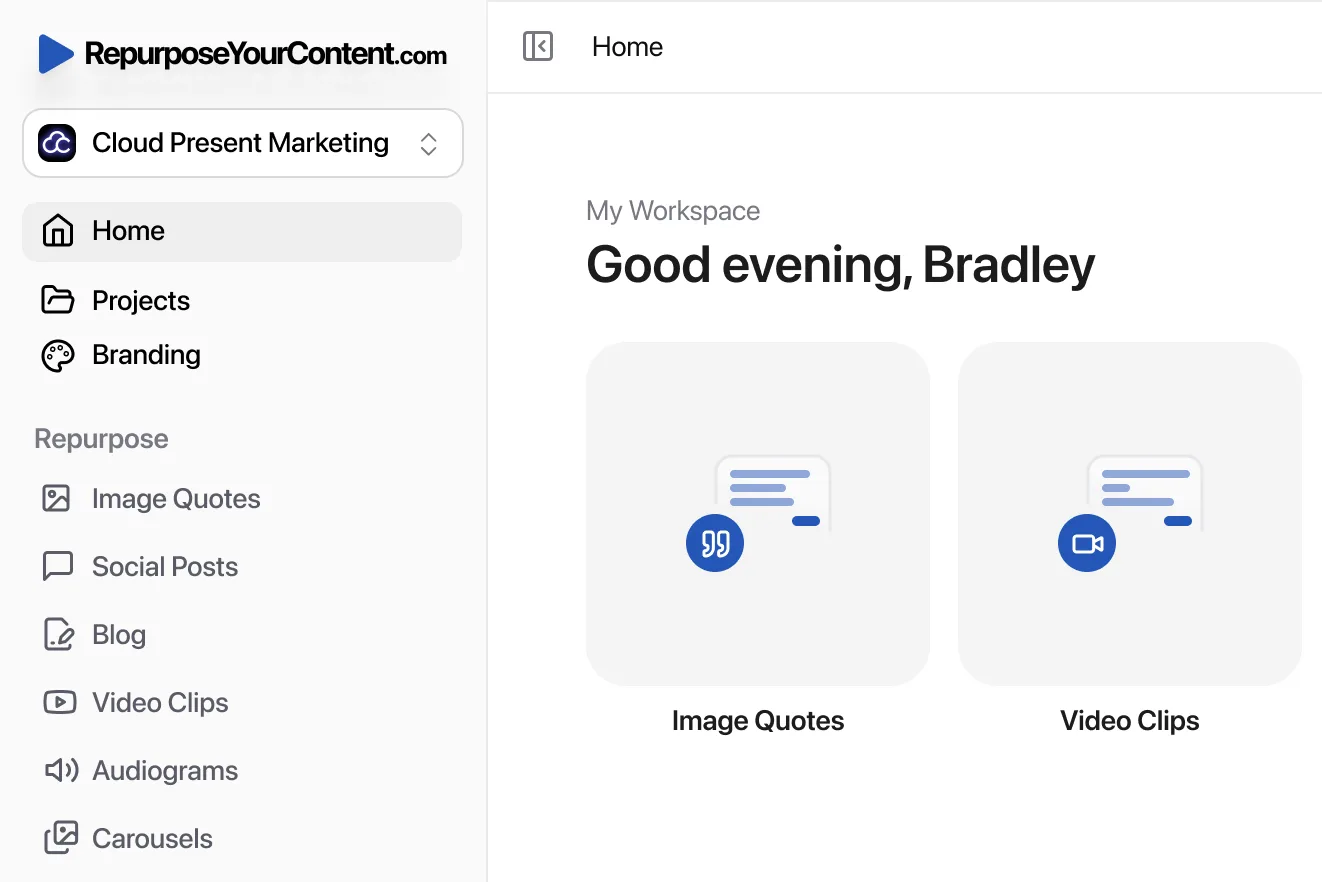
A platform-agnostic option is RepurposeYourContent, which takes a webinar recording from tools such as Zoom or Riverside and turns it into multiple content formats including clips, blog posts, social posts, audiograms, image quotes, newsletters, LinkedIn carousels, and timestamps.
Here's the basic sequence:
- Record the session in Zoom or Riverside.
- Upload the file or paste the link into the repurposing tool.
- Choose the content formats needed for that campaign.
- Review the outputs and make minor edits.
- Publish across channels while the webinar is still timely.
This walkthrough shows the workflow in action:
The best repurposing workflow doesn't care which platform recorded the webinar. It cares whether the file is usable.
That brings the whole comparison back to one question. How much work should one webinar do after the live event ends?
If the answer is “not much”, Zoom is fine. If the answer is “feed the content engine”, Riverside is the smarter recording choice.
If the team wants to turn webinar recordings into clips, blog posts, social posts, audiograms, image quotes, newsletters, LinkedIn carousels, and timestamps without extra manual work, try RepurposeYourContent.
Tags: