Scaling Content Production: A Practical Guide
A practical guide to scaling content production with workflow design, repurposing, automation, and KPIs that turn one recording into a month of content.

A recorded session can become 30 publishable assets, but many teams still publish it once and move on. The constraint isn't creativity. It's the production system behind the recording.
Scaling content production means multiplying output per source asset, not hiring more writers or editors. The practical model combines a defined workflow, modular repurposing, human review, and measurable handoffs.
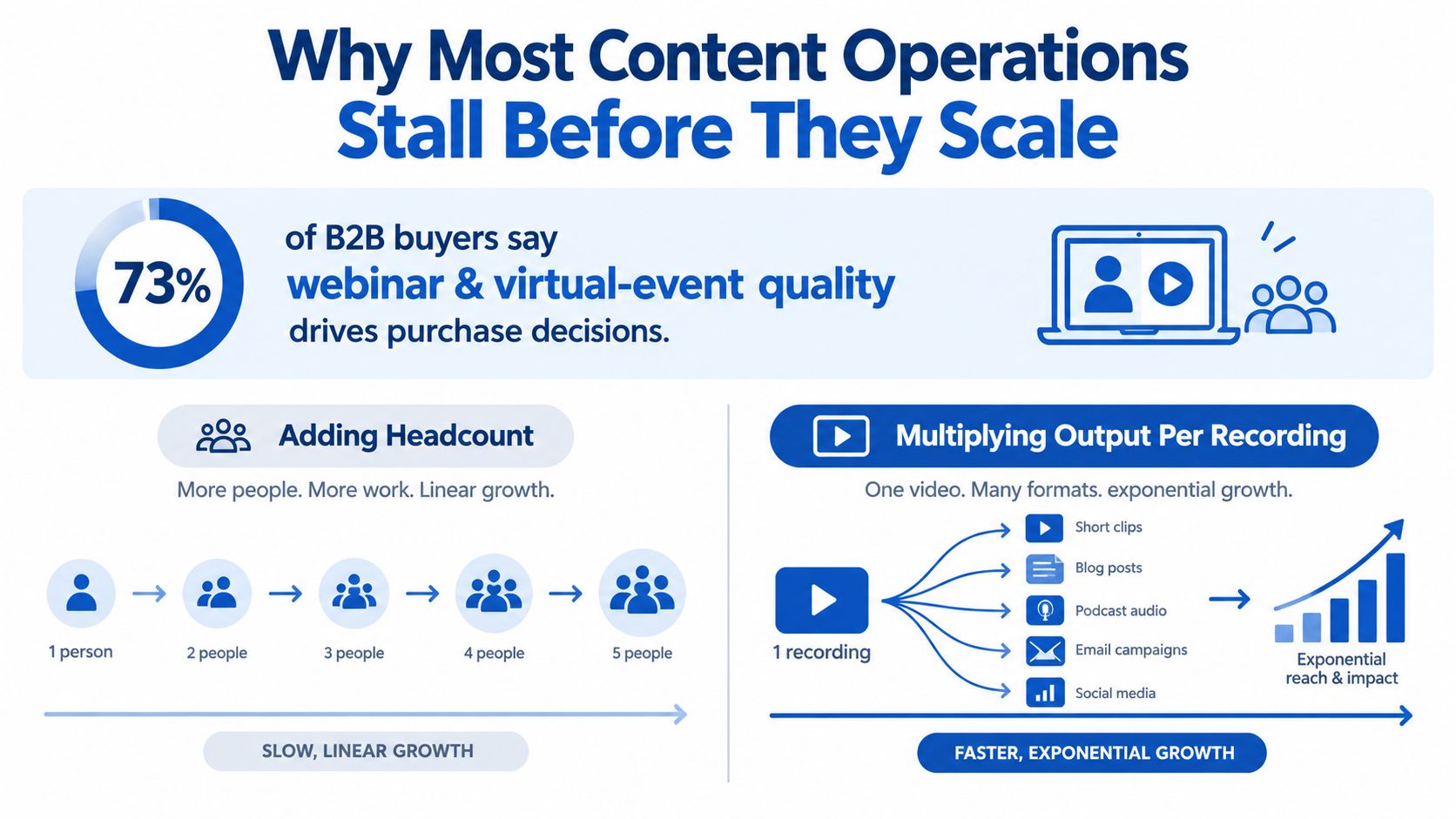
Why Most Content Operations Stall Before They Scale
A webinar marketing roundup reports that 73% of B2B marketers rank webinars as their top source of high-quality leads, while 65% repurpose webinar content. The implication extends beyond webinars. Podcasts, interviews, keynotes, sales calls, livestreams, courses, and meetings can all become source material for a wider content system. (Webinar content repurposing statistics)
The problem appears after the recording ends. Teams often depend on real-time production, publish one format, route every asset through the same approver, and stop producing when the calendar stops. Adding another editor may increase capacity briefly, but it doesn't remove the underlying handoff failures.
Diagnose the supply chain first
A scalable operation needs four connected parts:
- Workflow: A recording moves through defined stages instead of scattered messages.
- Roles: Each person owns a decision, handoff, or quality gate.
- Governance: Voice, claims, usage rights, and compliance have explicit checks.
- Repurposing: One source becomes channel-specific assets without restarting production.
Tools and hiring come later. A project board won't fix an unclear brief, and an AI transcription service won't decide whether a clip represents the speaker accurately.
Practical rule: Fix the handoff that delays publication before buying capacity for the next stage.
A useful operating model starts with the pipeline type, then maps a six-stage workflow from brief to publish. It measures the conversion from one recording to multiple assets, keeps humans responsible for judgment, and tracks cycle time, rework, approval latency, and cost per publishable asset. Teams that need broader lifecycle controls can also review this guide to content lifecycle management for marketing teams.
The redesign matters most for founders and B2B marketers who already publish consistently but have hit a ceiling. Buying another seat before fixing the system usually creates more work in the same broken process.
The Linear Pipeline vs the Repurposing Engine
A linear pipeline treats every format as a separate production job. A podcast episode produces a video edit, then a writer creates a post, then a designer creates graphics, then another person drafts an article. Each format has its own brief, handoff, review, and delay.
A repurposing engine treats the recording as a source library. The transcript identifies ideas, stories, objections, proof points, and quotable lines. Editors and channel owners then package those raw materials for specific audiences.
The difference is not just speed. It changes the unit economics of production.
| Dimension | Linear Pipeline | Repurposing Engine |
|---|---|---|
| Source material | One format at a time | One recording becomes a reusable library |
| Briefing | Separate brief for each asset | Shared source brief with channel adaptations |
| Production | New work for every format | Common capture event supports many formats |
| Approvals | Sequential and repeated | Shared review with defined checkpoints |
| Cost measurement | Cost per individual piece | Cost per source recording and derivative asset |
| Bottleneck | Headcount and handoffs | Editorial capacity and quality gates |
| Output model | More work for every new channel | More yield from the same source |
The linear model keeps marginal cost high because every new format requires fresh planning and production. The engine lowers the cost of each additional derivative because research, transcription, context, and source verification already exist.
That doesn't mean every recording should produce identical assets. Platform-native packaging still matters. A LinkedIn post needs a clear argument, a short video needs a strong opening, and a carousel needs visual progression. The engine shares the raw material, not the final format.
Measure yield, not activity
A content lead should ask two questions:
- How many publishable assets came from each recording?
- How much human time did the source require before publication?
A team that tracks only articles completed may miss the larger opportunity. One long-form recording can support short clips, social posts, quote graphics, carousels, newsletter material, and a blog draft. The useful measure is derivative yield per source, balanced against accuracy, approval time, and channel performance.
Teams using AI report different output gains depending on implementation. One benchmark reports 42% more monthly content, with a median of 17 articles versus 12 without AI, while another reports 3 to 5 times more content without increasing headcount. These figures come from separate benchmarks and shouldn't be treated as universal targets. (AI content marketing benchmarks)
The operating principle remains stable. More output comes from standardizing the source-to-publish process, not from asking each contributor to work faster inside an unstructured queue.
Build the Workflow Before You Add the Tools
The workflow should be visible before the team chooses software. A workable six-stage pipeline assigns one owner to each handoff and defines what completion means.
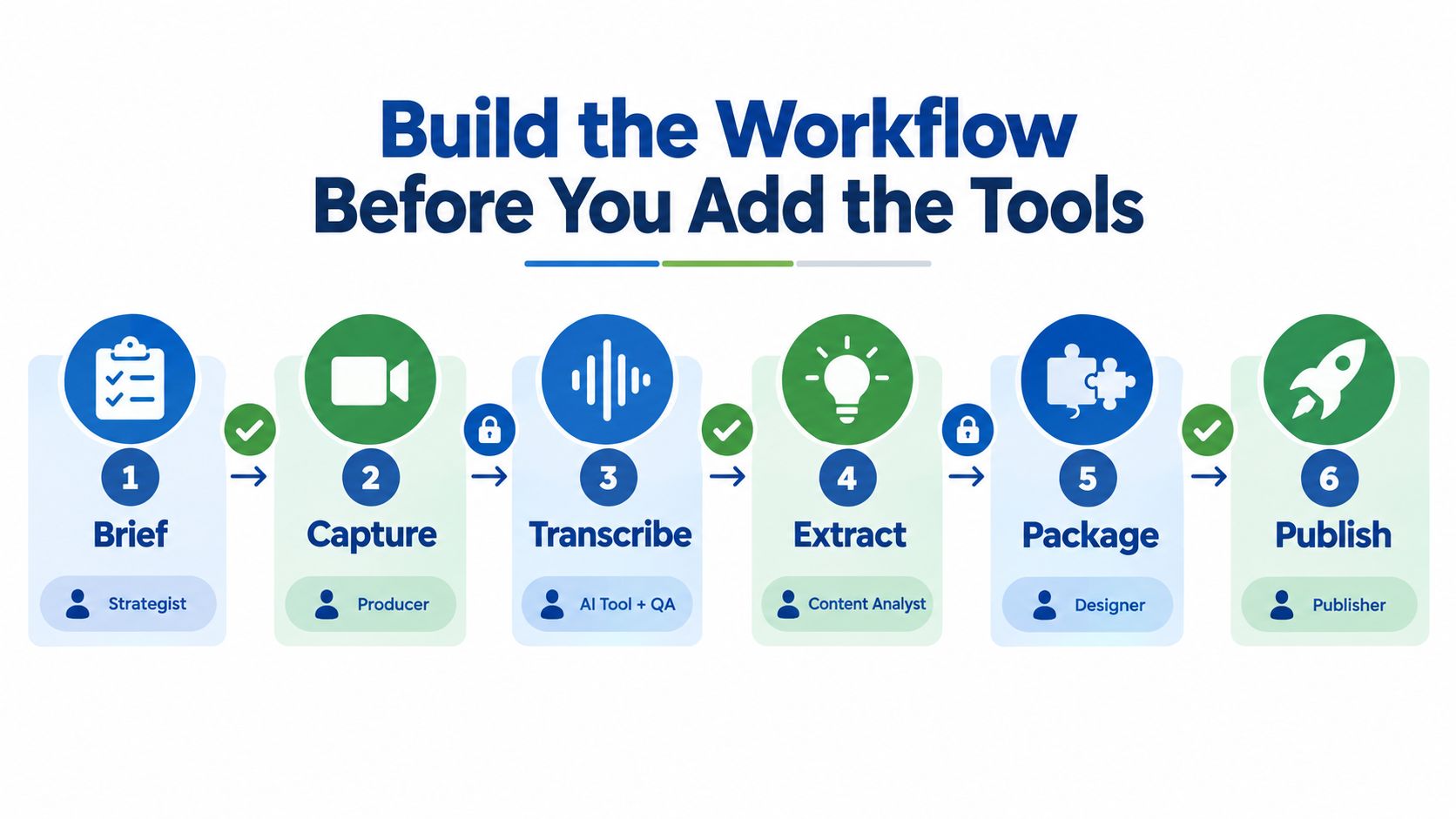
A six-stage operating model
Brief, owned by the host or strategist. The brief states the audience, intent, core question, and three takeaways. It should fit in one clear paragraph. The checkpoint asks whether the recording has a useful commercial or educational purpose.
Capture, owned by the host, producer, or subject-matter expert. The recording must be usable for the intended formats. The producer checks audio, framing, permissions, and source-file access before the session begins.
Transcribe, owned by the editor with quality assurance. The transcript is timestamped, cleaned, and checked for speaker identity. Names, product terms, and technical language need human review.
Extract, owned by the editor or content analyst. The team marks potential clips, strong quotes, objections, examples, and article sections. The checkpoint asks whether each extract supports the original brief.
Package, owned by the channel owner and designer. Each extract becomes a platform-native asset. A package can include a captioned clip, a LinkedIn post, a quote graphic, or a carousel draft.
Publish, owned by the publisher or channel manager. Approved assets are scheduled with the correct copy, links, tracking tags, accessibility text, and publication dates.
A content lead runs the loop and resolves conflicts. The host shouldn't be asked to approve every design decision, while the designer shouldn't decide whether a factual claim is safe to publish.
A stage is complete only when the next person can work without asking for missing context.
Two failures repeatedly damage scaling attempts. The first is skipping the brief, which produces attractive assets without a coherent point of view. The second is skipping the approval checkpoint, which pushes corrections into public channels or creates late-stage rework.
A documented workflow also makes tool changes less disruptive. Transcription, project management, editing, and scheduling tools can change without forcing the team to relearn ownership and quality criteria. For a useful companion on documenting handoffs, see Contesimal workflow for content teams. Teams with small internal groups can also adapt this content repurposing workflow for small teams.
Turn One Recording Into 30 Assets
A 45-minute podcast episode can supply a month of channel material when the team plans around ideas rather than file formats. The source conversation may contain several explanations, objections, examples, and opinions. Each can become a different asset with its own audience, hook, and publishing context.
The DIY workload is substantial. Editors must review the recording, clean the transcript, mark usable moments, remove filler, cut clips, add captions, test visual treatments, and adapt the same ideas for written channels. One analysis estimates 10 to 16 hours per recording for manual repurposing, including review, clipping, and editing. (Manual content repurposing time breakdown)
That time estimate changes the scaling decision. If a founder records one episode each week, manual production can consume 40 to 64 hours per month before distribution, analytics, and revisions. The constraint is not a shortage of possible content. It is the number of handoffs required to convert one source into publishable outputs.
A 30-asset plan makes those handoffs visible:
| Asset Type | Channel | DIY Minutes | DFY Minutes |
|---|---|---|---|
| 10 short-form video clips | YouTube Shorts, LinkedIn, Instagram | 240 | 0 |
| 5 audio clips or audiograms | Podcast and social channels | 90 | 0 |
| 6 LinkedIn posts | 180 | 0 | |
| 3 quote graphics | LinkedIn and social channels | 75 | 0 |
| 2 carousels | 120 | 0 | |
| 1 blog post | Company blog | 180 | 0 |
| 2 newsletter snippets | 45 | 0 | |
| 1 email sequence | 90 | 0 | |
| Founder review and approval | Internal | 30 | 15 |
| Total | 30 assets | 1,050 | 15 |
The table assigns 17.5 hours of DIY work to one recording. Transcription cleanup accounts for only part of it. Clip selection, caption corrections, framing, copy adaptation, design revisions, and approval consume the rest. A teaser study found assisted production took 9.9 minutes on average, compared with 16.7 minutes for the baseline, while a 30-second teaser from a one-hour podcast required about an hour when assembly and production were included. (Video podcast teaser research)
The 30-asset target works as a capacity plan, not a vanity goal. Before recording, list the ideas the episode must produce, assign each idea to a channel, and reserve time for review. Keep related outputs together so one approved claim can support a clip, a post, a newsletter excerpt, and a blog section without four separate research cycles.
Use this practical guide to turn one piece of content into many formats when designing the asset map. A useful map also exposes weak source material early. If the episode contains only one usable idea, no editing system can turn it into 30 valuable assets.
Where Humans Must Stay in the Loop
Automation handles repetitive transformation. It doesn't own editorial judgment.
Creators have adopted generative AI widely, but adoption doesn't mean end-to-end automation. Adobe reports 86% of global creators use generative AI, Artlist reports 87%, and more than 40% use it daily. Yet only 24% of AI-using creators apply it across the full creative process, which indicates that human judgment still governs most final output. (Content repurposing statistics)
Three checkpoints protect quality
The first checkpoint happens before production. The host or strategist approves the brief, audience, claims, and intended distribution. This prevents the team from extracting technically polished material that doesn't serve a clear purpose.
The second checkpoint sits after extraction. An editor or content lead reviews selected clips, quotes, and claims against the recording. Context errors surface here. A short clip can sound persuasive while changing the speaker's meaning when separated from the original exchange.
The third checkpoint happens before publication. A named approver checks voice, factual accuracy, permissions, accessibility, disclosures, and platform fit. The approver should have a defined turnaround expectation, otherwise the queue remains dependent on availability.
Automation accelerates production. Named humans govern what gets shipped.
The same division applies to channel adaptation. A transcript can generate a draft, but a human must decide whether the opening sounds like the brand. A system can suggest a quote, but an editor must confirm that the quote is complete and accurate. A caption generator can format text, but someone must check names, claims, and on-screen readability.
A human-in-the-loop model doesn't mean reviewing every keystroke. It means placing judgment at the points where errors become expensive. Teams evaluating AI-assisted repurposing can use this explanation of how AI content repurposing works to separate automation tasks from editorial responsibilities.
Measure Scaling With the Right KPIs
A dashboard should reveal where work slows, not merely report how much content was published. Four operational KPIs provide a practical starting point.
| KPI | What It Measures | Target Range | Question It Answers |
|---|---|---|---|
| Cycle time | Recording to first publication | Set a baseline, then reduce recurring delays | Where does the source wait? |
| Cost per published asset | Total production cost divided by approved assets | Track the trend by source type | Does added volume remain economical? |
| Reuse rate | Derivative assets created per recording | Set a source-specific planning target | Are recordings producing enough yield? |
| Approval latency | Time spent waiting at review gates | Define an internal response window | Which approval blocks throughput? |
The brief, handoff, and review process should also track touch points, rework rate, work in progress per editor, and cost per publishable asset. Guidance on scaling content programs recommends defining quality criteria first, documenting them in briefs, standardizing handoffs, and reviewing bottlenecks weekly. (Content program scaling guidance)
Cycle time and approval latency are leading indicators. They show trouble before the monthly output falls. Cost per asset and reuse rate are more useful after a production cycle, because they reveal whether the system is producing enough value from each source.
A governance review should sit beside the production dashboard. Teams can reference MyMentions AI content governance for context on managing quality and oversight in AI-assisted content operations. The important principle is ownership. Every KPI needs one person responsible for reviewing it and changing the workflow when it drifts.
Review the dashboard weekly. Without a named owner and a recurring decision, measurement becomes decoration and the operation gradually returns to ad hoc requests. Teams measuring commercial outcomes can also connect the workflow to this guide on content marketing ROI measurement.
The Done-for-You Alternative
A supply-chain redesign does not require every company to build an internal production department. If a founder or content lead spends more than 15 minutes per asset, outsourcing repurposing can preserve the recording habit without adding headcount.
The DIY cost is substantial. A 45-minute recording can consume 8 to 12 hours when a team turns it into 30 assets. The work covers transcript review, clip selection, editing, captions, design, copywriting, scheduling, and revisions. That time cost is often the primary scaling constraint, not the lack of another tool.
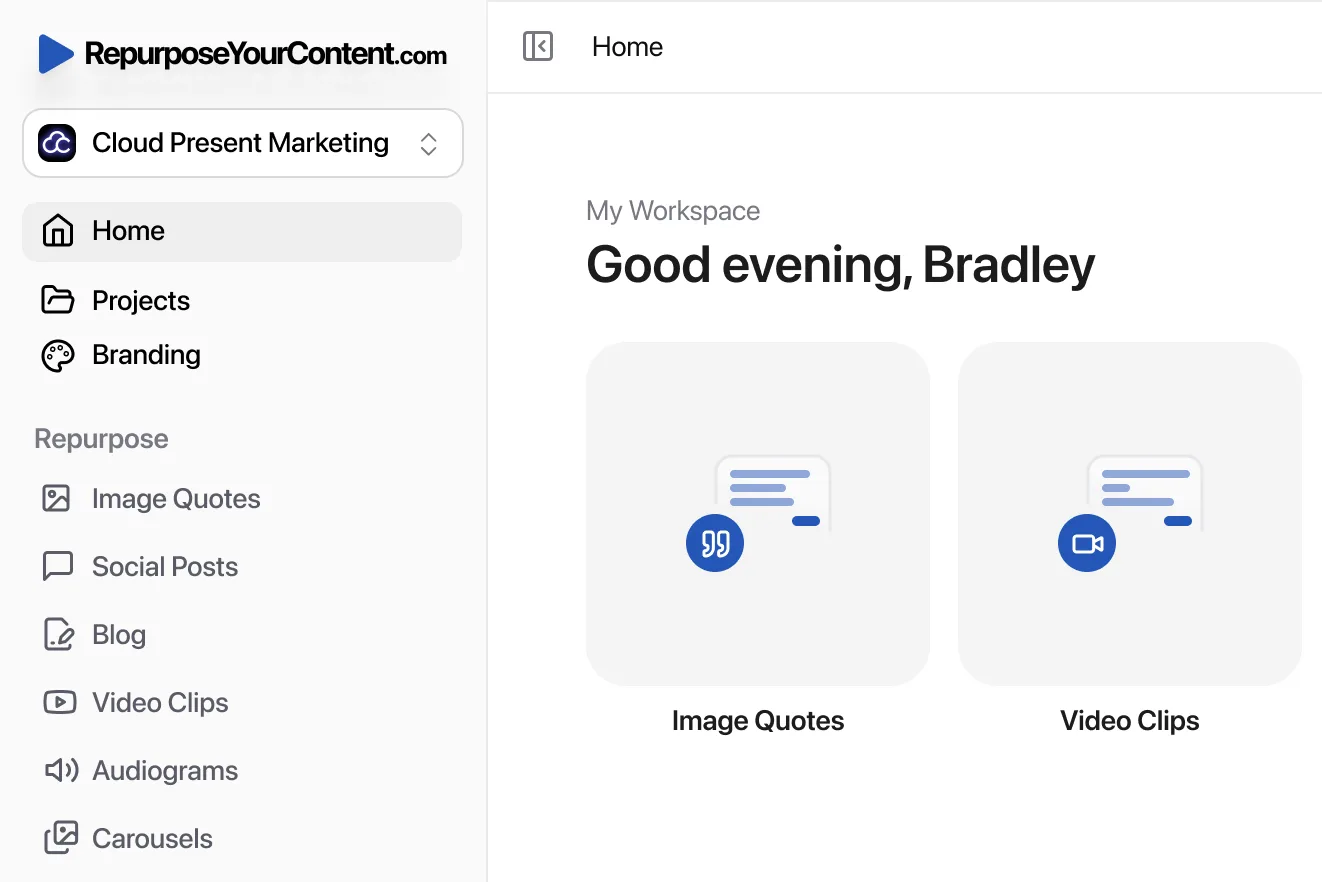
RepurposeYourContent is one done-for-you option. Clients send one podcast, interview, keynote, sales call, livestream, course, or meeting recording. The service returns 20 to 30 ready-to-publish assets in 72 hours, including short-form video cuts, LinkedIn carousels, Twitter threads, newsletter blurbs, blog drafts, audiograms, and quote graphics.
The client commitment is about 15 minutes, limited to review and approval. The service includes unlimited revisions, while the client retains the source files, brand voice documentation, finished assets, and analytics. Pricing starts at $14 per finished asset, and the stated 72-hour turnaround guarantee means the client doesn't pay when the deadline is missed. A 45-minute recording can become 30 assets without requiring the founder to manage production.
| Dimension | DIY Pipeline | Done-for-You |
|---|---|---|
| Founder time | 8 to 12 hours per recording | About 15 minutes |
| Production responsibility | Internal team | External repurposing team |
| Review role | Editing, drafting, design, and approval | Approval and targeted feedback |
| Deliverables | Limited by internal capacity | Clips, posts, graphics, carousels, audio, and blog content |
| Turnaround | Depends on queue and handoffs | 72 hours |
| Revision burden | Founder coordinates corrections | Unlimited revisions included |
| Ownership | Internal | Client retains files and assets |
The fit is strongest for a content lead, founder, podcaster, or B2B team producing at least one long-form recording each week. The model works when source material already exists and the bottleneck is converting it into consistent channel output.
Book a call with RepurposeYourContent or request a sample from a recent recording. The team can show how one source becomes publish-ready clips, posts, graphics, carousels, audiograms, and a blog draft within the 72-hour workflow.
Tags: