Mastering B2B Thought Leadership Content Strategy
Build a B2B thought leadership content strategy that works. Leverage webinars to generate original insights & scale them across all your channels.

High-quality thought leadership makes two-thirds of C-suite leaders question incumbent suppliers after reading a competitor’s content, according to the 2025 Edelman-LinkedIn B2B Thought Leadership Impact Report. That’s the standard. Not traffic. Not applause. Not a polished post that says nothing new.
Many organizations still treat thought leadership like an editorial theme. They publish safe summaries, trend recaps, and recycled advice. Buyers skim it, forget it, and move on. That isn’t a thought leadership content strategy. It’s content production with better branding.
A real thought leadership content strategy does one thing differently. It captures original perspective. It gives buyers a reason to rethink the category, the problem, or the criteria they use to evaluate vendors.
For most B2B teams, the fastest way to get there isn’t another long briefing doc. It’s a live conversation. Webinars, roundtables, customer panels, and expert interviews pull out the unscripted thinking that written-first workflows usually flatten. The strongest points often appear in the answer after the planned answer. That’s where expertise sounds real.
The practical playbook is simple. Find the point of view. Capture it live. Shape it into multiple formats. Distribute it where buyers already consume thought leadership. Measure whether it changes conversation quality, not just content output.
Your Introduction Is a Statistic
Many B2B content teams get this wrong from the first line. They treat thought leadership as a format instead of a standard.
A stat can open the door, but it cannot carry the argument. If the rest of the piece sounds like a cleaned-up recap of what the market already knows, buyers stop there. They have seen the same post from vendors who make the same claims and use the same language.
That creates a real commercial problem. During vendor evaluation, weak thought leadership does more than miss an engagement target. It tells prospects your team has no clear point of view, no hard-earned pattern recognition, and no useful perspective beyond safe consensus.
What most teams get wrong
B2B marketing teams often label a piece as thought leadership because it came from an executive, a strategist, or a subject matter expert.
That still is not enough.
Thought leadership earns attention by changing how the audience frames the issue. It challenges a default assumption, sharpens the decision criteria, or gives buyers a more useful way to judge options. Good educational content explains. Strong thought leadership changes the conversation.
Buyers look for clarity, conviction, and evidence that your team understands the problem at a deeper level than competing vendors.
Why live expertise wins
Typically, the process falters here. Written-first workflows smooth out the very ideas that make expert content worth reading.
A marketer drafts the angle. An executive softens the claim. Legal removes anything too pointed. The final version is accurate, approved, and easy to forget.
Live conversations produce better source material because experts speak in specifics when they are reacting in real time. In webinars, roundtables, and customer discussions, they reveal trade-offs, caveats, disagreements, and stories they would never put into a first draft. Those unscripted moments are often the clearest expression of real expertise.
For teams building a thought leadership content strategy at scale, that matters. The fastest path to original content is often to capture the expertise live, then shape the best parts into articles, clips, emails, and sales follow-up. That model is faster than starting with a blank page, and it usually sounds more credible too.
Redefining Thought Leadership Beyond Recycled Content
Thought leadership isn’t “content from experts”. It’s content with a clear point of view.
That distinction sounds small. It changes everything.
A company can publish ten articles about AI, supply chains, compliance, or revenue operations and still have no authority. If every article repeats what the market already believes, it adds nothing. Buyers may agree with it. They won’t remember it.
Topic ownership is not the same as opinion ownership
Many teams aim to “own a topic”. That usually leads to broad coverage.
They publish on industry trends, best practices, common mistakes, and basic explainers. Useful, yes. Distinctive, no.
Thought leadership works when you own an argument, not a category label.
A stronger approach looks like this:
- Weak position: “Data governance matters for enterprise AI.”
- Stronger position: “Most enterprise AI projects fail because data governance starts after vendor selection.”
- Weak position: “ABM needs sales and marketing alignment.”
- Stronger position: “Most ABM programmes underperform because teams target accounts before defining the buying problem.”
The second version gives the audience something to react to. That’s the point.
The test for a real point of view
A useful internal test is simple. Ask whether the content could be published by three direct competitors with only minor edits.
If the answer is yes, it isn’t thought leadership.
Another test works just as well. Remove the logo and byline. If the audience still can’t tell who would say this, the content is too generic.
Teams that need a reference point can review strong thought leadership content examples to see what distinct positioning looks like in practice. The common thread isn’t polish. It’s a defensible stance.
What real thought leadership usually contains
It tends to include a few specific ingredients.
- A clear claim: The piece says something riskier than “it depends”.
- Operating experience: It reflects what the company has seen in customers, delivery, product work, or sales conversations.
- Useful tension: It challenges a familiar assumption without becoming contrarian for attention.
- Commercial relevance: It helps a buyer make a better decision.
That last point matters. Thought leadership isn’t separate from revenue. It shapes how buyers evaluate the problem and, by extension, the solution.
A practical definition is worth keeping close. The RepurposeYourContent glossary entry on thought leadership frames it well for teams that need internal alignment on what the term should mean operationally.
Helpful content and thought leadership serve different jobs
A mature content programme needs both.
| Content type | Primary job | Typical format | Usual outcome |
|---|---|---|---|
| Helpful educational content | Answer known questions | SEO posts, guides, checklists | Capture demand |
| Thought leadership | Change how buyers think | Webinars, opinion pieces, interviews, executive posts | Shape demand |
The mistake is expecting one to do the other’s job.
Educational content wins when a buyer already knows what to search for. Thought leadership wins earlier. It creates the frame through which the buyer interprets the issue.
Practical rule: Don’t ask thought leadership to rank like a how-to article. Ask it to make the right buyer stop, think, and talk back.
What usually fails
The pattern is familiar.
- Trend summaries fail because everyone has the same sources.
- Committee-written pieces fail because they smooth out every sharp edge.
- Executive ghostwriting without real input fails because the content sounds borrowed.
- Overly polished brand copy fails because buyers don’t trust abstract certainty.
The strongest pieces often sound like they came from a smart person who’s been in the room, not a team trying to sound smart.
A Framework for Your Thought Leadership Content Strategy
A workable thought leadership strategy starts with source material, not a blank page.
For B2B teams, the highest-value source is usually a live expert conversation. It produces sharper opinions, better examples, and fewer recycled takes than article-first planning. It also gives the content team something practical to scale.

Build around three inputs
Strong thought leadership sits where three inputs overlap. Miss one, and the output gets weaker fast.
Internal expert conviction
Start with people who have earned a point of view through repeated exposure to the same buyer problems.
The right expert can explain where deals stall, which assumptions break during implementation, and what the market keeps getting wrong. That is the material worth publishing. A generic brief written from keyword research will not produce it.
Useful prompts include:
- What does the market misunderstand again and again
- Which buyer belief creates bad decisions
- What common advice fails once a company tries to apply it
Proprietary customer insight
Opinion without evidence turns into brand theatre.
Use what the business already sees. Sales call notes, onboarding issues, churn reasons, support trends, implementation friction, win-loss interviews, and product usage patterns all give you signals about what buyers struggle with. Those signals make the argument sharper and harder to copy.
Unanswered audience pain
A strong point of view still needs a clear audience job.
The best topics sit close to real commercial tension. Category confusion. Buying hesitation. Internal resistance. Budget scrutiny. If the content does not help a specific buyer make sense of a hard decision, it may sound smart but it will not travel through the market.
The operating model
Here is the model I would hand to a new Head of Content.
Set 3 to 5 thesis areas
Choose themes tied to revenue, sales friction, product adoption, market education, or category positioning.Match each thesis to a live expert format
Assign a webinar, panel, interview, or roundtable to each theme. The goal is to get experts speaking, not drafting.Prepare questions that force specificity
Ask for trade-offs, failure points, examples, and disagreement with standard advice. Surface-level prompts produce surface-level content.Run the live session and capture everything
Record the webinar, keep the transcript, and note the strongest unscripted moments. Those moments often become the best assets.Turn one session into an asset set
Build the recap article, short clips, executive posts, email content, sales follow-up material, and quote graphics from the same conversation.Plan the cadence visibly
This only works if scheduling, owners, and reuse windows are clear. A practical editorial calendar template for marketing teams helps teams keep the system consistent.
The real trade-off
This model asks more from experts upfront.
You need calendar time, a moderator who can ask better questions than "tell us about trends," and an editorial lead who knows when an opinion is strong enough to publish. Approval can take longer than generic blog production. Scheduling is harder than assigning a writer.
The return is better source material and far less content waste.
Instead of asking your team to invent authority after the fact, you capture expertise in the room, then repurpose it across channels with the original nuance still intact. That is the part many thought leadership strategies miss. The strategy is not just topic selection. It is a repeatable way to turn live expertise into a content engine that keeps its edge.
Why Webinars Are The Best Source for Authentic Expertise
Authentic expertise rarely shows up at its best in a blank document. It shows up when a smart operator has to explain a hard decision out loud, defend it, qualify it, and answer the question they did not expect.
That is why webinars outperform written-first thought leadership as source material.

A strong writer can polish an idea. A live conversation exposes whether the idea is actually strong. You hear the reasoning, the caveats, the disagreement between two experienced people, and the example that only comes out because someone asked a sharper question than the brief covered.
That difference matters in B2B. Buyers are not looking for more content volume. They are looking for signs that your team has done the work, seen the trade-offs, and can talk about them without sounding rehearsed.
The missed opportunity is usually operational.
B2B marketing teams already spend time booking speakers, preparing talking points, promoting the session, and recording it. Then the webinar gets treated like a one-time event asset instead of the raw material for a month of thought leadership. The replay goes up. The transcript sits untouched. The strongest five minutes disappear into the archive.
That is a content production mistake.
A webinar captures the part written-first workflows often flatten. An expert says, "We thought the rollout problem was training, but it was stakeholder ownership." A second speaker pushes back and explains when more training does matter. Someone in the audience asks a question that reveals how buyers describe the problem in their own words. Now the team has something useful. It has a point of view under pressure.
A standard blog draft on the same topic often strips out exactly what made the idea credible. It cleans up the language, removes tension, and turns a real opinion into a safe summary.
Live conversations preserve the signals that make expertise believable:
- specific phrasing real people use when they explain a decision
- qualified opinions instead of generic best practices
- disagreement that shows where the edge cases are
- examples pulled from memory, not added later by a copywriter
- audience questions that reveal confusion, urgency, and buying language
I have seen this play out repeatedly. The line that gets quoted in sales decks, clipped for social, or expanded into a strong article is often not in the prep doc. It comes out when the speaker is responding in real time and has to choose clarity over polish.
That is also why webinars are faster than starting from scratch with written thought leadership. The hard part is not formatting the final asset. The hard part is getting a useful original point of view out of busy experts. A live session does that in one sitting. The team gets the transcript, the examples, the objections, the strongest lines, and the follow-up questions in the same hour.
There is a trade-off. Webinars are less controlled. Some speakers ramble. Some sessions produce more insight than others. A weak moderator will let the conversation drift into familiar talking points. But that is still a better problem than publishing polished content with no real opinion inside it.
Content leaders should treat webinars as the primary capture format for expertise. The event matters. The recording matters more.
The Webinar-First Thought Leadership Playbook in Action
A webinar-first strategy works when the team treats the live session as the source of truth, then builds every follow-on asset around one argument.

The point is simple. Capture original thinking once, in a format that brings out real expertise, then distribute that thinking in the formats buyers consume.
A real workflow example
Say the team runs a webinar called Why most category strategies fail after positioning workshops.
That title does two jobs. It gives the audience a clear problem, and it gives the speaker permission to take a position.
A weak session title invites summary. A strong one creates tension. That tension matters because strong thought leadership usually starts with a claim someone could disagree with.
Step 1
Set a thesis that can hold a 45-minute conversation.
Use a statement like, “Category strategies fail when companies keep old buyer language after the workshop.”
Now the moderator has a job. Push for proof. Ask where that shows up. Ask which teams get this wrong. Ask what has to change in messaging, sales calls, and pipeline reviews if the claim is true.
That structure produces material with teeth.
Step 2
Review the recording for decision-useful moments, not just interesting lines.
Pull the parts a buyer, seller, or executive can act on:
- The core claim that sets up the point of view
- Specific examples from real companies or projects
- An audience question that exposes confusion or resistance
- A strong closing statement that can stand on its own in email or social
- Any disagreement or nuance that makes the perspective more credible
Weaker teams lose value. They pull highlights based on what sounds polished. Strong teams pull the moments that change how the audience sees the problem.
Step 3
Turn each moment into a channel-specific asset.
One webinar can produce:
- Short video clips for LinkedIn and paid social
- A blog post that expands the main claim with examples
- A LinkedIn carousel that breaks the argument into steps
- Email follow-up for attendees and a separate nurture version for no-shows
- Quote graphics or audiograms that preserve exact phrasing from the speaker
- Timestamped clips that sales can send to prospects after calls
Teams that want a repeatable system can build from this content multiplication framework instead of rebuilding the process every time.
Distribution should match the job of the asset
The mistake is not under-creating. It is under-distributing with intent.
Each asset needs a role inside the buyer journey and inside the revenue team.
| Asset | Best use | Why it matters |
|---|---|---|
| Video clip | Social reach and executive visibility | Delivers the argument fast |
| Blog post | Search, sales enablement, and deeper education | Gives the thesis structure and proof |
| Carousel | Framework communication | Makes a complex point easier to scan and share |
| Nurture and re-engagement | Pulls the audience back into the argument | |
| Timestamps | Sales follow-up | Lets reps send the exact moment that answers an objection |
A good distribution plan also spaces the content out. Publish the sharpest clip first. Follow with the executive post, then the article, then the carousel, then the email sequence. Repetition helps when the format changes and the message stays consistent.
Keep the cadence tight
This walkthrough shows the mechanics well.
I would rather see one webinar produce five strong assets over three weeks than fifteen rushed assets in three days.
That trade-off matters. Speed helps, but only if the core argument stays intact across formats. Once the clips, post, article, and email start saying slightly different things, the system creates noise instead of authority.
A recorded webinar is just a file. A webinar-first strategy turns that file into a month of useful, opinion-led content.
What usually breaks the model
Three mistakes show up again and again.
- Posting the full recording and stopping there. Buyers need a reason to invest 45 minutes.
- Turning the session into a recap. Recaps remove tension, and tension is often where the insight lives.
- Creating assets without a clear thesis. Output goes up, but the market still does not know what the company believes.
The teams that get results from thought leadership do not chase volume. They keep one point of view intact, then repeat it across formats until the market remembers it.
How RepurposeYourContent Automates Your Playbook
A webinar-first strategy breaks down at the production layer.
The subject matter expert showed up. The conversation had real tension. The audience questions surfaced objections you would never get from a polished ghostwritten draft. Then the recording lands in a folder, and the team has to turn one live session into a blog post, clips, social copy, a carousel, email copy, and sales follow-up. That is where good strategy gets stuck.

The problem is not a lack of ideas. It is production drag, review drag, and message drift.
RepurposeYourContent is useful because it treats the webinar as the source of truth, then builds the asset set from that source instead of asking five people to interpret the same session five different ways. That matters more than speed alone. It protects the original argument.
What the workflow looks like in practice
A strong system should let a content lead move from recording to approved assets without rebuilding the message each time.
The core steps are straightforward:
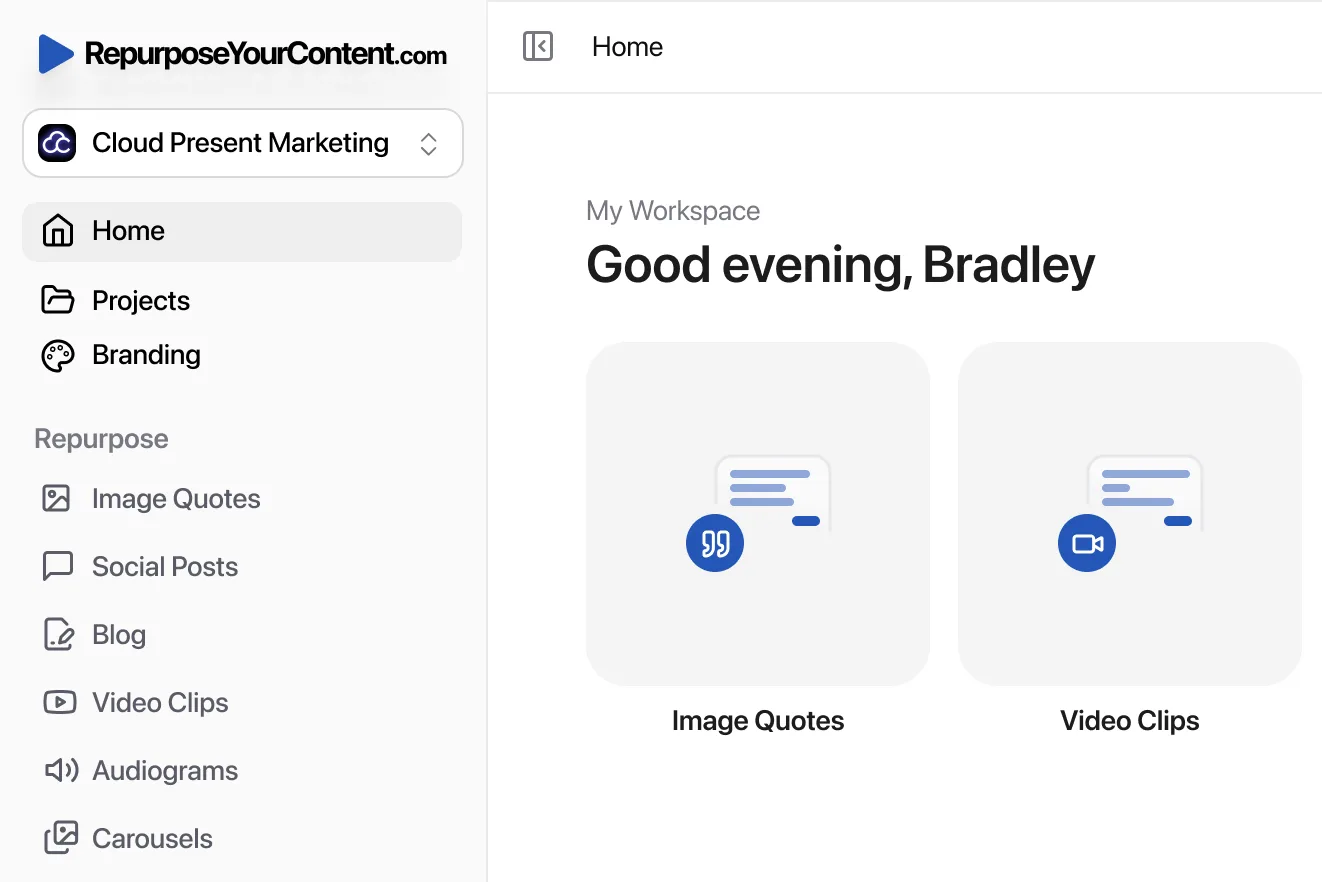
- Upload the webinar recording from Zoom, YouTube, Vimeo, or another platform
- Select the outputs you need, such as clips, blog drafts, social posts, audiograms, quote graphics, newsletters, LinkedIn carousels, and timestamp summaries
- Set the volume and priority based on the campaign, channel mix, and promotion window
- Review and refine before publishing so the final assets still sound like your team
That model fits how B2B content teams work. One expert session produces the raw material. Marketing shapes it for distribution. The platform removes the repetitive production work in the middle.
Why leadership teams care
A VP of Marketing or Head of Content is not buying automation to save a few editing hours. They are trying to get more market presence from limited expert time.
There are three concrete gains.
It cuts coordination waste
Manual repurposing turns every asset into its own mini project. Content writes the article. Social rewrites the angle. Design rebuilds the narrative into slides. Demand gen adapts it again for email. By the time everything ships, the campaign is slower than the market conversation it was supposed to shape.
It keeps the point of view intact
Live webinars work because experts say what they actually believe, in their own language, with audience pressure on the call. That is hard to fake in a blank document.
When downstream assets come from the same recorded exchange, the article, clip, and post are all grounded in the same argument. That consistency is what helps a company become known for a specific point of view.
It gives you cleaner reporting
If one webinar drives the blog post, the social cutdowns, the email sequence, and the sales follow-up assets, performance is easier to evaluate. You can judge the strength of the thesis, the speaker, and the repurposing mix from one source event instead of trying to compare disconnected content pieces.
Transcripts matter, but they are only the start
Transcript quality affects every downstream asset. Bad transcription creates weak hooks, inaccurate quotes, and extra editing work. Teams reviewing transcript options can use this guide to a video to text converter for background.
But transcription by itself does not give you a working thought leadership system.
Gain comes from combining capture, extraction, formatting, and approval into one repeatable workflow. Teams assessing that operating model can see the process in this guide on how to automate webinar repurposing.
Judge the system by output quality and speed to market
Time saved matters. Strategic consistency matters more.
Use a simple test:
- Did the webinar become publishable assets while the conversation was still relevant
- Did the expert’s language survive the repurposing process
- Did sales receive usable content tied to the same thesis marketing was promoting
- Did the team increase output without adding review chaos or headcount
If those answers are yes, automation is doing the right job. It is turning unscripted expertise into a repeatable thought leadership engine, which is exactly what a webinar-first strategy needs.
Measuring the Real Impact of Your Thought Leadership
Most thought leadership reporting is still too shallow for an executive team.
Page views, impressions, and reactions can help with diagnosis. They don’t prove strategic value on their own. A VP or Director needs a measurement model tied to authority, buyer engagement, and commercial movement.
Start with authority signals
Authority is the earliest layer, and it’s often visible before revenue attribution catches up.
Track whether the company is becoming associated with the specific argument it wants to own. That includes branded search shifts, invitations to speak, podcast guest requests, analyst attention, and whether sales starts hearing the same phrase back from prospects.
A useful dashboard should also track content performance by thesis, not just by format. One argument may consistently create stronger discussion than another. That’s a strategic signal.
Then measure engagement quality
Engagement quality matters more than broad engagement volume.
The important question isn’t “did people interact”. It’s “did the right people interact in the right way”.
Look for:
- Comments from target accounts
- Shares by recognised operators or leaders in the category
- Direct messages that reference the argument
- Replies that extend the discussion instead of praising the post
A lightweight review process helps here. Sales and marketing should look at discussion quality together, then compare it with what appears in pipeline conversations.
For teams that need a cleaner reporting structure around event-driven content, this guide on webinar metrics and KPIs to track is a practical starting point.
Vanity metrics tell you that content was seen. Revenue-facing metrics tell you whether the market cared enough to act.
Finally, track business impact
Here, thought leadership earns its budget.
A useful business layer includes:
| Measurement layer | What to track | Why it matters |
|---|---|---|
| Pipeline influence | Opportunities that consumed webinar-led assets | Shows relevance in active deals |
| Sales usage | Which assets reps send and reuse | Indicates practical value |
| Deal movement | Whether informed prospects move faster or arrive better educated | Reflects trust and clarity |
| Qualitative proof | Prospect mentions in calls, emails, or forms | Captures influence that attribution often misses |
Not every effect will show up neatly in last-touch reporting. Thought leadership often works upstream by changing the way a buyer understands the problem before they fill in a form.
That’s why qualitative evidence should be captured deliberately. If prospects mention a webinar, a clip, or an executive post, sales should log it. Those comments help explain performance that dashboards miss.
What good reporting looks like
The best reporting packs are short.
They show which thesis areas generated the strongest target-account engagement, which assets sales used, and which conversations or opportunities referenced the content directly. That keeps the programme tied to strategic outcomes instead of drifting into publishing activity for its own sake.
Your Conclusion with a Clear Call to Action
A strong thought leadership content strategy doesn’t start with more writing. It starts with a sharper point of view and a better way to capture it.
Live webinars are the fastest route to authentic expertise because they surface the unscripted thinking buyers trust. Repurposing is what turns that thinking into a scalable system across clips, blogs, emails, carousels, and more.
Stop treating webinars like one-off events. Use them as the engine behind your authority programme.
Turn your next webinar into weeks of thought leadership content. Try RepurposeYourContent and create video clips, blog posts, social posts, audiograms, image quotes, newsletters, LinkedIn carousels, and timestamps in minutes.
Tags: