B2B Marketing Newsletters That Actually Convert
Build b2b marketing newsletters that get opened, clicked, and read. Practical frameworks, real costs, and a done-for-you path from one recording to 30 assets.
A typical B2B marketing newsletter reaches a 20% to 28% open rate and a 2.1% to 4.2% click-through rate. Top-quartile programs reach 38% to 55% opens, which means the problem usually isn't sending frequency. It's relevance, differentiation, and distribution.
Teams already have enough expertise for a strong newsletter. The raw material sits inside podcast interviews, sales calls, keynotes, customer conversations, livestreams, and internal expert sessions. The expensive mistake is treating each issue as a fresh writing assignment instead of turning one recording into a repeatable content supply.
B2B email newsletters became a mainstream content-marketing format by the mid-2020s. Industry benchmark summaries report that 77% to 81% of B2B marketers use newsletters as a core or primary format, while 79% say email is the most effective channel for distributing content (B2B newsletter benchmarks). That level of adoption creates a crowded inbox. Generic newsletters now compete with social feeds, AI-curated recommendations, and every rival publishing a similar roundup.
The answer is a newsletter built around a sharp point of view, useful segmentation, and a production system that makes good material inexpensive to publish.
Why Most B2B Newsletters Fail Before They Start
Average performance already tells the story. B2B newsletters commonly land at 20% to 28% opens and 2.1% to 4.2% click-through, while top-quartile programs reach 38% to 55% opens (B2B newsletter benchmarks). That gap rarely comes from one weak subject line. It starts earlier, with poor audience decisions and undifferentiated content.
A company can write polished copy and still send an irrelevant email. A procurement leader, a technical practitioner, an active customer, and a dormant lead shouldn't receive the same editorial mix. Yet many teams maintain one list, one template, and one weekly blast.
The real failure points
Three problems appear repeatedly:
- Generic audience design: The newsletter addresses an imaginary average subscriber instead of a real buyer group.
- One-off production: Each issue starts from a blank page, so the team spends its energy rebuilding research and context.
- Obligation-based publishing: The send exists because the calendar says so, not because the issue has a useful argument.
Recurring sends can outperform purely automated emails. One dataset covering 15.6 billion emails reported newsletter opens at 37.67%, compared with 35.12% for automated emails. Another benchmark reported 40.08% for newsletters and 34.18% for autoresponders (newsletter engagement benchmarks). Privacy features can inflate open rates, but the broader lesson remains useful. A consistent editorial rhythm can train anticipation when each issue earns attention.
Practical rule: Improve the audience promise and source material before testing another subject-line variation.
A podcast episode can become newsletter material when the team extracts a clear argument, supporting evidence, and a useful action. The podcast-to-email newsletter workflow shows why the recording should become a source asset, not a forgotten media file.
| Metric | Average Program | Top-Quartile Program | What Top Performers Do Differently |
|---|---|---|---|
| Open rate | 20% to 28% | 38% to 55% | They segment by audience need and lead with a distinct point of view |
| Click-through rate | 2.1% to 4.2% | 6% to 12% | They make the next action specific and tightly connected to the issue |
| Unsubscribe rate | 0.1% to 0.3% | Not specified | They protect relevance and remove disengaged contacts |
The fix isn't more email. Better B2B marketing newsletters make a stronger promise, reuse original thinking, and distribute that thinking across email and social channels.
What a B2B Marketing Newsletter Actually Does
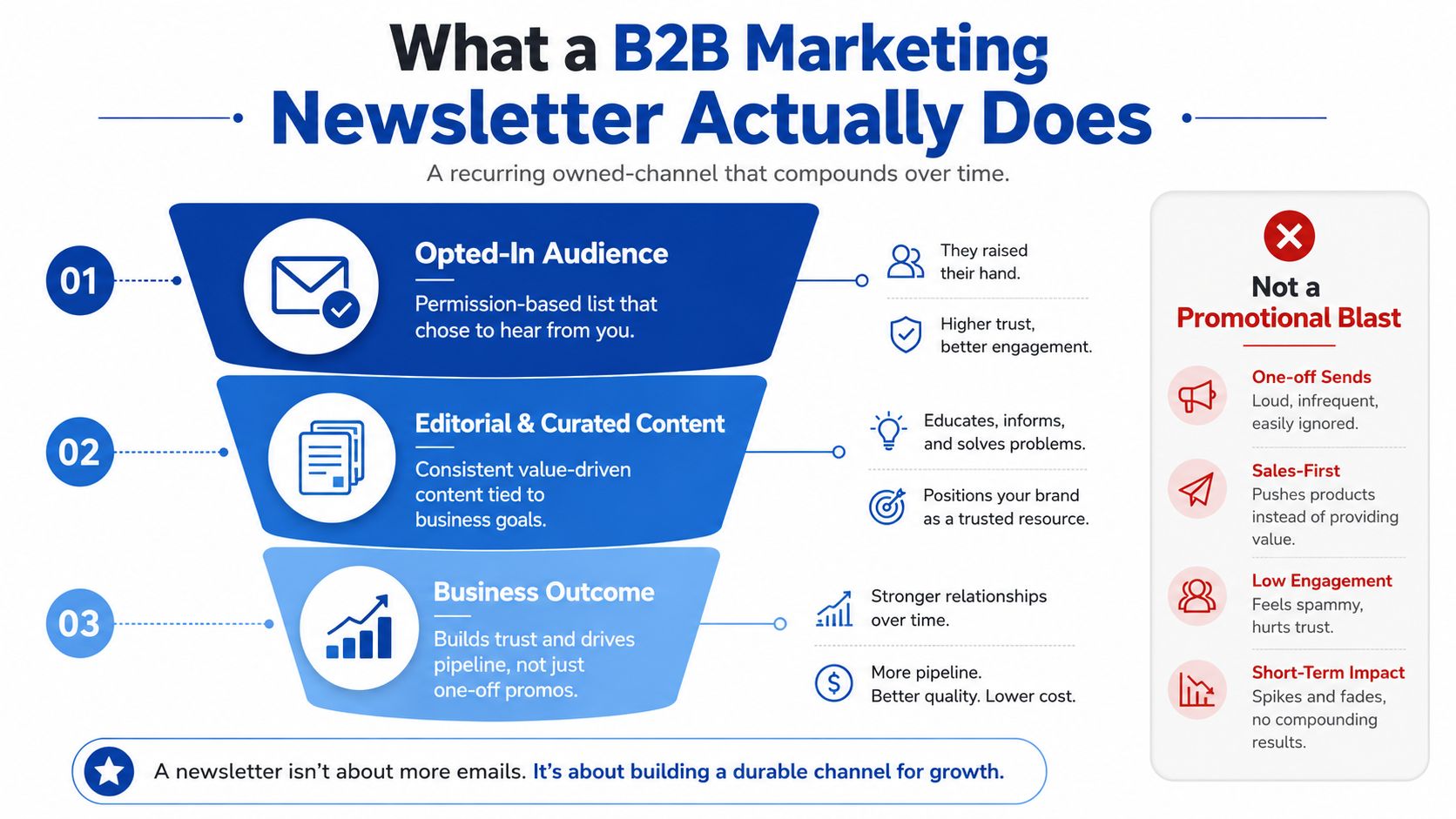
A B2B marketing newsletter is a recurring, permission-based email publication for an opted-in business audience. It delivers editorial, educational, or curated content tied to a commercial goal. It isn't the same as a product announcement, promotional blast, or automated receipt.
The format supports several jobs across the buying cycle.
Five commercial roles
Demand capture gives early-stage readers a reason to remember the company. A practical analysis can introduce a problem before the reader starts evaluating vendors.
Nurture and education help prospects understand a complex decision. A newsletter can explain implementation risks, buying criteria, or operating models without forcing a sales conversation.
Category framing gives the company language for describing the market. A contrarian interpretation of a headline can position the sender against safer, more generic competitors.
Customer activation and retention keeps existing customers aware of useful workflows, product capabilities, and relevant customer examples. The content should help customers achieve more, not merely announce updates.
Pipeline acceleration gives sales teams a permission-based way to reach dormant or cold contacts. A strong issue can reopen a conversation without another “just checking in” email.
Each role needs a measurable business goal. Demand capture might support qualified resource downloads. Nurture might influence demo requests. Customer content might support expansion conversations. Sales-focused issues might generate replies or reactivated opportunities.
Social distribution still matters, but email gives the company a direct route to an opted-in audience. Business readers may miss a LinkedIn post while managing meetings, research, and internal approvals. A useful newsletter gives them a durable editorial touchpoint that doesn't depend on a feed algorithm.
The time cost needs an honest number
A newsletter requires more than writing. Someone must identify source material, shape the argument, draft the copy, design supporting elements, check links, schedule the send, and review performance. Manual repurposing makes that burden visible. A 2,000-word blog post can take 4 to 8 hours to convert into multiple formats, while deeper repurposing can exceed 20 hours (B2B engagement and repurposing benchmarks).
That workload is why a source-first production system matters. The newsletter should sit inside a broader distribution engine, not compete with every other content task for the same few hours.
Content Types and Section Templates That Earn Opens
B2B newsletters earn opens by giving readers a clear reason to return. Build each issue around one useful point of view, two or three supporting blocks, and one action. The raw material can come from a customer interview, podcast episode, keynote, sales call, or expert discussion. That source-first approach turns distribution into a repeatable process instead of another weekly research project.
Six reliable editorial formats
One big idea: Make one claim in plain language. Use a specific heading, such as “The buying signal most teams ignore.” Keep the body around 80 to 120 words, then link to a deeper analysis.
Curated roundup: Choose three to five resources around one theme. Do not paste URLs into a list. Add a sentence explaining the practical value of each item.
Customer story: Show the decision, constraint, and result. Operating detail creates proof. A vague success statement gives readers nothing they can apply or trust.
Contrarian take: Open with a common assumption and challenge it with a specific opinion. The argument gives the issue a distinct identity and prevents interchangeable corporate language.
Teardown: Examine a competitor campaign, landing page, onboarding flow, or industry message. Identify what works, what fails, and what another team can borrow.
Tactical checklist: Give readers a short sequence they can save and follow. Checklists suit implementation topics because the value remains available after the email is closed.
A practical issue could open with a contrarian take, add a three-link roundup, support the argument with a customer example, and finish with a checklist. The source provides the substance. The template gives it a readable shape.
Executive expertise also needs a recognisable editorial voice. The resource on LinkedIn growth for executives offers a useful adjacent perspective. Apply the same standard to newsletters: state a clear belief, support it with evidence, and avoid generic company language.
| Section Template | Word Count | Best Use Case | Typical CTR Contribution |
|---|---|---|---|
| One big idea | 80 to 120 words | Teach one decision or principle | Strong when the link expands the argument |
| Curated roundup | 150 to 250 words | Package useful external resources | Moderate, depending on link relevance |
| Customer story | 150 to 250 words | Build proof and reduce buying risk | Strong when the next step matches the story |
| Contrarian take | 100 to 180 words | Differentiate the sender | Strong when the opinion leads to a practical resource |
| Teardown | 200 to 350 words | Teach through a real example | Strong for specialist audiences |
| Tactical checklist | 100 to 180 words | Help readers act immediately | Moderate to strong when paired with a template |
A 45-minute recording can supply the argument, examples, and checklist for a month of issues. Once that source exists, a repeatable newsletter can take under an hour to assemble. Starting from a blank page takes longer because research, positioning, and drafting compete for the same time. That is wasted effort, not editorial quality.
Audience Segmentation That Stops Generic Sends
Generic sends waste attention. Segmentation should begin with three questions: Who is the reader, where are they in the buying process, and what have they already shown interest in?
Job title gives the first layer. A decision-maker needs business impact and risk reduction. A practitioner needs implementation detail. An end user needs workflow guidance and proof that adoption won't create extra work.
Funnel stage adds context. A cold subscriber may need category education. An activated reader may be ready for a comparison or technical guide. An active buyer needs evidence that supports internal approval. A churned customer needs a useful reason to reconsider the relationship.
Behavior reveals intent. A click on pricing deserves a different follow-up from a click on a case study. A reader who repeatedly chooses product updates should receive a product-led content block. Someone who reads technical analysis should see deeper implementation material.
Three practical segment examples
CMO, first 60 days: Trigger this segment after a high-intent CTA click. Lead with a market framing article, follow with a proof point, and close with a strategy call CTA.
Engineering leader, Tier 1: Gate the content mix toward technical deep dives, architecture decisions, and operational checklists. Use a technical resource CTA instead of a generic demo.
No opens in 90 days: Send a re-engagement issue with a clear description of the newsletter's value. If the reader doesn't respond, reduce frequency or suppress the contact.
The goal is fewer irrelevant sends, not more volume. A smaller list with sharp segments can outperform a much larger list receiving one undifferentiated blast.
| Segment | Trigger | Content Swap | CTA Focus |
|---|---|---|---|
| Decision-maker | Senior role and high-intent click | Business case and risk analysis | Book a qualified conversation |
| Practitioner | Technical resource engagement | Implementation detail and checklist | Download or share the guide |
| Active buyer | Pricing or comparison click | Proof, objections, and evaluation support | Request a review |
| Customer | Product or support engagement | Activation and expansion content | Use a feature or contact success |
| Dormant reader | No opens for 90 days | Relevance reset and preference choice | Confirm continued interest |
The audience analysis guide for creators is useful because it treats audience understanding as a working discipline rather than a demographic label. The same approach belongs in B2B newsletter planning.
A triggered follow-up can also do more work than another broadcast. The drip campaign strategy for webinar follow-up provides a relevant model for matching content to demonstrated interest.
Cadence, List Growth, and Deliverability in 2026
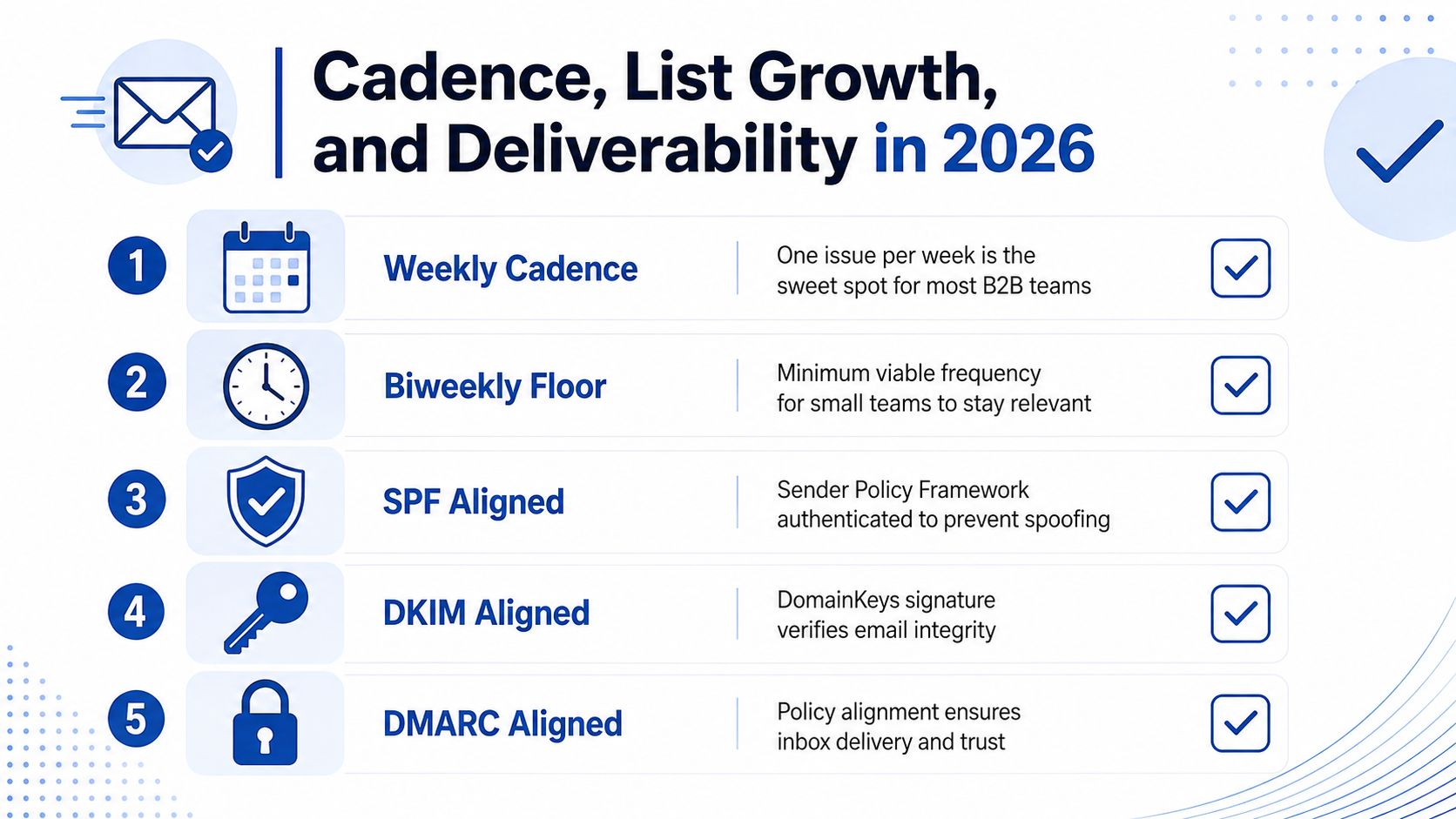
Cadence is a constraint, not a strategy. Most B2B teams can sustain one strong issue per week. Smaller teams may need a biweekly floor to stay relevant without lowering editorial quality.
The sender setup must be dependable before the calendar expands. SPF, DKIM, and DMARC should align on a dedicated sending subdomain such as newsletter.yourdomain.com. The program also needs a published suppression file and double opt-in for cold signups.
A practical operating rhythm
A weekly send works when the team has a source pipeline. A podcast, customer conversation, keynote, or sales call can supply multiple issues. Without that source pipeline, weekly publishing often turns into recycled commentary and product promotion.
List growth shouldn't depend on giveaways. Better acquisition points include:
- Signature bars: Add a newsletter invitation to executive and sales signatures.
- In-product prompts: Ask active users to receive practical updates during relevant workflows.
- Partner cross-promotions: Exchange mentions with non-competing SaaS companies that serve the same audience.
Deliverability needs clear internal targets. Teams can aim for 85% or higher in Gmail Primary, 80% or higher in Outlook Focused Inbox, and a spam complaint rate below 0.08%. These are operating targets, not guarantees. Inbox placement depends on authentication, engagement, content, list quality, and provider policy.
A quarterly hygiene routine should identify readers with no opens in 180 days, send a dedicated “still want this?” message, and suppress contacts who don't respond. Recent industry analysis reports that compliant senders reach the inbox about 89% of the time, while non-compliant mail can lose 22% to 34% to spam (newsletter growth trends). Relevance and hygiene now matter more than volume.
For a broader acquisition checklist, the guide on how to grow a B2B newsletter covers practical growth channels without reducing list building to incentives.
A documented calendar helps the team coordinate themes, source assets, and review time. The editorial calendar template for marketing teams can support that operating discipline.
Metrics That Matter When Open Rates Lie
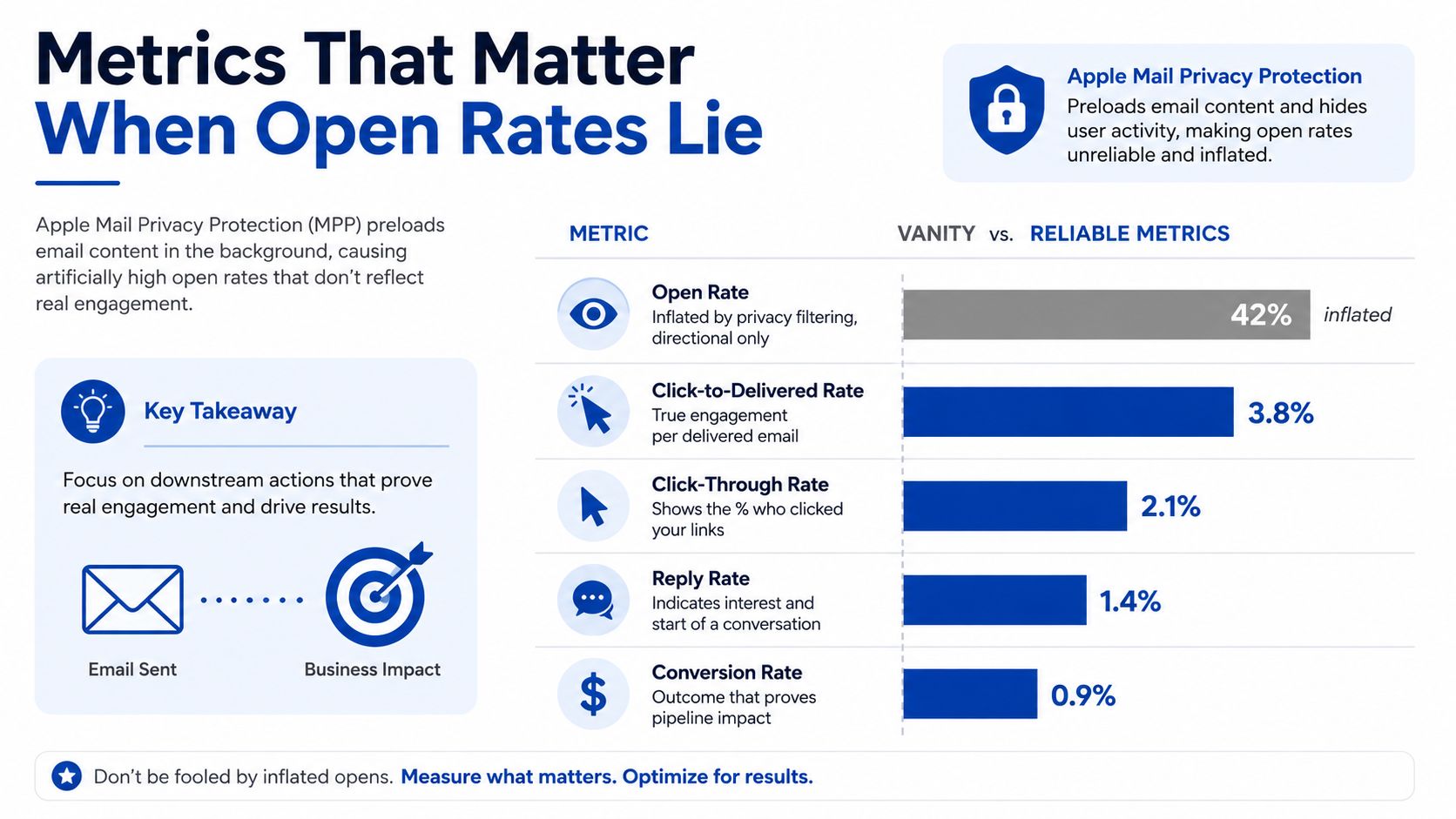
Open rate is a directional signal, not proof of attention. Apple Mail Privacy Protection, server-side filtering, and less dependable tracking pixels make open data too weak to anchor a B2B newsletter program.
Build the scorecard around reader actions and commercial outcomes. Click-to-delivery measures engagement among delivered emails. Replies show whether an issue created enough relevance for a real conversation. Meetings and pipeline connect distribution to sales activity.
A stronger newsletter dashboard
Growth view: Track subscriber quality, acquisition source, role, and engagement status. A larger list full of inactive contacts is poor growth.
Engagement view: Track delivered clicks, replies, performance by content block, and unsubscribe behavior. The B2B click-through benchmark range is 2.1% to 4.2%, while top-quartile programs reach 6% to 12% (B2B newsletter benchmarks). Use these figures for context, then judge each issue by the actions it generates.
Revenue view: Track qualified replies, booked meetings, sourced pipeline, and influenced pipeline. Give every CTA a UTM tied to the relevant CRM stage.
A newsletter earns its keep through qualified actions, not attractive screenshots of open rates.
Keep attribution simple. Tag the issue and CTA, record the contact's stage, then compare the send with the resulting reply, meeting, or opportunity. That comparison shows whether a technical teardown creates better conversations than a curated roundup.
The unsubscribe-to-click ratio exposes fatigue. A rising ratio signals declining trust even when delivery remains stable. Set a hard internal rule: an issue that produces no qualified reply per 500 sends failed, regardless of its open rate.
Use this content marketing ROI measurement framework to connect newsletter activity with pipeline instead of stopping at engagement metrics. That discipline also makes one focused recording easier to evaluate as a month of distribution fuel.
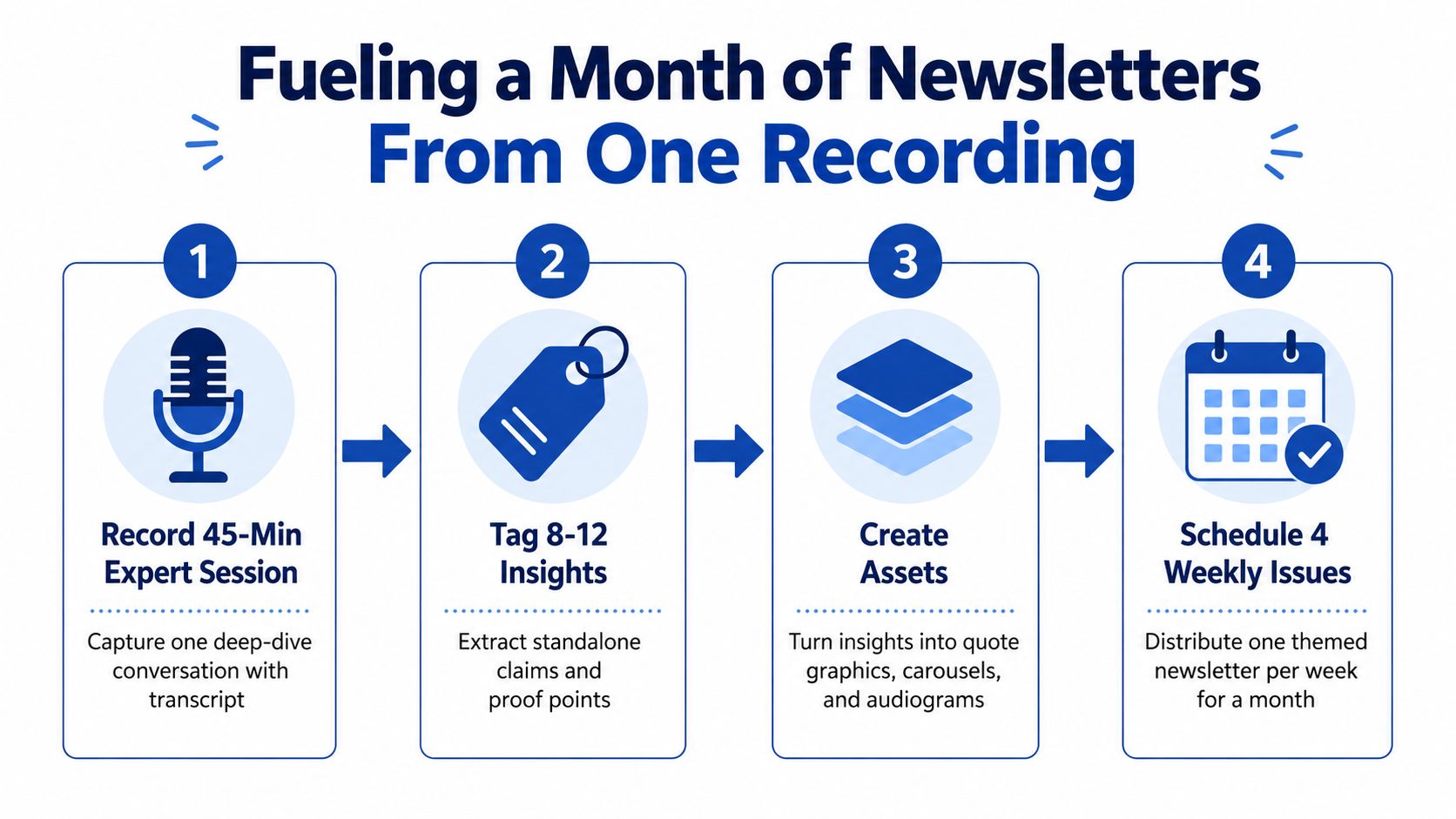
Fueling a Month of Newsletters From One Recording
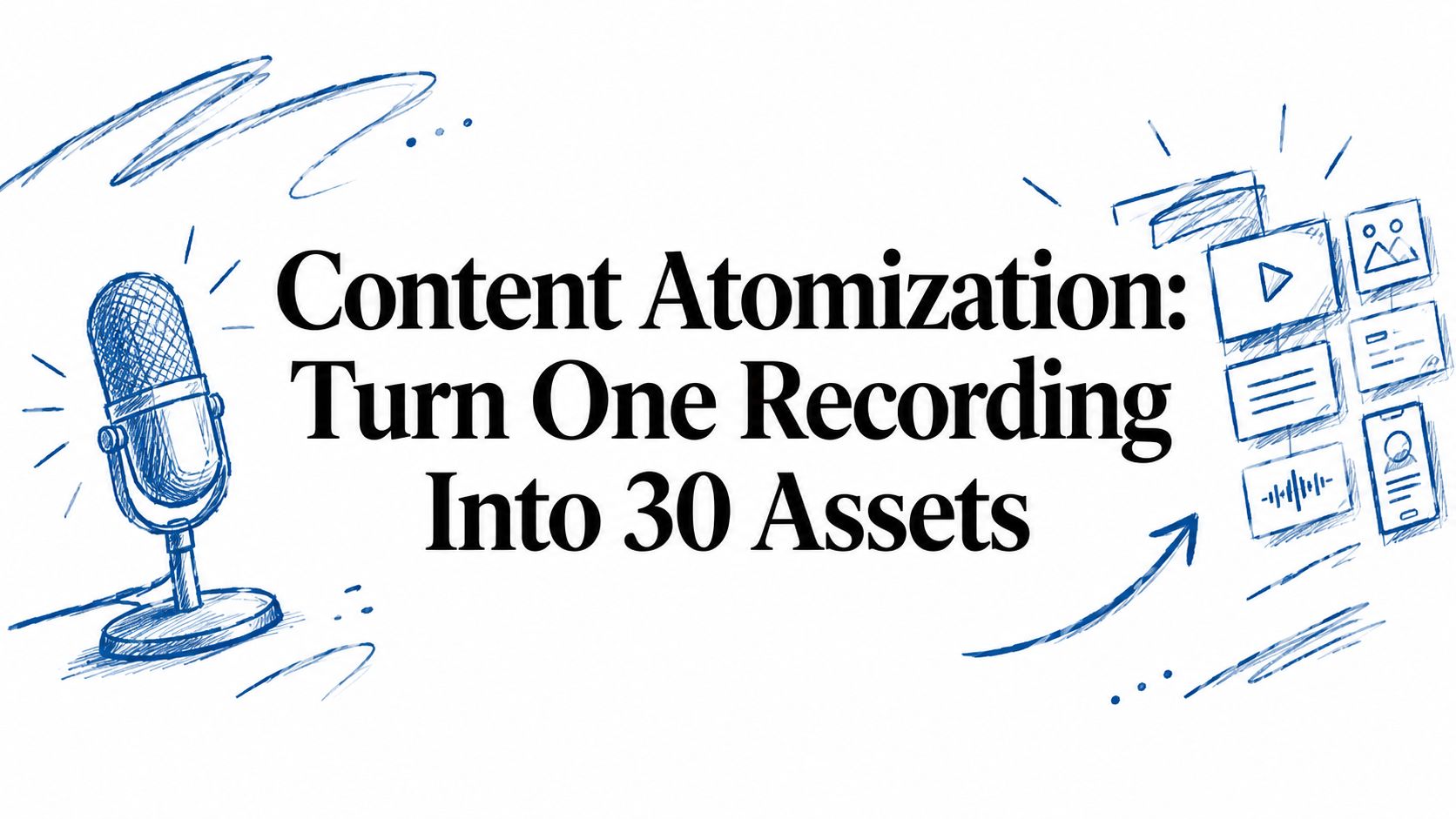
One 45-minute recording can provide enough material for four newsletter issues, supporting social posts, graphics, and video clips. The source might be a podcast interview, customer conversation, keynote, sales call, livestream, or internal expert session.
The workflow below keeps the editorial work close to the original voice.
Step 1 Pull and tag the transcript
The production team pulls the transcript and identifies 8 to 12 standalone insights. Each insight needs a clear claim, evidence, and implication. Manual tagging takes about 90 minutes when the recording has a focused topic.
The team should reject observations that have no useful consequence. “Communication matters” isn't an issue. “Technical buyers need implementation evidence before they trust a category claim” is a usable editorial point.
Step 2 Cluster the material into themes
Next, the team groups the insights into four weekly themes and assigns a template to each. This takes about 60 minutes.
A practical month might look like this:
- Week one: A metric or market interpretation.
- Week two: A practical how-to.
- Week three: A contrarian opinion.
- Week four: A teardown or customer lesson.
The themes prevent four versions of the same email. They also make supporting social content easier to schedule.
Step 3 Draft the issue components
The team writes subject lines, preview text, and 80 to 120 words of body copy for each template. This step takes about 120 minutes when the source voice is clear.
The draft should preserve the speaker's language without copying conversational clutter. Each issue needs one dominant idea, one supporting link path, and one soft CTA.
Step 4 Produce support assets
The team pulls quote candidates for graphics, clips 3 to 4 short video moments, and extracts one stat callout per issue. This takes about 90 minutes.
The output from one recording can include 4 issues, 12 social posts, 4 quote graphics, and 3 video clips. A serious repurposing workflow supports that scale. A 3,000-word guide or 40-minute webinar can take 15 to 25 hours to produce well, while turning it into more than 20 channel-native pieces can require roughly 16 to 20 additional hours manually (content repurposing workflow benchmark).
Step 5 Schedule and trigger follow-up
Scheduling the four issues and creating a non-opener trigger takes about 30 minutes. The client then spends roughly 6 hours reviewing the complete set.
The source-first workflow avoids writing four unrelated newsletters from scratch. For a detailed process focused on video-derived email content, the newsletter creation guide shows how one recording can support multiple email assets.
The result is a month of publishable material without inventing new ideas every week. The recording already contains the expertise. Production turns it into formats the audience can consume.
The Done-for-You Alternative and How to Start
In-house newsletter production works when a team has editorial capacity, design support, editing skills, and time for performance review. Many B2B marketing teams have none of those resources available consistently. They have useful recordings, but post-production keeps losing priority to launches, sales support, and customer requests.
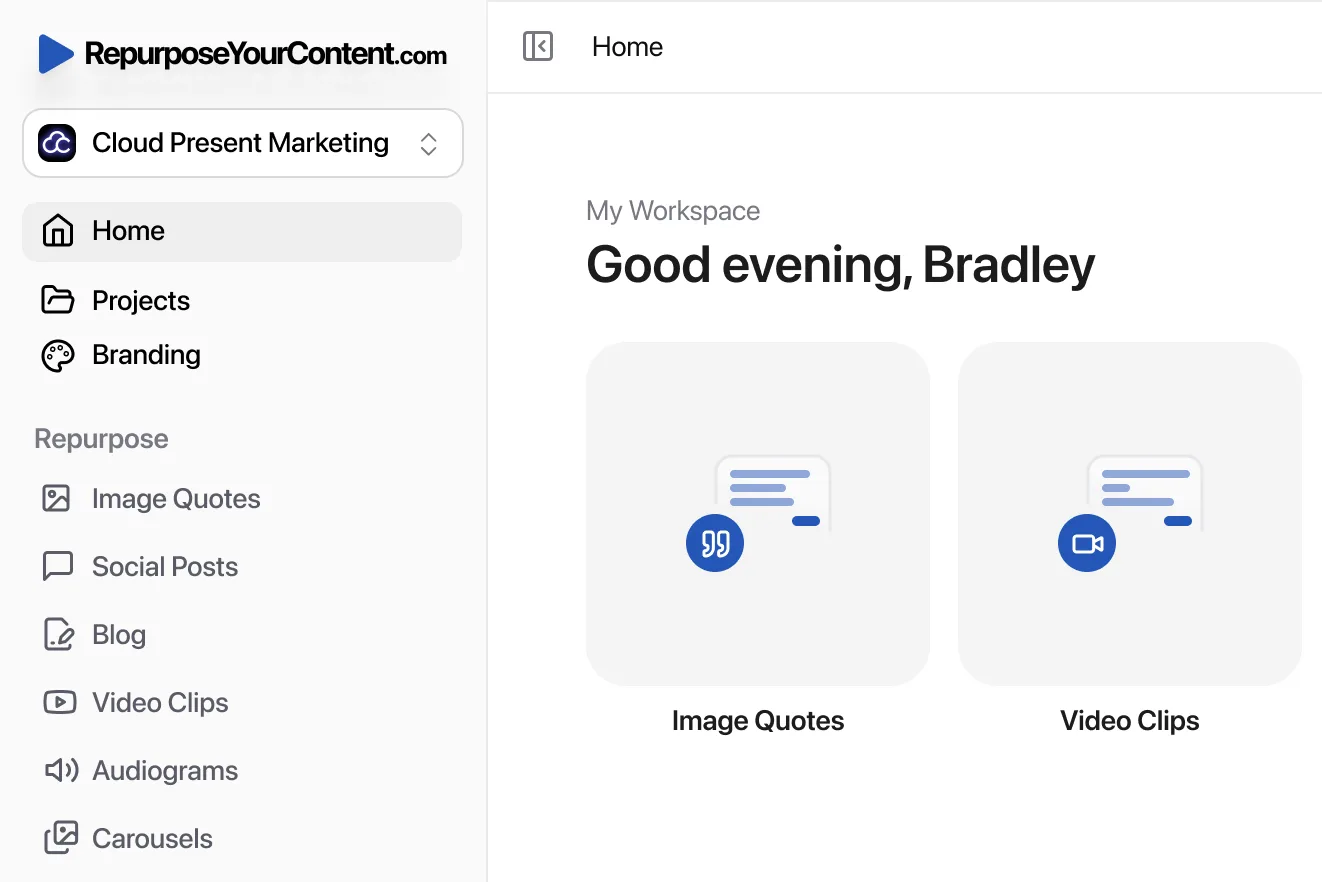
A done-for-you workflow removes that production bottleneck. The client supplies one recording, such as a podcast, interview, keynote, sales call, livestream, course session, or meeting. A content team turns it into 20 to 30 ready-to-publish assets within 72 hours, including newsletter copy, video clips, LinkedIn posts, quote graphics, carousels, audiograms, and a blog post.
The client contribution is about 15 minutes. That intake covers the audience, brand voice, business goal, and preferred calls to action. The client keeps final approval and brand ownership. The production team handles transcription, editing, writing, design, formatting, and content organization.
What the economics look like
Manual repurposing creates a labor bill that rarely appears in the newsletter budget. A serious long-form source can require 15 to 25 hours before the team has a polished pillar asset, followed by another 16 to 20 hours for a broad channel-native workflow. One guide estimates 4 to 8 hours to repurpose a 2,000-word post and says deeper repurposing can exceed 20 hours. These figures show why writing every newsletter from scratch is an inefficient use of specialist time.
An internal team may spend 12 to 20 hours monthly on newsletter production at a loaded rate of $50 to $85 per hour. Those figures describe the stated in-house comparison for this service model, not a universal labor benchmark. Outsourcing changes the work from an open-ended production burden into a defined project tied to one recording.
RepurposeYourContent is one done-for-you option. Clients submit a recording, and the service returns brand-aligned content for newsletters, social channels, video, graphics, and blogs. According to the company's published pricing, rates start at $14 per finished asset. Its published delivery promise is 72 hours or the client doesn't pay.
| Factor | In-House | Done-for-You |
|---|---|---|
| Client time | 12 to 20 hours monthly | About 15 minutes per recording |
| Source preparation | Transcription and research handled internally | Client sends an existing recording |
| Editorial work | Internal writer extracts and shapes ideas | Production team drafts in the brand voice |
| Design and editing | Requires separate skills or staff | Included in the asset workflow |
| Output | Limited by internal capacity | 20 to 30 finished assets |
| Delivery expectation | Depends on competing priorities | Within 72 hours, or the client doesn't pay |
| Review process | Internal approvals and revisions | Final approval with unlimited revisions |
The choice depends on where the bottleneck sits. Teams with spare production capacity can keep the work internal. Teams with a backlog of recordings and no dependable production time should test the workflow before committing to a broader engagement. A short intake call and a sample asset set provide a low-risk way to judge quality, turnaround, brand fit, and the amount of review the newsletter team must provide.
One 45-minute recording should feed a month of newsletter material, not become another file in the backlog. Use the workflow only if it gives the team enough usable assets to publish consistently without inventing a new idea every week.
Tags: