Batch Content Creation for Creators That Works
A practical batch content creation for creators system, with weekly schedules, templates, and the hidden cost of doing it yourself.

A creator can spend Sunday recording four videos and still publish nothing by Friday. The camera roll looks productive, but transcription fixes, editing, captions, thumbnails, descriptions, and scheduling remain untouched.
Batch content creation for creators solves that gap by treating one long-form recording as source material for many finished assets. The recording is only the anchor. The system batches selection, editing, writing, design, revisions, and distribution.
A single 45-minute recording can produce 20 to 30 publish-ready assets, according to workflow estimates for manual content batching. The catch is that doing all the post-production alone can take roughly 10 to 16 hours before approvals, scheduling, and revisions. Batching works when the post-recording work gets its own operating system.
The Creator Content Trap Most People Miss
Maya blocked Sunday for content. She planned to film four short videos, change outfits between takes, and leave the afternoon with a full week of marketing.
By evening, she had four rough recordings. That felt like progress. On Tuesday, she opened the first file and spent the day fixing transcription errors, choosing a thumbnail, tightening pauses, writing captions, and deciding where the clip belonged.
Wednesday disappeared into the second video. The other two stayed untouched.
Maya didn't record too little. She confused filming with finishing.
That mistake affects solo podcasters, founders, interview hosts, and creators who publish from keynotes, livestreams, sales calls, or courses. They batch the visible step, then handle every downstream task separately. Each recording creates another queue of decisions.
The camera roll is not the content calendar
A recording becomes useful only after someone turns it into specific assets:
- Video clips: Short moments with a clear hook and platform-native pacing.
- Written posts: LinkedIn perspectives, captions, and newsletter drafts.
- Visual assets: Quote graphics, thumbnails, carousels, and audiograms.
- Long-form derivatives: A transcript-based article or episode summary.
- Distribution records: Publish dates, channels, links, and revision status.
More raw footage usually creates more downstream work. Four recordings don't create four pieces of content. They create four editing queues, four sets of captions, four thumbnail decisions, and four publishing plans.
Practical rule: A recording isn't complete until every derivative asset has an owner, a format, and a publish date.
The hidden bottleneck sits between hitting stop and pressing publish. A practical creator content repurposing workflow makes that gap visible by treating the recording as a source file, not a finished deliverable.
Batching collapses when only the shoot is batched. The creator still switches between editing, writing, design, scheduling, and approval work throughout the week. That switching makes a five-minute task feel like a new project.
The Three Principles Behind Batch Content Creation
Effective batch content creation for creators starts with one anchor recording. The anchor might be a podcast episode, livestream, interview, keynote, or workshop.
1. Anchor the week to one long-form session
A practical anchor lasts 60 to 90 minutes, based on the creator workflow guidance in the brief. A weekly podcast episode works well because it already contains a beginning, several topics, examples, objections, and a natural conclusion.
For a shorter operating rhythm, one 45-minute recording can serve as the source for the week's asset set. Structure it around three or four core topics. Each topic should answer one audience question or support one business point.
Don't record disconnected thoughts. Record a conversation with reusable sections.
2. Cut for atoms first
Before recording, define the smaller assets that need to come out of the session. A useful target includes 10 to 15 short clips, two newsletters, and one written post, as specified in the batching framework.
That changes how the creator speaks. Strong points get stated cleanly. Stories reach a clear conclusion. Definitions don't get buried under long introductions.
The long-form episode remains the main experience. The short-form assets should not sound like random leftovers. Each clip needs its own opening, context, and reason to continue watching.
3. Stage the workflow after recording
The calendar must include production blocks, not just recording time. Select moments in one pass. Edit all chosen clips together. Write captions as a separate stage. Create graphics afterward. Schedule everything in one final block.
This separation reduces context switching. Productivity research cited in the batch content creation glossary notes that a single context switch can cost about 23 minutes of refocus time. The source links that figure to productivity research on task switching.

The three principles stack together. One anchor creates the material. Atomic planning gives the recording multiple destinations. Staged production turns those destinations into a manageable queue.
A Realistic Weekly Batching Schedule
A batching schedule should protect one core creative session and prevent production from leaking into every evening.
The following template uses one weekly anchor recording. It allocates focused work without pretending that editing, writing, design, and scheduling happen automatically.
| Day | Block | Duration | Output |
|---|---|---|---|
| Monday | Anchor recording | 45 minutes | One podcast, livestream, interview, or keynote recording |
| Monday | Topic map for the next week | 30 minutes | Three to four core topics and planned asset angles |
| Tuesday | Long-form edit | 90 minutes | One polished episode or full-length video |
| Wednesday | Clipping and captioning | 60 minutes | Ten to 15 short assets with captions and on-screen text |
| Thursday | Packaging and newsletter writing | 45 minutes | Thumbnails, titles, descriptions, two newsletter drafts |
| Friday | Scheduling and cross-posting | 30 minutes | The week's content queue loaded across channels |
That schedule totals five and a half focused hours. It works because every block has one type of work. Tuesday isn't also a thumbnail day. Wednesday isn't interrupted by newsletter drafting.
Step 1
Monday's topic map should identify the main argument, supporting examples, audience objections, and likely clip moments. The recording then follows a clear editorial spine.
Step 2
Tuesday produces the polished source asset. Editing at this stage should focus on pacing, clarity, structure, and sound. Short clips shouldn't distract from finishing the main episode.
Step 3
Wednesday extracts moments from the finished source. Each clip receives a hook, captions, and any required context. A creator publishing on YouTube can also increase engagement using playlists by grouping related episodes and clips around a clear viewer need.
Step 4
Thursday packages the ideas for different channels. The LinkedIn version should add a business perspective. The newsletter should provide more context. The thumbnail should create a clear visual promise.
Step 5
Friday loads the publishing queue and checks every asset against the calendar. A documented editorial calendar template for marketing teams can help solo creators track status without building a complicated system.
The schedule is deliberately modest. Creators can also batch two or three interview sessions back-to-back each month. The key limit is creative quality. Beyond roughly three hours of creative recording, performance tends to decline, according to the provided operational guidance. Batch production, not exhausted performance.
Where the Hours Go After You Hit Stop
A 45-minute recording can look efficient on the calendar. The workload starts after the camera stops, when one source file must become a complete publishing set.
Consider one realistic 45-minute video walkthrough. The creator finishes recording and begins with a raw edit, then works through several asset types.
| Production Task | Time per Recording | What It Produces |
|---|---|---|
| Raw edit | 90 minutes | One tighter long-form recording |
| Clip selection and cutting | 60 minutes | Five short video clips |
| Captions and on-screen text | 45 minutes | Platform-ready text treatment |
| Thumbnails and quote graphics | 40 minutes | Visual packaging for video and social posts |
| LinkedIn posts and newsletter | 50 minutes | Two LinkedIn posts and one newsletter |
| Scheduling | 30 minutes | Cross-platform publishing queue |
The listed post-recording work totals five hours and 15 minutes. It excludes script preparation, keyword research, approvals, revisions, and re-recording.
Manual repurposing estimates place the broader workload at 10 to 16 hours per recording, with one 45-minute source producing 20 to 30 publish-ready assets. Those figures appear in the manual batching workflow breakdown.
Why the backlog grows
Creators rarely experience that workload as one uninterrupted block. Editing may happen for an hour in the morning, captions later between messages, and design on the weekend.
Fragmented work adds decision fatigue. Each return requires reopening the file, recalling the intended hook, checking the brand style, and choosing the next task. The lost time is small on each visit, but repeated handoffs make the session harder to finish.
The problem is the job design. One person is expected to edit, write, design, package, and schedule while preserving creative judgment across every format.
The production math
The recording takes 45 minutes. The listed post-production takes five hours and 15 minutes. Script preparation and revisions can push total labor toward 8 to 10 hours per weekly session, based on the operational scenario provided.
That calculation changes the batching decision. Recording more is rarely the first fix. Batch or delegate the post-recording stages that consume the most focused time, and remove steps that do not improve the finished asset.
Stage Batching and the Asset Organization System
Stage batching means completing one task across the whole asset set before moving to the next. The creator doesn't finish one clip end-to-end. The creator selects every moment, cuts every clip, writes every caption, creates every graphic, and schedules every asset as separate stages.
A practical production sequence looks like this:
- Edit the source: Use a 90-minute block to create the polished long-form version.
- Select and cut: Use a 60-minute block to produce the short clips and audiograms.
- Write and caption: Reserve 75 minutes for captions, LinkedIn copy, newsletter text, and platform variations.
- Design: Allocate 60 minutes for quote graphics, thumbnails, and carousels.
- Schedule: Finish with a 30-minute publishing block.
The exact duration will vary by recording and team. The principle stays fixed. Similar tasks belong together.
Build one source of truth
Create one folder or board for each recording. Inside it, use consistent subfolders:
- RAW: Original audio, video, and supporting files.
- EDITS: The finished long-form version and review exports.
- CLIPS: Short videos, audiograms, and alternate cuts.
- GRAPHICS: Quote cards, thumbnails, and carousels.
- COPY: Captions, posts, newsletters, and article drafts.
- SCHEDULED: Approved assets with their planned dates.
Name each file with the date, channel, and hook. A useful pattern is 2025-01-14_LI_ContrarianHook_v1.mp4. The name tells the editor what the asset is before opening it.

A one-page tracker should list the topic, hook, platform, publish date, owner, and status. Creators who serve a defined audience can also use problem audience structure checklists to keep topics connected to real audience problems.
The content repurposing matrix provides another way to map one source across formats without losing track of the original idea.
Revisions belong in the same system. Review the whole delivery in one sitting, record specific timestamps and asset names, then process fixes as one stage. Piecemeal feedback across several days forces the creator or editor to reopen the project repeatedly.
DIY vs Tools vs Done-for-You Batching
Creators usually choose among three operating models. The right choice depends on available time, required output, and how much editorial control the creator wants to retain.
The figures below reflect the comparison supplied for this workflow. Subscription costs and output ranges are operating estimates, not universal benchmarks.
| Model | Monthly Cost | Weekly Time | Assets/Week | Output Stress |
|---|---|---|---|---|
| DIY batching | $50 to $150 | 8 to 12 hours | 8 to 12 | High |
| Tools-only batching | Tool subscriptions vary | Lower editing time, but writing and publishing remain with the creator | 18 to 25 | Medium |
| Done-for-you batching | About $1,120 for a 20-asset monthly package | About 15 minutes of client time | 20 to 30 | Low |
The DIY model has the lowest direct subscription cost, but the creator owns every production decision. At a stated hourly value of $60, 8 to 12 hours represents $480 to $720 in time cost, before accounting for missed sales work or personal time. Those figures come from the provided model assumptions.
Tools-only batching can help with transcription, clipping, design, and scheduling. Opus Clip, Descript, Canva, and a scheduling suite may reduce editing work, but they don't remove the need for editorial judgment. The creator still needs to choose the hook, correct weak copy, adapt each platform version, and approve the queue. Teams comparing broader workflows can review productivity tools for recruiters for examples of how specialized software fits into an operator's day.
Done-for-you batching changes who performs the work. The creator sends the recording and receives finished assets. The trade-off is less hands-on control during production and a higher direct fee. The benefit is reclaimed time and a predictable delivery process.
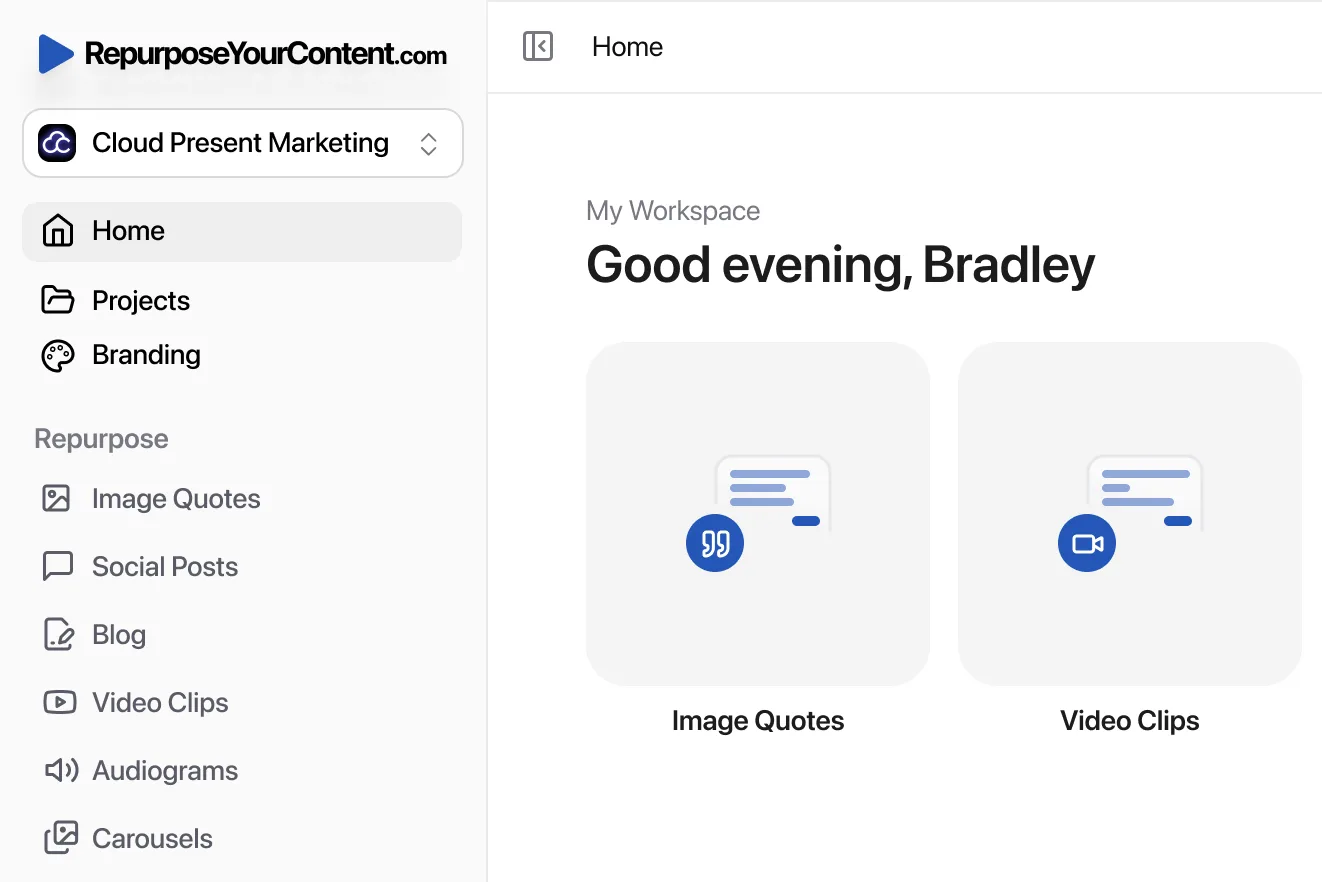
RepurposeYourContent is one done-for-you option. Clients send a recording, and the service returns video clips, LinkedIn posts, quote graphics, carousels, audiograms, and a blog post in the client's brand voice.
The Done-for-You Shortcut for Busy Creators
A done-for-you workflow makes sense when the creator has enough source material but not enough post-production capacity.
The handoff should be short and specific:
- Send one recording: The source can be a podcast, interview, keynote, sales call, livestream, course session, or meeting recording.
- Mark priorities: Identify must-use moments, sensitive sections, preferred topics, and clips that need special treatment.
- Confirm the brand: Provide brand colors, fonts, examples, audience details, and any publishing preferences.
- Review one delivery: Leave notes using asset names and timestamps instead of sending scattered messages.
- Approve and schedule: Move finished assets into the content calendar with the accompanying posting playbook.
The creator's time is about 15 minutes. The delivery includes 20 to 30 ready-to-publish assets within 72 hours, including video clips, LinkedIn posts, quote graphics, carousels, audiograms, and a blog post. The service includes unlimited revisions, according to the supplied business information.
Pricing starts at $14 per finished asset, also from the supplied business information. That price needs to be compared with the creator's post-recording workload, not just the recording length.
| Factor | DIY Batching | Done-for-You |
|---|---|---|
| Client time | Roughly 7 to 12 hours for post-production work | About 15 minutes |
| Source | One long-form recording | One long-form recording |
| Deliverables | Depends on the creator's capacity | 20 to 30 finished assets |
| Formats | Clips, posts, graphics, and articles require separate production | Clips, posts, graphics, carousels, audiograms, and a blog post |
| Revision process | Creator manages every correction | Batch review with unlimited revisions |
| Delivery promise | Depends on the creator's schedule | 72-hour turnaround guarantee, or the client doesn't pay |
| Price basis | Time and subscriptions | From $14 per finished asset |
This model suits coaches, podcasters, founders, speakers, and personal brands publishing several pieces each week. DIY still makes sense for early-stage creators testing an offer or developing a distinctive editorial style.
A sensible next step is to book a call and request a sample batch from an existing recording. Send one 45-minute episode, interview, keynote, or sales conversation, then judge the finished assets against the creator's voice, audience, and publishing standards.
Book a call with RepurposeYourContent or request a sample batch today. Send one existing recording and see what it becomes before committing to a larger content workflow.
Tags: