Creator Content Repurposing Workflow That Actually Works
Stop the content treadmill. Learn a creator content repurposing workflow to turn 1 weekly recording into 30+ posts in 3-5 hours—or let us do it for you.

A creator content repurposing workflow is a system that turns one long-form piece of content, like a podcast or livestream, into 10 to 15 smaller assets for daily social media posts. A sustainable DIY workflow takes 3 to 5 hours per week, while a done-for-you service reduces that time to about 15 minutes.
Most creators aren't exhausted by recording. They're exhausted by everything that happens after recording. The clipping, captioning, rewriting, designing, scheduling, and second-guessing create the main drag.
That's the part that breaks consistency. Not creativity. A strong creator content repurposing workflow fixes that by separating the work only the creator can do from the work that can be systemized, batched, or outsourced.
You Create Content You Burn Out on Post-Production
The treadmill usually looks like this. A creator records a solid podcast, interview, vlog, or livestream. Then the recording sits there because turning it into a week of content feels like another job.
That isn't a motivation problem. It's a workflow problem.
About 94% of marketers actively repurpose content to get more value from what they already create, which means solo creators without a scalable process are competing with a fraction of their potential output, according to this content repurposing analysis. Professional teams already know the rule. One recording should not produce one post.
Practical rule: creators rarely burn out from the act of creating. They burn out from the repetitive post-production work that follows.
A podcast episode can fuel clips, LinkedIn posts, quote graphics, carousels, audiograms, and a blog post. But without a repeatable system, every asset feels like starting over. That's why daily posting feels heavy. The burden isn't publishing. It's making fresh assets from scratch every day.
Why the daily-posting model fails
Daily-first creation asks a creator to do too many context switches.
- New idea selection: decide what to post today
- Format choice: decide whether it should be video, text, graphic, or carousel
- Production work: write, edit, design, and polish each item separately
- Distribution work: schedule, publish, and adapt for each channel
That model rewards people with teams. It punishes solo operators.
A better system starts with one weekly anchor. Then it runs one extraction session. Then it spreads the output across the week. The creator does the thinking once. The workflow multiplies it.
What changes when the system is in place
A creator stops asking, “What should be posted today?”
The better question is, “What should be extracted from this week's recording?”
That shift changes everything. Instead of living in constant production mode, the creator works in cycles. Record once. Extract in batch. Publish daily from that inventory.
That's the win. More consistency with less mental load.
The Anchor Content System Explained
The anchor content system works because it matches how creators think. Big ideas usually come out in conversation, teaching, storytelling, or explanation. Not in isolated one-off posts.
An anchor is the long-form source asset. It might be a podcast episode, sales call recap, interview, keynote, livestream, course lesson, or founder rant recorded on camera. That one piece becomes the source for the next week of distribution.
For a clean definition of the term, this anchor content glossary entry is useful.

One anchor replaces seven daily decisions
The anchor model removes the worst part of content production. Daily reinvention.
Instead of making seven unrelated posts, the creator makes one strong recording with enough substance to split into multiple formats. That creates message consistency as well. The same core idea appears in different forms, which is exactly what an audience needs.
A high-yield repurposing process typically follows five phases: planning, creation with repurposing in mind, transformation through templates, distribution, and performance analysis, according to this expert workflow breakdown.
What an anchor should contain
Not every recording is equally repurposable. Good anchor content has structure.
The easiest recordings to extract from usually include:
- Clear sections so key ideas are easy to isolate
- Strong opinions that can stand alone as clips or text posts
- Examples and stories that become posts, quotes, and carousels
- Repeatable language that supports brand consistency
- One central theme so the week's content doesn't feel scattered
A creator who records with repurposing in mind spends less time searching for content later.
A rambling recording creates editing debt. A structured recording creates assets.
The weekly shape of the system
The simplest version looks like this:
- Record one anchor: one podcast, vlog, interview, or livestream
- Extract in one batch: pull clips, posts, quotes, and carousel ideas
- Distribute across the week: post from the batch instead of creating from zero
That's the entire operating model. It isn't fancy, but it works.
For a wider view of how one source can branch into many outputs, this guide on turning one piece of content into many formats lays out the expansion clearly.
Your Weekly Creator Content Repurposing Workflow
Without automation, manual repurposing takes 8 to 15 hours of editor time per hour of source content. With templates and batching, a solo creator can usually reduce that to a 3 to 5 hour weekly sprint, based on this workflow guide.
That 3 to 5 hour number is realistic only once the system is practiced. Early on, DIY usually runs longer. That's normal. Every missing template and every undecided style choice adds friction.
Here's the practical weekly flow.

Step 1 Record the weekly anchor
Record one long-form asset. Podcast. Interview. Livestream. Solo talking-head video. Sales breakdown. Client lesson.
A useful target is one recording that has enough substance to support a week of publishing. The anchor should answer one important problem clearly, not chase five topics badly.
Typical DIY time budget for the anchor itself can be kept tight if the creator works from a simple outline and records in one take.
Step 2 Work from the transcript first
The biggest time saver is transcript-first selection.
Reviewing text is faster than scrubbing video. A transcript makes it easier to mark tension points, quotable lines, objections, story beats, and clean clip starts. Using this information, the creator determines which segments merit extraction.
For a solo workflow, this review phase usually looks like:
- Transcription and review: about 30 minutes
- Moment selection: about 45 to 60 minutes
That part sounds small. It isn't. This stage decides quality. Weak selection leads to generic assets later.
Editorial rule: if a moment doesn't work as text on a transcript, it usually won't become a strong clip either.
A useful supporting resource is this content repurposing workflow diagram template.
Step 3 Cut clips in a batch
At this stage, most creators lose the week.
Cutting short-form video isn't just trimming timestamps. It includes selecting the start and end, tightening pauses, formatting for platform dimensions, adding captions, and checking whether the clip still makes sense without the full conversation.
Typical DIY timing per recording:
| Task | Realistic manual time |
|---|---|
| Clip selection review | 45 to 60 minutes |
| Clip editing and captions | 2 to 3 hours |
| Caption style cleanup | folded into editing pass |
For most creators, clip editing is the heaviest part of the workflow. It's repetitive, detail-heavy, and hard to rush without quality loss.
A practical benchmark from a real service workflow is to cut 8 to 12 clips, then caption them in brand style. That gives enough inventory for a week without flooding the audience.
A quick visual walkthrough helps here:
Step 4 Write the text assets
Once the transcript has been mined, the text posts get easier. The ideas already exist. The writing task becomes adaptation, not invention.
A practical extraction sprint per recording often includes:
- 6 to 8 social posts
- 4 to 6 image quotes
- 1 to 3 carousels
- 1 blog draft
Typical manual writing time:
- Posts and quotes: about 1 hour
- Blog post draft: about 1 to 2 hours
That means a realistic DIY total per 60-minute recording lands around 4 to 6 hours for many creators. That aligns with the lived reality of doing the work manually, even with a decent process.
Step 5 Schedule the week in one sitting
Scheduling should happen after everything is extracted. Not between creative steps.
A simple weekly pattern works well:
- Early week: strongest clip or opinion post
- Midweek: carousel or teaching post
- Late week: quote, follow-up clip, or blog push
That keeps the message coherent without repeating the same format daily. Teams that need a stricter publishing cadence can pair this with a social media content batching workflow.
Essential Templates to Accelerate Your Workflow
The weekly sprint only works if decisions have already been made.
That's what templates do. They remove repeat choices. A creator who builds from scratch every week won't stay inside a 3 to 5 hour workflow for long.
Build one brand kit and stick to it
Brand consistency isn't an editing talent. It's a system property.
A practical brand kit should define:
- Logo use: where it appears and where it doesn't
- Colors and fonts: fixed choices for graphics and carousels
- Caption style: subtitle look, placement, and pacing
- Tone rules: short list of words, phrases, and style boundaries
- Sample posts: examples that show what good output sounds like
Once those rules exist, every asset can be checked against them. That removes a surprising amount of weekly hesitation.
Good templates don't make content generic. They protect quality while speeding up production.
Create format templates for the recurring asset types
A useful DIY system usually needs only a few repeatable layouts.
For example:
- Quote graphics: two or three approved visual layouts
- Carousels: one teaching structure, one mistake-based structure, one opinion-led structure
- Short-form captions: one preset with brand font, color, and placement
- LinkedIn posts: opening hook template, insight body, and one closing action line
- Blog draft structure: intro, key points, examples, and closing CTA framework
The goal isn't variety for its own sake. It's speed with consistency.
Use a standing checklist
Weekly discipline matters more than motivation. A checklist keeps the process from slipping.
A simple recurring checklist can include ingesting the recording, transcribing it, marking moments, cutting clips, drafting posts, creating quotes, building carousels, drafting the blog, running human QA, and preparing the posting notes.
That sequence also fits nicely into an editorial calendar. For creators who need a planning layer on top, this editorial calendar template for marketing teams can be adapted for a solo workflow.
The Burnout Math When to Outsource Your Workflow
At some point, DIY stops being scrappy and starts being expensive.
That decision point has less to do with budget than people think. It has more to do with what the creator's time is worth and what those post-production hours are preventing.
For B2B teams, 73% of marketers identify recordings as their primary source of quality leads, yet only one in three teams have a scalable method to turn those recordings into usable content. That gap matters because the recording already contains the expertise. The bottleneck is processing it.

The simple outsourcing test
The math is straightforward.
If a creator spends 3 to 5 hours each week on repurposing, those are hours not spent on sales, client delivery, product work, partnerships, or recording the next anchor. If the value of those hours is higher than the cost of outsourcing, DIY is the expensive option.
That doesn't make outsourcing a luxury. It makes it a time allocation decision.
A valuable perspective on this is:
| Question | Why it matters |
|---|---|
| What is one hour of the creator's best work worth? | This defines the real internal cost of DIY |
| How many hours disappear into post-production each week? | This reveals recurring time drain |
| What higher-value work gets delayed? | This shows opportunity cost |
| What does finished content cost externally? | This makes comparison practical |
Why creators misprice their own time
Many creators only count cash out. They don't count hours lost.
But the post-production grind isn't neutral. It carries a real business cost. It also carries a creative cost. The creator spends energy on clipping and formatting instead of talking to customers, refining the offer, or producing another strong recording.
Outsourcing starts making sense when the creator is no longer the cheapest qualified person to do the work.
That threshold arrives earlier than commonly expected.
A useful comparison on the service side is outsourced content repurposing, especially for tiny teams that need output but can't justify separate hires for editing, design, writing, and QA.
What does not scale
Three things usually break first in a DIY workflow:
- Editing stamina: the creator runs out of patience for clip cleanup
- Publishing consistency: batches get delayed and the content calendar empties
- Quality control: rushed assets drift from voice and brand
That's when content starts feeling heavy again. Not because the system is wrong. Because the creator is still doing every job inside it.
The Done-for-You Alternative
There's a point where the cleanest workflow is simple. The creator records. Someone else handles the post-production stack.
That's the done-for-you model.
Send one recording. That can be a podcast, webinar, keynote, interview, meeting recording, or livestream. The service team handles the extraction, editing, writing, design, QA, and delivery.

What the delivery looks like
A practical end-to-end checklist per recording looks like this:
- Ingest the recording
- Transcribe it
- Mark clip-worthy moments editorially
- Cut 8 to 12 clips and caption them in brand style
- Write 6 to 8 social posts and 4 to 6 image quotes
- Design 1 to 3 carousels
- Draft the SEO blog post
- Run human QA against the brand kit
- Deliver with a posting playbook
- Revise until approved
That output is concrete. It doesn't ask the creator to “finish” anything after delivery. The assets are ready to publish.
The time trade-off is the real product
For the creator, the workflow drops to about 15 minutes. That usually means a few minutes to send the recording and a short review pass once the assets arrive.
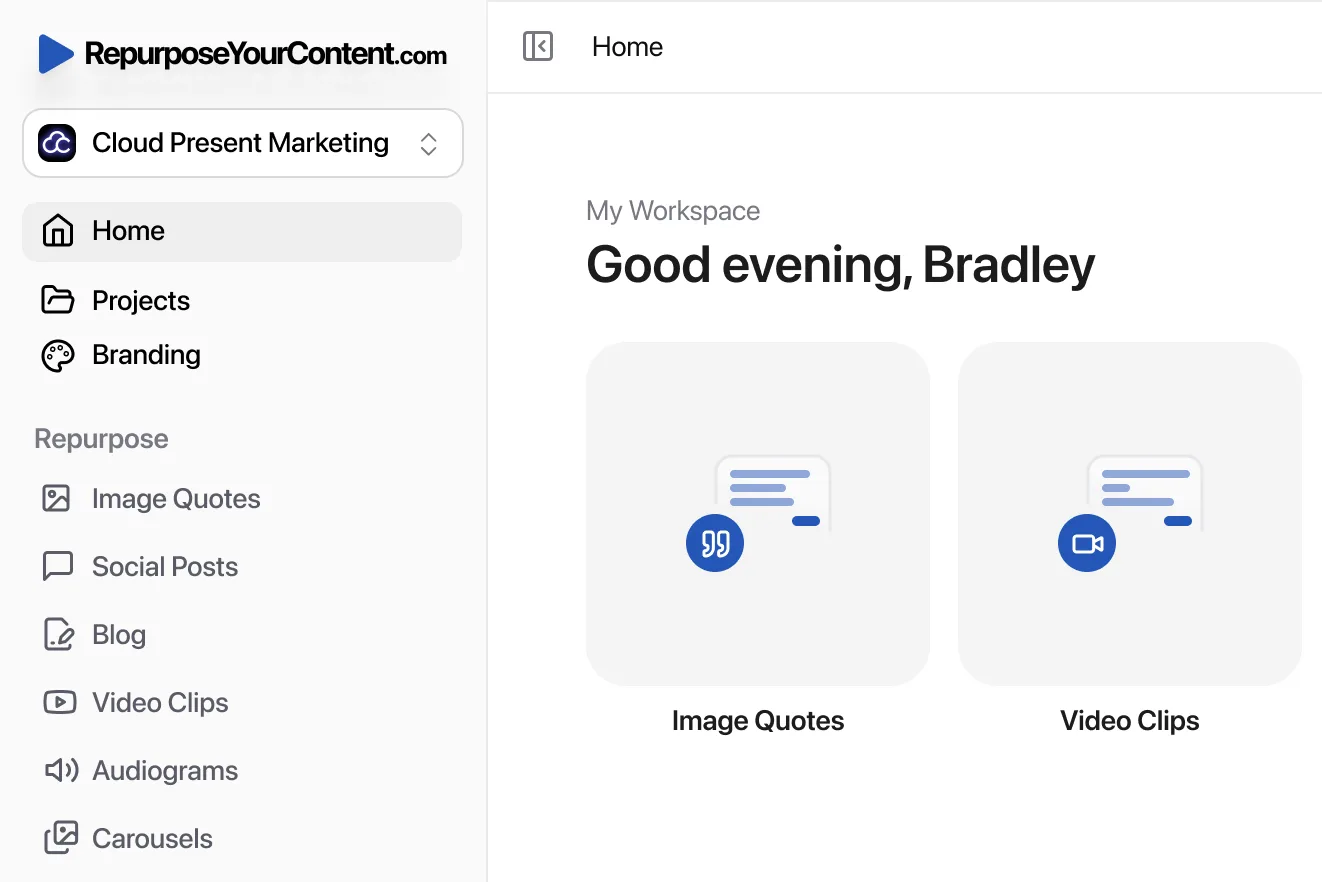
The service-side promise can be even tighter: 20 to 30 ready-to-publish assets in 72 hours, including video clips, LinkedIn posts, quote graphics, carousels, audiograms, and a blog post, all in brand voice, with unlimited revisions. Some offers also include a 72-hour turnaround guarantee or the client doesn't pay, plus pricing that starts from $14 per finished asset. One 45-minute recording becomes 30 assets.
That's a very different operating model from DIY.
Creators comparing options should also look at how this fits a broader team workflow. This guide on content repurposing workflow for small teams is useful for that transition, and the service format itself is explained on RepurposeYourContent content repurposing services.
Stop Grinding Start Creating
There are only two durable options.
Build a disciplined creator content repurposing workflow and protect a weekly 3 to 5 hour extraction sprint. Or remove that work from the creator's plate and buy the time back.
What doesn't work is staying stuck in the middle. Recording valuable content, then letting it die because post-production keeps slipping to tomorrow.
The anchor-and-extract model solves the core problem. It keeps the creator focused on the work that specifically requires them. The talking. The teaching. The perspective. The original thinking.
Everything after that is process.
If the DIY system still feels heavy, the math has already answered the question. When post-production costs more in lost time than a done-for-you service costs in cash, doing it alone isn't the cheaper choice.
If the goal is to turn one recording into 20 to 30 ready-to-publish assets in 72 hours, with about 15 minutes of client time, book a call with RepurposeYourContent or request a sample to see what the finished assets look like before making a decision.
Tags: