Cheapest Video Repurposing Tools 2026: A Full Review
Your guide to the cheapest video repurposing tools 2026. Compare free, freemium, and budget options to find the best value for your time and money.

Marketers do not lose money on software first. They lose it on manual work.
That is the right way to judge the cheapest video repurposing tools 2026. A free or low-cost tool looks efficient until someone on your team spends hours trimming footage, fixing captions, resizing clips, writing LinkedIn posts, drafting follow-up emails, and exporting assets one by one. The monthly fee stays low. The labour cost does not.
For B2B teams, the fundamental calculation is simple. Add the tool cost to the hours needed to turn one webinar or podcast into usable campaign assets. Then multiply those hours by the value of the marketer doing the work. If a paid tool saves enough time to publish faster and remove repetitive tasks, it is the cheaper option.
Use that logic throughout this guide. If a platform saves five hours a month and your team values that time above the subscription fee, the ROI is already positive. If it still leaves half the workflow manual, the low price is misleading.
If you want a wider view of the best content repurposing tools for 2026, compare them by output per hour, not by headline price alone.
This list focuses on budget-friendly video repurposing tools, but the point is sharper than “find the lowest fee”. Find the tool that cuts production time enough to justify itself quickly. Free can be expensive. Automation often costs less.
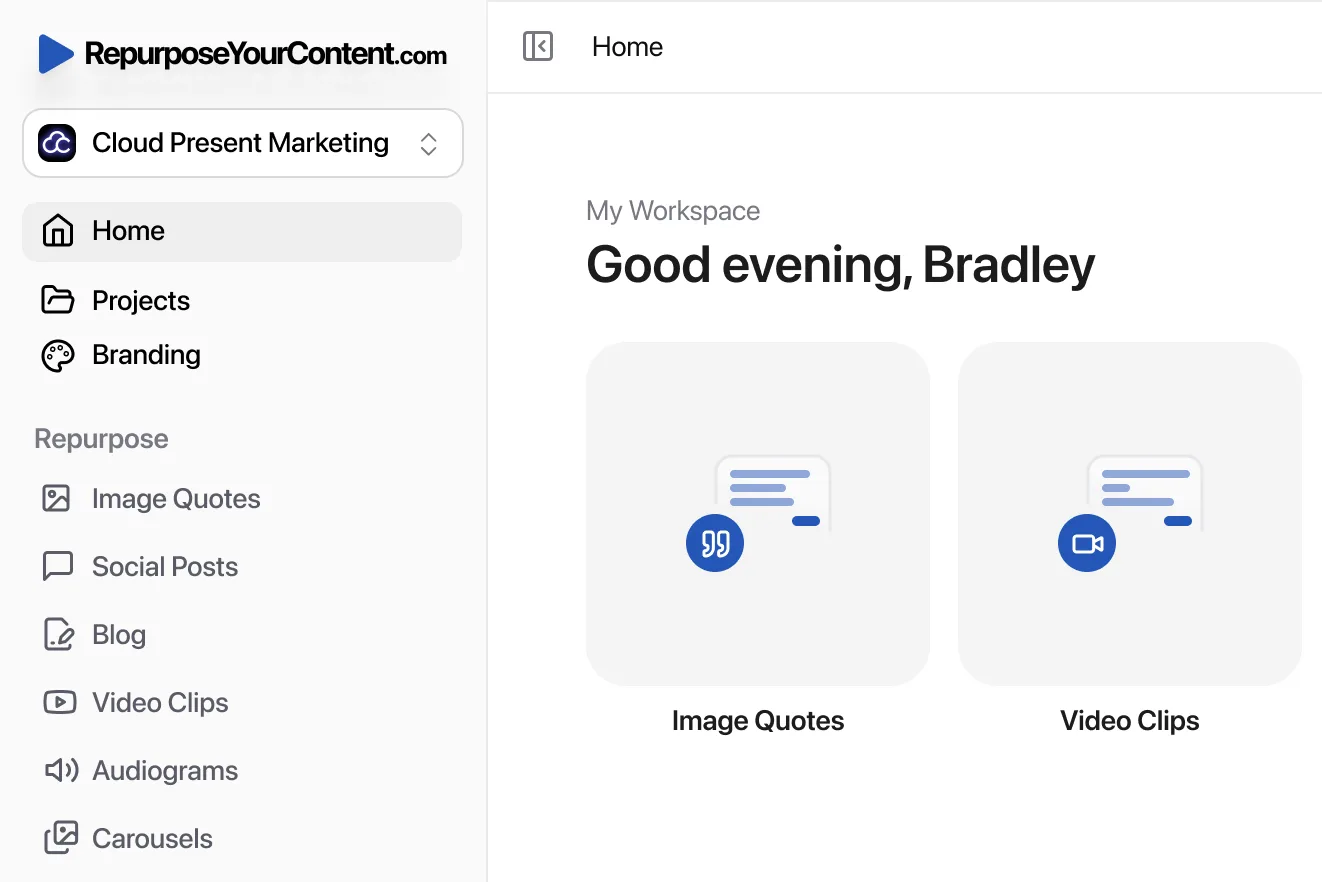
1. RepurposeYourContent

RepurposeYourContent earns its place here for one reason. It cuts labour across the whole post-webinar workflow, not just the editing step.
The starting price is $99 per month, so it is not the cheapest invoice on this list. For B2B teams publishing from webinars every month, it is often the lowest total cost. One recording can become short clips, a blog draft, social posts, audiograms, image quotes, newsletters, LinkedIn carousels, and timestamps from a single workflow.
That matters because clip-only tools leave expensive work behind. A marketer still has to write the post copy, pull quotes, draft the follow-up email, and turn the webinar into something the sales or demand gen team can use. Free and low-cost tools often win on price and lose on hours.
Why the maths works
Use a simple test. Compare the monthly fee against the hours your team would spend doing the same work manually.
If RepurposeYourContent saves four to six hours per webinar and your team runs even a modest webinar programme, the subscription can pay for itself quickly. The exact break-even point depends on your internal hourly cost, but the logic is straightforward. Time saved is part of the software price.
That makes it a stronger buy for agencies, solo consultants, and small in-house teams than many cheaper clippers.
What you actually get
RepurposeYourContent stands out because the output is wider than basic short-form editing.
- Video clips for social distribution
- Blog drafts for SEO and post-event traffic
- Social posts for LinkedIn and other channels
- Audiograms for audio-led promotion
- Image quotes for quick visual assets
- LinkedIn carousels for B2B engagement
- Newsletters for attendee and non-attendee follow-up
- Timestamps for faster review and better usability
That range changes the ROI calculation. Buying one tool to cover multiple outputs is usually cheaper than stitching together a clipper, a writing assistant, a design tool, and manual review time.
Best fit
RepurposeYourContent suits B2B marketers who treat webinars as a repeatable content source, not a one-off event. It is a strong choice if your team needs to publish fast after a session ends and cannot spare half a day rebuilding the same webinar into five different formats.
For a broader comparison, see this guide to the best content repurposing tools for 2026. If you need to defend the spend internally, pair your time-saved estimate with Cometly ad performance insights and show what faster post-webinar distribution is worth in pipeline terms.
2. ROI Calculator Is a Paid Tool Worth It

Half a day on one webinar repurposing job can wipe out the savings from a cheap plan for the entire month. That is the real calculation. Plan price matters less than the cost of skilled marketers doing manual clipping, rewriting, formatting, and review.
For webinar-led B2B teams, speed after the event affects reach, follow-up, and pipeline value. A slow free workflow often looks cheap in procurement and expensive in practice.
Use a basic ROI sheet. Keep it blunt.
- Tool cost per month
- Hours spent per webinar
- Internal hourly cost
- Number of webinars per month
- Total monthly labour cost
- Estimated hours saved with automation
- Payback point in webinars per month
Here is the decision rule. If a paid tool saves enough team time to cover its monthly fee, buy it. If it does not, keep the manual process or choose a cheaper option.
A simple example makes the point. If your team spends 4 hours repurposing each webinar and your blended internal cost is £40 per hour, that is £160 in labour per webinar before software. Run four webinars a month and the manual cost is £640. A paid tool at £99 that cuts the work in half is already cheaper than the free stack.
This is also why all-in-one webinar workflows tend to win the time versus money test. A tool that clips, drafts, and packages follow-up assets in one place removes handoffs and review cycles. If you are comparing options for that workflow, this webinar repurposing tool guide is a useful reference.
For internal buy-in, connect time saved to revenue impact. Pair your spreadsheet with Cometly ad performance insights and show what faster post-webinar distribution is worth in campaign terms.
3. OpusClip
OpusClip saves money only if your job ends at short clips. If your team also needs copy, campaign assets, and approval-ready outputs, the low monthly price stops looking cheap fast.
The tool is built for speed. Upload a webinar, podcast, or interview, and it pulls highlight moments, reframes for vertical channels, and adds captions without much manual work. That makes it a practical fit for solo marketers, consultants, and small agencies pushing out social clips on a tight budget.
For B2B teams, the primary concern is labour cost. If OpusClip cuts two hours of manual clipping per webinar and your internal cost is £40 per hour, that is £80 saved per session. At that point, paying for automation is easy to justify. If someone still has to write the post copy, email follow-up, and campaign wrap-up elsewhere, your total workflow cost stays higher than the sticker price suggests.
Where OpusClip is cheap and where it isn’t
OpusClip works best as a clip-first tool. It does one job well. It does not replace a broader repurposing workflow.
Use it if your output is mostly short-form video and your team already has the rest of the content process covered. Skip it if you need one tool to turn long-form video into clips plus written assets for B2B distribution.
- Best for turning webinars, podcasts, and interviews into short clips fast
- Strong point good clipping speed and captioning for the price
- Watch for credit usage, export limits, and the extra team time needed outside the editor
If you are weighing up clip-first options, this comparison of AI video clipping tools for 2026 is a useful side-by-side. The pricing page is OpusClip.
4. Klap

Klap is for teams that want a simple clip factory. It takes long videos, finds social-friendly moments, and reformats them for vertical output without much setup.
That simplicity is the product. There’s no broad content engine here. No blog drafts. No email copy. No carousel generation. Just clips.
Best use case
Klap fits a small agency producing recurring short-form assets from webinars or YouTube uploads. It also suits founders repurposing thought-leadership videos into social posts, provided those posts are written elsewhere.
Its transparent usage limits are helpful. That makes it easier to budget than some credit-heavy products. But teams will feel the cap quickly if they run frequent events.
Cheap tools with narrow scope work best when the rest of the workflow is already solved somewhere else.
The product page is Klap pricing.
5. Vizard
Vizard sits in the practical middle. It’s built around turning long-form video into shorter clips, and it gives enough free usage to test a workflow before committing.
That’s useful for small teams under pressure. Testing matters because not every webinar or panel discussion clips well automatically. Some content needs stronger speaker changes, tighter answers, or clearer hooks.
Where Vizard makes sense
Vizard works for teams that want an AI-first clipping workflow with a bit more room to grow than a barebones editor. Paid plans add scheduling and higher quality export, which reduces friction once a team is publishing regularly.
The downside is the credit model. A minute-based system can feel cheap at first, then become hard to forecast if the team starts processing longer recordings every week.
- Good fit for testing clip workflows on a budget
- Good enough for small recurring content programmes
- Less ideal for teams that need predictable monthly usage
The product site is Vizard pricing.
6. ContentFries

ContentFries stands out because it goes beyond clips. It can also produce supporting assets like blog drafts, quote images, and thumbnails. That gives it a broader value story than many cheap clipping tools.
For teams that can’t justify a bigger all-in-one platform, that matters. It reduces the need to bolt together extra design and writing steps.
Where the value shows up
ContentFries is strongest for ad hoc repurposing. A small agency can process a client webinar, pull out short clips, then grab visual and written starter assets from the same source. The pay-as-you-go model also helps teams with uneven publishing schedules.
The trade-off is control. Specialist clippers can offer finer tuning, and broader B2B repurposing tools can go further on messaging and follow-up content. Still, for mixed output on a tight budget, it earns a place on the shortlist.
The product site is ContentFries pricing.
7. Kapwing

Kapwing is less “AI repurposing engine” and more “budget online editing workspace”. That’s a good thing for some teams. It gives a browser-based editor, auto-subtitles, translation, and enough repurposing support to handle practical content work without specialist software.
For small agencies, predictable pricing is the draw. It doesn’t try to pretend everything is one-click magic. It gives teams a flexible workspace instead.
When Kapwing is the right cheap option
Kapwing is a good fit when the team still wants hands-on control. It works well for marketers who already know what clips they want and need a fast browser tool to package them for publishing.
It becomes less attractive when the job includes heavy volume and lots of repetitive outputs. In those cases, manual editing time starts to stack up.
A strong companion read is how to repurpose long-form video into short clips. The platform itself is Kapwing pricing.
8. Pictory

Pictory suits teams that put a real cost on editing hours. It covers clip extraction, transcript-based editing, and script-to-video in one tool, so the value is not just the subscription fee. It is the time saved from not jumping between separate apps for clipping, captions, and simple content conversion.
That matters for B2B marketers working from webinars, interviews, and thought leadership videos. If a marketer costs the business meaningful hourly time, a cheaper tool stops being cheap once manual edits pile up.
Where Pictory earns its price
Pictory is a sensible buy when the team needs more than short-form clipping. It works well for turning transcripts, scripts, or blog content into usable video drafts, and that broadens the ROI case. One subscription can replace part of the work that would otherwise sit with an editor or content marketer.
The trade-off is speed. Pictory can feel slower and less focused than tools built purely for rapid short clips, so high-volume social teams may still find the workflow heavier than they want. If your main job is pumping out lots of shorts from long recordings, calculate the time per finished asset, not just the monthly plan price.
A simple rule helps here. If automation saves even a few hours each month, paying for it is usually cheaper than asking a marketer to do repetitive editing by hand. Teams comparing editing-first platforms should also read this guide to AI video editing tools for marketers. The platform is Pictory pricing.
9. VEED

VEED is one of the safer choices for UK teams that want an all-purpose online editor with repurposing features. It does clipping, subtitles, translation, brand kit work, hosting, and share pages in one product.
That range is useful for lean teams. One tool can cover editing and lightweight publishing support without adding a bigger stack.
Where VEED helps and where it slips
VEED is good for teams that need editing flexibility first and repurposing second. It’s also useful when local support considerations matter and the team wants a familiar browser-based interface.
It’s less convincing when buyers want clear AI output limits and predictable all-in pricing. Some features vary by tier or sit behind add-ons, so the “cheap” label depends on the exact workflow.
For teams weighing editing-first tools, this round-up of AI video editing tools for marketers is useful. VEED’s site is VEED pricing.
10. Microsoft Clipchamp

Clipchamp is the obvious low-cost pick for teams already inside Microsoft 365. It handles screen recording, webcam capture, templates, subtitles, and straightforward editing without much training.
That makes it practical for internal marketing teams and solo operators who don’t want another subscription if their software stack is already tied to Microsoft.
Best fit
Clipchamp is best for basic repurposing and straightforward editing. It won’t replace a dedicated AI repurposing platform, but it can handle short clips, captioned snippets, and simple social-ready edits well enough.
Its value depends heavily on the existing Microsoft setup. If premium features are already bundled, the effective cost is low. If not, there may be better specialist options for the same budget.
The platform site is Microsoft Clipchamp pricing.
11. CapCut
CapCut is the first stop for marketers who want to spend nothing upfront. For basic clipping, captions, templates, and vertical reframing, it’s hard to beat as a starting point.
That said, starting point is the key phrase. CapCut is cheap software. It isn’t always cheap labour.
Why free often stops being cheap
CapCut works best when one person wants to make a few clips quickly. It works less well as a repeatable B2B workflow for webinars, regional campaigns, or compliance-sensitive content.
One under-discussed issue with cheap tools is localisation. Existing comparisons often miss output quality variation by region, compliance needs, and the extra editing required for UK B2B teams. Some cheap tools can produce generic, US-oriented content that then needs substantial regional editing, according to analysis of output quality gaps in repurposing tools. That extra clean-up can erase the savings fast.
- Use CapCut for testing, basic clips, and one-off content
- Avoid relying on it alone for full webinar repurposing
- Expect manual work on messaging, quality control, and non-video assets
The product site is CapCut pricing details.
Cheapest Video Repurposing Tools 2026: 11-Tool Comparison
| Product | Core outputs | Speed / workflow | Target users | Pricing & model | Unique selling point |
|---|---|---|---|---|---|
| RepurposeYourContent | 8 formats (clips, blog posts, social, carousels, emails, audiograms, podcasts, quote images) | Upload or paste link → pick formats & quantities → generate; ~5 min typical | B2B marketing teams, demand gen, agencies, content teams | Credit-based; plans from $99/mo, free Basic & 7‑day trial, enterprise options | Built for B2B webinars, platform-agnostic, auto-applies full brand kit across all outputs |
| ROI Calculator: Is a Paid Tool Worth It? | ROI infographic, break-even math | N/A (guide/infographic) | Decision-makers evaluating paid tools | Free infographic/resource | Simple ROI formula to compare tool cost vs. labor time saved |
| OpusClip | Short-form clips, auto captions, reframe | Auto-clip + Virality Score, quick exports | Solo creators, social teams, SMBs | Free tier (watermark), paid plans with scheduler & templates | Virality Score, strong auto-clipping quality for price |
| Klap | Vertical clips, dynamic captions, dubbing | Auto-clipping & reframing to vertical | YouTube creators, agencies on budget | Low-cost plans, transparent upload/clip limits, Pro for dubbing/API | Clear limits & competitive yearly pricing; 4K export & AI dubbing on Pro |
| Vizard | AI clips, auto-captions, social scheduling | Credit-based (minutes → credits), quick clip workflows | Small teams, social managers testing workflows | Minute-to-credit model, 60 free monthly credits | Generous free credits, built-in scheduling and team features |
| ContentFries | Clips + blog drafts, quote images, thumbnails | Auto-highlight → multi-format outputs | Small teams, freelancers, agencies | Pay-as-you-go credits or subscriptions | Multi-format beyond video at budget-friendly pricing |
| Kapwing | Editor + auto-subtitles, translation, brand kit | Link import, subtitle & edit tools, team workspace | Teams needing simple editor + repurposing | Predictable subscriptions, credits for AI actions | Browser editor with solid repurposing utilities and team features |
| Pictory | Highlight clips, transcript editing, subtitles | Transcript-based edits, stock assets bundled | Marketers needing transcripts & stock assets | Subscription tiers (higher for avatars/voices) | Reliable transcript editing and included stock libraries |
| VEED | AI Clips, subtitles, translations, hosting | Fast clips, templates, team workspaces | UK teams, agencies, global social teams | Tiered plans with team/enterprise options | UK-based support/compliance, hosting & share pages included |
| Microsoft Clipchamp | Editor with AI subtitles, templates, recording | Web/desktop, auto cleanup, HD exports | Teams using Microsoft 365, beginners | Free HD exports; premium via M365 bundle | Integrates with Microsoft 365; useful free tier without watermark |
| CapCut | Auto captions, reframing, large template library | Rapid edits across web/desktop/mobile | Mass-market creators, social-first teams | Mostly free; Pro varies by region/device | Powerful free tools and huge template ecosystem for Shorts/Reels |
Your Checklist for Choosing the Right Budget Tool
One wasted hour a week costs more than a cheap subscription for many B2B teams. That is the calculation that matters.
Budget tools should be judged on total production cost, not headline price. Monthly fees are visible. Editing time, caption fixes, resizing, rewriting posts, and chasing exports are the true budget killers.
Free and low-cost tools split into two groups. Some remove steps. Others give you a lower bill and more manual work. If a marketer still spends an hour turning one webinar into clips, captions, posts, and follow-up assets, the tool is not cheap. It is labour disguised as savings.
The four checks that matter
Match the tool to the output If you only need short clips, keep it simple. OpusClip, Klap, and Vizard cover that job well enough. If you also need blogs, LinkedIn posts, audiograms, email copy, or carousel assets, clip-only tools create extra work fast.
Put a value on team time Use a basic ROI check. Multiply the hours saved each month by the hourly cost of the person doing the work. Then compare that number with the monthly subscription. A £19 tool that saves four hours of a marketer's time usually beats a free tool that saves none.
Check the limits before you buy Credits, export caps, watermarks, short storage windows, and locked features change the monthly cost. Many cheap plans look good until volume rises. Then the upgrade bill arrives, or your team starts patching the gaps manually.
Choose for B2B output, not creator hype A lot of budget editors are built for social-first creators. B2B teams need cleaner clips, accurate captions, stronger framing, and assets that fit campaigns, not just feeds.
The cheapest tool is the one that cuts paid hours, not the one with the lowest sticker price.
The direct recommendation
Use CapCut if budget is effectively zero and speed matters more than process control.
Use OpusClip if your only goal is turning long videos into short social clips at low cost.
Use ContentFries or Pictory if you need broader content output and can accept some trade-offs in workflow depth.
Use RepurposeYourContent if webinar repurposing is a repeatable channel for your team and you want fewer handoffs, fewer extra tools, and a clearer ROI case for paid automation. That is the point where software starts replacing labour instead of just assisting it.
If you need a quick internal business case, keep it simple. Estimate monthly webinar volume. Estimate hours spent per webinar with your current setup. Estimate hours after automation. Multiply the time saved by your team's hourly cost. If the saving is higher than the subscription, pay for the tool.
Stop choosing on price alone.
Start a free trial with RepurposeYourContent and review plans on the RepurposeYourContent pricing page. For a broader look at automated editing, ClipCreator.ai's guide to AI video is also useful.
Tags: