A Content Atomization Strategy from Webinars That Works
Stop letting webinar recordings die. Learn a practical content atomization strategy from webinars to turn one 45-minute session into 30+ pieces of content.

A webinar often gets one strong day, then disappears into the resource centre.
That's a waste of a high-cost asset. In the UK, webinar software revenue was projected at US$63.63 million in 2025 and forecast to reach US$92.90 million by 2030, with a 7.85% CAGR over that period, according to this webinar market projection and atomization analysis. More webinar tooling means more recorded sessions. More recorded sessions means more trapped value.
A proper content atomization strategy from webinars fixes that. It treats the webinar as raw material, not a finished asset. Instead of publishing a replay and moving on, the team extracts the strongest ideas, turns them into in-feed assets, and runs a structured distribution cycle around them.
This is content operations work. It needs a system.
Your Most Valuable Content Is Gathering Dust
Most webinar programmes have the same failure point. The team plans the event, promotes it, runs it live, follows up with attendees, then drops the full recording into a library. After that, the asset is effectively dormant.
That approach breaks because buyers rarely consume content the way marketing teams package it. A full replay asks for too much time. A short clip, a quote card, a carousel, or a newsletter section asks for far less. The value usually sits inside the webinar, not in the webinar as a single object.
Where the waste actually happens
The waste is rarely in production quality. It sits in extraction.
A typical webinar contains:
- Strong opinions that can become text posts
- Clear explanations that fit carousels
- Sharp one-liners that work as image quotes
- Audience questions that become FAQ content
- Process walkthroughs that belong in blogs or email nurture
When teams ignore those pieces, they force themselves to create fresh content from scratch the next week.
Practical rule: If a webinar is worth hosting, it's worth decomposing.
In the UK, webinars aren't an experimental format. They're part of a mature B2B stack. That matters because atomization only works when there's a steady flow of source material. UK teams already have it. The issue isn't access. The issue is process discipline.
The operational fix
A working atomization programme starts with one assumption. The recording is not the deliverable. The recording is the source file.
That changes planning immediately. The team stops asking, “How did the webinar perform?” and starts asking, “How many usable assets came out of it, how quickly, and where did they go?”
A useful starting point is to review how to get more value from webinars and then formalise a repeatable extraction workflow. Without that workflow, atomization turns into ad hoc clipping. With it, one webinar feeds content, lead nurture, social publishing, and follow-up assets for weeks.
A True Content Atomization Strategy from Webinars
Repurposing and atomization get treated as the same thing. They aren't.
Repurposing usually means format conversion. A webinar becomes a blog post. A blog post becomes a social caption. That's useful, but it's still linear.
Atomization is different. It breaks the webinar into the smallest units of value, then rebuilds those units as native assets for each channel. The unit might be a sharp claim, a memorable answer, a framework step, or a useful contrast.
What the atomic unit looks like
The atomic unit is the smallest standalone idea that still delivers value without the full webinar around it.
That unit might be:
- A single insight with a clear business implication
- A Q&A exchange that resolves a known buyer objection
- A short process that can be taught in slides
- A quote that carries enough context to stand on its own
The older thinking still proves useful. Gary Vaynerchuk's “document, don't create” idea pushed marketers to mine existing material instead of demanding net-new ideas every day. Jay Baer's atomic content model pushed the same logic further by treating content as modular.
The practical translation for B2B teams is simple. Don't ask how to shrink the webinar. Ask how to identify the value unit inside it, then repeat that unit across formats.
To make the distinction visual, use this model.

Ratios matter because planning changes when volume is expected
Teams that think in one-to-one conversions underproduce. Teams that think in atomization ratios plan differently.
For content operations leaders, a practical working ratio is this: one 45-minute webinar can produce 30 to 50 atomic pieces. That isn't a universal law. It's a planning standard. It forces better sourcing, better tagging, and better distribution design.
A rough hierarchy helps:
- Clips
- Quote cards
- Carousels
- Text posts
- Audiograms
That order isn't about prestige. It's about extraction logic. Clips often hold the clearest proof of expertise. Quote cards package memorable language. Carousels turn explanation into sequence. Text posts extend a single idea. Audiograms work when the spoken delivery carries the value.
A concise definition sits in this content atomization glossary entry. The useful part isn't the label. It's the operating model behind it.
Atomization isn't cutting content into smaller pieces. It's identifying the smallest useful idea, then reproducing it across every channel in the right format.
The Atomization Workflow A Step-by-Step Process
Organizations often fail because they edit first and think later. The workflow has to run in the opposite order. Identify value, tag it, then transform it.
Aprimo's guidance is useful here. It recommends dissecting a pillar asset such as a webinar into discrete elements, then adapting each one so it feels native to the destination channel. That adaptation step is where weaker repurposing workflows usually break, as noted in Aprimo's guide to content atomization.

Step 1 and Step 2 capture the raw material
Start with the recording and transcript. No transcript, no efficient atomization.
Then build a moment map. This is a timestamped record of every usable section in the webinar. The team marks:
- Key takeaways worth clipping
- Strong phrasing worth pulling into graphics
- Repeated themes that suggest a carousel or blog angle
- Audience questions that reveal intent
- Process segments that can stand as educational posts
This is editorial work, not admin work. The team is deciding what deserves another life.
Step 3 and Step 4 create structure
Once the moments are mapped, extract atomic units and tag them. Good tagging keeps the archive usable long after launch.
Useful tags include:
- Topic
- Buyer stage
- Persona
- Format fit
- Channel
- Speaker
- Intent type such as problem, solution, objection, or proof
A webinar archive without tags becomes a video graveyard. A tagged archive becomes a production library.
For teams that need ideation support before recording, these brainstorming techniques for remote agencies are useful because they help shape webinar prompts that later produce cleaner atomic outputs.
Step 5 transforms by hierarchy, not by habit
The asset hierarchy matters. Don't start with the easiest format. Start with the highest-value format.
A practical sequence looks like this:
Pull clips first
Video shows expertise, tone, and confidence. It usually creates the strongest top-of-funnel asset.Turn the same moments into quote cards
If a sentence works aloud and reads cleanly, it can usually become an image quote.Build carousels from process sections
Any webinar segment with a sequence, checklist, or framework should become slides.Write text posts from single claims
One clip can fuel multiple written angles if each post has a different context.Use audiograms for voice-led soundbites
These work best when delivery matters as much as wording.
Step 6 publishes in a sequence
Publishing everything at once kills the value. Assets need spacing, narrative order, and message variation.
A simple manual workflow example:
- Step 1: Run the webinar and export transcript
- Step 2: Create a moment map within the same working day
- Step 3: Tag each atomic unit by topic and buyer stage
- Step 4: Produce clips, quotes, carousels, posts, and audio in that order
- Step 5: Schedule assets across a multi-week calendar
- Step 6: Track which units create response, not just reach
A template helps standardise this process across the team. This content repurposing workflow diagram template is a practical starting point.
The best atomization workflows don't ask editors to invent. They ask them to detect, classify, and adapt.
Your Atomization Engine RepurposeYourContent in Action
Manual atomization works. It also creates bottlenecks fast.
The pain points are predictable. Someone has to watch the recording again. Someone has to pull timestamps. Someone has to cut clips, write captions, draft blog sections, build carousels, format quotes, and package email copy. That's manageable for one webinar. It gets messy across an archive.

Where the tool fits
An atomization engine should sit between the raw webinar file and the editorial calendar. Its job is to reduce repetitive production work without removing editorial judgement.
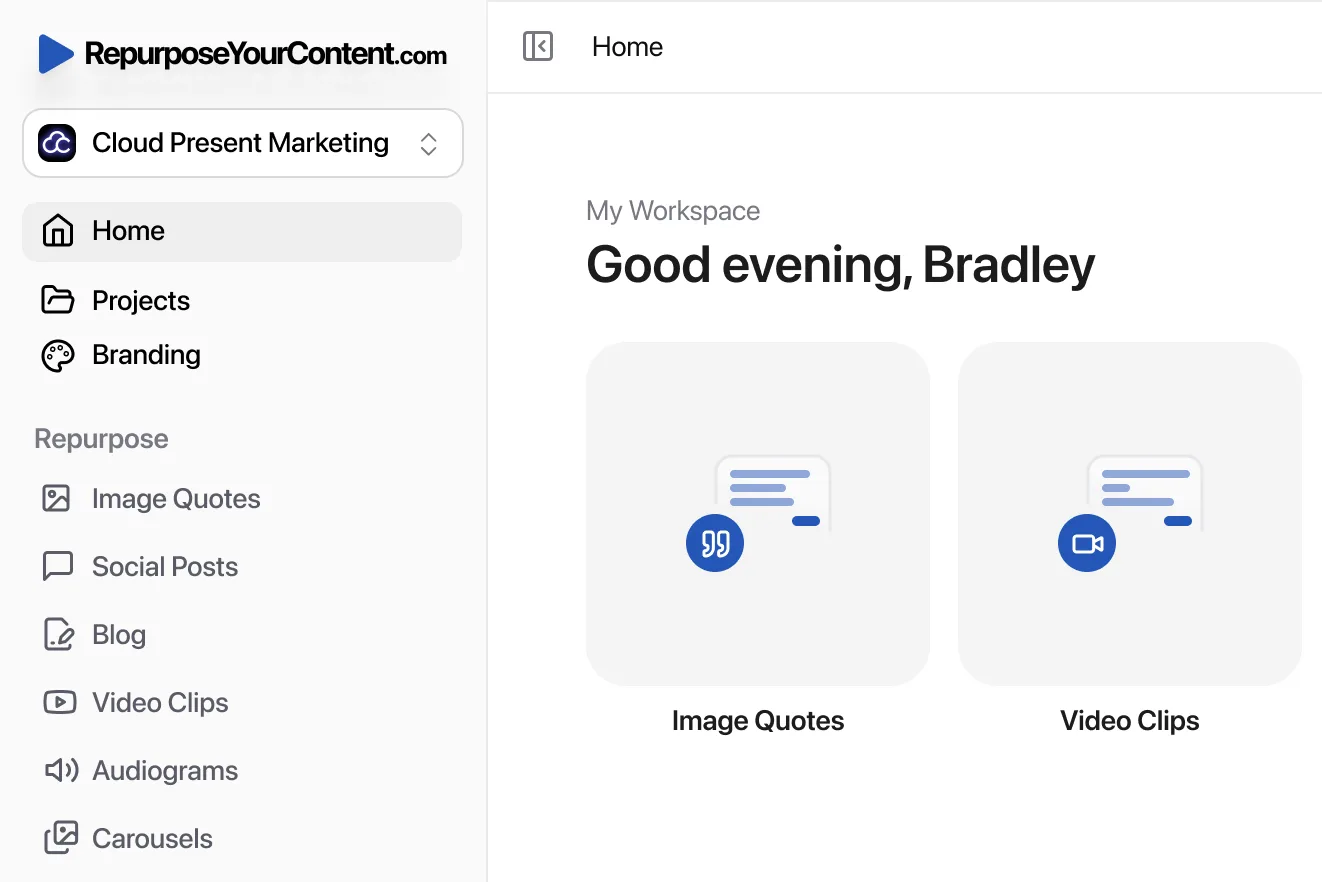
RepurposeYourContent fits that role by taking one webinar recording and generating multiple formats from it, including video clips, blog posts, social posts, audiograms, image quotes, newsletters, LinkedIn carousels, and timestamps. The team uploads a recording, selects output types, chooses how many pieces it wants, and generates platform-ready assets with branding applied.
That matters because content ops leaders usually don't need another editing surface. They need throughput.
What this changes inside the team
The main shift is from production labour to editorial control.
Instead of spending time on repetitive assembly, the team can focus on:
- Choosing what to publish
- Refining the narrative order
- Matching assets to channels
- Checking voice and claims
- Prioritising the strongest moments
That's the right split. Automation should handle extraction and formatting. Humans should handle judgement.
For teams building a multiplication programme rather than a one-off campaign, this is the bigger model to aim for:
- Source asset in
- Atomic units identified
- Formats generated
- Distribution queued
- Archive retained for reuse
The broader system is easier to understand through the content multiplication framework. The point isn't volume for its own sake. The point is to create a repeatable machine that turns webinar archives into a steady content supply.
Building Your 30-Day Atomic Content Calendar
Asset creation isn't enough. Without sequencing, atomization turns into a pile of disconnected outputs.
A hub-and-spoke model fixes that. Bluetext recommends using the webinar as the hub and aligning derivative assets to the buyer journey, then staggering releases to sustain engagement, as outlined in Bluetext's content atomization playbook.

A simple monthly rollout
The hub is the full webinar and its recap blog. Every other asset exists to pull attention back to those anchors or deepen one idea from them.
A practical cadence:
Week 1 launch and proof
Publish the webinar replay and the main blog recap. Then push the strongest clip first. The goal is to establish authority and remind non-attendees that the session exists.
Use:
- One flagship clip with a strong opening line
- One text post built around the biggest claim
- One newsletter section summarising the webinar's main takeaway
Week 2 explanation and depth
This is where carousels and blog excerpts do their work. The team should focus on explanation, not announcement.
Use:
- A LinkedIn carousel built from the clearest framework in the session
- A blog excerpt post that links back to the hub
- An email follow-up focused on one practical lesson
Week 3 objections and audience questions
By this point, basic awareness has already been created. Now the team should publish assets that answer hesitations and sharpen relevance.
Use:
- A Q&A clip
- An image quote drawn from a hard-hitting answer
- A text thread unpacking one objection raised in the webinar
Week 4 recall and re-entry
The final stretch should bring the month back to the source asset while reaching people who missed earlier posts.
Use:
- An audiogram with a memorable spoken point
- A final recap post with next-step CTA
- A fresh social question or poll tied to the webinar theme
Distribution rules that keep the calendar coherent
A few operational rules make the calendar work:
- Don't post adjacent assets with the same angle. A clip and a text post can come from the same moment, but the framing should differ.
- Match format to buying stage. Short clips suit awareness. Carousels and emails suit consideration. Q&A assets often support decision.
- Keep the hub visible. Every spoke should either point back to the webinar or extend one part of it.
- Reuse the message, not the packaging. Native formatting matters more than output volume.
For teams that need a structured rollout template, this guide on creating a B2B content calendar fits well with an atomized campaign model.
A webinar shouldn't create one launch day. It should create a month of connected touchpoints.
Measuring the Impact of Your Atomization Strategy
If the team only tracks impressions, it won't know whether the system is working.
Measurement has to focus on operational efficiency and business contribution. In the UK, 53% of B2B marketers prioritise content marketing and 48% prioritise lead generation, while 69% use social media for work and 58% use video-sharing platforms, according to this analysis of UK B2B content and channel priorities. Atomization matters because it supports both content output and lead support across channels teams already use.
The KPIs worth tracking
| KPI | What It Measures | Why It Matters |
|---|---|---|
| Asset utilisation rate | How much of the generated content actually gets published | Shows whether the workflow is producing usable assets or excess clutter |
| Content velocity | How quickly the team moves from webinar to published assets | Reveals operational drag and helps spot production bottlenecks |
| Cost per asset | The production cost spread across the final published outputs | Helps compare webinar atomization against creating net-new assets |
| Format performance by channel | Which atomic formats get response on which channels | Stops the team from overproducing weak formats |
| Hub return rate | How often spokes drive attention back to the webinar or recap page | Shows whether distribution supports the main asset |
| Lead-assist contribution | Whether atomic pieces help move contacts into follow-up activity | Connects content ops to demand generation |
What good measurement looks like
A disciplined team reviews metrics in layers.
First, it checks operational health. Did the webinar produce enough publishable material? How fast did the team ship it? Which output types stalled in review?
Then it checks format fit. Clips may work well on one channel while carousels perform better elsewhere. The answer isn't to keep every format. The answer is to keep the formats that carry the atomic unit most clearly.
Finally, it checks commercial relevance. Content ops leaders need to show that the programme supports pipeline-facing work, not just content volume. That means tying atomic assets to newsletter clicks, webinar replay visits, follow-up engagement, and lead nurture outcomes.
A practical guide to this reporting approach sits in this article on content marketing ROI measurement.
Measurement rule: Count what gets used, how fast it ships, and whether it helps the next action happen.
A solid content atomization strategy from webinars turns one event into a repeatable content system. It reduces creative scramble. It gives the team a clearer archive. It creates more channel-native assets from work already done.
Try RepurposeYourContent to turn one webinar into clips, posts, emails, visuals, and a full month of publish-ready content.
Tags: