Content Refresh Strategy for Webinar Content: Boost Rankings
Content refresh strategy for webinar content - Is your webinar content losing traffic? Apply this content refresh strategy for webinar content to audit assets,

Most webinar content doesn't fail because the original event was weak. It fails because the replay sits untouched while the search results move on.
That's a costly mistake in a market that is still expanding. In the UK, the webinars and webcasts market was valued at about USD 507.6 million in 2023 and is projected to reach roughly USD 887.7 million by 2030, with a forecast 8.3% CAGR according to Animalz. If webinar demand keeps growing, old webinar-derived content shouldn't be treated as dead inventory.
That is where a proper content refresh strategy for webinar content matters. Webinar recordings give content teams something standard blog posts don't. They give them a permanent source file. The recording, transcript, Q&A, and audience questions are still there, even when the first blog post or landing page starts losing rankings.
Why Your Webinar Content Library Is a Ticking Clock
A webinar blog post can rank well for months, then slowly slide. Competitors publish newer takes. Product screenshots date fast. Old terminology lingers. Search intent shifts. The traffic loss is gradual, which is why teams often miss it until a once-useful library stops pulling its weight.
That's the wrong way to frame the problem. Webinar content isn't a disposable campaign asset. It has a lifecycle, and teams that manage that lifecycle properly keep extracting value long after the live session ends. The recording is still usable. The transcript is still mineable. The questions from attendees still reveal what buyers cared about.
A standard article often needs fresh thinking to be updated well. Webinar content usually needs fresh extraction.
The asset decays, but the source stays useful
A typical marketing team publishes the same standard set of outputs after a webinar. One replay page. One recap post. A few clips. Maybe an email. Then they move on. Months later, those assets start decaying, but the source material is still sitting there with unused angles.
That changes the economics of refresh work. Rewriting from scratch takes more effort than going back to the original recording and cutting a sharper angle from the same session. A missed Q&A segment can become a new FAQ block. A speaker soundbite can become a stronger intro. A buried topic can become a second article with a better keyword target.
Practical rule: Treat the recording as the master asset and every published derivative as temporary packaging.
That mindset helps teams manage webinar content as an ongoing system rather than a one-off output. The framework behind a good content lifecycle for repurposed assets is simple. Publish, monitor, refresh, merge, retire.
Why this matters more for SEO teams
SEO-focused teams usually inherit a backlog. Some pages still rank. Some are slipping. Some are competing against each other because one webinar spawned too many near-duplicate posts.
A webinar library becomes a ticking clock when nobody owns the refresh process. Rankings fade, internal links age, and newer posts start outranking stronger but older assets. The fix isn't more random publishing. It's a repeatable refresh motion built around what the original recording can still give you.
When to Refresh Your Webinar Content
Not every asset needs work at the same time. Some need a light edit. Others need a full rewrite. A few should be retired. The decision gets easier when teams use both time-based triggers and performance-based triggers.

Use time windows as a review trigger
For planning, a simple review cadence works well:
- Trend-led webinar content: Review every 6 to 12 months.
- Evergreen webinar content: Review every 18 to 24 months.
Those ranges are operational guidelines, not a universal law. Trend content moves faster because terminology, buyer concerns, product positioning, and category language can shift quickly. Evergreen content lasts longer, but it still ages.
A review window prevents passive decay. It also stops teams from only refreshing pages after rankings have already fallen.
Watch the on-demand behaviour, not only the live event
Webinar content usually gets most of its long-tail value after the event ends. Benchmark research reported that 67% of webinars are watched on-demand rather than live, which is why replay performance should guide refresh decisions, as noted by LiveWebinar's summary of webinar engagement data.
That changes what teams should monitor. The replay page matters. The recap post matters. The derivative articles matter. If the on-demand audience is doing most of the consuming, refresh work is not optional maintenance. It's part of the content model.
A good companion process is to track the same signals already used for webinar metrics and KPIs, then apply them to post-event assets.
The signals that mean a refresh is due
Use a shortlist. If too many conditions appear at once, the asset moves up the queue.
- Traffic slide: Organic traffic drops for a sustained period.
- Ranking drift: Core keywords lose position and don't recover.
- Outdated references: Stats, screenshots, feature names, or examples are no longer current.
- Weak engagement: Visitors land, skim, and leave without moving deeper into the site.
- Broken ecosystem: Internal links point to retired pages, old campaigns, or thin supporting posts.
- Message mismatch: The page still reflects the webinar title, but current search intent wants a narrower or different framing.
Refresh before the page becomes obviously stale. Recovery is easier when the asset still has some authority left.
A content refresh strategy for webinar content works best when teams review by asset type, not just by date. Replay pages, recap posts, and transcript-derived articles decay for different reasons, so they shouldn't all be treated the same.
Building Your Refresh Audit and Priority List
A big webinar backlog gets messy fast. One session turns into a landing page, replay page, blog recap, clip page, social posts, and maybe a second article pulled from the transcript. If nobody consolidates that sprawl, the assets start competing with each other.
That's why the audit needs three decisions only. Refresh, Merge, or Kill.
The three buckets that keep the backlog under control
Uproer recommends consolidating overlapping assets and keeping a kill list for thin or outdated pieces that should be redirected. That matters even more for webinar content because one session often creates multiple pages that can cannibalise each other unless a canonical URL is chosen, as described in Uproer's content refresh framework.
Use these buckets:
- Refresh if the asset still has topic value, some visibility, or strong source material behind it.
- Merge if several thin pages cover the same webinar theme and none of them is strong enough alone.
- Kill if the page is outdated, off-message, low-value, or impossible to fix without confusing users.
The point isn't to preserve every asset. The point is to preserve the useful ones and remove the drag.
Build the audit in a spreadsheet
Many organizations don't need a complex database to start. A single sheet is enough if the fields are right. The audit should connect the published asset to the original webinar so a strategist can see what source material still exists.
This is the practical structure to use. It fits well with a broader content operations playbook for B2B teams because it forces clear ownership and action.
| Content URL | Original Webinar | Publish Date | Current Traffic (30d) | Keyword Rank | Decay Signal | Action (Refresh/Merge/Kill) | Priority |
|---|---|---|---|---|---|---|---|
How to score priority without overengineering it
A simple decision stack works better than a complicated scoring model.
- Start with business relevance. If the webinar topic still matches current positioning, keep evaluating.
- Check organic potential. If the page still has search demand or link equity, don't discard it too quickly.
- Review source richness. A webinar with strong Q&A, useful examples, and multiple subtopics is easier to refresh well.
- Look for overlap. If two or three pages target the same topic, pick the strongest canonical destination.
- Estimate effort. If a refresh needs minor structural work, move it up. If it needs a full rewrite and new proof points, lower the priority unless the topic is strategic.
Audit shortcut: If the source webinar is still strong but the published asset is weak, that's usually a refresh, not a replacement.
This keeps the queue realistic. Teams stop reacting to whichever page looks oldest and start fixing the assets with the clearest return.
A Content Refresh Strategy for Webinar Content in Action
The easiest way to refresh webinar-derived content is to start with one page that has already slipped, then pull new value from the source recording instead of rewriting blind.

A practical workflow for one ageing asset
Take an older transcript-based article that once ranked for a useful topic but now feels thin. The process should look like this:
- Pull the current page and mark weak sections. Short intros, vague takeaways, dated screenshots, and thin subheadings usually stand out fast.
- Review the full transcript before editing copy. Don't rely on the published article alone.
- Flag missed material in the recording. Good candidates include objections raised in Q&A, stronger quotes, and sections that deserve their own subheading.
- Update the framing. Sometimes the content is fine but the angle is off. Rework the title, intro, and headings to match current search intent.
- Strengthen the body. Add missing sections, FAQs, examples, and newer internal links.
- Refresh the metadata and republish only after a material rewrite.
- Re-promote the asset. Share it again through email, social, and any relevant resource hub.
This is why webinar refreshes are often easier than standard blog refreshes. The raw material already exists.
Mine the recording for value the first version missed
A transcript-first workflow is the most effective pattern because it lets teams mine spoken material for informational and entertainment value, then reuse standout moments in new blog sections, clips, or social posts without losing context, as covered in WeMarketers' guide to repurposing webinar content.
That principle is especially useful during refresh work. Old webinar content often underuses the richest parts of the session.
Look for these additions:
- A missed question from Q&A: Turn it into an FAQ section near the end of the article.
- A sharp speaker line: Use it in the opening to replace a generic introduction.
- A neglected subtopic: Break it into a new H3 and support it with transcript detail.
- A stronger sequence: Reorder sections so the article follows buyer logic, not webinar agenda order.
- A reusable clip: Embed or republish a segment that reinforces the revised angle.
A related planning model is to treat the webinar as a topic source for a broader content pillar strategy built around webinar marketing. That keeps the refreshed asset connected to surrounding content instead of operating as an isolated page.
Re-repurpose, don't just update
A proper refresh sometimes means changing the angle entirely. The original post may have focused on a broad webinar recap. The better opportunity now might be a narrower problem from the same recording.
For example, a webinar called “State of B2B Attribution” might have produced a generic recap post. Months later, the stronger refresh move could be a focused article built from one segment, such as attribution reporting mistakes, stakeholder alignment, or channel-specific measurement issues.
Old webinar content often contains better second articles than first articles.
That is the core advantage here. The recording stays available as a content well, so teams can keep extracting new framings long after the first publication pass.
Automate Your Refresh Workflow with New Angles
A high volume of backlog items causes manual refresh workflows to collapse. Reviewing recordings, extracting quotes, trimming videos, composing fresh blog variations, and organizing social assets demands more time than standard teams possess.

The gap in most refresh advice is simple. It rarely gives a UK-specific ROI threshold or a data-backed rule for which assets deserve a full refresh. That makes automation more important because lower effort changes the decision. When tools reduce production cost, it becomes viable to refresh more assets more often, which is the point highlighted in CMSWire's overview of content refresh decisions.
What automation should actually do
Automation is useful when it removes repetitive extraction work, not when it produces generic filler. For webinar content, that means the tool should help teams:
- Generate fresh blog drafts from different transcript segments, not only from the original theme.
- Create new video clips from timestamps that were ignored the first time.
- Pull image quotes from speakers or guests for social distribution.
- Build audiograms from strong audio moments that still stand alone.
- Turn insights into newsletters for re-promotion after the refresh goes live.
- Create LinkedIn carousels from one section that deserves its own angle.
- Surface timestamps so editors can move quickly from source to asset.
Teams building this into a wider system should also think in terms of process design. This guide on how to build a smart automated marketing workflow is useful because refresh operations fail when handoffs, approvals, and content packaging stay ad hoc.
How product-assisted extraction fits
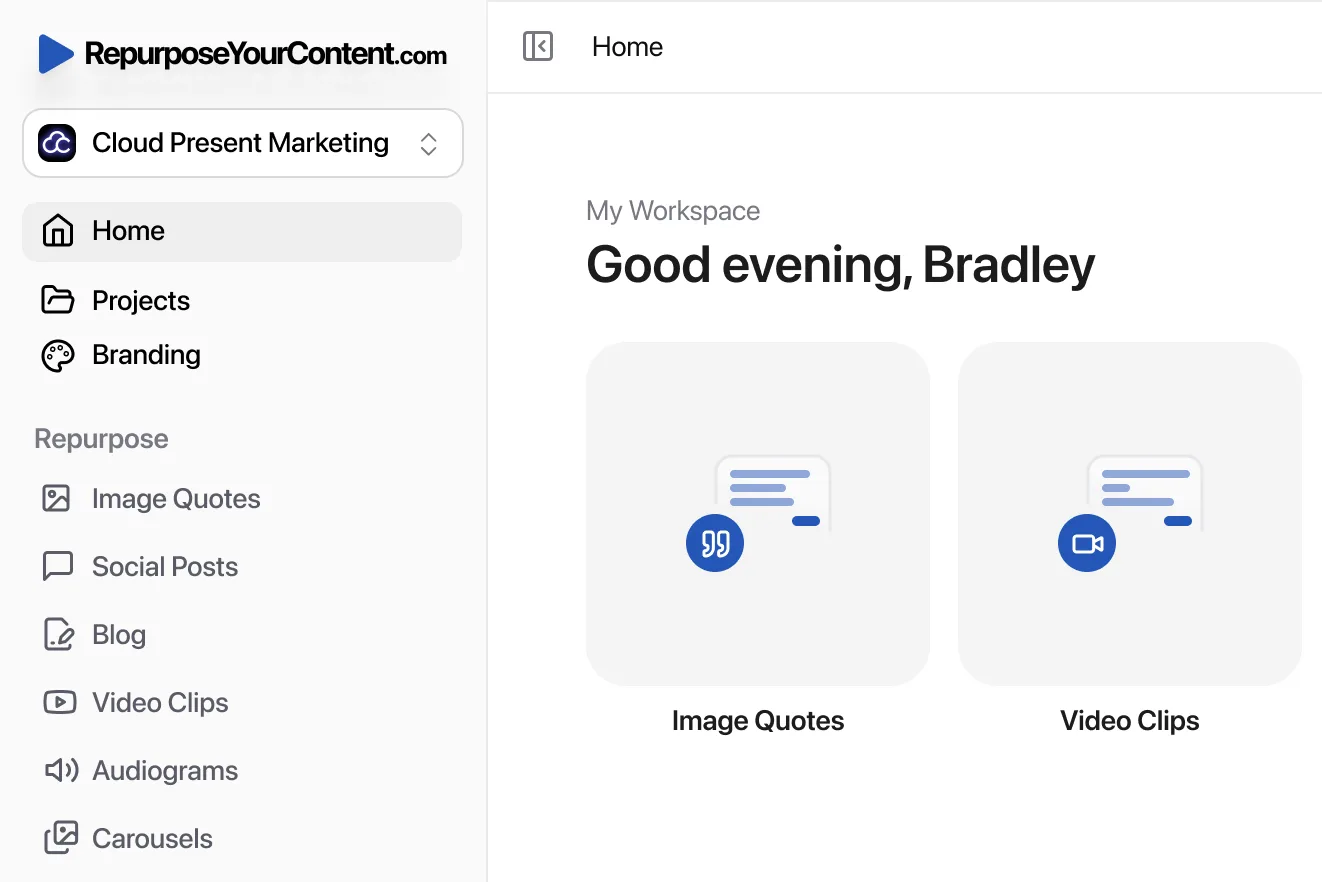
One practical option is RepurposeYourContent's automated webinar repurposing workflow. It takes a webinar recording and generates outputs such as video clips, blog posts, social posts, audiograms, image quotes, newsletters, LinkedIn carousels, and timestamps. For refresh work, that matters because an old recording can be uploaded again and mined for angles the first publishing cycle missed.
That means the team doesn't need to start with a blank page. It can start with the source file.
A short product walkthrough helps make that concrete:
The strongest use case isn't replacing editorial judgement. It's reducing the manual labour involved in finding reusable moments inside older webinars. Strategy still decides what to refresh. Automation makes the extraction work faster.
Measuring Success and Finalising Your Cadence
Refresh work needs a scoreboard. Otherwise, it becomes a maintenance task nobody prioritises.
The cleanest way to measure lift is to compare each refreshed asset against its own baseline. Watch ranking movement for the target query set. Check whether organic sessions recover. Review conversion behaviour on the updated page. If the asset now sends visitors deeper into the site or generates more qualified next-step actions, the refresh did its job.
The KPIs worth tracking
Use a small set of metrics. Too many inputs make reporting noisy.
- Keyword movement: Track the primary and secondary terms tied to the refreshed page.
- Organic traffic trend: Compare pre-refresh and post-refresh periods consistently.
- Page-level conversions: Monitor demo clicks, CTA clicks, sign-ups, or whatever matters for that page type.
- Internal click-through behaviour: Check whether updated internal links are driving movement to connected assets.
- Replay engagement signals: For embedded or linked webinar assets, watch whether the refreshed framing improves downstream consumption.
Set a cadence the team will actually keep
A strong cadence is boring by design. It should fit the team's real capacity.
For many teams, that means refreshing a small number of high-priority assets each month and reviewing the broader backlog on a recurring schedule. Trend content gets checked more often. Evergreen pieces get a longer runway. The backlog stays under control because every cycle includes some refreshes, some merges, and a few retirements.
The real win is not one successful refresh. It's a system that stops old webinar content from silently decaying.
If the team also tracks content across adjacent channels, the same discipline applies elsewhere. For example, teams working with creators can learn from guides that show how to build your influencer tracking system, because consistent measurement is what turns scattered activity into an operating model.
If old webinar-derived pages are losing rankings, stop rewriting from scratch. Go back to the recording, extract a better angle, and refresh the asset properly. To turn that process into a repeatable workflow, try RepurposeYourContent blog post generation.
Tags: