Content Repurposing Software for Marketing Teams 2026
Find the best content repurposing software for marketing teams 2026. Compare 10 top tools, features, pricing, and ROI for marketing managers. Get insights now!

28% of content spend going to repurposing software sounds efficient. For many teams, it is not. The waste shows up after the webinar, when the recording lands in a folder and no one owns the next ten outputs.
That is the core problem. Workflow failure.
This guide reviews content repurposing software for marketing teams in 2026 through the lens that matters in a real buying process. Can a team of 3 to 20 people run it together without creating more admin? Shared libraries, approvals, brand controls, role-based access, and SSO support decide whether a tool holds up after procurement.
Tools bought by one person usually break at team scale. They produce clips. They do not create a shared operating model for content, social, demand gen, and design. If your team is building a repeatable post-webinar engine, this B2B content repurposing strategy for 2026 frames the right requirements.
That is the standard for this list. The question is not whether a tool can generate assets. The question is whether your team can use it from day one without losing brand control or handoff speed.
1. RepurposeYourContent

68% is the wrong number to focus on. The actual problem is that more teams are buying repurposing software, and many still run the post-webinar process through shared folders, Slack threads, and manual cleanup.
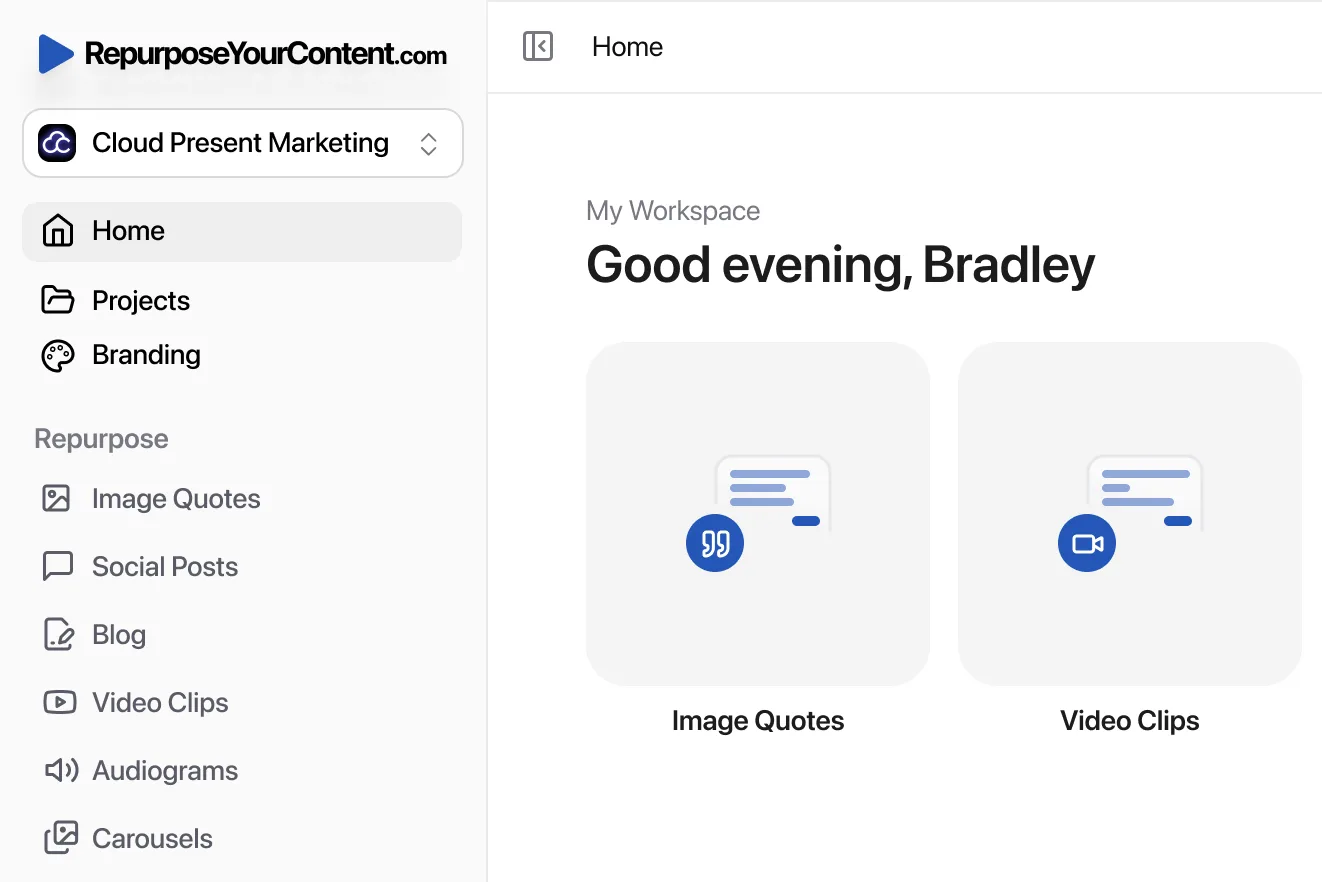
RepurposeYourContent fits teams that need one system for post-event production from day one. The tool is built around shared workflow, not solo creator usage. That matters if content, demand gen, social, and design all need access to the same source asset and the same output queue.
The practical value is coverage. One recording can produce video clips, blog posts, social posts, email sequences, audiograms, podcasts, image quotes, LinkedIn carousels, and timestamps. The brand kit carries logos, colours, and fonts across those outputs, which cuts down the cleanup work that usually lands on design or content ops.
Why it works for teams
Team scale fails on coordination first.
If one person owns the account, the rest of the team waits for exports, asks for edits in chat, and loses version control fast. This setup avoids that trap by giving teams a shared workspace and a clearer operating model.
- Shared asset library: The team works from one recording and one output set.
- Multi-user access: Content, demand gen, social, and design can work in the same workspace.
- Brand controls: Outputs stay closer to approved visual standards.
- Input flexibility: Teams can upload from Zoom, YouTube, Vimeo, and other webinar hosts.
- Procurement fit: SSO and higher-volume support are available for larger buying processes.
That is the difference between software a marketer can test and software a team can run.
How the workflow holds up
The process is simple, which is exactly what a busy team needs.
Step 1. Upload the webinar file or paste a link.
Step 2. Choose the outputs, such as clips, blog posts, social posts, audiograms, image quotes, newsletters, LinkedIn carousels, and timestamps.
Step 3. Set output volume.
Step 4. Generate the batch with the brand kit applied.
Step 5. Review, edit, download, and publish.
That sequence supports handoffs better than a stack of isolated AI prompts. It also maps well to teams building a repeatable webinar-to-written-content workflow. If that is your priority, this guide to software that converts webinar recordings into blog posts is worth reviewing alongside the product.
Pricing and scale fit
Pricing is credit-based, with plans starting at $99 per month, plus a free Basic tier and a 7-day trial. For teams with uneven webinar volume, that model is easier to manage than adding seat costs every time another contributor needs access.
Best fit:
- Teams that run webinars or virtual events regularly
- B2B SaaS and demand gen teams
- Marketing teams that need one recording turned into campaign assets across channels
Weak spot:
- Human review is still required before publishing. That is normal, and it protects brand quality.
2. Parmonic

Parmonic is a team buy, not a solo creator tool.
That distinction matters in 2026. A lot of repurposing software looks good in a demo, then breaks down once demand gen, content, and sales all need access to the same outputs. Parmonic is built for the opposite situation. It takes webinar content and pushes it into shared campaign workflows with article drafts, social assets, audiograms, and connections to the systems revenue teams already use.
Where Parmonic fits
Parmonic works best for B2B teams with an established webinar program and a real post-event process. If webinars already feed nurture, follow-up, and sales enablement, this product makes sense.
It fits teams using systems such as Marketo, HubSpot, Pardot, Eloqua, Salesloft, Outreach, or Seismic. That matters because software bought by one marketer often stalls when the rest of the team cannot review, reuse, or route outputs inside existing ops workflows.
Parmonic is a stronger option than generic video editors for teams that need:
- Shared campaign execution: Webinar assets need to move into email, social, and sales follow-up without manual copying.
- Brand governance: Teams need output that is close to campaign-ready and easier to review across stakeholders.
- Multi-system adoption: Ops leaders do not need another isolated app that lives outside the stack.
If your team is also comparing workflow depth against distribution-first tools, this breakdown of Repurpose.io alternatives for marketing teams in 2026 gives useful context.
Parmonic fits teams that treat repurposing as part of campaign operations, not a side task.
Pricing and buying reality
Parmonic does not publish pricing. That is common in mid-market and enterprise software, but it creates friction for lean teams trying to scope cost before procurement starts.
For a 3 to 20 person marketing team, that buying model cuts both ways. You get a sales process built around integration and rollout. You also lose the speed and clarity that self-serve tools offer. If your team needs shared access, approval structure, and tighter alignment with revenue systems, that trade-off can be worth it.
Website: Parmonic
3. Repurpose.io

Repurpose.io is an automation engine first. Teams that care most about routing content to lots of destinations will like it. Teams that need deeper asset transformation may not.
This tool is good at moving content around. It automates publishing to multiple platforms and supports high-volume distribution pipelines. For agency-style social workflows, that’s useful. For B2B marketing teams trying to turn a webinar into a full campaign package, it’s only part of the stack.
Best use case
Repurpose.io works best when the team already has edited content and wants to automate distribution.
- Cross-platform publishing: Good for pushing video and audio across social channels.
- Agency workflows: Useful when one operations lead manages many destination accounts.
- Repeatability: Helpful for standard publishing rules.
Its main limitation is strategic, not technical. A distribution engine doesn’t solve team collaboration by itself. Shared approvals, brand review, and text asset generation still need another layer.
That’s why teams comparing options often look at Repurpose.io alternatives for 2026 when they need broader post-event output, not just publishing automation.
Team reality
Repurpose.io can scale operationally. It’s battle-tested for automated flows. But over-automation creates platform risk if teams push too much identical content too often.
For a small marketing team, that means one thing. Somebody still needs to own channel judgement. Automation is useful. Unsupervised automation is usually sloppy.
Website: Repurpose.io
4. OpusClip

OpusClip is for teams that need volume in short-form video. If the brief is “cut this webinar into social clips by this afternoon,” it does that well.
Its core strength is fast AI clipping with captions, reframing, filler removal, and scheduling support. It also includes team workspace features on higher tiers. That gives it a path from solo use to team use, though the product still centres on video output.
What it does well
OpusClip is a strong choice when video is the priority and written assets come later in another tool.
- Short-form clip generation: Fast output from long webinars or livestreams.
- Multi-aspect exports: Useful for teams publishing across several channels.
- Team workspace: Better than pure single-user tools for shared production.
This is not the best fit for a content team that needs blogs, newsletters, and email sequences from the same source. It’s a clipping product first.
A team should buy OpusClip for social video throughput, not for full campaign repurposing.
For buyers focused on that category, this roundup of AI video clipping tools in 2026 gives the right comparison frame.
Scale fit
OpusClip works well for small and mid-sized teams with one social lead, one editor, and one approver. It becomes less complete when the team expects broader written content production inside the same system.
Website: OpusClip
5. Quso

Too many repurposing tools still start as single-user products. That creates problems fast once a marketing team adds approvals, publishing ownership, brand review, and channel accountability. Quso gets closer to the actual team brief than many creator-first tools because it combines clipping, captions, planning, scheduling, and basic written output in one workspace.
That matters for lean teams trying to reduce tool sprawl.
Where Quso fits
Quso makes sense for teams that run social production as a shared operating function, not a string of one-off creator tasks.
- Shared social workflow: Planning, production, and publishing live in the same system. That cuts admin work across coordinators, editors, and social leads.
- Brand controls: Brand kit support helps keep captions, visual output, and post formatting consistent across users.
- Low-friction evaluation: The free entry point makes it easier to test team adoption before procurement turns it into a long project.
The tradeoff is depth. Quso covers a lot, but it does not give larger content operations the governance structure, role clarity, and approval discipline that bigger teams usually need. If your team has separate owners for content strategy, creative, paid, and compliance, you will feel those limits quickly.
The rename from vidyo.ai to Quso also creates buying friction. Confirm current pricing, user limits, workspace access, and admin controls before rollout. Do not assume the product you trialed under the old name maps cleanly to the current plans.
That same procurement logic shows up in adjacent systems. Teams running paid and organic together usually benefit from fewer disconnected tools, especially if the agency side is also managing AI ad automation for agencies alongside content production.
Team fit
Quso is a practical option for small marketing teams that need one place to move from source content to scheduled social output. It is less convincing for teams with formal review steps, multi-department contributors, and strict brand governance. Buy it for coordinated social execution, not as the operating system for a mature content team.
Website: Quso
6. Munch

Munch is built around finding the moments most likely to perform as short clips. That makes it attractive to brand and media teams pushing volume on social.
It uses audio and visual analysis to identify standout sections, then reformats them for channel-specific output. For webinar teams, that means less manual scrubbing through long recordings.
Good choice for clip-heavy teams
Munch is worth shortlisting when social clips are the primary asset type.
- Moment detection: Useful when the team wants the platform to surface highlights.
- Platform formatting: Saves editing time on crop and caption work.
- Trend-aware approach: Helpful for teams that think in social performance terms.
The issue is scope. Munch doesn’t solve team-wide repurposing if the team also needs blogs, emails, sales snippets, and branded image assets. It’s one lane of the process.
Buying note
Pricing isn’t clearly listed on the site. That pushes it into a demo-led buying motion. Some teams are comfortable with that. Others just want a straightforward monthly software decision.
Website: Munch
7. Castmagic

Castmagic is one of the better options when the team wants written outputs from recordings. It handles transcripts, show notes, blog drafts, newsletters, and social copy well.
For content teams with strong editors, that’s useful. Castmagic gives structure fast. It doesn’t replace final editorial review, but it removes the blank-page problem.
Where it stands out
Castmagic fits text-heavy workflows better than video-heavy ones.
- Written asset generation: Good for blogs, newsletters, recaps, and social captions.
- Collaborative editing: Better than basic solo prompt tools.
- Custom prompts: Helpful when teams need repeatable editorial patterns.
This suits content operations teams that already have a separate clip editor in the stack. It’s less complete for teams wanting one platform to handle text, visuals, and branded media from the same source.
That split matters because one of the biggest gaps in the category is workflow governance. Teams need process, not just output. This broader issue sits inside the wider challenge of marketing automation for content teams.
Castmagic is strong when the bottleneck is turning conversation into usable copy.
Scale and cost
Castmagic can scale from small teams upward, but higher plans become a budget conversation. That’s normal for software built around processing time and collaboration.
Website: Castmagic
8. VEED.io

VEED is a browser-based video suite with team relevance because it reduces setup friction. No desktop install. Easy access for distributed teams. Solid editing and caption workflows.
For UK and EU teams, that simplicity matters. It’s easier to onboard multiple contributors when the tool lives in the browser and the workflow is obvious.
Strong all-rounder, not a specialist
VEED covers a broad set of video tasks. AI clips, subtitles, translations, eye-contact correction, noise cleanup, layout changes, hosting, and sharing all sit under one roof.
That makes it a good operational choice for teams that need:
- Distributed access: Browser-based collaboration is easier to manage.
- Video-first workflows: Recording, editing, and export happen in one place.
- Enterprise options: API and larger-scale support exist.
Its weakness is the same as most broad video suites. It isn’t purpose-built for webinar-to-campaign repurposing. Teams still need separate support for written assets and some brand-governed post-event workflows.
Team fit
VEED works for content teams that already think like video producers. It’s less suited for demand gen teams trying to transform one webinar into a multi-format nurture system.
Website: VEED.io
9. Chopcast

Chopcast is one of the clearer team options in the short-form clipping category because it addresses permissions and sharing more directly than many creator-first tools.
It uses upload-minutes billing with unlimited exports. That’s easy to understand operationally. Teams can monitor input volume rather than counting every output clip.
Why teams may prefer it
Chopcast is a sensible option for UK and EU teams that care about permissions and a cleaner route to enterprise controls.
- Team sharing: Minutes can be shared rather than trapped in one user account.
- Enterprise path: SSO and permissions are available at higher tiers.
- Unlimited exports: Helpful when social teams want more output from fewer uploaded assets.
This isn’t a complete repurposing system. It’s a clipping tool with better team mechanics than most.
Limits
The tool stays focused on short video formats. Teams needing blog posts, email content, or branded image assets will need another platform.
That’s fine if the team wants a specialised stack. It’s less efficient if the goal is one shared post-webinar workflow.
Website: Chopcast
10. Headliner

Headliner still has a place for teams creating audiograms and simple social clips from webinar recordings. It’s not the most advanced option in this list, but it’s straightforward.
For marketing teams with a podcast element or audio-first snippets, that simplicity can be enough. Not every team needs complex AI selection or enterprise workspaces.
Best use case
Headliner is a practical add-on when the team already has copy and design workflows sorted.
- Audiograms: Strong fit for turning spoken insights into social assets.
- Templates and branding: Good enough for lightweight brand consistency.
- Built-in publishing: Useful for smaller social teams.
Its ceiling is obvious. It’s not a full team content engine. It’s a utility.
Team recommendation
Headliner works best for small teams that need quick audio and clip outputs at low complexity. It’s not the tool to standardise a broader content operations process around.
Website: Headliner
2026 Top 10 Content Repurposing Tools for Marketing Teams
| Product | Core outputs | Best for | Key differentiator | Speed & UX | Pricing (entry) |
|---|---|---|---|---|---|
| RepurposeYourContent | 8 formats: clips, blog posts, social, carousels, emails, audiograms, podcasts, image quotes | B2B marketing, demand‑gen, agencies, content teams | Platform‑agnostic + auto brand kit across all outputs; built for B2B webinars | ≈5 minutes per webinar; team workspaces; near‑final assets | Credit system; plans from $99/mo; free Basic + 7‑day trial |
| Parmonic | Clips, blogs, social, audiograms, sales enablement | Mid‑market / enterprise B2B webinar teams | Deep CRM/MAP integrations and campaign‑ready outputs | Purpose‑built webinar workflows; demo sales | Custom enterprise pricing (demo required) |
| Repurpose.io | Automated clips + cross‑posting to social platforms | Teams/agencies needing automated distribution | Mature automation pipelines and high publish caps | Automation‑first; scheduling & publish flows | Tiered plans; 14‑day trial; free starter quota |
| OpusClip (Opus.pro) | Short vertical clips, captions, reframing, scheduler | High‑volume social teams | Virality scoring, multi‑aspect reframing, built‑in scheduler | Fast clip generation; credit tiers; free credits | Credit‑based; free plan (60 credits) |
| Quso (formerly vidyo.ai) | Clips, auto‑subtitles, video→blog, scheduling, analytics | Small teams & agencies wanting all‑in‑one clip→schedule→analyze | Integrated clip→schedule→analyze workflow + brand kit | One‑click scheduling; free tier with credits | Free tier + Growth plans; promos/legacy pricing vary |
| Munch | Moment detection, auto‑crop, captions, social copy | Media & brand teams focused on viral shorts | Strong multi‑modal “find the moment” engine; trend guidance | Creator‑friendly discovery and onboarding | Self‑serve pricing not public; in‑app tiers |
| Castmagic | Transcripts, show notes, blog drafts, email/newsletter copy | Teams needing text‑heavy outputs from webinars/podcasts | Deep text generation, collaborative editing, custom prompts | Text‑first workflow; pairs with clipping tools | Usage‑based transcription; tiered hours/seats |
| VEED.io | Editing, subtitles/translations (125+), layout/resizing, hosting | Distributed UK/EU teams needing end‑to‑end video suite | Browser‑based full‑suite with enterprise & API options | Record→edit→publish workflow; enterprise features | Tiered plans; geo‑dependent pricing (GBP/VAT) |
| Chopcast | Shorts/Reels/TikToks, captions, resizing, key‑moments | Teams focused on short‑form exports; EU data preference | Minutes‑based billing with unlimited exports; SSO | Simple clipping; pay‑by‑upload‑minutes model | Upload‑minutes pricing; enterprise upgrade available |
| Headliner | Audiograms, clips, captions, transcripts, templates | Creators and small teams atomizing audio/video | Affordable audiograms + transcription and templates | Simple, budget‑friendly; auto‑audiogram tools | Inexpensive plans; regional pricing varies |
Your Next Step: Systemise Your Content Output
Teams that treat repurposing as a one-off production task usually end up buying twice. First for speed. Then again for workflow, access control, and governance after the first tool breaks under real team use.
That is the mistake to avoid in content repurposing software for marketing teams 2026.
A single user can tolerate loose processes. A marketing team cannot. Shared libraries, approval paths, role-based access, brand controls, and predictable handoffs are the key buying criteria. If those pieces are missing, the tool stays stuck with one operator and never becomes part of the team’s operating model.
Cost needs the same discipline. Compare software against the full delivery model, not just the subscription line item.
A practical ROI view looks like this:
- Software cost: One platform fee. One source asset. Multiple outputs produced by the team inside one system.
- Agency cost: Every extra clip, copy draft, resize, and revision adds cost and slows turnaround.
- In-house cost: Salary is only part of the equation. Production queues, review cycles, and channel delays are the bigger drag.
The economics usually support software. The operational gap is governance.
Many tools can generate clips or drafts fast. Fewer support the controls a team needs to scale output without creating brand debt. Tofu HQ highlights the speed and automation strengths in AI repurposing tools. Postiv’s review also focuses heavily on feature breadth and output efficiency. That is useful, but it is not enough for a team buying for 2026. Marketing ops leaders need to ask who can access the workspace, how reviews happen, where approved assets live, and how brand standards hold up across channels.
One product in this list, RepurposeYourContent, is built around the team workflow rather than the solo creator workflow. That matters because webinars are rarely the problem. The problem is turning one recorded event into a governed, repeatable system that content, demand gen, social, and leadership can all use.
Set the process before volume increases. Define the source formats you repurpose, assign owners for review and approval, lock brand rules early, and choose software your whole team can use from day one.
Stop treating webinars like isolated campaigns. Build a content system your team can run every week.
Tags: