Content Style Guide That Scales Across Channels
Build a content style guide your team will actually use. Covers voice, tone, formatting, examples, and governance for creators and marketing teams.
A content style guide is a written set of rules for voice, tone, formatting, and channel behavior that lets any writer or tool produce on-brand output. Without one, repurposing a single recording can consume 5 to 8 hours before the finished posts, clips, and articles are ready to publish, according to Sembra's content amplification benchmark.
That time disappears into decisions nobody documented. Writers debate whether a LinkedIn post can use contractions, editors rewrite headlines, and designers wait for someone to confirm the approved product name. The recording is finished, but the content pipeline isn't.
A practical content style guide fixes that by turning brand judgment into production rules. It tells a freelancer, editor, or AI-assisted drafter what to preserve, what to change, and what to reject across every channel.
Why Teams Skip the Style Guide and Pay for It Later
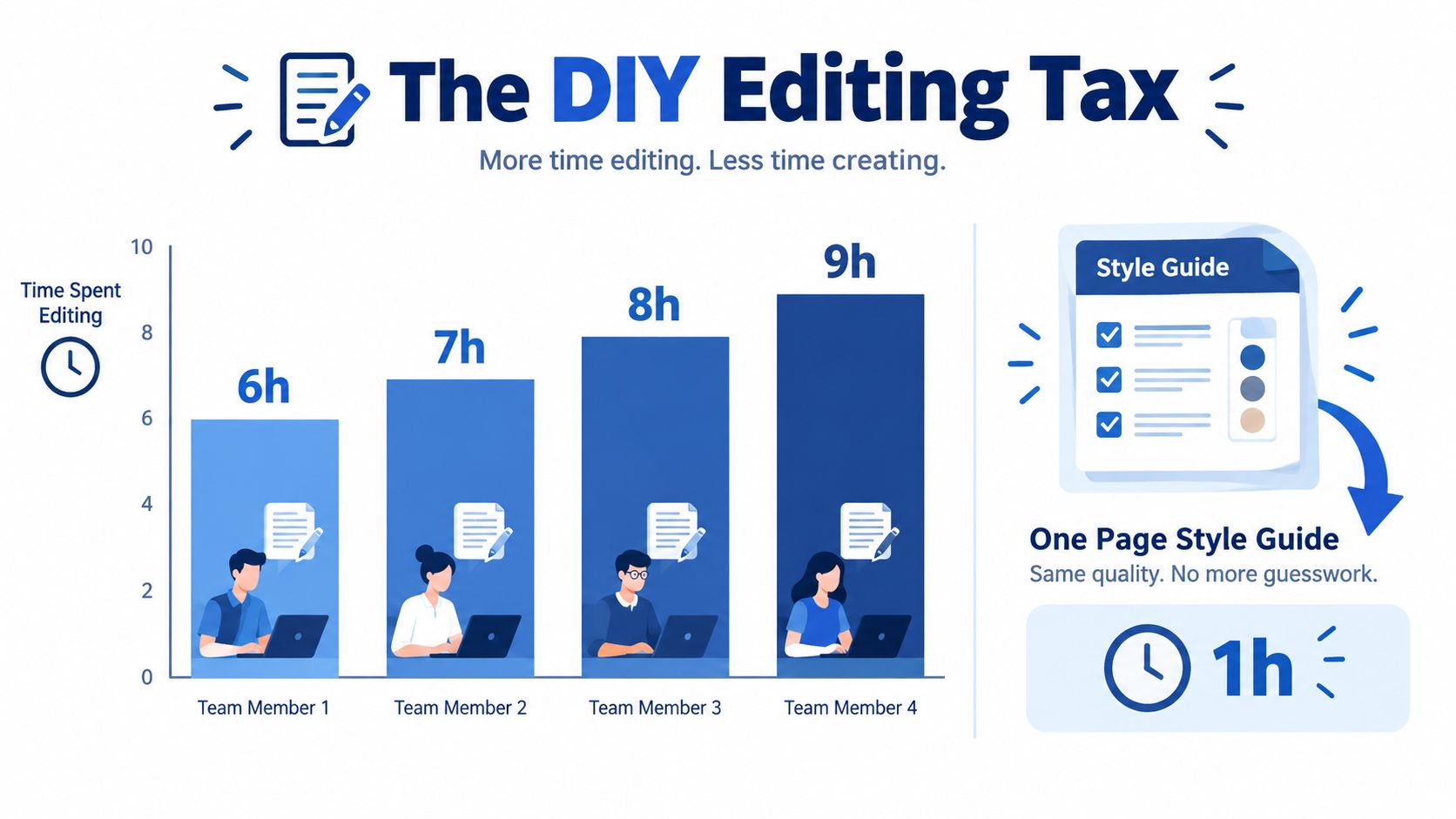
DIY editing consumes time before anyone opens an editing timeline. A four-person content team can spend 6 to 9 hours cleaning voice, formatting, and channel-fit problems from one major asset. Treat those figures as illustrative planning assumptions, not a universal cost model. A one-page content style guide will not remove every review, but it can prevent repeated debates about basic production decisions.
Assume a blended rate of $70 per hour. That editing work represents roughly $420 to $700 per asset. Across 50 assets, the annual bleed reaches $21,000 to $35,000. The calculation makes the trade-off visible: time spent resolving undocumented choices is budget that cannot support new production.
The hidden cost is rework
The visible expense is editing time. The larger problem is the operational drag around it.
- Freelancer onboarding: Every new contractor asks the same questions because the team has no authoritative answer.
- Voice drift: A clip can preserve the speaker's words while changing the company's personality through captions, hooks, and CTAs.
- Manager bottlenecks: Marketing leads spend Monday rewriting finished work instead of approving and shipping it.
- Channel mismatch: A blog paragraph gets pasted into LinkedIn, while a short social hook gets stretched into an awkward email.
A content production scaling framework works better when the guide sits inside the workflow. It serves as the control layer between the source recording and every derivative asset, so editors can apply documented decisions instead of reopening the same questions.
Operational rule: If a decision appears in three review comments, it belongs in the guide.
Strong guides do not promise perfect writing. They reduce avoidable ambiguity, helping teams ship repurposed assets during the same week as the recording without paying freelance rates to repair preventable issues.
What a Content Style Guide Actually Is
A content style guide is a living production reference. It documents voice, tone, terminology, formatting, accessibility, citation behavior, and channel-specific rules so different contributors can create consistent work without a long editor conversation.
That definition matters because many teams confuse three separate documents.
A brand book usually governs visual identity. It covers logos, colors, typography, imagery, and layout. Those rules tell designers how the company looks, but they rarely explain whether a writer should say “customer” or “client,” use sentence case, or write in first person.
An editorial calendar governs publishing decisions. It records what gets published and when. It doesn't enforce how a podcast transcript becomes a LinkedIn post, a newsletter paragraph, or a YouTube description.
The production rulebook between strategy and output
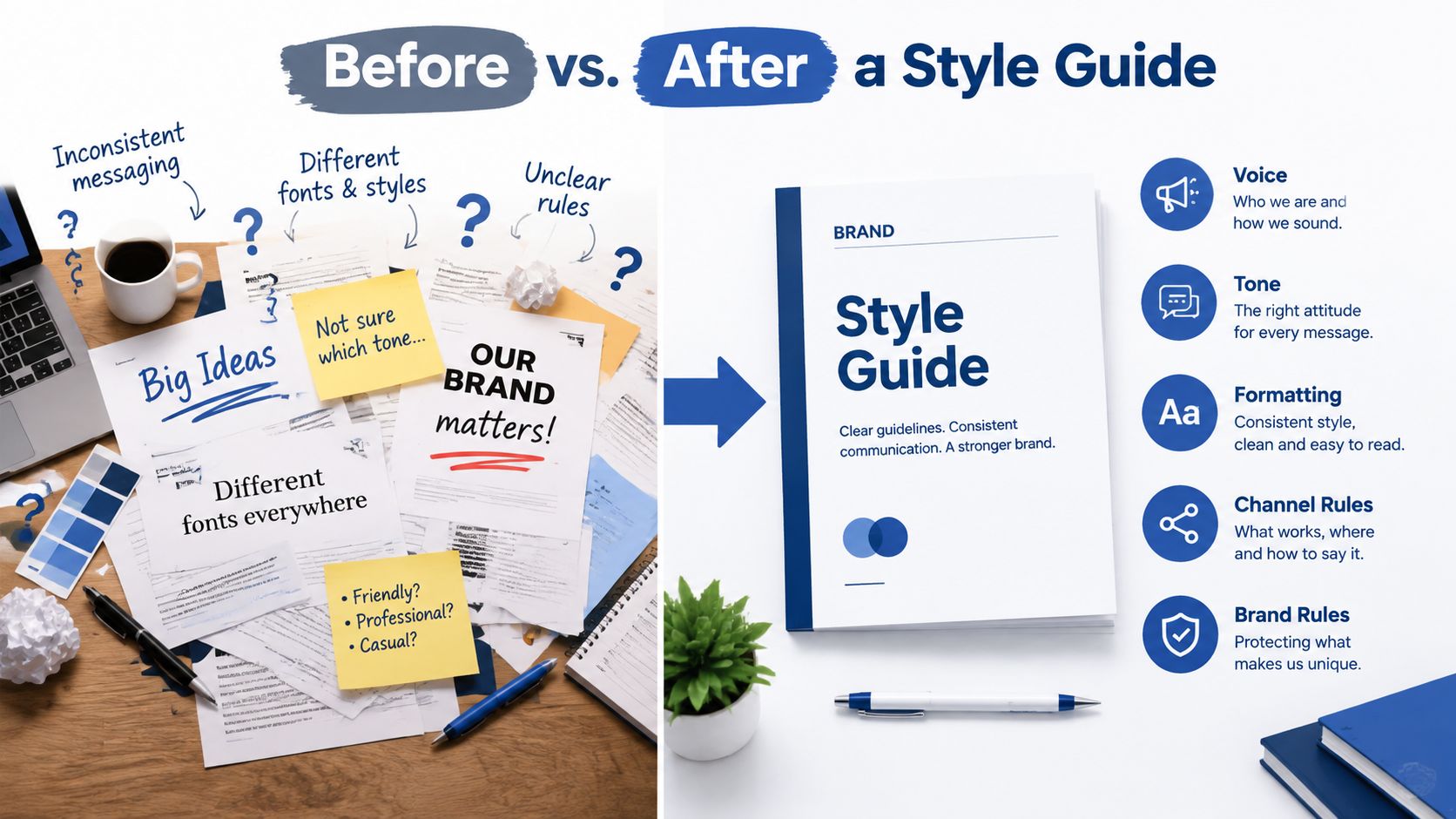
The guide connects source material to channel execution. It can define:
- Voice: The stable personality that should remain recognizable.
- Tone: The emotional and contextual adjustment for each situation.
- Mechanics: Capitalization, punctuation, sentence length, bullets, and headings.
- Terminology: Approved product names, stakeholder labels, and banned phrases.
- Channel behavior: Rules for LinkedIn, YouTube, email, blogs, and other formats.
- Evidence handling: Source links, publication dates, citations, and context for factual claims.
- Accessibility: Descriptive links, heading order, captions, transcripts, and useful alt text.
The practical brand consistency guide offers useful context for separating broader brand standards from the writing rules contributors need during production. That distinction prevents a common failure, where a polished visual brand document leaves writers guessing.
A guide should be easy to scan while a source recording is being repurposed. The content repurposing glossary can help teams establish shared terminology before they document channel rules.
A useful test is simple. Give the document to a capable freelancer who doesn't know the company. If that person still needs a 30-minute Slack thread to write a basic post, the guide describes intentions instead of decisions.
The Five Core Components Every Guide Needs
A production-ready guide has five connected components. Each should settle a decision that otherwise gets revisited during editing, especially when one recording becomes posts, descriptions, emails, and longer-form content.
1. Voice
Voice is the company's consistent way of speaking. Define it with a short list of observable traits, then show those traits in a reference paragraph that editors can compare against.
Rule: Write with practical confidence, avoid inflated claims, and use plain English.
Example: “The team removes production friction so experts can publish more consistently.”
Mailchimp's voice and tone guidance recommends active voice, plain English, and avoiding slang and jargon. The Australian Government style manual also frames tone through word choice, viewpoint, grammar, and formality.
2. Tone
Tone shifts with the situation. The voice can remain direct while the tone becomes warmer in customer support, sharper in sales copy, or more measured in executive communication.
Rule: Use a standard tone for routine marketing and a formal tone for sensitive announcements.
Example: A launch email might say, “The new workflow helps teams turn recordings into publishable content.” A crisis response should state what happened, what the team knows, and what happens next.
3. Formatting
Formatting rules remove low-value decisions from production and make assets easier to review across channels.
Rule: Use sentence case for web headings, short paragraphs, bullets for grouped actions, and no emojis in executive communications.
Example: “How to repurpose a founder interview” is approved. “How To Repurpose A Founder Interview” is not.
4. Brand rules
Brand rules protect meaning as content moves through a repurposing pipeline. Record product names, capitalization, approved metaphors, stakeholder labels, and language that creates legal or strategic risk.
A useful before-and-after test exposes vague copy:
| Before | After |
|---|---|
| “Our industry-leading recording repurposing service” | “Our recording repurposing service that returns 30 assets in 48 hours” |
The second version names a capability and a delivery expectation. If the team cannot support the claim, remove the detail rather than substitute another superlative. For product references, use the approved name consistently, including RepurposeYourContent where it applies.
5. Channel behavior
Channel rules determine what survives adaptation. Document length ranges, hook patterns, hashtag policies, CTA styles, and formatting expectations so editors do not rebuild decisions for every asset.
Rule: LinkedIn posts lead with a clear point, YouTube descriptions lead with the topic, email uses one primary CTA, and blog posts use descriptive headings.
Example: A LinkedIn opening might challenge a common assumption. A YouTube opening should identify the episode topic before the supporting detail.
| Component | What It Governs | Example Rule | Example |
|---|---|---|---|
| Voice | Stable brand personality | Use direct, plain language | “Publish the useful part of every conversation.” |
| Tone | Contextual emotional register | Use measured language in sensitive updates | “The team is reviewing the issue and will share confirmed details.” |
| Formatting | Visual and editorial mechanics | Use sentence case headings | “How the workflow works” |
| Brand rules | Names, terms, and approved language | Use approved product names consistently | “RepurposeYourContent” |
| Channel behavior | Platform-native execution | Use one clear CTA in email | “Book a content planning call.” |
The production page should be scannable in under three minutes. Keep detailed references behind it, but make the rules visible where writers and editors work. That small investment prevents repeated interpretation, manual rewrites, and inconsistent assets across the pipeline.
Voice and Tone Across Channels
A recording contains one source voice. The finished assets need different tones because each channel creates a different reading situation.
LinkedIn rewards a direct point and a recognizable perspective. YouTube descriptions need search clarity and navigation. Email needs focus. A blog can support longer reasoning, headings, citations, and related examples.
| Channel | Tone Descriptor | Target Length | Opening Hook Pattern | Formatting Rules | Example Line |
|---|---|---|---|---|---|
| Direct and contrarian | Under 1,200 characters | Lead with a challenge or sharp observation | Short lines, limited emojis, selective hashtags, one CTA | “Most teams don't need more ideas. They need a faster way to reuse the ideas they already recorded.” | |
| YouTube | Clear and useful | Topic-led description with timestamps | Front-load the main keyword and viewer outcome | Add timestamps, short paragraphs, relevant links, focused CTA | “Content style guide workflows help teams turn one recording into consistent channel assets.” |
| Warm and focused | Short paragraphs | Start with the reader's problem | One CTA, no dense blocks, restrained formatting | “Your recording is finished. The follow-up content shouldn't wait until next month.” | |
| Blog | Measured and explanatory | Longer-form reasoning | State the answer, then develop the argument | Use descriptive headings, bullets, citations, and internal links | “A content style guide turns editorial preferences into repeatable production rules.” |
The voice remains recognizable across all four examples. It stays direct, practical, and specific. The tone changes through pacing, context, and the amount of explanation.
Native formatting beats copy-paste reuse
A common failure is treating repurposing as resizing. A writer copies a blog introduction into LinkedIn, shortens it slightly, and calls the result platform-ready. The words may be accurate, but the asset still feels imported.
Channel behavior prevents that problem. The guide should state whether a channel uses first person, how quickly the hook must reach the point, whether hashtags add value, and what the CTA should ask the reader to do.
Cross-platform repurposing guidance helps teams think beyond format conversion. The operational question is not “How can this paragraph appear everywhere?” It is “What should this source idea become here?”
The workflow below applies those decisions before copy reaches review.
A Real Workflow From One Recording to Thirty Assets
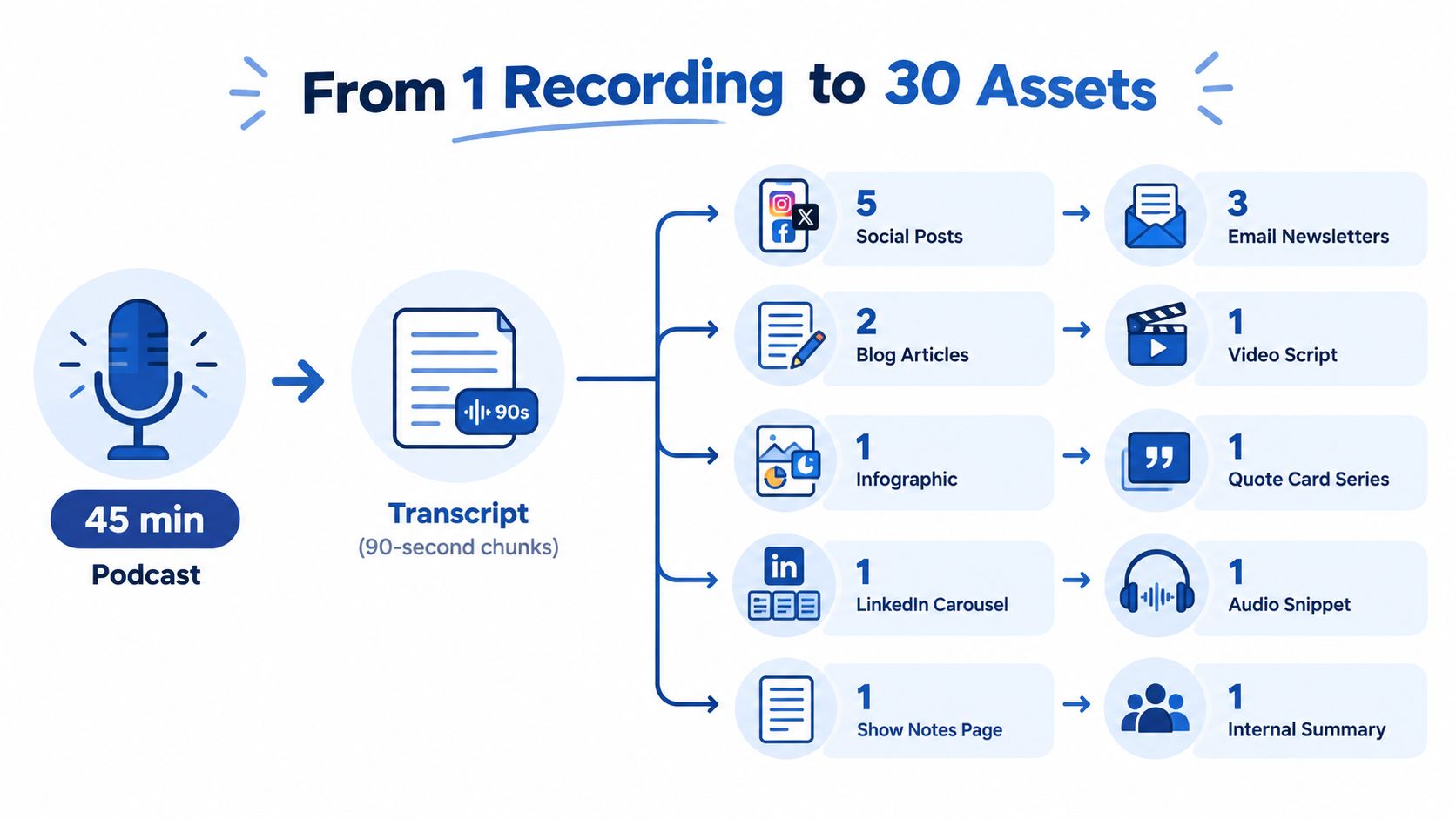
A governed repurposing pipeline begins with the source recording, not a blank social post. One 45-minute founder podcast episode can produce 30 assets when the allocation and review rules are written down.
The worked allocation includes six LinkedIn posts, four YouTube Shorts, one long blog, eight tweets, six newsletter snippets, one lead magnet outline, and four Instagram captions. Teams may shift the mix by channel, but every derivative should retain its source timestamp, audience, format, and approval criteria.
Step 1, transcribe and select
The team transcribes the episode and marks it in 90-second chunks. Each segment receives tags for topic, audience, proof, objection, story, or CTA. Those tags make selection faster and give editors a shared reason for keeping or rejecting a moment.
Without written criteria, selection and review can take 1 to 2 hours, before the team decides which moments fit each channel. A guide lets the producer flag usable sections while preserving timestamps and source context.
Step 2, convert the transcript
Selected segments become channel-specific drafts:
- LinkedIn gets a direct opening and one clear point.
- Shorts receive a spoken hook, captions, and a concise ending.
- The blog develops an organized argument with supporting context.
- Newsletter snippets keep the core idea and add a reader-focused transition.
- Instagram captions use a shorter lead and a visual-aware CTA.
Manual repurposing can take 10 to 16 hours per recording, including review, clips, posts, graphics, and an article, according to the cited benchmark. The guide does not eliminate skilled editorial work. It prevents skilled people from reopening decisions the team has already made.
Step 3, run the QA pass
The editor checks each asset against the source and the guide. A LinkedIn draft may turn a measured founder observation into hype copy. A YouTube description may bury the main keyword instead of placing it first. Written rules make both failures visible during review.
Step 4, schedule and archive
The team records the final version, source timestamp, channel, reviewer, and publication status. A reusable content multiplication framework helps organize the relationship between the recording and its derivatives.
At the full 30-asset allocation shown above, four episodes per month yield 120 assets from roughly eight hours of source material. Teams that trim the allocation for particular channels will produce fewer. Editorial judgment remains necessary, while the guide makes that judgment repeatable.
Governance, Ownership, and a Reusable Checklist
A style guide rots when nobody owns its decisions. The document needs a named maintainer, a visible change process, and reviewers who use it during real production.
Assign three roles
The guide owner maintains the document, accepts change requests, and records approved updates. This person doesn't need to make every editorial decision, but someone must decide when a suggestion becomes a rule.
Channel editors enforce the rules for their platforms. A YouTube editor may refine timestamp conventions, while a social editor checks hooks, line breaks, and CTA patterns.
The rotating reviewer audits one channel each week. Rotation matters because a guide can look accurate while one platform drifts.
Versioning should remain plain. Version 1.0 ships with the brand launch. Minor updates land monthly. Major updates happen quarterly or when the team adds a new channel.
Governance principle: A rule without an owner becomes a preference. A preference without an example becomes a debate.
Use signals, not arbitrary maintenance
A calendar reminder helps, but production signals are stronger. Update the guide when:
- Writers repeat the same question: The current rule isn't findable or specific enough.
- New hires can't find answers: Access, navigation, or terminology needs work.
- Teammates produce visibly different output: The guide lacks channel examples or enforcement.
Use this checklist during each review:
- Name the guide owner.
- List every channel editor.
- Give contributors a single source of truth.
- Record the current version and update date.
- Maintain a short change log.
- Explain how contributors request edits.
- Train new writers with approved examples.
- Sample finished assets during QA.
- Check citations and source links.
- Test headings, links, captions, transcripts, and alt text for accessibility.
- Resolve conflicting channel rules with an approver.
- Retire rules that no longer affect production.
Accessibility belongs inside the editorial system. The Australian Government Style Manual's accessibility guidance covers operational details such as descriptive link text, logical headings, captions, transcripts, alt text, and screen-reader considerations.
The Done-for-You Alternative When Time Is the Constraint
A style guide only creates value when it shortens production decisions. If internal editors still rewrite every caption, clip, and post from scratch, the document has become another project rather than an operating tool. A done-for-you repurposing service can add production capacity while the guide remains the approval standard.
The provider should review the existing guide, source material, channel requirements, and approval workflow before editing begins. The handoff should define:
- One source-of-truth rule set
- Channel-specific adaptations
- A practical example bank
- A repurposing template
- A decision tree for self-approval and escalation
- A versioned document
- Before-and-after copy samples
- A reusable QA checklist
Teams creating their own documentation can find document generation templates to establish a structure. Templates do not decide the brand's voice, channel rules, or escalation thresholds. Those decisions still require editorial judgment.
What to confirm before outsourcing
A responsible handoff answers practical questions before production begins:
- Ownership: Who updates the guide after delivery?
- Source control: How are source links, dates, and citations maintained?
- Approval: Which assets can ship without review?
- AI-assisted drafting: Does machine-assisted copy follow the same human QA rules?
- Revisions: How are changes recorded and applied to future assets?
- Examples: Does the handoff include approved copy, not only abstract principles?
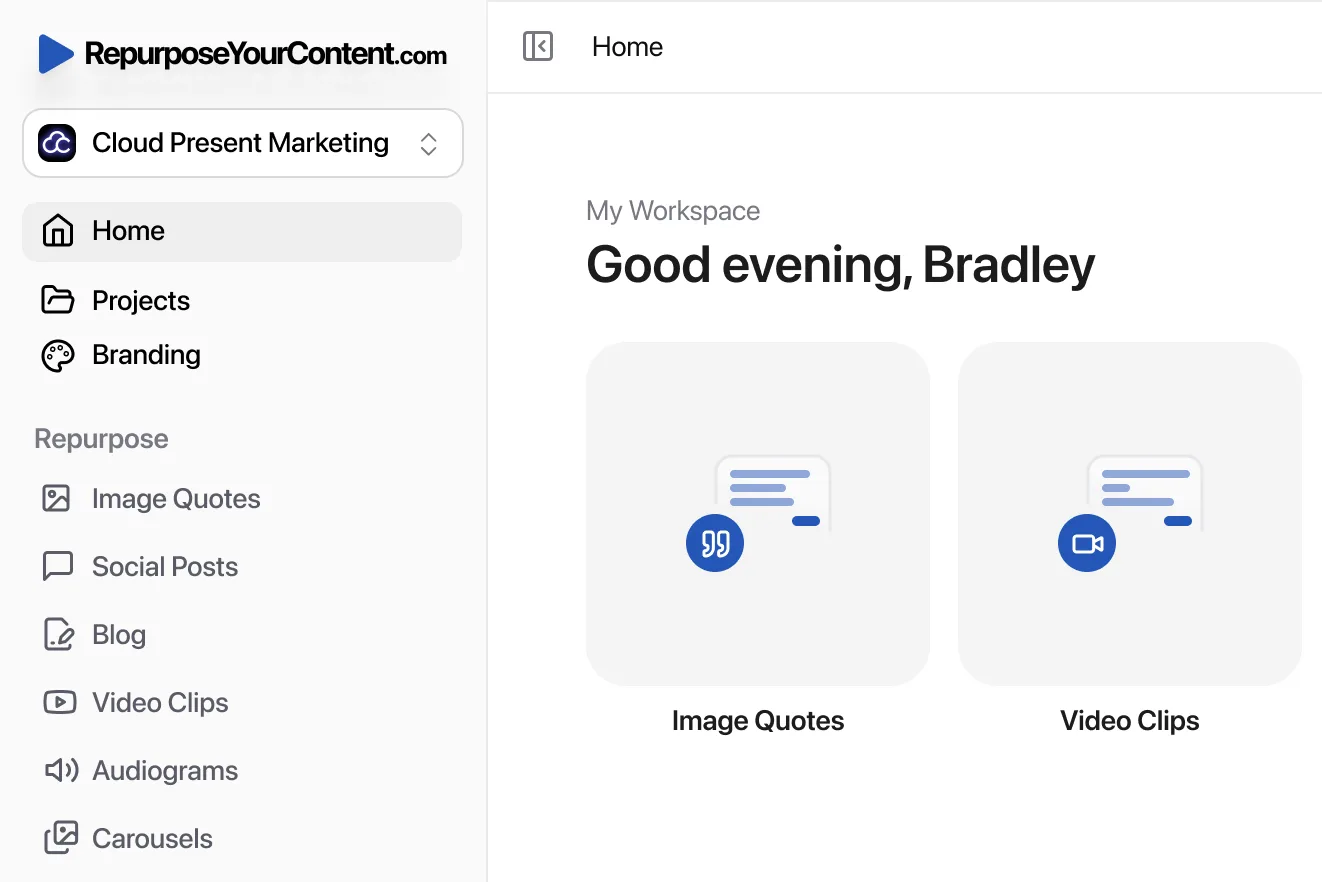
RepurposeYourContent is a done-for-you option focused on content repurposing rather than style-guide consulting. Clients send a podcast, interview, keynote, sales call, livestream, course, or other long-form recording. The service returns 20 to 30 ready-to-publish assets in 48 hours, including video clips, LinkedIn posts, quote graphics, carousels, audiograms, and a blog post, with unlimited revisions. The stated client time is about 15 minutes. Its stated terms include a 48-hour turnaround guarantee, or the client doesn't pay, and pricing calculated from $14 per finished asset.
The content repurposing service for long-form recordings suits teams with strong source material but limited editing capacity. The trade-off is straightforward: internal teams retain final judgment, while an external production path handles the repetitive conversion work. The style guide supplies the rules that keep those assets consistent across channels.
A recording can otherwise require separate editing, copywriting, design, formatting, and review passes. Without documented rules, each pass creates another interpretation to approve. With clear examples and escalation criteria, reviewers can assess output against a shared standard instead of rewriting from instinct.
Tags: