Done for You Podcast Content: A Buyer's Guide
Done for you podcast content saves podcasters 4-6 hours per episode. Learn what to expect, costs, and how to choose a provider.

A true done-for-you podcast service handles the recording, strategy, production, publishing, and follow-up. The host records and approves, while the rest gets handled without extra admin.
That matters because podcasting is crowded. There were more than 4.5 million active podcasts worldwide as of November 2025, and global listening was projected to reach 619.2 million listeners in 2026 as summarized in this industry roundup. In that environment, done for you podcast content is less about convenience and more about keeping one recording alive across search, social, and email.
The True Cost Of Unpublished Podcast Episodes
Podcasting is no longer a niche channel. More than 4.5 million active podcasts existed worldwide as of November 2025, and that scale makes single-use publishing a bad trade. A 45-minute episode should not live and die in one feed post.
The cost shows up after the recording ends. You still need the show notes, clip selection, social captions, image quotes, and a blog draft. That work is where many teams lose momentum, which is why Done for You Podcast Content has become operationally valuable.
The hidden weekly block
A weekly show creates a repeating production bill. The recording might take 45 minutes, but the post-production block can eat 4 to 6 hours per episode when the same person is clipping, writing, formatting, and publishing. That is the cost most podcasters feel, even when they never write it down.
Practical rule: If an episode cannot be repurposed, it is usually underperforming, not because the content is weak, but because the distribution stopped too early.
That is also why repurposing has moved from optional to standard practice. A podcast episode can become a search asset, a social asset, and a sales asset. If you want the broader context on repurposing's role in content systems, this repurposing statistics roundup is a useful companion read.
Why one publish is a waste
A single publish event is fragile. It depends on followers seeing the episode on launch day, then it disappears into the archive. Search, social, and email all punish that approach because none of them reward one-time effort for long.
A better model treats each recording as source material. One episode can feed multiple channels if the workflow is built for it. That is the practical reason busy podcasters start buying Done for You Podcast Content instead of trying to keep up manually.
What Done For You Podcast Content Means
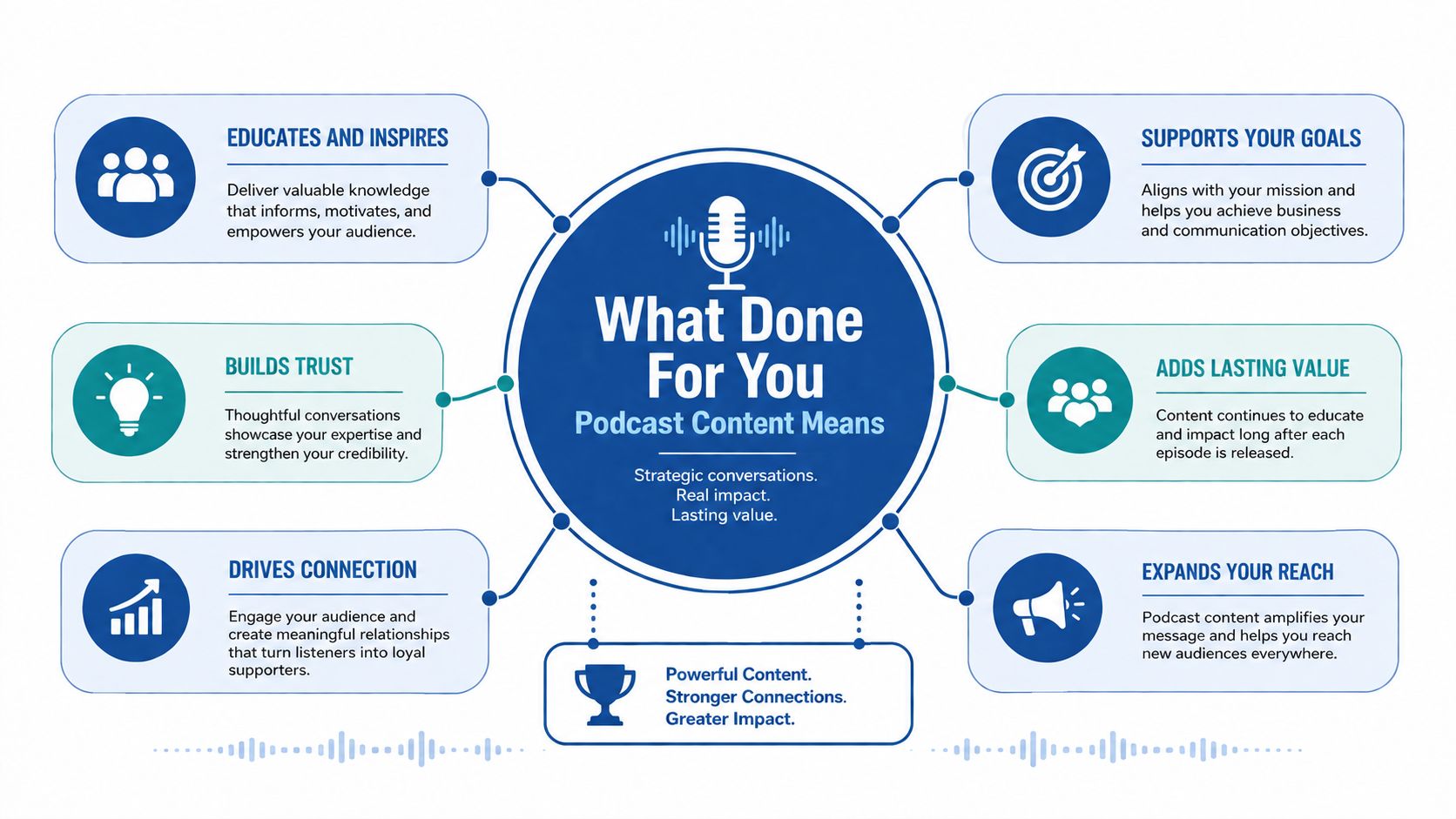
Done for you podcast content means the service handles end-to-end execution. You send one recording, the team turns it into finished assets, and you approve the output. The client is not inside editing timelines, caption drafts, or content formatting.
The boundary between real service and partial help
A true service starts with strategic intake, not just editing. The provider should understand the client's ICP, competitive analysis, and sales cycle, because that determines which moments deserve to become clips or posts as outlined in this guide to done-for-you podcast solutions. Without that step, you get content that looks busy but misses the point.
That also separates service from software. Buying tools still leaves the work on your plate. Hiring a freelancer can help, but you still need briefs, approvals, and oversight. A real done-for-you setup reduces the number of decisions you have to make every week.
What should be included
Per episode, the package should include the full written layer and the social layer. At minimum, that means clips, show notes, a blog post, newsletter copy, and social captions. Stronger offers also include quote graphics, carousels, and a posting playbook.
A useful benchmark is whether the provider can take one recording and return assets that are ready to publish without another round of rewriting. If you still need to shape everything yourself, it is not done for you. It is assisted DIY.
Why the workflow matters
The best systems atomize the episode into smaller assets. One workflow recommendation explicitly separates technical editing from content editing so teams can isolate high-signal moments for clips, blog posts, quote cards, and social content as described in this workflow video. That structure is what turns one recording into a content engine.
The point is simple. If your name is still attached to the hardest part of the process, you are not really buying back time.
What A Full Service Includes Per Episode
A proper per-episode package should not stop at clips. It should return a complete publishable set. For a podcast, that means 8 to 12 short clips, 6 to 8 social posts, image quotes, carousels, a 400 to 500 word SEO blog post, show notes, and a posting playbook.
What each asset is doing
Clips pull attention. Show notes support listeners and help with structure. The blog post gives the episode a searchable home. Social captions and quote graphics extend the reach into feeds where people skim, not listen. The posting playbook keeps the assets from sitting in a folder.
If the provider only offers clips, the writing burden stays with you. That is where many teams stall. They will publish the video and ignore the rest, even though the written layer is what keeps the episode working after launch.
A strong show-notes workflow usually starts from the transcript, then trims filler, reshapes the structure, and adds headings. If that part is handled badly, the rest of the package feels thin. This show-notes guide is relevant if you want to see how the written layer should be built.
| DIY Production Time Per Episode | DIY Hours |
|---|---|
| Clip selection and editing | 2 to 3 |
| Show notes | 1 |
| SEO blog post | 2 |
| Social captions and formatting | 1 |
That adds up fast. Even before image work or approvals, the production block is already heavy.
Why the writing layer saves the most time
The biggest time drain is not only clipping. It is writing. Podcasters consistently skip the written layer when they get busy, because the blog draft, show notes, and social copy all require separate thinking. That is why a full-service package removes more friction than editing alone.
For search visibility, blog content matters. A podcast guide from Podcast.co says episodes only rank on Google when they are turned into blog posts or published as detailed show notes of about 400 to 500 words and it also covers trailer timing. That makes the written layer more than a nice extra. It is the part that gives the episode a second life.
A quick check before you buy
If a provider cannot show the deliverable stack before you pay, they probably plan to leave part of the workload with you.
That is the wrong trade. The whole point of done for you podcast content is to remove the 4 to 6 hour production block, not rename it.
How A Weekly Show Gets Repurposed
A weekly founder podcast works best when the process is boringly consistent. Record the episode, hand over the file, approve the outputs, repeat. The time saved comes from removing the middle layer, not from doing a faster version of the same manual work.
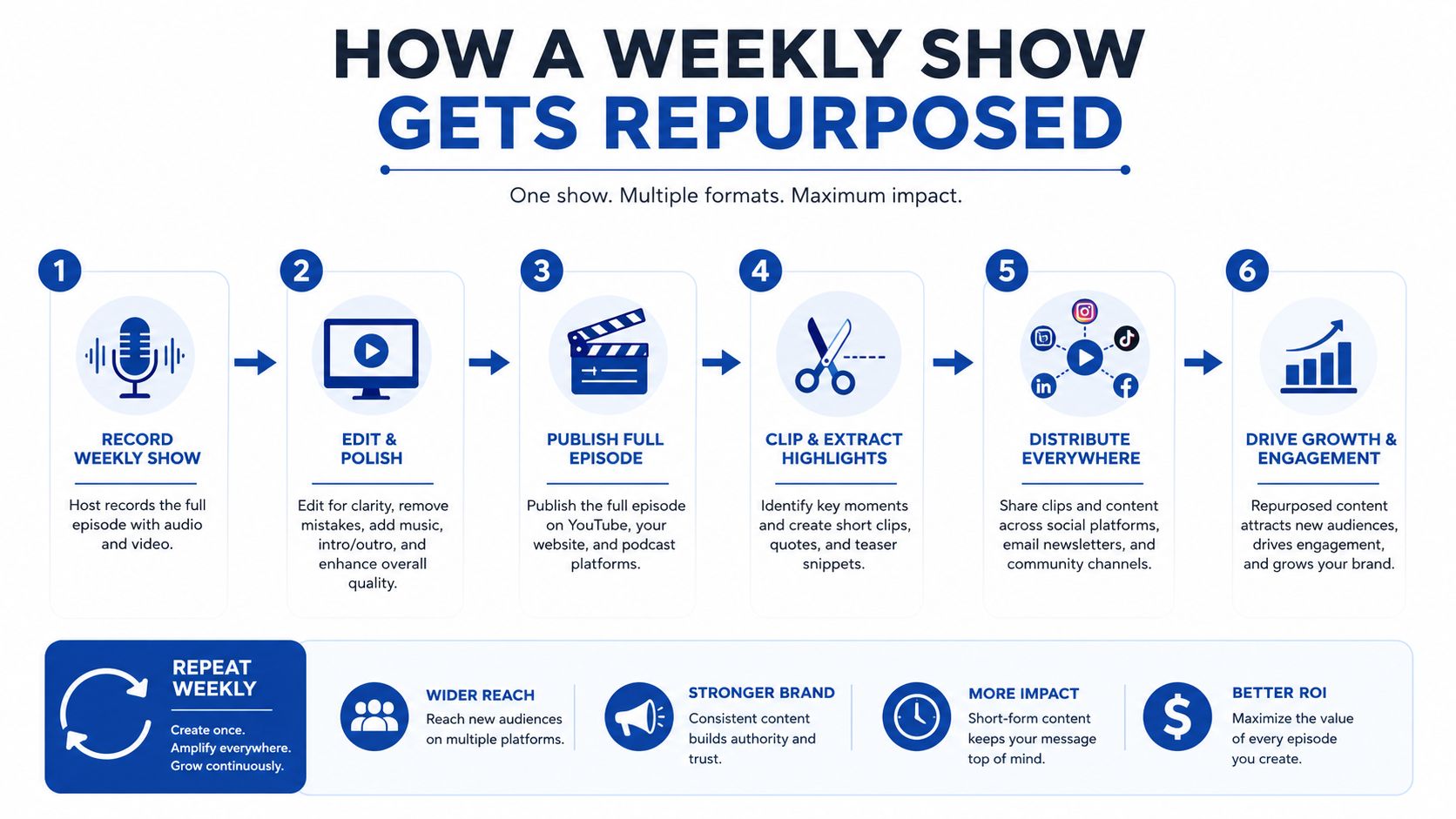
Step 1, the episode gets recorded
A founder records a 45-minute episode and sends the file. That part stays simple. No extra prep package, no editing queue, no in-house project management.
Step 2, the assets get built
The service transcribes the audio, identifies strong moments, and turns the recording into a full content set. For one weekly show, that can mean 30 assets built from one episode, including clips, LinkedIn posts, quote graphics, carousels, and an SEO blog. A video walkthrough of the repurposing process is embedded below for anyone who wants to see the workflow style in motion.
Step 3, the host reviews and approves
The host spends about 15 minutes reviewing in the portal. That is the only part that should still sit with the client. The rest gets handled by the service, including the written layer and the posting guidance.
The cleanest repurposing system feels invisible to the host. They record once, approve once, and keep publishing while the team does the rest.
The same model works for more than podcasts. Webinars, keynotes, panels, interviews, and livestreams all create the same problem and the same opportunity. The mistake most advice makes is focusing on topic choice. The key operational question is how to turn one recording into a durable month of assets without adding another production job.
For a tighter breakdown of this workflow, this repurposing guide is worth keeping nearby.
Time And Cost Savings Versus DIY And Freelancers
The main decision is not whether content should be repurposed. It is who should do it, and how many hours you want to keep spending every week. DIY, freelancers, and done-for-you services all look different once the actual production block is counted.
DIY still eats the same hours
DIY with tools is not free time. The software may help, but the operator still has to choose moments, trim clips, write copy, format assets, and publish. That still leaves the 4 to 6 hour per episode block on the calendar.
Freelancers reduce your hands-on work, but they add briefing and management. You still need to explain the show, define the voice, review drafts, and correct mistakes. If the freelancer is only handling one slice, the coordination overhead stays with you.
What the market usually looks like
A freelancer can be a good fit for one-off tasks, but the model is rarely smooth for weekly publishing. You are paying for labor in pieces, not a system. That means every episode becomes a mini project.
A done-for-you service changes the math. RepurposeYourContent's published offer runs from $999/month for one recording, which includes 20 to 30 assets, to $2,499/month for a weekly content engine. The same pricing frame works out to as little as $14 per finished asset as stated in the company overview.
Why the hourly savings matter more than the sticker price
A weekly show that moves to done-for-you production reclaims roughly 4 to 6 hours per week. That is about a workday. The main win is not just lower stress. It is that publishing keeps happening even when the host is busy.
| Path | Cash cost | Time cost |
|---|---|---|
| DIY with tools | Lower cash, high labor | 4 to 6 hours per episode |
| Freelancer mix | Variable cash, some labor | Briefing, review, corrections |
| Done-for-you service | Flat monthly fee | About 15 minutes of review |
That table is the comparison. If the goal is to keep the show live without burning internal capacity, done-for-you is the cleaner operating model.
How To Evaluate Podcast Content Providers
Not every provider calling itself done for you is handling the hard parts. The quickest way to screen them is to ask whether they manage the strategic and written layers, not just the edit.
Questions that separate service from surface help
Ask whether they handle strategic intake around ICP, sales cycle, and content priorities. Ask who chooses the guest or the strongest episode segments. If the answer is vague, the provider is probably avoiding the work that matters most.
Then ask how onboarding works. A serious provider should collect the brand kit, tone rules, audience priorities, and sample posts before delivery starts. They should also define what a strong moment sounds like for the show. If they skip that, the first batch will miss your voice.
The five-point test
- Strategic intake: Do they map audience, offer, and sales cycle before editing starts?
- Guest or topic control: Do they help choose what should become content?
- Brand calibration: Do they collect voice samples, visual rules, and platform priorities?
- Revision flow: Is the first delivery treated as a calibration pass with unlimited revisions?
- Publishing support: Do they deliver a posting playbook, not just files?
If a vendor fails two or more of those checks, the offer is probably a lightweight editing service in disguise. That may work for a very small show, but it will not remove the burden of weekly production.
For a deeper look at service models, this repurposing services guide can help frame the decision. The right provider should reduce your workload, not create another inbox to manage.
Done For You Podcast Content Next Steps And FAQs
A practical done-for-you setup is simple. Send one recording, podcast, webinar, keynote, interview, or meeting, and let the service return finished assets in your voice. RepurposeYourContent does that as one option in the market, with 20 to 30 ready-to-publish assets delivered in 72 hours, a 72-hour guarantee or you do not pay, and unlimited revisions. Your time is about 15 minutes.
How onboarding works
The best onboarding is structured, not open-ended. The client shares the brand kit, tone-of-voice samples, audience priorities, platform priorities, and what a strong moment sounds like on the show. The first delivery acts as calibration, so anything off gets corrected before the pattern repeats.
That is important because consistency is the true value. Clients do not want a pile of files. They want publishing to keep moving even when the week gets messy.
Common buyer questions
What happens if a week is missed?
The workflow should adapt to the next recording without creating a backlog crisis. The point is to keep production steady, not punish busy weeks.
How do revisions work?
Unlimited revisions should be part of the model. The first batch should sharpen the voice, and later batches should already reflect the brand tone.
Who owns the assets?
The client should own every finished asset outright. No gating, no watermarks, no hidden usage limits.
What if the recording source changes?
A real done-for-you service should handle podcasts, interviews, meetings, keynotes, webinars, and livestreams. The input format can change as long as the recording is clear.
The clean promise here is consistency without client effort. That is what busy podcasters usually want most, because the show stops being a content bottleneck and starts acting like a distribution engine.
Book a call or request a sample if the goal is to hand off the full podcast production layer and keep publishing without the weekly grind.
Tags: