Your Guide to Done for You Social Media Content 2026
Explore done for you social media content options. Compare agencies, VAs, & repurposing services for your B2B team in 2026.

Done-for-you social media content is a service where an external provider creates and manages your social posts. The three main types are full-service agencies, virtual assistants, and content repurposing services. One 45-minute recording can become 20 to 30 assets, and a professionally engineered workflow can reduce asset creation time to under 48 hours while increasing content velocity by 300 to 400% according to CELUM's workflow breakdown.
That matters because many teams already have the raw material. They just don't have the capacity to turn it into consistent output. Founders record podcasts, sales calls, interviews, keynotes, demos, and livestreams. Then the file sits in Zoom, Riverside, YouTube, or a drive folder.
The best done for you social media content isn't written for you. It's extracted from you. That distinction changes cost, speed, and authenticity.
What Is Done-for-You Social Media Content
Done for you social media content means an outside service takes over the work of turning your ideas into publishable social assets. That can include strategy, writing, clipping, design, formatting, and delivery. For founders and marketing leads, the appeal isn't convenience. It's getting consistent output without dragging senior people into post-production.
The market gap is obvious. 73% of B2B marketers identify recordings as their primary source of quality leads, yet only 1 in 3 teams have a scalable workflow to convert them, which leaves high-value content posted once and forgotten, as noted in this analysis of content repurposing demand.
Most companies don't have a content problem. They have a workflow problem.
The three versions buyers usually choose
There are three common ways to buy done-for-you social support:
- Agency model: A social media agency creates posts from scratch, usually through strategy calls, briefs, and ghostwriting.
- VA model: A virtual assistant handles execution tasks like formatting, scheduling, and publishing.
- Repurposing model: A specialist service takes existing long-form recordings and turns them into multiple assets.
Each model solves a different bottleneck. Agencies solve planning. VAs solve admin. Repurposing solves throughput and authenticity.
Practical rule: If the founder already speaks clearly on calls, podcasts, demos, or interviews, the cheapest content source is often the footage already recorded.
That is why content repurposing has become a serious operating model, not a side tactic. A single recording can feed LinkedIn, Shorts, Reels, carousels, quote graphics, and blog content without asking the team to invent more ideas from scratch.
For a broader breakdown of the underlying model, this guide on what content repurposing actually is is useful background.
Comparing the Three Models of Done-for-You Content
A founder looking for done for you social media content usually compares three options. The wrong comparison is "Which one posts for less?" The right comparison is "Which one produces usable content in the right voice with the least executive time?"
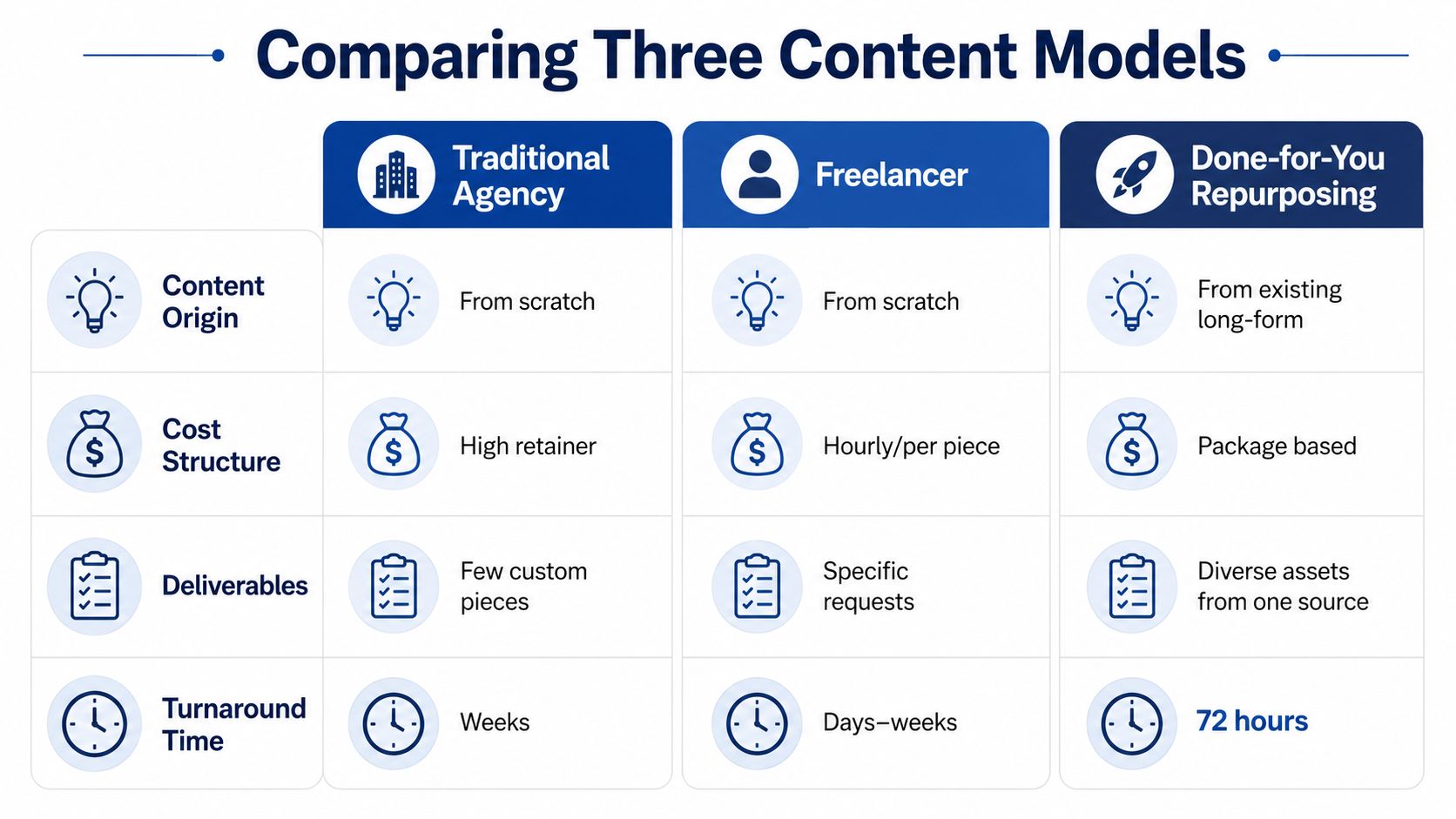
Side-by-side trade-offs
| Model | Typical cost | Content origin | Strength | Weakness |
|---|---|---|---|---|
| Agency | Roughly $3,000 to $10,000 per month | Created from scratch through briefs and ghostwriting | Strategy and campaign thinking | Voice is often approximated |
| VA | Roughly $800 to $1,500 per month | Created or assembled from instructions | Affordable execution | Limited editorial judgment |
| Recording-based repurposing | From $999 per month | Extracted from your actual recordings | Authentic voice and high output | Depends on having strong long-form source material |
Agencies are expensive because they rebuild the message each time
Agencies can work well when a company needs campaign direction, approvals, and channel management. But they usually start with a blank page. That means more meetings, more briefs, and more ghostwriting. The result can be polished, but it often sounds like a marketing team speaking on behalf of a founder.
That gap matters. Social content that feels overprocessed usually gets ignored.
VAs are useful, but they don't replace editorial judgment
A VA is often the cheapest route to consistency. They can schedule posts, resize graphics, move copy into a calendar, and keep the machine running. But most VAs don't shape narrative, identify strong hooks, or decide which spoken moment should become a clip, quote, or carousel.
They're operators, not editors.
Repurposing services start with what was already said
This is the model with the strongest authenticity. Instead of ghostwriting a founder's opinion, the service pulls from a real podcast, keynote, interview, customer call, or meeting. The wording, tone, examples, and point of view are already there.
Ghostwritten content often sounds like marketing. Repurposed content sounds like the founder, because it is the founder.
The market is moving in that direction. Only 48% of social media marketers share repurposed content across platforms, even though 92% of businesses report higher ROI from video campaigns, according to these social media marketing benchmarks. That gap is where recording-based services win.
For teams weighing outsourcing options, this comparison of how to outsource content repurposing helps frame the decision.
What a Complete Social Content Package Includes
A real package should fill a month of publishing, not produce a few clips and call it a strategy. If one recording only turns into three posts, the service isn't doing enough extraction.
A stronger benchmark looks like this.
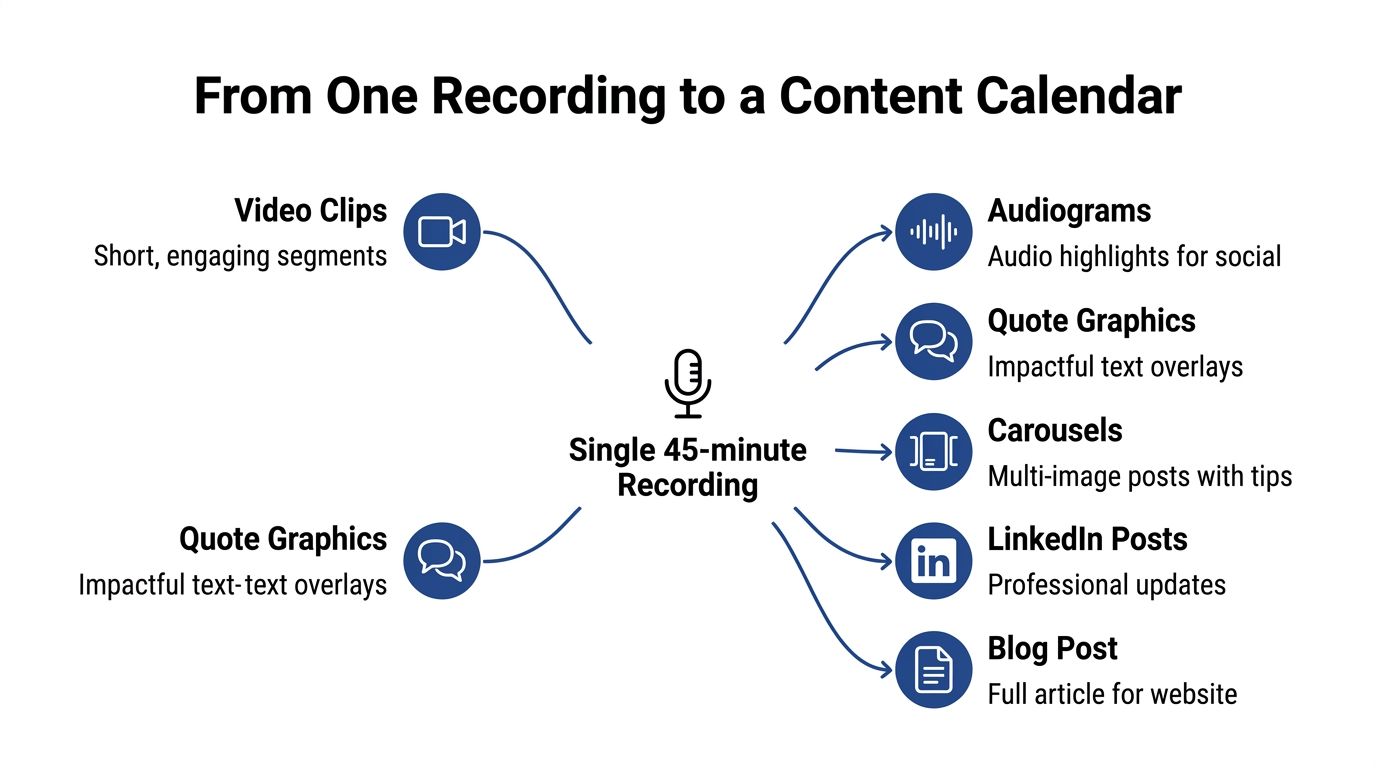
What one recording should produce
From one recording, a complete package can include:
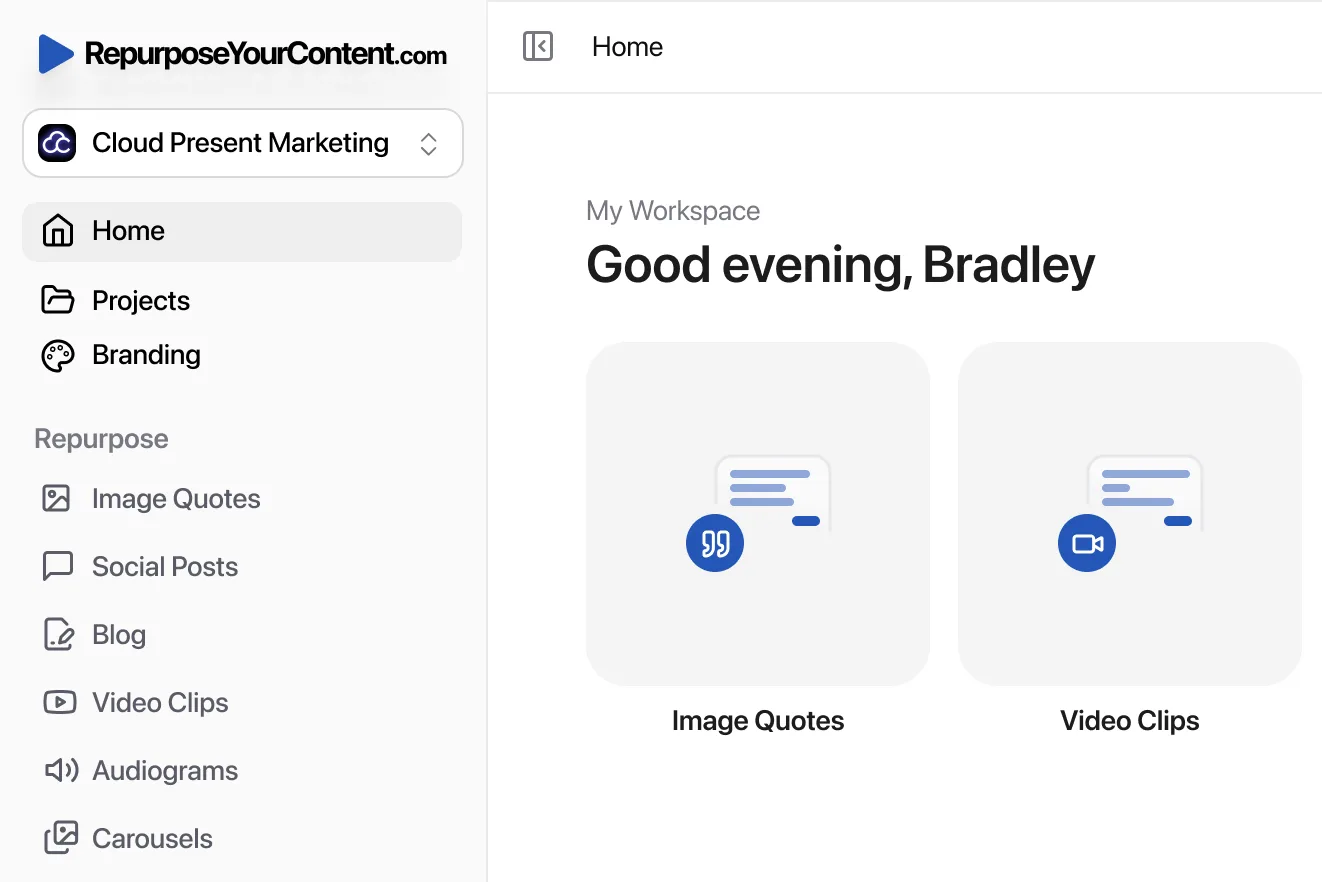
- 8 to 12 video or audio clips: Short-form assets with branded captions for LinkedIn, Reels, Shorts, TikTok, or email embeds.
- 6 to 8 text posts with visuals: Ready-to-publish posts written by humans in the client's voice, not generic AI summaries.
- 4 to 6 quote graphics: Strong one-liners turned into branded images.
- 1 to 3 carousels: Multi-slide posts built from a teaching sequence, framework, or opinion.
- 1 SEO blog post: A full article built from the recording's transcript and argument.
- 1 posting playbook: Clear guidance on what to publish, where, and when.
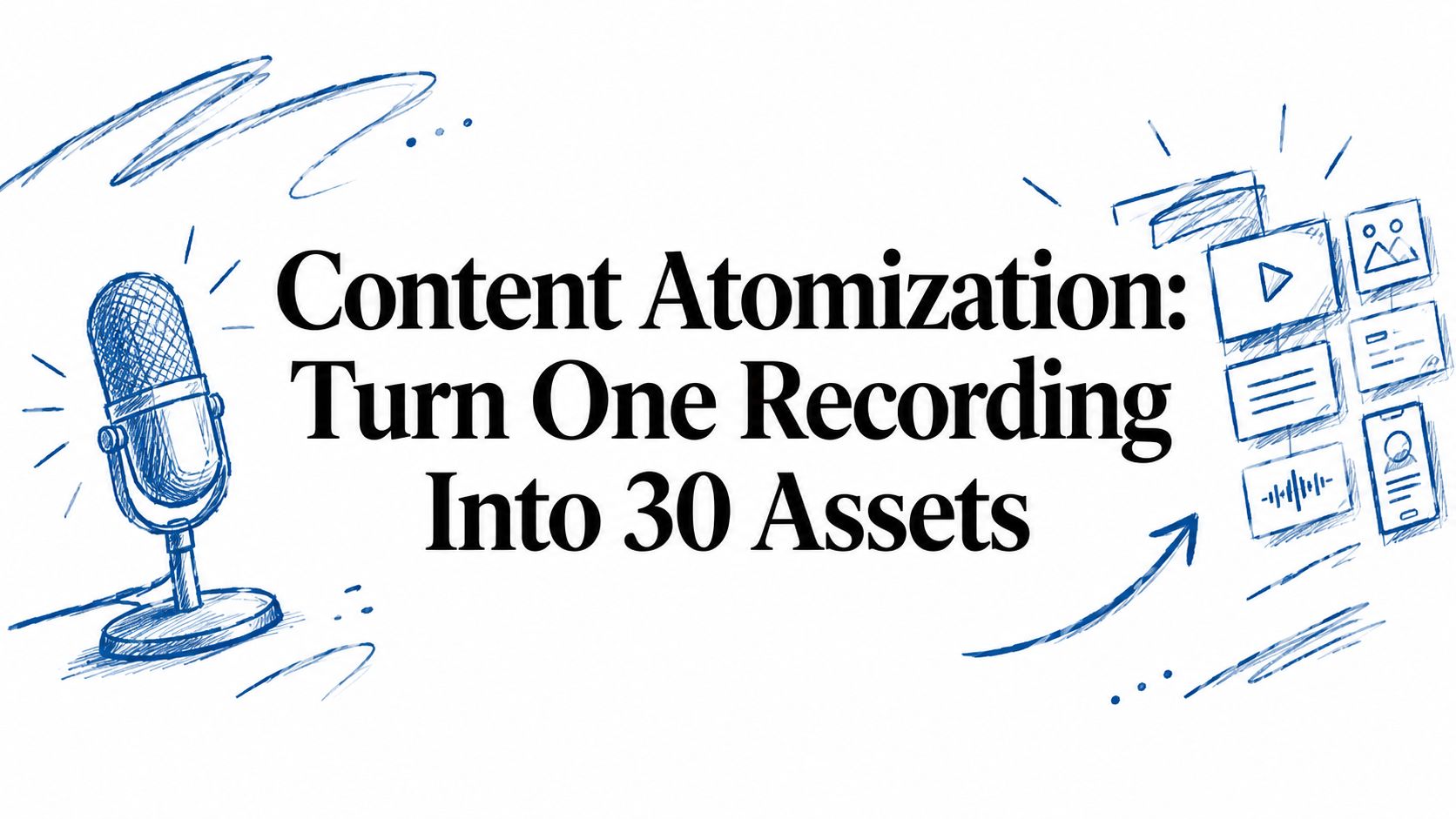
One video podcast episode can be broken into 20 to 30 distinct assets across channels including LinkedIn, Instagram Reels, TikTok, and YouTube Shorts, based on this practical repurposing guide for video podcasts.
What a 30-day content calendar can look like
One 45-minute recording becomes 30 assets when the editor extracts multiple angles from a single conversation. That usually supports a simple monthly plan like this:
- Week 1: two clips, two text posts, one quote graphic
- Week 2: two clips, one carousel, two text posts
- Week 3: three clips, one quote graphic, one blog-derived post
- Week 4: three clips, two text posts, one quote graphic, one carousel
That cadence keeps output steady without forcing the founder to produce new material every day.
A walkthrough of the asset mix is shown below.
What separates a real package from a clip farm
The difference isn't volume alone. It's whether the service gives editorial coverage across formats.
A clip-only service gives fragments. A complete package gives a content system.
For examples of what ready-to-publish assets should look like, this collection of done-for-you social post outputs shows the standard buyers should expect. A brand example is also useful, especially for teams looking at how content is produced for Shopify-style outputs.
The True Cost of a DIY Social Media Workflow
DIY looks cheap until someone tracks the hours. Then it looks like a senior employee doing junior production work.
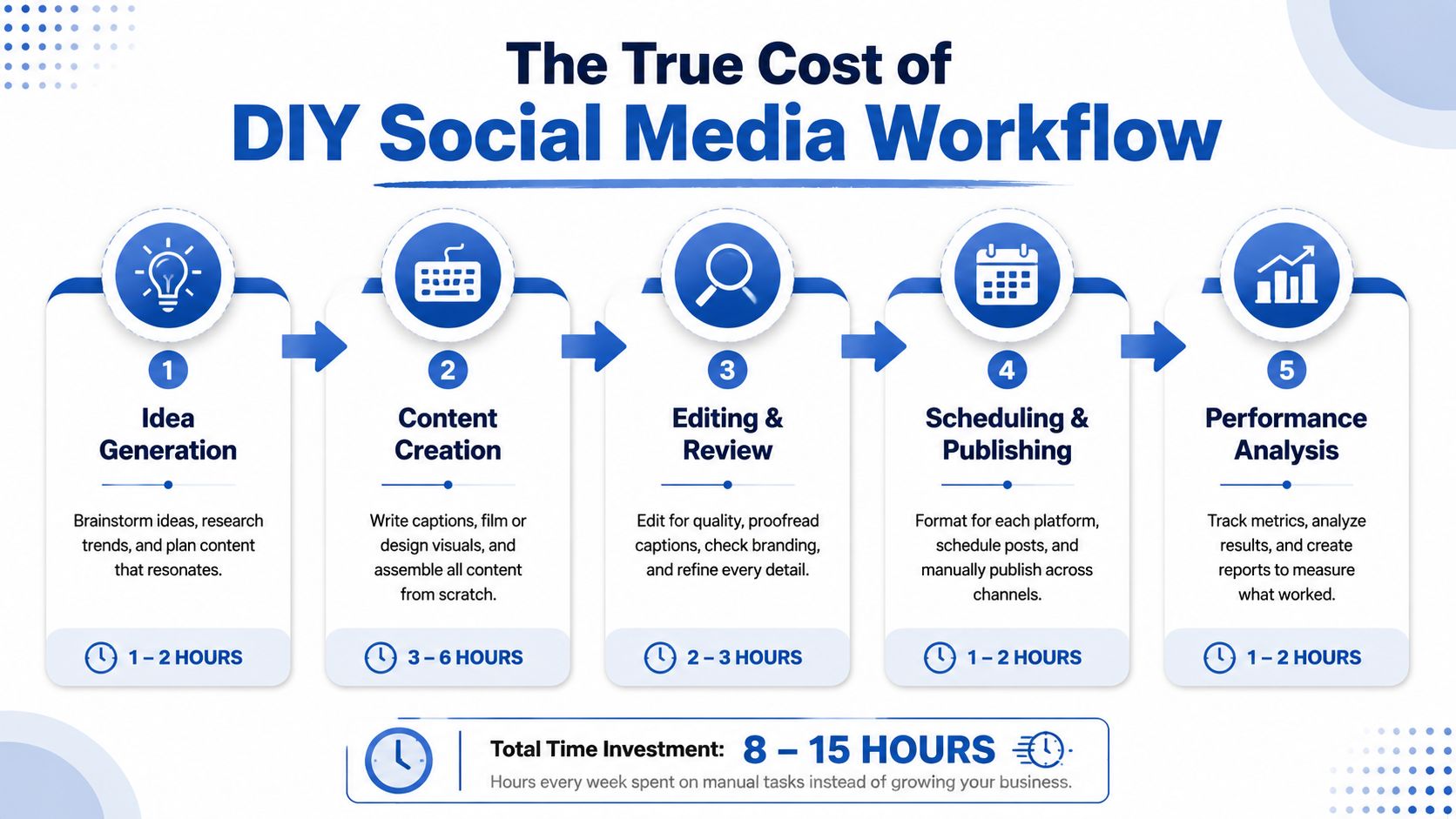
Where the hours actually go
For one recording, the manual workflow often looks like this:
Transcript cleanup
Automated transcripts still need fixing. A 45-minute podcast episode requires 15 to 20 minutes of manual review to correct speaker labels, proper nouns, and garbled sections, according to this podcast repurposing workflow note.Clip selection and editing
Here, teams lose half a day. Clipping a 60-minute podcast into 3 to 8 usable clips takes 4 to 6 hours manually, based on Choppity's manual clipping estimate.Post writing and design
Someone still needs to write hooks, trim captions, format visuals, and decide what belongs on LinkedIn versus Shorts versus email.Scheduling and publishing
Assets need file names, thumbnails, captions, tags, links, and a calendar.Review and revisions
Founders then spend time correcting tone, wording, or design because the first pass often misses context.
DIY doesn't just cost time. It burns specialist attention
Repurposing a single podcast episode manually can save 10+ hours of work by eliminating the need for separate editors, writers, and designers to handle each asset type one by one, as explained in this breakdown of podcast repurposing service value.
That is the hidden cost of internal production. The team isn't only making content. They're context-switching across editing, writing, design, approvals, and scheduling.
A founder shouldn't spend an afternoon hunting timestamps when that founder could be on sales calls, customer interviews, or product work.
A realistic workflow example
Take one interview recording.
- Step 1: download the file, export audio, generate a transcript
- Step 2: clean transcript errors and identify likely hooks
- Step 3: scan for 3 to 8 clips worth cutting
- Step 4: edit clips, caption them, and check framing
- Step 5: turn the best moments into text posts and graphics
- Step 6: build a posting order and load it into the calendar
That isn't a quick side task. It's a production workflow.
Teams that want the full internal process mapped out can review this guide on social media content batching workflows and this operational breakdown of how to scale content production without hiring.
How to Evaluate Done-for-You Social Media Vendors
Price matters. But vendor selection should start with voice control, process transparency, and delivery standards. A cheap service that publishes generic content creates clean-looking assets and weak brand equity.
Ask how the content gets your voice right
The first question is simple. Is the service writing from scratch, or extracting from your actual speech?
If the vendor starts with a blank page, ask what inputs they use beyond a kickoff call. If they work from recordings, ask how they choose moments, shape posts, and keep nuance intact. Authenticity usually improves when the source material is a founder's real language, not a marketer's reconstruction of it.
Ask what gets reviewed by a human
Human review is not optional when a service is publishing in a founder's name. Copy written by humans in the client's voice outperforms AI-generated text by 34% in engagement, and high-performing brands rely on human review before publishing, as summarized in this discussion of brand integrity and human review.
That makes a few questions essential:
- Who reviews each asset before delivery? Ask whether clips, captions, graphics, and written posts all get checked by a person.
- How are revisions handled? Some vendors cap revisions so tightly that the client ends up finishing the work.
- Do they disclose AI use? A vendor doesn't need to avoid AI entirely. But hiding shortcuts is a red flag.
If a service can't explain its review process in plain language, it probably doesn't have a reliable one.
Ask operational questions, not vague ones
A strong buyer asks process questions that reveal quality fast.
| Question | What a strong answer sounds like | Red flag |
|---|---|---|
| What inputs do you need? | Raw recording, brand kit, voice notes, sample posts | Long setup, repeated briefing |
| How fast is delivery? | Clear turnaround and clear revision flow | "It depends" |
| Do you work from unedited recordings? | Yes, raw files are normal | Client must pre-edit everything |
| What's included? | Specific asset counts and format list | Vague "social content package" |
| What happens if tone is off? | Human revisions until it's right | Extra fees for basic correction |
What to look for in the final sample
Before hiring, ask for one sample pack or a detailed example. Review it like an editor.
Check for:
- Hook quality: Does the first line stop the scroll?
- Voice match: Does it sound like the founder, or a content intern?
- Format judgment: Was the right idea turned into the right asset?
- Brand fit: Do visuals follow the brand kit cleanly?
- Publishing readiness: Could the asset go live today without cleanup?
The best vendor won't only produce more content. They'll remove review friction.
The Repurposing Workflow A High-ROI Alternative
The cleanest workflow starts with a file that already exists. A podcast episode. A keynote. A sales call. An interview. A customer conversation. A meeting recording with sharp thinking in it.
That is why recording-based done for you social media content tends to outperform ghostwriting for founder-led brands. The raw insight is already captured. The job is extraction, packaging, and distribution.
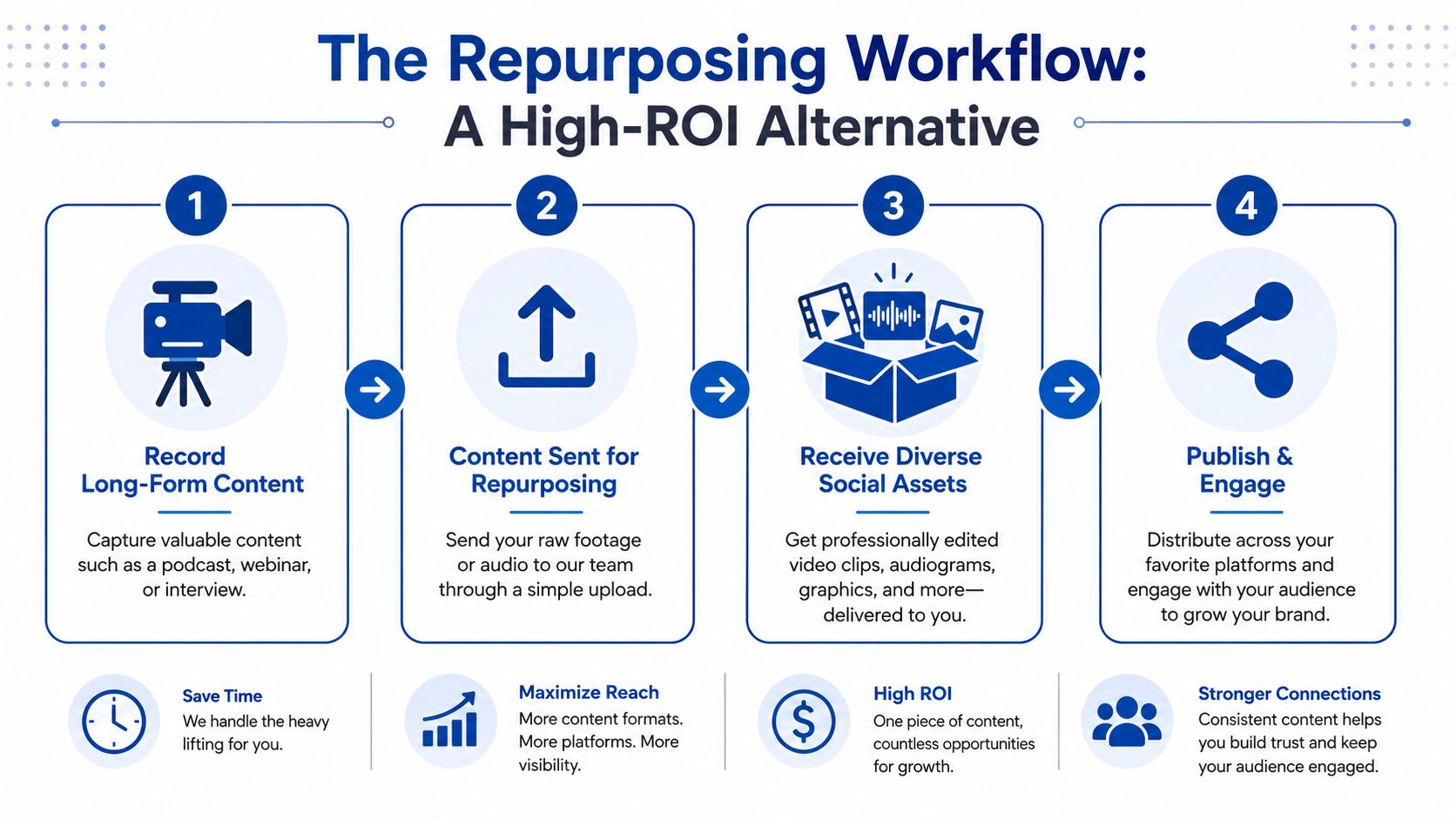
A simple workflow that respects executive time
A practical repurposing workflow looks like this:
Send one recording
The input can be a podcast, webinar, keynote, interview, meeting recording, course lesson, or sales call. Client time is about 15 minutes across handoff and review.Extract the strongest moments
Editors and writers identify clips, quotes, frameworks, objections, stories, and teachable moments.Turn one source into a full asset mix
Delivery includes 20 to 30 ready-to-publish assets in 72 hours. That can include video clips, LinkedIn posts, quote graphics, carousels, audiograms, and a blog post. Everything is produced in the client's brand voice with unlimited revisions.Publish from a ready-made plan
The output isn't a folder of random files. It should include a playbook that maps what to post, where, and when.
What a month of content looks like from one source
A single 45-minute recording can support a full month of output when the service knows how to segment one conversation into multiple narrative angles.
Here is one realistic example:
- Clip set: 8 to 12 short clips with branded captions
- Text set: 6 to 8 ready-to-publish posts with visuals
- Visual set: 4 to 6 quote graphics
- Depth set: 1 to 3 carousels
- Search set: 1 blog post
- Publishing plan: channel-by-channel schedule
That output maps cleanly onto a 30-day calendar without asking the founder to create new content from scratch every week.
Why this model has better authenticity
The biggest objection to done-for-you content is voice. Founders worry the output will sound bland, overpolished, or fake.
That concern is valid. Ghostwritten content often misses cadence, phrasing, and conviction. Repurposed content doesn't have that problem in the same way because the source language already belongs to the speaker. The founder already said the point out loud. Someone just needs to catch it, structure it, and format it.
The best done-for-you social isn't written for you. It's extracted from you.
That is the key distinction.
Why the turnaround matters
Speed is not cosmetic. Timeliness affects relevance. A comment from a keynote or interview is more useful when it gets published while the topic still feels current.
A professionally engineered workflow can reduce asset creation time to under 48 hours while converting long-form recordings into 20 to 30 platform-ready assets, increasing content velocity by 300 to 400%, according to CELUM's workflow benchmark. For service delivery, a 48 to 72 hour turnaround is the practical standard that keeps momentum high without dragging clients into endless approval cycles.
For small teams building this model into operations, this guide to a content repurposing workflow for small teams is a useful reference.
The done-for-you alternative
Instead of staffing an agency retainer or managing a VA, there is a cleaner option. Send one recording. Get back 20 to 30 ready-to-publish assets in 72 hours. That includes video clips, LinkedIn posts, quote graphics, carousels, audiograms, and a blog post, all in your brand voice, with unlimited revisions. Your time is about 15 minutes.
For teams that want concrete buying benchmarks, the comparison is straightforward:
- Agency: roughly $3,000 to $10,000 per month
- VA: roughly $800 to $1,500 per month
- Recording-based repurposing: from $999 per month
The unit economics are hard to ignore when one recording can become a month of social content and pricing can work out to from $14 per finished asset. Add a 72-hour turnaround guarantee or you don't pay, and the risk profile changes again.
If social still depends on someone "finding time," it won't stay consistent. To see what recording-based done-for-you social media content looks like in practice, book a call with RepurposeYourContent or request a sample from one of your own recordings.
Tags: