8 Format for Podcast Ideas for B2B Creators
Choose the right format for podcast content with eight B2B episode structures, templates, production tips, and repurposing ideas.
The best format for podcast content depends on the creator's goal, but interview, rapid-fire, and educational structures usually offer the clearest B2B repurposing paths. The right structure creates clear segments, quotable insights, and reusable teaching points without forcing every episode into the same template.
Podcasting now reaches a large global audience. One 2026 estimate puts worldwide podcast listeners at 619.2 million, up from 506.9 million in 2023, with a projection of 651.7 million by 2027 (PodcastStatistics' global podcast audience data). That scale changes the production question. A podcast episode shouldn't end when it reaches Apple Podcasts, Spotify, or YouTube.
For B2B creators, the strongest format for podcast content supports discovery, authority, lead generation, and repeatable distribution. The eight formats below compare audience fit, production effort, episode structure, social distribution, blog potential, and the true cost of doing the work internally.
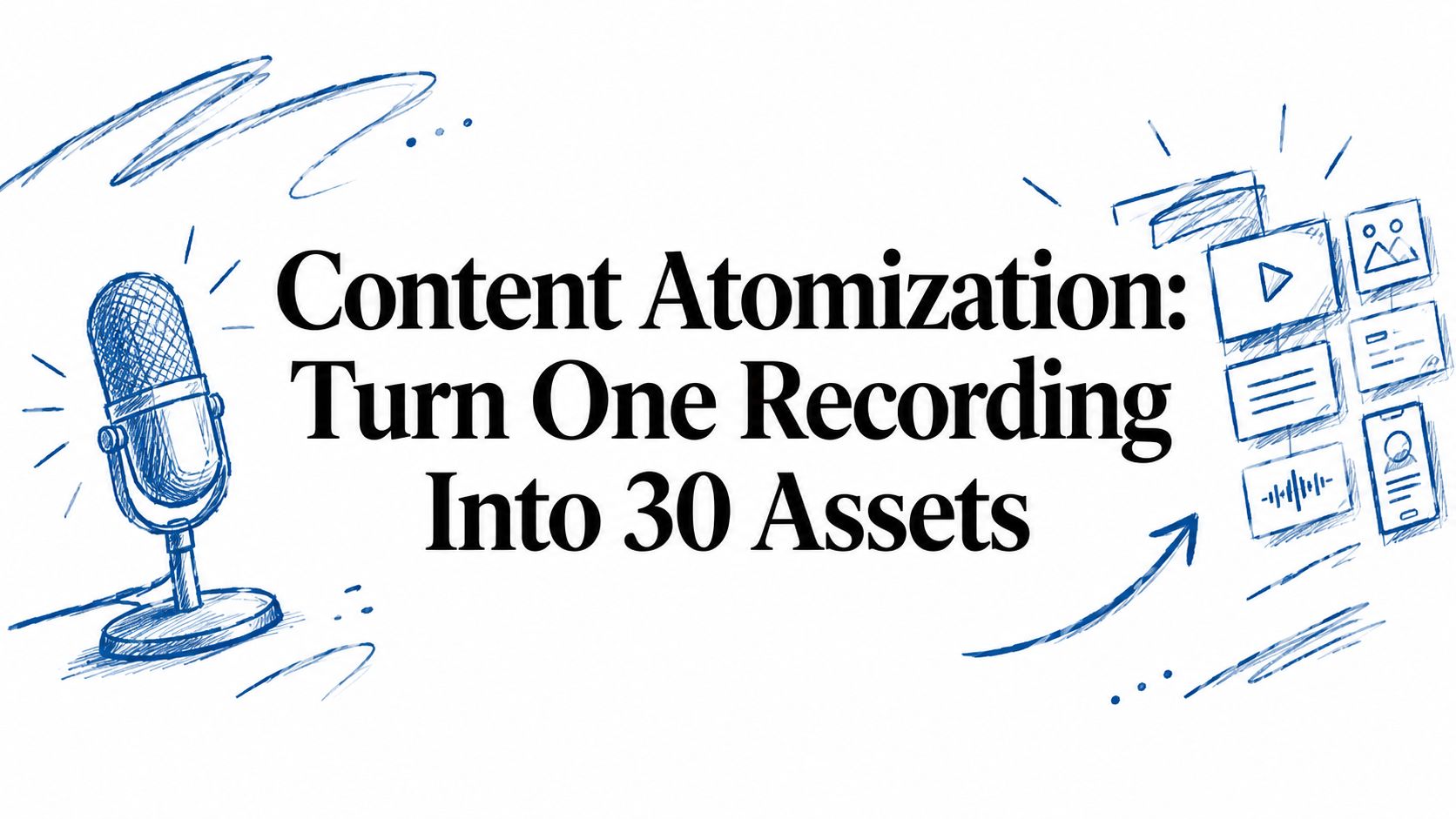
A realistic DIY workflow is demanding. Planning takes 30 to 60 minutes, recording takes 45 to 120 minutes, clipping takes 2 to 3 hours, writing social posts takes 2 to 4 hours, and designing visuals takes 1 to 2 hours. A single 45-minute recording can become 30 assets, but only when the conversation includes clear ideas, strong transitions, and deliberate clip boundaries.
1. Interview and Conversation Format
Interview podcasts remain one of the most practical choices for B2B authority building. A host guides a guest through expertise, decisions, failures, frameworks, and opinions. The conversation can feel natural, but the best repurposing results still require preparation.
A typical interview runs 45 to 120 minutes. That length gives the editor several narrative arcs to work with. A guest might offer a contrarian insight near the beginning, explain the operational details later, and finish with a useful framework.
The format works especially well for founder content, customer interviews, partner marketing, and thought leadership. Shows such as The Tim Ferriss Show, Lex Fridman Podcast, and Masters of Scale with Reid Hoffman demonstrate how a guided conversation can support both depth and personality.
Practical rule: Brief guests with three to five open questions, not a rigid script. The host needs direction, while the guest still needs room to think aloud.
Why interviews repurpose well
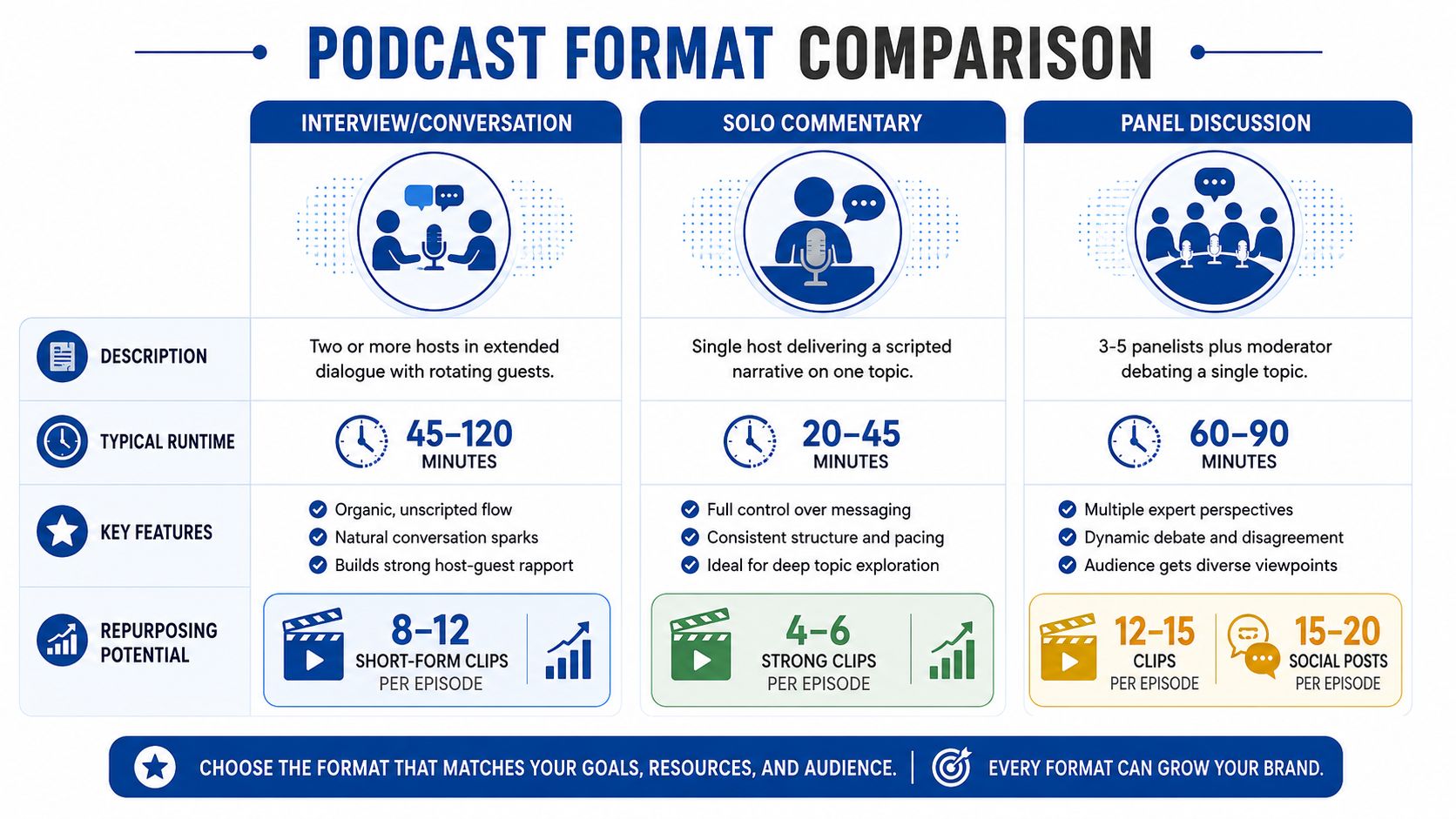
One 60-minute conversation can yield approximately 25 to 30 repurposable assets, including 10 video clips, 8 quote graphics, 6 social posts, and 1 blog post. That output depends on the recording itself. Generic answers create generic content. Specific stories, strong opinions, and clear examples create usable assets.
The host should send preparation notes 24 hours before recording, record separate audio tracks locally, and flag potential clip moments during the conversation. A five to ten-minute buffer after the formal interview often captures a cleaner follow-up answer or a sharper closing thought.
The production cost is moderate. Scheduling and briefing take time, while remote recording adds technical risk. Editing also takes longer when speakers interrupt each other or answer without completing a thought.
For a deeper B2B application, teams can use this interview-based content marketing strategy. An AI-powered interview transcription guide can also help teams understand where transcription fits, although transcription alone doesn't create finished social assets.
2. Solo Commentary and Monologue Format
Solo commentary gives the host complete control over the message, pacing, examples, and call to action. It suits founders with a clear point of view, marketers analyzing industry changes, and specialists teaching a focused concept.
A useful episode usually follows a simple structure: a sharp opening hook, two or three main points, and a closing takeaway. The host can record faster because there's no guest scheduling, briefing, or remote audio troubleshooting.
The trade-off is editorial pressure. A solo host must create momentum without another voice. A loose monologue often wanders, repeats itself, or buries the strongest insight under background context.
Build the episode around one claim
The opening should present a specific statistic, problem, or counterintuitive claim within the first minute. Each main point needs one clear job. A five-minute explanation about one idea usually repurposes better than a fifteen-minute explanation containing several unrelated ideas.
A practical structure looks like this:
- Hook: State the problem and why it matters.
- Point one: Explain the mistake or misconception.
- Point two: Show the practical alternative.
- Point three: Give the audience an action.
- Close: Repeat the decision or next step.
The host should read the script aloud before recording. Written prose often sounds stiff in audio. Short pauses also help. A pause of two to three seconds after an important point can create a clean edit and give the speaker emphasis.
Solo episodes create strong blog material when the argument has a logical sequence. They also produce fewer organic reactions than interviews, panels, or debates. A content team may need to create more visual framing around each clip.
Teams publishing this format should apply podcast SEO best practices for 2026. The show notes, transcript, episode title, and clip captions should all reinforce the same search intent.
3. Panel Discussion Format
Panel discussions bring several perspectives into one episode. A moderator introduces the topic, manages the questions, and keeps the speakers moving. The format works for industry trends, event content, customer perspectives, and topics where one answer would feel incomplete.
Panels commonly run 60 to 90 minutes. That length creates room for disagreement, examples, and audience questions. It also creates production risk. Multiple microphones, cameras, remote connections, and speaker levels all need attention.
The strongest panels include speakers with different positions. If every participant agrees, the recording may sound polished but flat. A useful panel gives the audience competing frameworks, not four versions of the same answer.
Moderation determines clip quality
The moderator should prepare 10 to 15 questions, while remaining willing to abandon the script when the discussion becomes valuable. Opening statements help each panelist establish a position before the questions begin.
Separate audio tracks make editing easier. A hybrid panel also benefits from one camera per panelist. Editors can then cut reactions, interruptions, and visual emphasis without relying on a single wide shot.
A 75-minute panel can yield approximately 12 to 15 clips and 15 to 20 social posts. The output is often broader than an interview because each topic may produce several perspectives. However, the clips need more context. A viewer may not understand a response if the question or opposing view is removed.
Panels are also strong sources for comparison articles and expert roundups. The writing team can group answers by theme, contrast positions, and build a more balanced blog post.
For a practical distribution workflow, teams can repurpose expert interviews into content. The same process applies to panel recordings, provided the editor preserves speaker identity and conversational context.
4. Narrative and Story-Driven Format
Narrative podcasts use interviews, narration, archival audio, music, and sound design to build a cohesive story. This format suits customer journeys, company histories, investigative topics, founder origin stories, and complex business problems.
The finished episode may run 30 to 60 minutes, but the production process is far longer than the runtime suggests. The producer must plan the story arc before recording, gather enough source material, and decide which details advance the narrative.
A narrative episode can feel highly distinctive. It can also become the most expensive format to produce internally. Research, interview scheduling, transcription, scripting, fact checking, sound design, and editing all compete for attention.
Story structure creates durable content
A producer may conduct 8 to 12 interviews for one episode to gather enough material for a strong edit. The final episode uses only the most relevant sections. Music and ambient sound bridge scenes, establish mood, and help maintain pacing.
The host narration needs tight scripting. Every sentence should move the story forward, clarify the stakes, or connect two pieces of evidence. Long introductions and broad background explanations usually weaken clips and make blog extraction harder.
DIY editing can take more than 50 hours per episode. That figure makes this format unsuitable for teams expecting a weekly production schedule without a dedicated producer.
The repurposing upside is substantial. A strong narrative can produce a flagship blog post, several thematic clips, a timeline graphic, quote cards, and a sales enablement story. The downside is that each asset needs editorial context. A random excerpt rarely works as a standalone social post.
Teams can turn the finished story into a structured article with this guide to turning podcast episodes into blog posts. The blog should preserve the narrative logic rather than reproduce a transcript.
5. Rapid-Fire and Segment-Based Format
Rapid-fire episodes divide one recording into several self-contained topics. Each segment has its own hook, explanation, and conclusion. The structure suits news roundups, marketing updates, product commentary, list episodes, and recurring industry analysis.
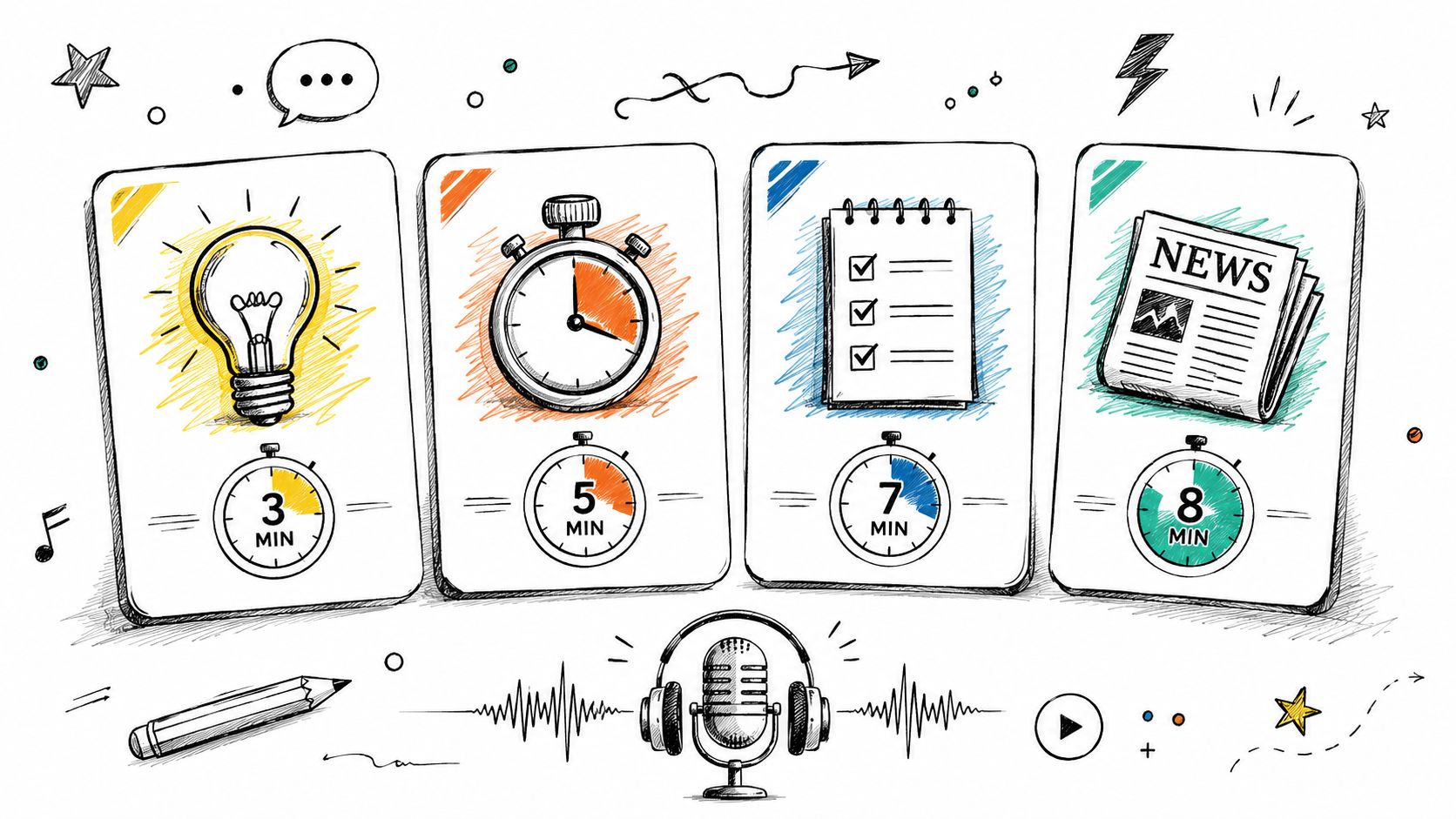
A typical episode contains 5 to 15 topics, with each segment lasting 3 to 8 minutes. Total runtime often falls between 30 and 45 minutes, but the audience experiences the episode as a sequence of smaller units.
This format has a major B2B advantage. Each segment can become a separate publishing opportunity. The production team doesn't need to find a usable moment inside a long, continuous discussion. The boundaries already exist.
Segment boundaries reduce editing time
The host should write segment titles before recording and use them as hard breaks. A timer keeps each topic contained. Every segment should open with a sentence explaining why the topic matters.
A useful segment template includes:
- Hook: Name the issue or surprising development.
- Context: Explain what changed.
- Analysis: Give the host's interpretation.
- Action: State what the audience should do.
- Transition: Move cleanly to the next topic.
One 45-minute, 10-segment episode can yield 10 individual clips ready for YouTube Shorts, TikTok, and LinkedIn. Title cards also help viewers understand the topic immediately, especially when the original recording uses a video-first setup.
The weakness is depth. Rapid-fire content can sound shallow if every segment receives the same generic treatment. It also demands more preparation than it appears to. Topic research, transitions, titles, and visual references all need to be ready before recording.
For distribution, creators should follow a platform-native approach to podcast clips for social media. The same clip can be adapted for each channel, but captions and opening text shouldn't be copied mechanically.
6. Debate and Versus Format
Debate podcasts turn disagreement into the organising principle. Two hosts or guests defend opposing positions around a defined question. The structure suits business strategy, pricing, hiring, marketing channels, product decisions, and other topics where reasonable people can disagree.
A debate usually runs 30 to 60 minutes. The episode needs a clear resolution before recording begins. “Is video useful?” is broad. “Should a B2B podcast build for YouTube discovery before audio loyalty?” creates a sharper discussion.
The format produces strong clips because each speaker responds to a claim. Viewers can understand the conflict quickly, especially when the clip begins with the resolution or the strongest counterargument.
Rules protect the recording
Each participant should receive a position one week before recording. That gives both sides time to research and prepare examples. A moderator can define the rules, track the arguments, and identify when a speaker has answered the actual question.
Separate tracks matter even more here. Cross-talk and interruptions are part of the format, but poor audio makes the disagreement exhausting to follow. The moderator should also prevent personal attacks and unsupported claims.
One 50-minute debate can yield approximately 12 to 15 strong clips. Those clips can support opinion-led LinkedIn posts, comparison carousels, newsletter arguments, and sales content. The blog opportunity is equally strong when the writer presents both positions fairly before explaining the practical decision.
The weakness is brand risk. A debate can create attention, but a careless speaker can damage trust. B2B teams should choose topics where disagreement reveals useful trade-offs, not topics that encourage empty provocation.
This format works best for founders and experts with a clear position. It works poorly when participants avoid commitment or spend the episode negotiating a safe middle ground.
7. Round-Table and Peer Discussion Format
Round-table podcasts feature three to five regular hosts or contributors discussing a loose agenda. The appeal comes from familiarity, personality, reactions, and recurring dynamics. Business shows often use the format for weekly commentary, market analysis, and founder conversations.
The format can run 60 to 120 minutes, but duration shouldn't become a target. Long recordings create more material, yet they also create more dead air, repetition, and editing decisions.
Round tables can generate excellent social moments when each participant has a defined role. One person can lead questions, another can challenge assumptions, and another can add humour or practical examples. Without those roles, the discussion becomes a sequence of interruptions.
Control the energy without killing it
A loose agenda should contain two or three topics. The hosts need enough structure to protect the recording's purpose, but enough freedom to follow a useful tangent.
Remote sessions should use separate audio tracks for each host. The editor can then remove overlap, tighten pauses, and isolate reactions. Participants should also flag funny moments, strong reactions, and concise explanations during the recording.
The format creates a large raw content pool, but the clip quality varies. A reaction may work as a short video when paired with the original claim. A long tangent may be entertaining to existing listeners but confusing to new viewers.
Round tables produce strong community content. Regular hosts create continuity, and the audience learns each person's role. They are less efficient for SEO than educational episodes because the conversation may cover several unrelated topics. A writer can still extract a blog post, but the editorial team must impose a clear theme after recording.
This format suits brands that can sustain regular participation. It doesn't suit a solo founder who already struggles to schedule one guest. The production effort grows with every additional speaker, especially when video, captions, and multi-camera editing are required.
8. Educational and Instructional Series Format
Educational podcasts turn the show into a curriculum. Each episode teaches one skill, concept, or chapter, then points listeners toward a practical action. This structure fits B2B education, customer onboarding, founder expertise, professional training, and search-led content programs.
Episodes commonly run 15 to 30 minutes and follow a consistent template. The host states the objective, teaches the lesson, and closes with action steps. A series may contain 10 to 50 episodes, depending on the subject and curriculum depth.
The format creates fewer spontaneous moments than an interview. Its strength is clarity. Each episode can target one audience question, one search intent, and one business problem.
Teach one outcome per episode
A useful lesson structure looks like this:
- Objective: State what the listener will understand or complete.
- Problem: Connect the lesson to a real business situation.
- Teaching: Explain the framework or process.
- Example: Show how the idea works.
- Action step: Give the listener a task.
The host should map the full curriculum before recording. Each episode needs a one-page learning objective, a clear opening problem, and a natural transition into the next lesson. A worksheet or workbook can extend the content beyond the feed.
Educational episodes are excellent sources for SEO blog posts. The transcript can become a draft, while the content team adds headings, examples, internal links, and a clear call to action. Short clips also work when they answer one precise question.
The main cost is planning. A weak curriculum creates repetitive episodes and makes the series difficult to follow. A strong curriculum creates a durable content library that supports search, sales conversations, onboarding, and email distribution.
8 Podcast Format Comparison
| Format | Implementation complexity | Resource requirements | Expected outcomes | Ideal use cases | Key advantages |
|---|---|---|---|---|---|
| Interview / Conversation Format | Medium, needs skilled interviewer and guest prep | Moderate, guest coordination, separate audio tracks, moderate editing | High engagement; very high repurposing (many short clips) | Thought leadership, long-form expert interviews, audience growth | Authentic dialogue, abundant clipable moments, guest amplification |
| Solo Commentary / Monologue Format | Low–Medium, requires strong scripting and delivery | Low, single host, minimal production/editing | Consistent messaging; medium repurposing (4–6 clips) | News analysis, personal brand building, focused topical deep dives | Simple logistics, tight control of tone and pacing |
| Panel Discussion Format | High, moderator skill and time management required | High, multiple panelists, scheduling, multitrack recording, heavier editing | Very high engagement and reach; very high repurposing | Conferences, industry debates, multi-perspective exploration | Multiple expert voices, cross-promotion, dynamic debate moments |
| Narrative / Story-Driven Format | Very high, extensive planning, scripting and edit | Very high, producers, sound design, music licensing, 40–60 hrs/ep | Deep listener loyalty and premium perception; low–medium repurposing | Investigative series, serialized storytelling, documentary-style shows | Cinematic production, emotional resonance, awards potential |
| Rapid-Fire / Segment-Based Format | Medium, disciplined timing and segment structure | Low–Moderate, segment prep, simple editing, visual title cards | Extremely high repurposing (each segment = clip); broad topic reach | News roundups, list shows, variety and hot-take formats | Built-in clip structure, high social readiness, fast pacing |
| Debate / Versus Format | Medium–High, needs fair moderation and preparation | Moderate, two strong voices, prep, separate tracks | Very high engagement and virality; many quotable clips | Controversial topics, policy/ideology comparisons, opinion shows | Conflict-driven attention, clear opposing viewpoints, cross-audience pull |
| Round-Table / Peer Discussion Format | Medium, relies on host chemistry and loose agenda | Moderate, multiple regular hosts, complex editing for cross-talk | Medium–High retention; personality-driven clips (editing intensive) | Comedy, sports, peer-to-peer business chats, recurring panels | Strong listener loyalty, authentic banter, scalable repeat format |
| Educational / Instructional Series Format | Medium–High, curriculum mapping and consistent structure | Moderate, research, materials, short focused production per ep | High retention and repeat listeners; lower social clip value | Course-like learning, skill-building series, lead-generation content | Predictable structure, progressive learning, SEO and conversion friendly |
Choose the Structure That Multiplies Your Work
The right format for podcast content depends on the business outcome. Interviews suit authority building and guest reach. Rapid-fire episodes suit frequent clips and regular commentary. Debates suit strong opinions and decision-led content. Educational series suit SEO depth, customer education, and structured thought leadership.
Audience behaviour also matters. Across 49 global markets, 41% of consumers listen to podcasts for at least one hour each week, while 9% listen for more than 10 hours weekly (YouGov's 2025 global podcast listening research). In markets including Indonesia, Thailand, and India, reported weekly engagement is especially high. That makes localization, mobile-first delivery, and clear episode structure important for international B2B audiences.
Distribution choices now affect the recording itself. A 2026 MIDiA study found that 62% of monthly active podcast users accessed podcasts through YouTube, compared with 47% through Spotify, a 15-point gap (Podnews' summary of the MIDiA audio consumer study). A podcast designed only for uninterrupted audio may miss valuable video discovery. Each episode should include visually understandable statements, clean framing, captions, and clip boundaries.
A practical workflow looks like this:
- Choose one audience problem: Pick a decision, mistake, or question that matters to buyers.
- Select the format: Match the problem with an interview, rapid-fire episode, debate, or lesson.
- Create the template: Define the hook, segments, transitions, and closing action.
- Record separate tracks: Capture clean audio for every speaker and plan the visual framing.
- Mark five to ten moments: Flag strong claims, useful examples, objections, and concise answers.
- Send the recording to RepurposeYourContent: The source can be a podcast, interview, keynote, sales call, livestream, course, or meeting recording.
- Review the returned assets: Approve the content, request changes, and publish through the selected channels.
The done-for-you alternative reduces the post-production burden. Clients spend about 15 minutes sending one recording and reviewing the delivery. RepurposeYourContent returns 20 to 30 ready-to-publish assets in 72 hours, including video clips, LinkedIn posts, quote graphics, carousels, audiograms, and a blog post, written in the client's brand voice.
The service includes unlimited revisions and a 72-hour turnaround guarantee, or the client doesn't pay. Pricing starts at $14 per finished asset, and one 45-minute recording can become 30 assets. For teams comparing options, a cinematic AI video maker may support visual production, but a done-for-you service handles the broader editorial workflow from recording to finished distribution assets.
Podcast accessibility must also be built into the workflow. UC Berkeley requires an accurate, verbatim transcript, a clear transcript link on each hosting platform, speaker identification, and descriptions of important non-dialogue sounds, and states that all podcasts need transcripts regardless of posting date or access count (UC Berkeley's podcast transcript accessibility guidance).
Choose the structure that gives the team the clearest ideas with the least production friction. Then book a call with RepurposeYourContent or request a sample using one existing recording. The team can show exactly how that episode could become clips, posts, graphics, carousels, audiograms, and a blog post.
Tags: