Your Interview-Based Content Marketing Strategy Playbook
Build an interview-based content marketing strategy that turns one conversation into a month of content. This playbook covers planning, production, and KPIs.

An interview-based content marketing strategy is a system for turning one recorded conversation with an expert, customer, or internal leader into 20 to 30 content assets such as blog posts, video clips, social posts, and graphics. It works because authentic experience beats generic AI copy, especially when the goal is trust, search visibility, and pipeline.
Most advice on content strategy still pushes volume. Publish more. Prompt faster. Fill the calendar. That model is already breaking down for B2B teams planning 2026.
A better model is simpler. Record one strong conversation each week. Extract the sharpest ideas. Publish them across channels in the right format. Repeat. That gives content teams something AI can't manufacture on its own, which is original experience, named expertise, and real quotes.
Google's E-E-A-T signals and AI answer engines both favor content with real-world authority. That doesn't mean every post needs a founder manifesto. It means the raw material matters. A conversation with a customer who solved a hard problem contains friction, nuance, objections, trade-offs, and language that buyers use. A 45-minute interview with a product leader contains specifics that five polished AI articles usually miss.
The market signal is already clear. Recorded content is the #1 source of quality leads for 73% of B2B marketers, yet only 1 in 3 teams have a scalable way to repurpose it according to Search Engine Journal's content marketing statistics roundup. That gap is the strategy problem.
Why One Conversation Beats Five AI Articles
The strongest content teams in 2026 won't win by producing more words. They'll win by producing less content from more authentic sources.
An interview-based content marketing strategy replaces the write-from-scratch model with a source-first model. Instead of asking a writer or AI system to invent something useful from a blank page, the team starts with a recorded conversation. That recording becomes the source material for every downstream asset.
AI can summarize. It can't have experience
AI is useful for formatting, drafts, and analysis. It isn't a substitute for lived expertise. It can't be a customer who bought, struggled, switched, and got results. It can't be a subject matter expert who has spent years making trade-offs in a category. It can't explain what changed inside a buying committee when a deal finally moved.
That difference matters for search and for trust.
A lot of teams confuse efficiency with originality. They're not the same. Five AI-written posts often say what everyone else is already saying. One well-run interview creates material with tension, voice, and evidence.
Practical rule: If the idea could have been generated without talking to a real person, it probably won't stand out.
The debate between native publishing and repurposing usually misses this point. The actual issue isn't format. It's source quality. This is why native content vs repurposed content performance is the wrong first question. The first question is whether the content started with something worth quoting.
Interviews create the raw material most teams are missing
A strong interview gives a content team several things at once:
- Named authority: A real expert, customer, or executive is attached to the insight.
- Natural language: Buyers hear how practitioners describe problems in the wild.
- Original phrasing: Short quotes and sharp opinions travel well across formats.
- Narrative structure: Good conversations naturally produce before, after, problem, change, and outcome.
That last point matters more than is generally understood. Distribution gets easier when the source already contains story.
What fails is the opposite approach. Teams publish generic thought leadership, broad educational posts, and lightly edited summaries. The output looks busy but doesn't build authority. It also doesn't compound. Nobody wants to cite copy that sounds like it came from the same prompt library as everything else.
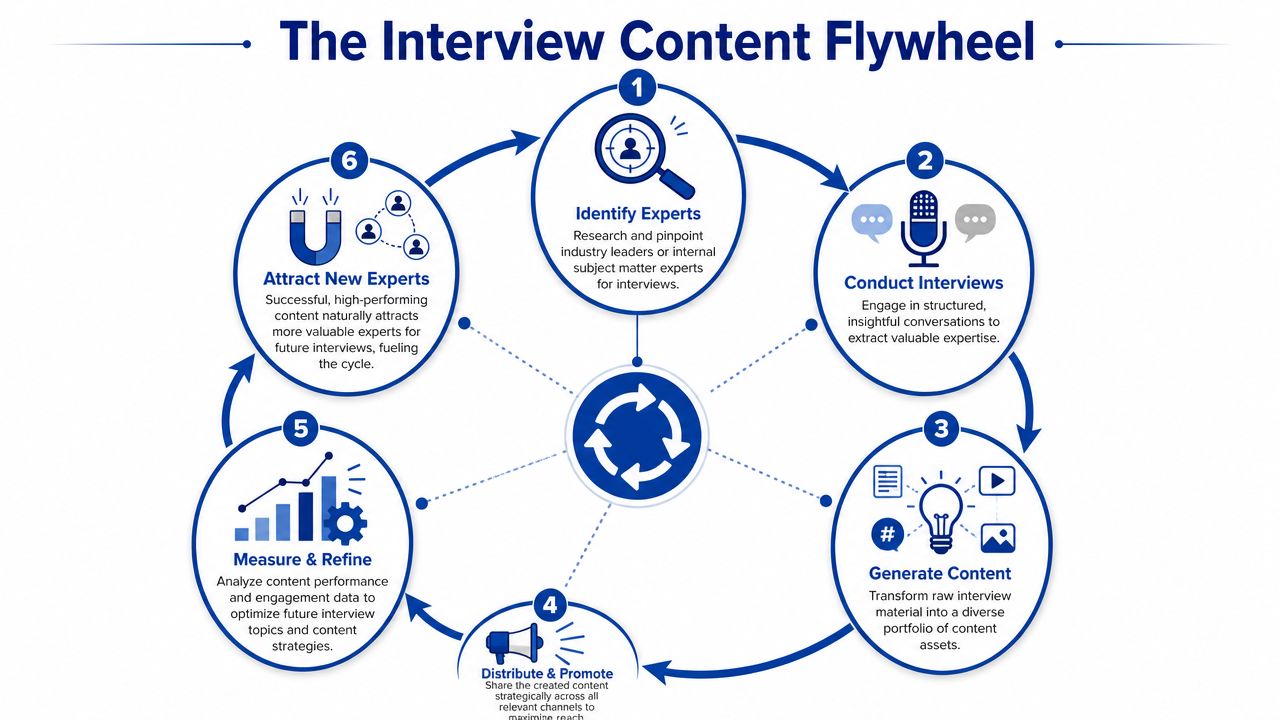
Build Your Interview Flywheel
A good interview program doesn't start with random guest outreach. It starts with a repeatable mix of voices.
The simplest flywheel has three inputs. External experts for category authority. Customers for proof and objections. Internal leaders for product and market insight. Those three voices give enough range to support thought leadership, demand generation, sales enablement, and retention content without forcing the team back to blank-page writing.
Choose people for buyer relevance, not status
A famous guest with vague opinions won't help much. A niche operator with strong specifics often will.
Case studies and customer stories have a 53% usage rate in B2B, the highest among content types, and success depends on choosing interview subjects whose stories align with specific buyer personas and extracting original perspectives rather than common advice, according to Forbes Advisor's content marketing statistics.
Use that as the filter.
- External experts: Pick people with a clear point of view on a problem your buyers already care about.
- Customers: Prioritize buyers who can explain their before-state, trigger event, selection process, and internal objections.
- Internal leaders: Use product marketers, founders, solutions consultants, and customer success leaders who hear the market every week.
A useful flywheel looks a lot like a structured editorial engine. Teams that already understand how to create a content flywheel from webinars can adapt the same logic to interviews, podcasts, keynotes, and sales conversations.
Set a cadence the team can keep
Teams often overplan and underrecord. The fix is a standing rhythm.
A practical operating cadence:
| Recording type | Frequency | Best use |
|---|---|---|
| Expert interview | Monthly | Top-of-funnel authority and AI-search visibility |
| Customer interview | Monthly | Mid-funnel proof and sales objections |
| Internal SME interview | Weekly or twice monthly | Product education, objections, trends |
One 45-minute session per week is enough to build a serious pipeline of source material. That pace is sustainable for lean teams. It also creates editorial consistency without requiring daily brainstorming.
Use standing formats instead of reinventing every session
Good interviews feel conversational. Good interview programs are heavily structured behind the scenes.
Three formats work well:
Expert roundtable Use this for category trends, strategic shifts, and strong opinions. Best for thought leadership.
Customer story session Keep this focused on change. What wasn't working, what triggered action, what objections came up, what happened next.
Internal insight briefing Record a product marketer, founder, or sales leader unpacking one topic buyers repeatedly ask about.
A weekly interview rhythm is easier to protect than a daily writing rhythm. One demands a calendar slot. The other demands endless idea generation.
The flywheel gets stronger over time. Good interviews attract more good interviewees. Customers are more willing to participate when they see polished outputs. Internal leaders are more willing to record when they know the result won't disappear into a single blog post.
Your Interview-Based Content Production System
One strong conversation does not become a content system on its own. It becomes a content system when the team knows exactly how to capture the good parts, shape them into assets, and ship them without rebuilding the process every week.
That is the difference between recording expertise and publishing it.
A practical production system has four parts. Record. Extract. Repurpose. Distribute. If one breaks, the backlog grows, the interview loses context, and the team slips back into writing from scratch.
The true cost of doing it manually
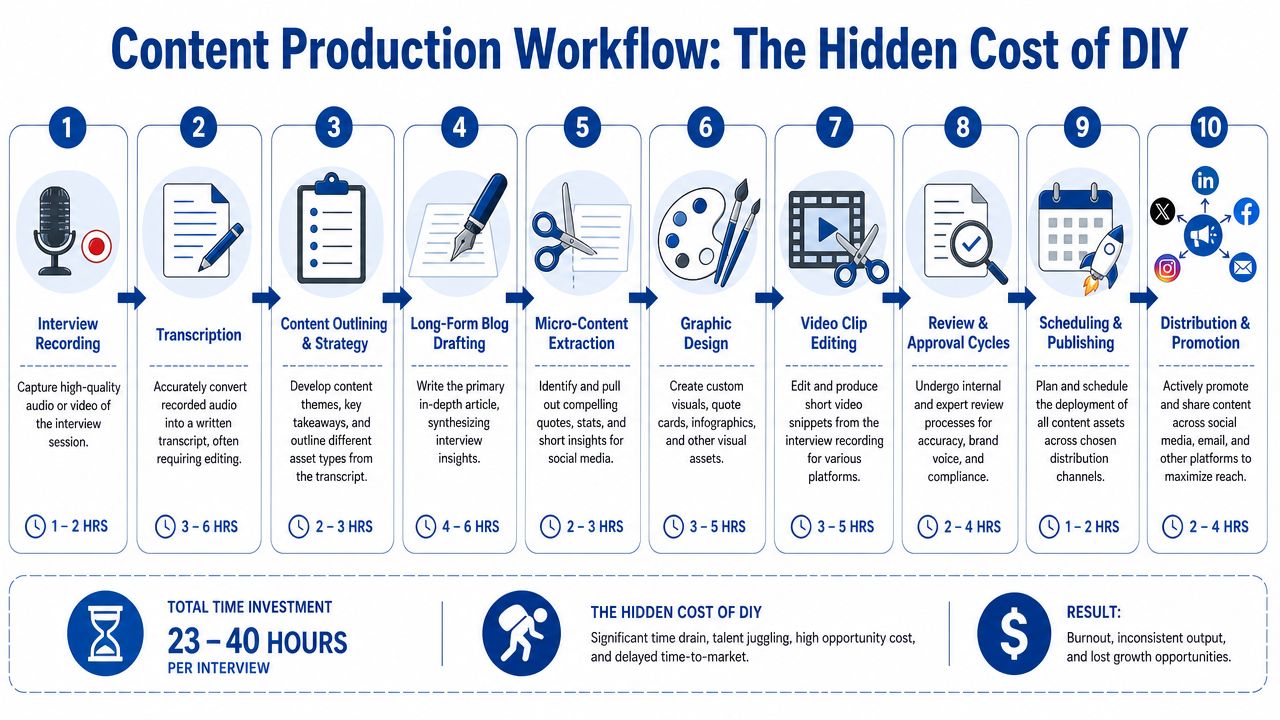
A 45-minute interview sounds efficient. The production work after the call is where teams get stuck.
For one session, a manual workflow usually includes:
Transcription and review
Plan for time to clean the transcript, remove filler, and mark the sections worth keeping.Clip selection and editing
Someone has to find the hooks, trim the clips, check pacing, and add captions that read cleanly on mobile.Long-form writing
The writer still needs to decide on the angle, structure the argument, pull supporting quotes, and edit it into a publishable post.Design and formatting
Carousels, quote cards, thumbnails, newsletter snippets, and channel-specific formatting all take separate effort.Approvals
This gets slower if the guest wants line edits, legal needs review, or the brand team checks every asset individually.
In practice, one interview can absorb a full day of skilled work before distribution even starts. That is why many B2B marketing teams say they want to repurpose content but only publish the full recording and one blog post.
A short demo of the production challenge sits below.
A workflow example that actually scales
The goal is not to squeeze more assets out of a transcript. The goal is to preserve the experience inside the conversation and turn it into assets that match how buyers consume information.
That requires a sequence.
Step 1. Record for extraction, not just publication
A weak interview gives you polished vagueness. A good one gives you proof, tension, and usable language.
Ask for specifics:
- Experience questions: What happened first? What failed? What changed after that?
- Buyer questions: What objections came up? What convinced the team to move?
- Point-of-view questions: What does the market misunderstand? What advice sounds good but fails in practice?
Good interviews produce raw material that AI cannot invent. Real examples. Real sequencing. Real trade-offs.
Step 2. Extract themes before making assets
Do not start with clip cutting. Start with transcript analysis.
Tag the transcript for a few high-value elements:
- One core argument that can support the main article
- Short, sharp quotes that work on social
- Moments with tension or emotion that make strong video clips
- A process or framework that can become a carousel or email
Teams that skip this step usually end up with disconnected content. The clips are fine on their own, but they do not reinforce a consistent message across channels.
One conversation should sound like one point of view, even after it has been split into ten formats.
Step 3. Repurpose by job, not by format
Format is the packaging. The key decision is what each asset needs to do.
| Asset type | Best use |
|---|---|
| Blog post | Full argument and search visibility |
| LinkedIn clips | Strong opinions and credibility |
| Quote graphics | Memorable phrasing and authority |
| Carousel | Framework or process education |
| Email snippet | Nurture and follow-up |
| Audiogram | Podcast and newsletter support |
Teams get better results when they assign each asset a role in the funnel before production starts. That is the difference between busywork and a system.
For a more specific example, turning customer interviews into marketing content works best when the team maps insights to objections, proof points, and buyer-stage questions instead of publishing generic highlights.
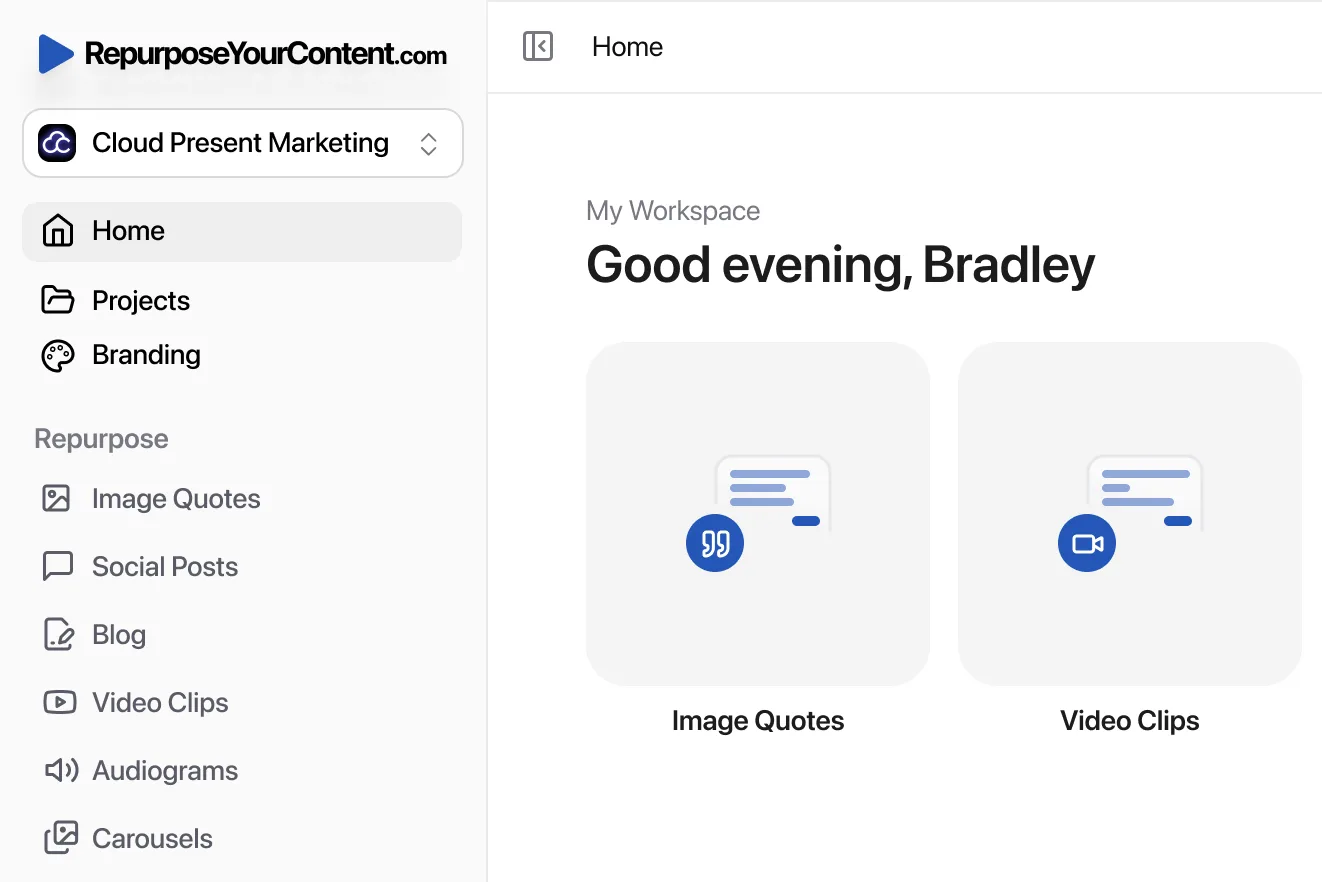
At RepurposeYourContent, our service model is built around this exact production gap. One recorded conversation can be turned into a package of channel-ready assets on a fixed workflow, with repurposing handled as an operating process rather than an extra task someone gets to later.
Team roles that keep the machine moving
Lean teams do not need a big studio setup. They do need clear ownership.
- Content strategist: Sets the interview angle, selects guests, and decides what business outcome the content needs to support.
- Interviewer: Pulls out specifics, challenges vague answers, and keeps the conversation useful.
- Editor or producer: Reviews the transcript, marks strong sections, and prepares source material for downstream use.
- Writer and designer: Turn the raw conversation into polished assets without flattening the speaker's voice.
- Marketing owner: Publishes, tracks performance, and uses the results to improve the next interview brief.
One person can cover multiple roles. That is common on lean teams. The trade-off is speed. If nobody owns extraction and repurposing, the interview turns into archived footage instead of a working content asset.
Distribution and Measuring What Matters
Publishing the assets is where the strategy either turns into pipeline or disappears into vanity metrics.
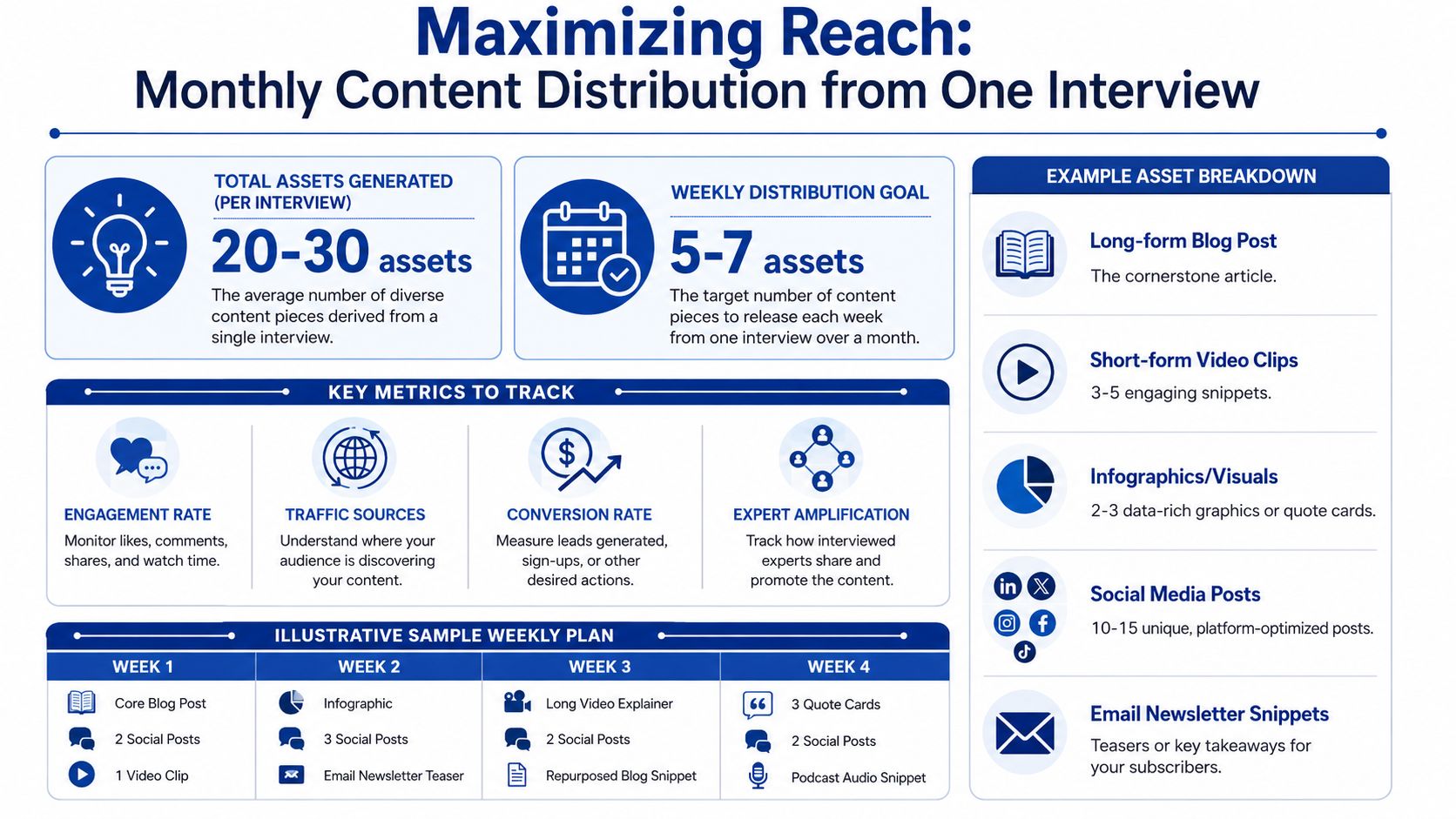
One interview should feed a full month of distribution, not a single launch day burst. That means each asset needs a job, a channel, and a timeline.
A simple monthly distribution pattern
A practical release pattern from one interview looks like this:
| Week | What goes out |
|---|---|
| Week 1 | Blog post, one clip, two LinkedIn posts |
| Week 2 | Carousel, quote graphic, email teaser |
| Week 3 | Two more clips, one objection-handling post |
| Week 4 | Summary post, audiogram, newsletter recap |
This works because different formats carry different levels of context. The blog holds the full story. Social pulls out the hooks. Email carries the strongest insight to an owned audience. YouTube can host clips or full conversation segments. LinkedIn is often the best home for named expertise and contrarian takes.
Teams that want a deeper breakdown can use content marketing ROI measurement frameworks, then adapt them to interview outputs rather than generic blog production.
Two related plays matter here. Repurposing expert interviews into content helps build authority at the top of the funnel. Customer interviews do the heavy lifting later in the journey because they answer real objections with lived experience.
Measure pipeline, not applause
Likes and comments aren't useless. They're just incomplete.
Track what the content influences:
- Content-influenced pipeline: Which opportunities touched interview-driven assets before moving forward.
- Lead quality: Whether these assets attract better-fit conversations.
- Sales cycle support: Whether customer or expert content helps answer objections faster.
- Email response quality: Whether nurture emails built from interview insights get meaningful replies.
Measurement rule: If a metric can't help decide the next interview topic, it's probably not a core metric.
The revenue logic behind this strategy is strong. Interview-based content marketing delivers an average 5:1 ROI across B2B channels, and email within content strategies returns $36 for every $1 spent, according to Geisheker's B2B content marketing strategy analysis.
That makes email one of the most important destinations for interview insights. A sharp quote, a condensed lesson, or a buyer-objection breakdown often performs better in nurture than another generic newsletter essay. The message feels grounded because it came from a real conversation.
The Done-For-You Alternative
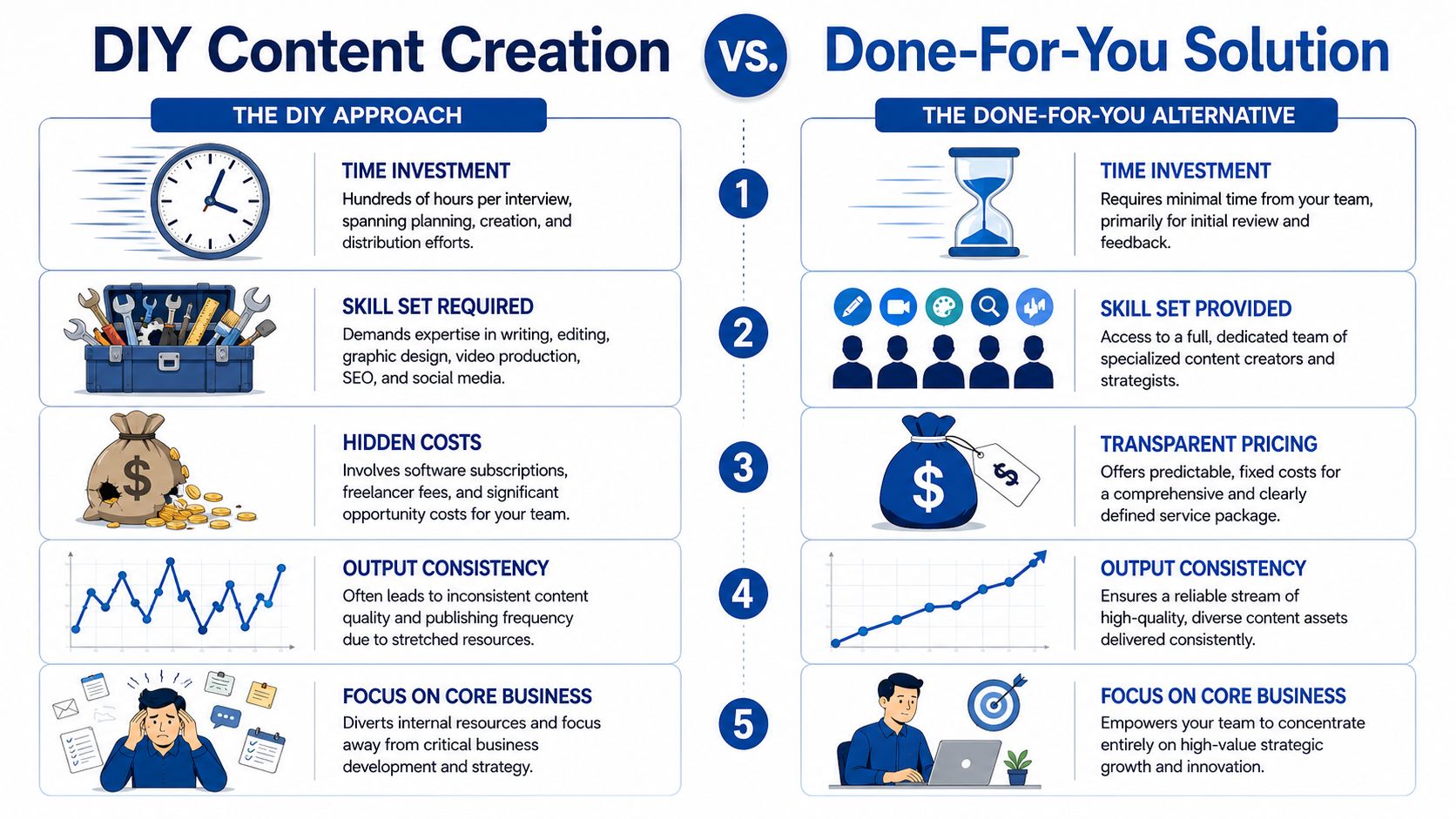
One good interview per week is a strong strategy. It still fails if nobody has the time to turn that interview into finished assets.
That is the primary bottleneck for many B2B teams. Analysts at Averi found that marketers spend a large share of their time creating content, yet many still struggle to produce enough high-quality material to support campaigns. The usual result is predictable. Good source material sits in Zoom, Riverside, or Google Drive while the team pushes out faster, weaker posts to keep the calendar full.
What the alternative looks like
A done-for-you model solves an operations problem. The team records the conversation once, then hands production to specialists who know how to turn raw dialogue into publishable content without flattening the voice.
That matters more in 2026 than it did a few years ago. Publishing more AI-assisted content is easy. Publishing fewer pieces that carry actual experience, original phrasing, and usable insight is harder. A service built around interview repurposing helps teams keep the authentic source material and remove the production drag.
For example, our service takes one recording, whether that is a podcast, webinar, keynote, interview, or internal meeting, and turns it into a batch of ready-to-publish assets. The operating model includes a 72-hour turnaround guarantee or you do not pay, output from one 45-minute recording into up to 30 assets, and pricing that starts from $14 per finished asset. That is a company service claim, not part of the Averi research.
The practical benefit is simple. The content lead stops acting as writer, editor, designer, video producer, and project manager in the same week. The team reviews, approves, and publishes.
Teams that want a clearer picture of how a single conversation can feed multiple channels can review this process for turning expert interviews into publishable content assets.
What to compare before choosing a service
The wrong service creates a new bottleneck. It gives the team more drafts to fix instead of more content to ship.
Use these filters before signing anything:
- Output quality: Are the assets ready to publish, or do they still need heavy editing?
- Voice control: Does the copy sound like the speaker, or like generic platform copy?
- Turnaround speed: Can the team publish while the topic is still relevant?
- Asset range: Can one recording become clips, posts, graphics, carousels, audiograms, and a blog post without extra vendors?
- Pricing clarity: Can the team calculate cost per finished asset without decoding the proposal?
- Editorial judgment: Does the service know what to cut, what to expand, and which quotes are strong enough to lead with?
RepurposeYourContent is one option in this category. The fit depends on what the team needs. Some teams want raw volume. Others need tighter messaging control, faster approvals, and assets that sound like they came from a real conversation because they did.
For busy content leaders, that choice is less about convenience and more about capacity planning.
Stop Writing From Scratch
The old content model starts with an empty document. The better model starts with a real conversation.
That's the shift that matters for 2026. Not more drafts. Better source material. One strong interview each week can feed thought leadership, customer proof, social distribution, email nurture, and search visibility for the rest of the month. The expertise is already inside the recording.
What wins now is harder to fake. Named experts. Customer language. Real objections. Specific trade-offs. Those are the pieces that support E-E-A-T, improve AI-search visibility, and make content worth citing. Teams that keep pushing generic AI output at high volume will publish a lot and say very little.
A stronger strategy uses interviews as the foundation. External experts build authority. Customers build trust. Internal leaders explain how the market works. Then the production system turns those conversations into assets that carry one coherent narrative across channels.
Teams building a serious authority engine should also study thought leadership content strategy. The pattern is the same. Strong opinions perform better when they're grounded in lived experience, not manufactured from prompts.
The content treadmill doesn't need another optimization layer. It needs a different input.
If one recording is already sitting in Zoom, Riverside, YouTube, or Google Drive, that's enough to start. Book a call or request a sample and see how one conversation can become a month of finished content.
Tags: