G2 Software Review Guide for Buyers and Vendors
Learn how the G2 software review scoring system works. Discover how buyers evaluate tools and how vendors can ethically generate more verified reviews.
AI now compresses software research into shortlists before a buyer ever reads a full review page. That changes the job of a G2 software review profile. It has to be structured, verified, and recent, or AI answer engines will ignore it.
For vendors, that means raw volume is no longer enough. For buyers, it means star ratings alone can mislead. The useful question is simpler, which reviews are credible enough to shape a shortlist?
How AI Changed the G2 Software Review Landscape
AI chatbots now sit between buyers and vendor pages. G2's 2025 Buyer Behavior Report says AI chatbots influence vendor shortlists at 17.1%, ahead of software review sites at 15.1%, and G2 also says 51% of B2B buyers now start software research with AI over Google, according to its own research page G2's buyer behavior research. That matters because AI tools compress the evaluation window.
Why shortlist visibility matters more than volume
A product can have plenty of reviews and still lose visibility. AI systems prefer content they can parse, summarize, and trust. That usually means clear use cases, recent feedback, and validation signals.
Practical rule: If a review would not help a buyer explain the product to a colleague, it probably won't help an AI summary either.
That is where G2 still matters. Its marketplace has scale, with more than 200 million annual software buyers and over 3 million verified reviews across more than 180,000 products and service profiles G2 About. AI answer engines need structured source material, and G2 is one of the cleaner inputs.
What buyers and vendors should change
Buyers should stop treating review count as the main filter. They need to scan for specifics, recency, and identity signals. Vendors should stop chasing generic praise.
Instead, they should collect reviews that mention setup, support, workflow fit, and business context. AI tools can summarize those details. They struggle with vague enthusiasm.
A strong G2 software review profile now works like a source file for AI summaries. If the review text is thin, the summary gets thin too. If the review text is detailed and verified, the summary has something useful to work with.
AI tools for content marketing follow the same logic. Structured inputs beat loose commentary every time.
Understanding the G2 Scoring Methodology
A high star rating does not guarantee a top rank. G2's G2 Score combines two normalized components, Satisfaction and Market Presence, according to its G2 scoring methodology. The model rewards review quality and market credibility, not popularity alone.
What moves rank
G2 weighs review volume, review recency, review quality, and review source differently. Recent feedback has greater value than older feedback. Detailed reviews provide more evidence than shallow submissions. Feedback from current users strengthens the underlying signal.
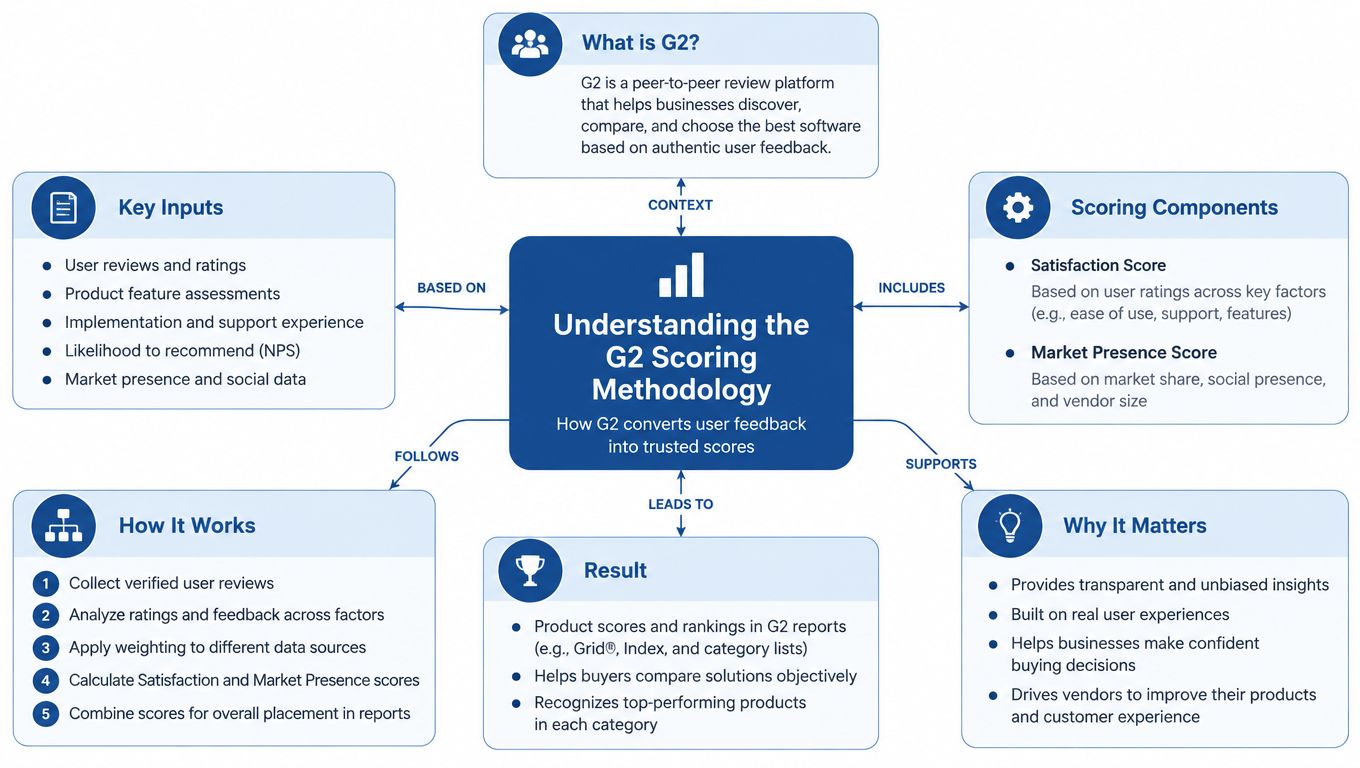
A product with fewer, stronger reviews can outrank a competitor with larger but stale volume. G2 also assigns readability scores using Flesch-Kincaid Reading Ease. Review quality affects both ranking and the material AI answer engines can summarize.
How buyers and vendors should use the model
Buyers should read beyond the stars. Check what the customer implemented, how the team used the product, and what changed afterward. Vendors should examine their profile against those same criteria.
AI answer engines increasingly compress review data into shortlists. Structured, verified detail gives those systems clearer evidence than raw review volume.
Use a focused checklist:
- Prioritize freshness: Older reviews lose weight over time.
- Ask for substance: Thin reviews offer little value to buyers or ranking systems.
- Avoid generic praise: Specific outcomes support stronger summaries.
- Favor current users: Current-user feedback provides more relevant context.
A category rank can shift even when total review count barely changes.
That creates a procurement risk for vendors focused only on volume. A successful G2 software review campaign needs recent, detailed feedback from credible users, not another bland five-star submission.
Identity Verification and Trust Signals
Fake reviews can undermine procurement trust quickly. G2 reduces that risk by verifying identity before publication, screening submissions against millions of data points, and using human moderation for higher-risk cases G2 trust and safety. This process gives AI answer engines cleaner evidence when they compress review data into buyer shortlists.
What G2 accepts
G2 accepts LinkedIn verification, a verified business email, or a personal email paired with a product screenshot G2 community guidelines. It also requires first-hand experience from the past two years. These rules shape the credibility of the dataset that buyers and answer engines evaluate.
A lighter moderation model waits for abuse to appear. G2 aims to block weak submissions earlier. That reduces contamination in category comparisons and gives procurement teams a more defensible review pool.
What buyers should trust
Badges provide useful context, but they do not replace judgment. A verified identity signal is stronger than a star rating alone. A review tied to real use, recent experience, and specific detail offers better evidence.
Customer testimonials follow the same standard. Repurposing customer testimonials works best when the source describes a clear situation and outcome. Reviews should provide comparable detail, including the workflow, use case, and practical result.
For vendors, authenticity protects brand confidence. A sudden fake-review spike can create more suspicion than a small review base. AI shortlists reward structured, verified quality, so review generation should prioritize credible customer experience over raw volume.
Interpreting Reviews in an AI-Assisted Era
G2 now permits AI-assisted and AI-generated reviews, provided they pass verification standards such as Vendor Verified, LinkedIn Verified, or in-app submission G2 conversational review experiences. That changes how readers should judge the text itself.
What still proves genuine experience
The text may be polished. The experience still has to be real. Buyers should look for details that AI typically can't fake well without domain knowledge, such as rollout context, team size, workflow fit, and where the product helped or slowed things down.
Generic sentiment is weak evidence. Specific usage patterns are stronger. So are mentions of integrations, handoff points, support interactions, and the practical trade-offs of using the product.
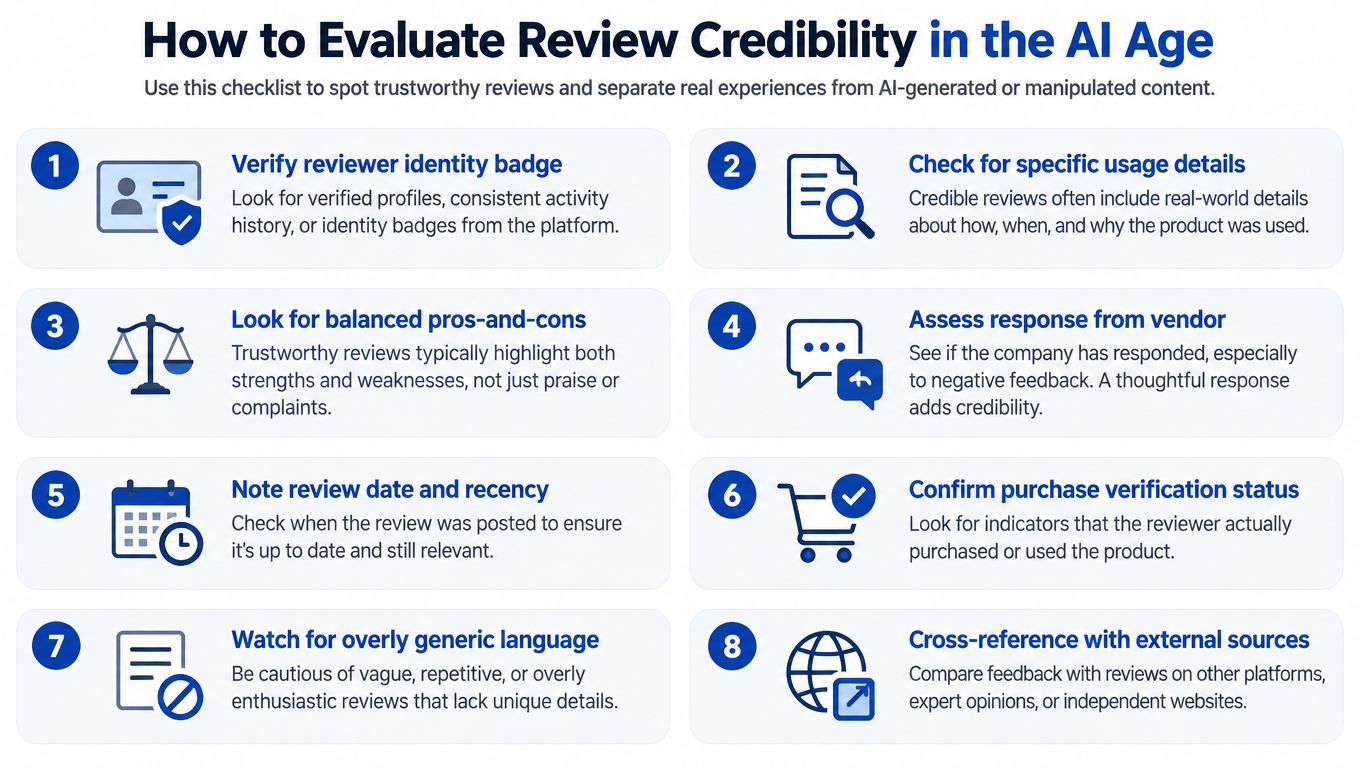
How to read AI-shaped review text
A useful review usually contains three things. It explains the problem, names the workflow, and shows the result. A polished paragraph without those anchors is weak.
- Verify reviewer identity badge: Identity confirmation still matters first.
- Check for specific usage details: Real workflows are harder to fake.
- Look for balanced pros-and-cons: Honest reviews rarely read like ads.
- Assess response from vendor: Vendor replies reveal maturity.
- Note review date and recency: Fresh context matters more.
- Confirm purchase verification status: Actual use carries more weight.
- Watch for overly generic language: Broad praise adds little.
- Cross-reference with external sources: Consistency builds confidence.
For a deeper model of how AI summarizes review content, understanding AI responses for marketers is a useful parallel. The same issue applies here, AI compresses detail, so the input has to be strong.
How AI content repurposing works follows the same pattern. The better the source material, the better the output.
A Practical Workflow for Review Generation
Email blasts for reviews usually underperform. They feel transactional, so customers ignore them. A better system starts during the customer conversation, not after it.
Record the right conversation
A 45-minute customer interview is enough if it's structured well. The goal is to pull out use case, implementation context, and outcome language. That makes the later review ask easy.
- Record a deep-dive interview: Ask about the original problem, the workflow, and the result.
- Extract exact phrases: Pull out the customer's wording on pain points and wins.
- Turn outcomes into prompts: Give users cues, not scripts.
- Request the review while the context is fresh: Timing matters more than volume.
- Archive the material: Save quotes for future campaigns and sales collateral.
A good interview also saves time later. Drafting prompts from a live conversation is faster than guessing what the customer should mention. That is the difference between a generic review request and a useful one.
Practical rule: If the customer can't describe the value in a sentence, the review request is too early.
What to ask for in the review prompt
Ask for the workflow they used. Ask what changed after rollout. Ask which team touched the product first. Those cues help the reviewer write a credible submission and help AI systems summarize the product correctly.
Read AI agent best practices is useful here because prompt quality shapes output quality. The same principle applies to review prompts. Better inputs produce more specific text.
AI content creation workflow for B2B also maps cleanly to this process. Record once, extract once, reuse many times.
The Done-For-You Content Alternative
A team publishing one customer interview weekly can spend 6 to 8 hours editing 8 to 12 clips and writing 6 to 8 posts. That workload competes directly with review follow-up.
A done-for-you workflow starts with one recording, such as a customer interview, podcast, keynote, webinar, or meeting. The production team can deliver 20 to 30 ready-to-publish assets in 72 hours, including video clips, LinkedIn posts, quote graphics, carousels, audiograms, and a blog post. The client's time is about 15 minutes.
The same transcript can support G2 review generation. Use it to draft a prompt asking for the customer's workflow, integrations, implementation experience, and measurable outcome. Those details give AI answer engines structured evidence to parse when they compress G2 data into software shortlists.
The workflow also creates source material for case studies, sales enablement, and follow-up campaigns. Editors can preserve the customer's wording while adapting each asset to its channel.
Content repurposing services fit teams with valuable recordings but limited production capacity. The service handles editing, writing, design, and formatting from the same source.
What the handoff looks like
- One recording in: Provide a podcast, webinar, keynote, interview, or meeting.
- One brand voice applied: Review samples and messaging before production starts.
- One review cycle: Consolidate feedback so the team can approve usable drafts quickly.
- One distribution plan: Assign assets to LinkedIn, email, the blog, and review outreach.
The strongest setup connects content production with review generation. One customer conversation produces publishable assets and a review prompt grounded in real product use. That improves consistency without prioritizing raw review volume over specific, verifiable detail.
Next Steps for Buyers and Vendors
Buyers should treat verification, recency, and specificity as the core signals in any G2 software review profile. Vendors should focus on the same three signals when they collect feedback. Raw star ratings and old review counts are too blunt for AI-driven research.
The bigger shift is simple. AI answer engines compress evaluation time, so structured proof matters more than ever. Reviews that explain use case, implementation, and outcome are the ones that survive that compression.
For teams managing software procurement, the checklist is straightforward:
- Buyers: Read for real usage, not just sentiment.
- Vendors: Collect recent, detailed, verified feedback.
- Both: Ignore vanity volume when the details are weak.
If your team also markets software or services, Scheduler.social's agency software guide is a helpful companion for comparing tools with a practical lens.
Book a strategy call with RepurposeYourContent if you want to turn existing customer recordings into a scalable content and review generation engine. Request a sample, and see how one recording can become finished assets that support trust, visibility, and faster buyer decisions.
Tags: