Generating Leads with Social Media That Actually Convert
A practical 2026 guide to generating leads with social media. Learn channel tactics, funnel design, and tracking methods that turn posts into pipeline.
A social lead contacted within five minutes is 21 times more likely to qualify than one contacted after 30 minutes, according to independent lead-generation benchmarks. That changes the job. Generating leads with social media isn't mainly a posting problem. It's a capture, routing, qualification, and follow-up problem.
Social content earns attention. A tight funnel converts that attention before intent fades. The strongest system combines one channel where the buyer already spends time, long-form recordings that produce useful assets quickly, a specific offer, and an immediate sales handoff.
Why Social Is Now a Default Lead Channel
Social media is now a standard acquisition channel because buyers use it to research vendors, follow founders, watch interviews, and compare opinions before submitting a form. That behavior gives B2B teams a direct route to create the first touch, demonstrate expertise, and move a qualified prospect toward an offer.
The operating problem is speed. A post can attract attention, but value disappears if capture, qualification, and follow-up depend on a manual handoff. Repurposed podcasts, interviews, keynotes, sales calls, livestreams, and courses solve two constraints at once: they produce useful assets quickly and give sales a clear context for the conversation.
This guide focuses on four decisions:
- Channel selection: Match the platform to the buyer role and buying context.
- Content production: Convert long-form recordings into lead-ready posts, clips, and offers.
- Funnel mechanics: Use one CTA, low-friction capture, clear qualification, and rapid follow-up.
- Pipeline measurement: Connect social activity to MQLs, opportunities, and revenue influence.
It does not cover paid-only playbooks, generic posting advice, or branding exercises without a lead outcome. Paid promotion can increase reach, but it will not fix slow routing or weak qualification. For campaign concepts and paid creative angles, Nereo video ad ideas provide a practical starting point.
Plan for roughly 6 to 10 focused hours each week for research, recording selection, editing, writing, publishing, community response, and reporting. An internal team can spend that time directly, while an outside service turns it into a recurring production cost. Either way, protect the hours that advance pipeline rather than filling a content calendar.
B2B teams can use this 2026 B2B social media strategy to align channel activity with demand generation. The rule is simple: publish fewer disconnected updates and build more assets around a defined buyer problem.
Practical rule: Social reach matters only when a buyer can take the next step immediately.
The Right Channel for the Right Buyer
LinkedIn should lead most B2B programs. 89% of B2B marketers use LinkedIn for lead generation, and 62% say it generates leads for them, more than twice the next-highest social channel, according to LinkedIn's B2B lead-generation resource. Use contrarian text posts and document carousels for executives, department heads, and operators, following this LinkedIn content strategy for B2B 2026. Send high-intent responses to a native Lead Gen Form or a closely matched asset, then qualify and route them quickly.
YouTube captures buyers who are already searching for answers. Long-form tutorials and customer interviews require more production time, editing, and metadata work, so publish one substantial upload with several supporting clips rather than attempting daily videos. A strong recording also gives the sales team material for follow-up, which makes the production cost more useful than a standalone post.
Instagram works for short educational reels and direct-message conversations. It suits personal brands, creators, and B2B companies with a visible human voice. The conversion often begins in a DM, then moves to a qualification question or booking page. Reserve time for prompt replies, or the channel will create conversations without advancing them.
TikTok fits niche expert clips built for discovery. Founders, creators, and specialist consultants can publish concise opinions, demonstrations, and responses to common objections. Attention arrives quickly, but the profile and CTA must state the next action clearly. Batch filming reduces editing time and keeps the channel practical for a small team.
X supports rapid-fire threads that develop one point across several posts. It reaches technical audiences, founders, operators, and communities that value real-time commentary. Each thread should send readers to one specific lead magnet instead of ending with a vague request to follow.
| Channel | Best Format | Buyer Reached | Weekly Cadence |
|---|---|---|---|
| Contrarian text posts and document carousels | B2B decision makers | Several posts and one carousel | |
| YouTube | Long-form tutorials and customer interviews | Intent-driven researchers | One long-form video plus supporting clips |
| Educational reels and DMs | Warm audiences, creators, and visible experts | Several reels and active DM response | |
| TikTok | Niche expert clips | Founders, creators, and discovery audiences | Several focused clips |
| X | Rapid-fire threads | Technical buyers, founders, and operators | Several threads or focused post sequences |
Facebook remains useful for broader B2B and SaaS audiences. One dataset reported Facebook as the leading source of marketer-reported leads, with LinkedIn close behind. Teams planning paid Meta distribution can use AdManage.ai's B2B Meta playbook for campaign structure and audience planning.
LinkedIn also tends to produce stronger visitor-to-lead conversion than Facebook or X in benchmark data. The cited benchmark reports 2.74% for LinkedIn, 0.77% for Facebook, and 0.69% for X, according to B2B social media benchmark data. Choose the channel where the buyer already pays attention, then build the fastest path from response to qualified follow-up.
Turn One Recording Into a Month of Leads
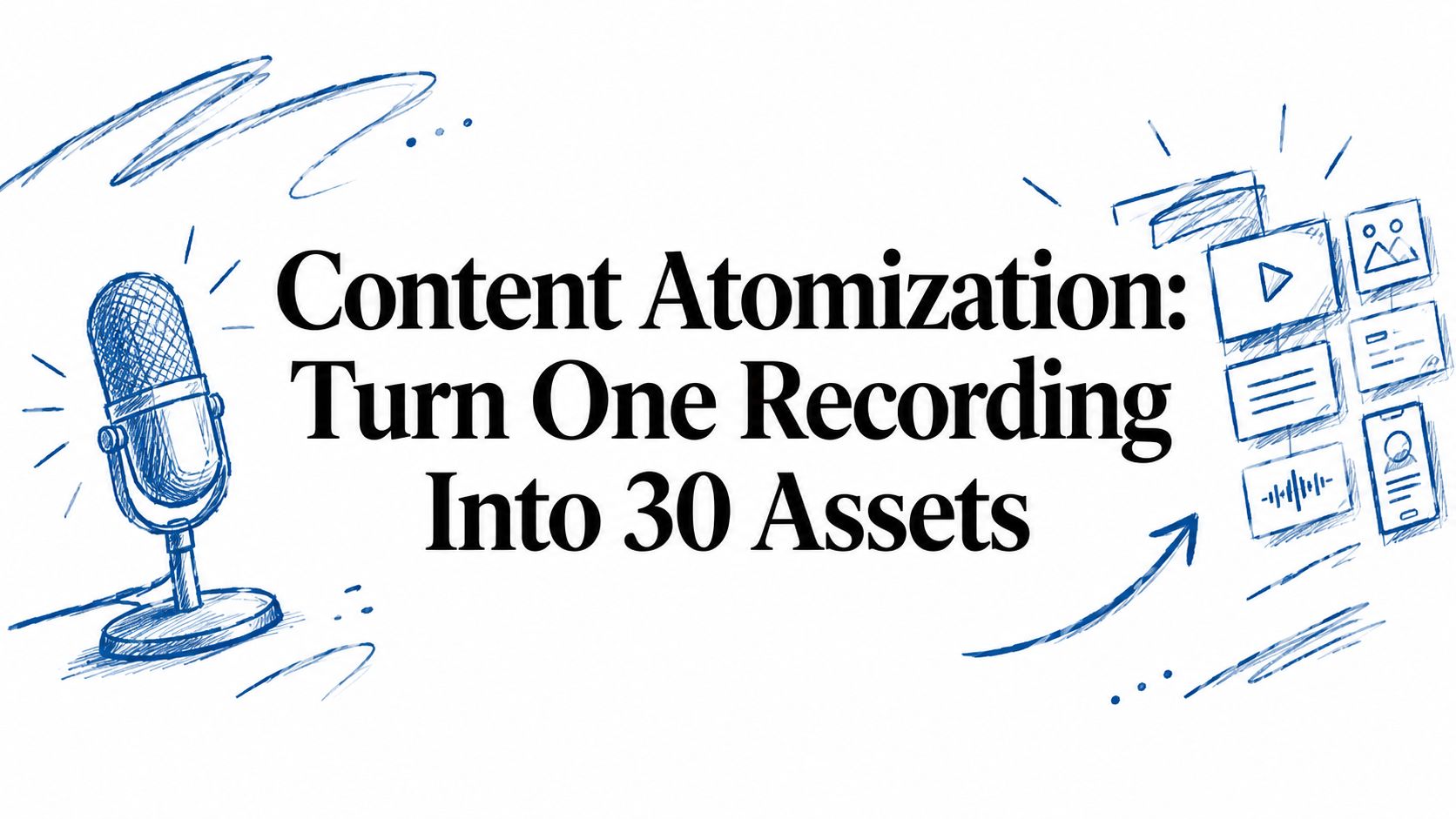
A 45-minute podcast, customer call, keynote, or interview can supply a complete month of social material. The source already contains the expertise. The production task is finding the sharpest moments and matching each one to a buying-stage question.
A practical workflow looks like this:
- Transcribe the recording. DIY transcription, cleanup, and speaker labeling take roughly 90 minutes. A transcript makes strong claims, objections, and examples searchable.
- Select three sharp insights. Allow 60 minutes to identify the moments with the clearest buyer value. Ignore entertaining sections that don't support the offer.
- Draft the anchor post. Spend about 90 minutes turning one insight into a long-form LinkedIn post. Add a point of view, a practical example, and one CTA.
- Create supporting formats. Produce one thread, two reels, one YouTube Short, one newsletter snippet, and three quote graphics.
- Edit and review. Video clipping, captions, framing, exports, and quality checks take another 60 to 90 minutes.
The defined workflow totals roughly 5 to 6 hours per recording for the listed work. More complex footage, multiple speakers, poor audio, or brand approvals can push the total higher.
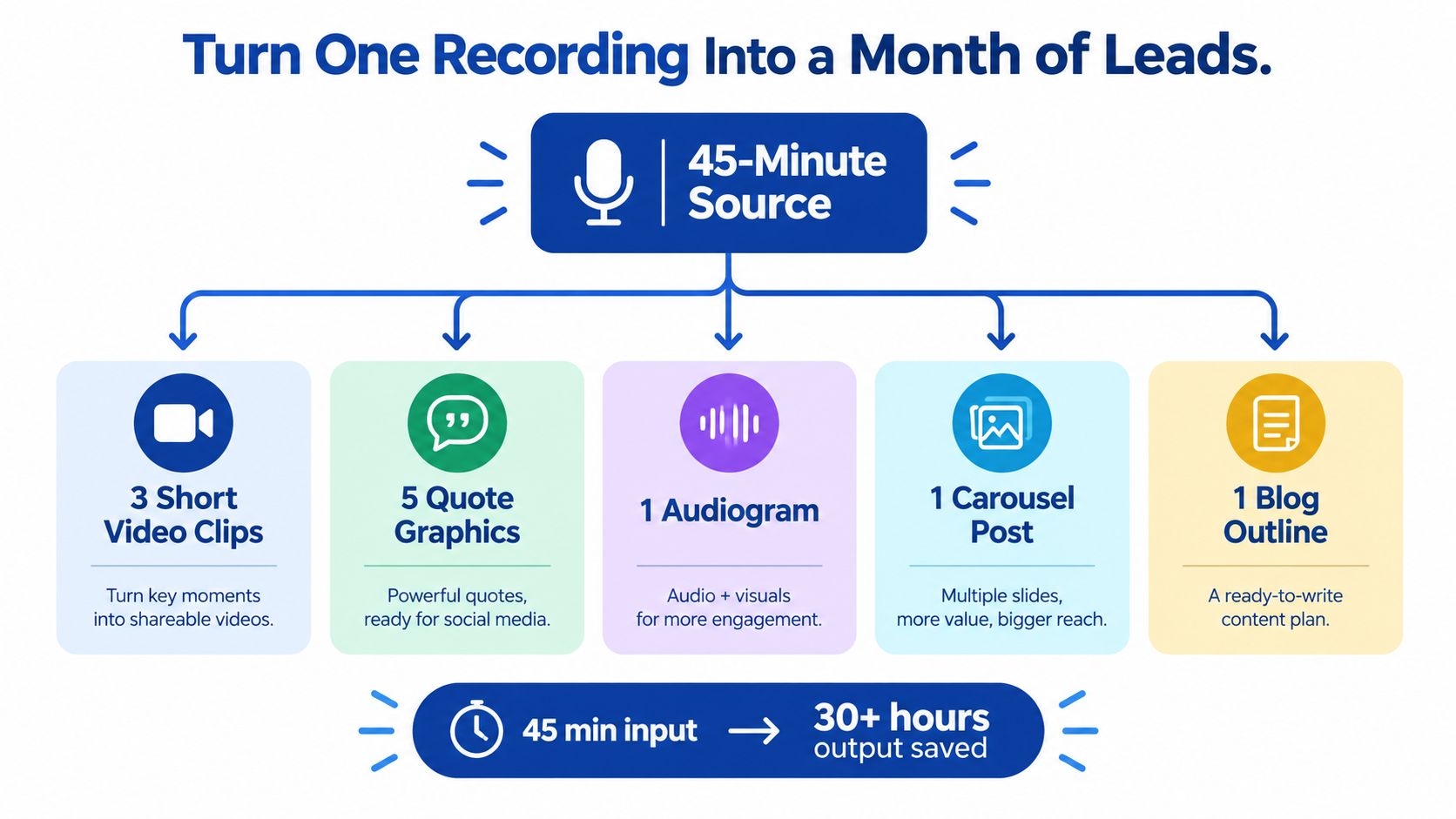
The asset mix should serve one campaign, not create disconnected noise. The LinkedIn post introduces the argument. The thread expands it. The reels make the insight discoverable. The quote graphics reinforce the point. The newsletter snippet gives existing subscribers a reason to return to the offer.
Teams working with technical recordings should understand how meeting transcription AI works before selecting a workflow. Speaker accuracy, timestamps, and searchable text affect every downstream asset.
A recorded source also changes speed-to-follow-up. Instead of waiting for a new idea, a writer, a designer, and an editor, the team starts with approved expertise. A social post can connect to a lead magnet while the original conversation is still relevant.
For adjacent recording workflows, this B2B content strategy for recorded sessions provides additional planning context. The core insight is operational: lead generation improves when useful content exists before the buyer raises a hand.
A recording is not one content asset. It is a source file for a campaign.
The Funnel Behind Every Converting Post
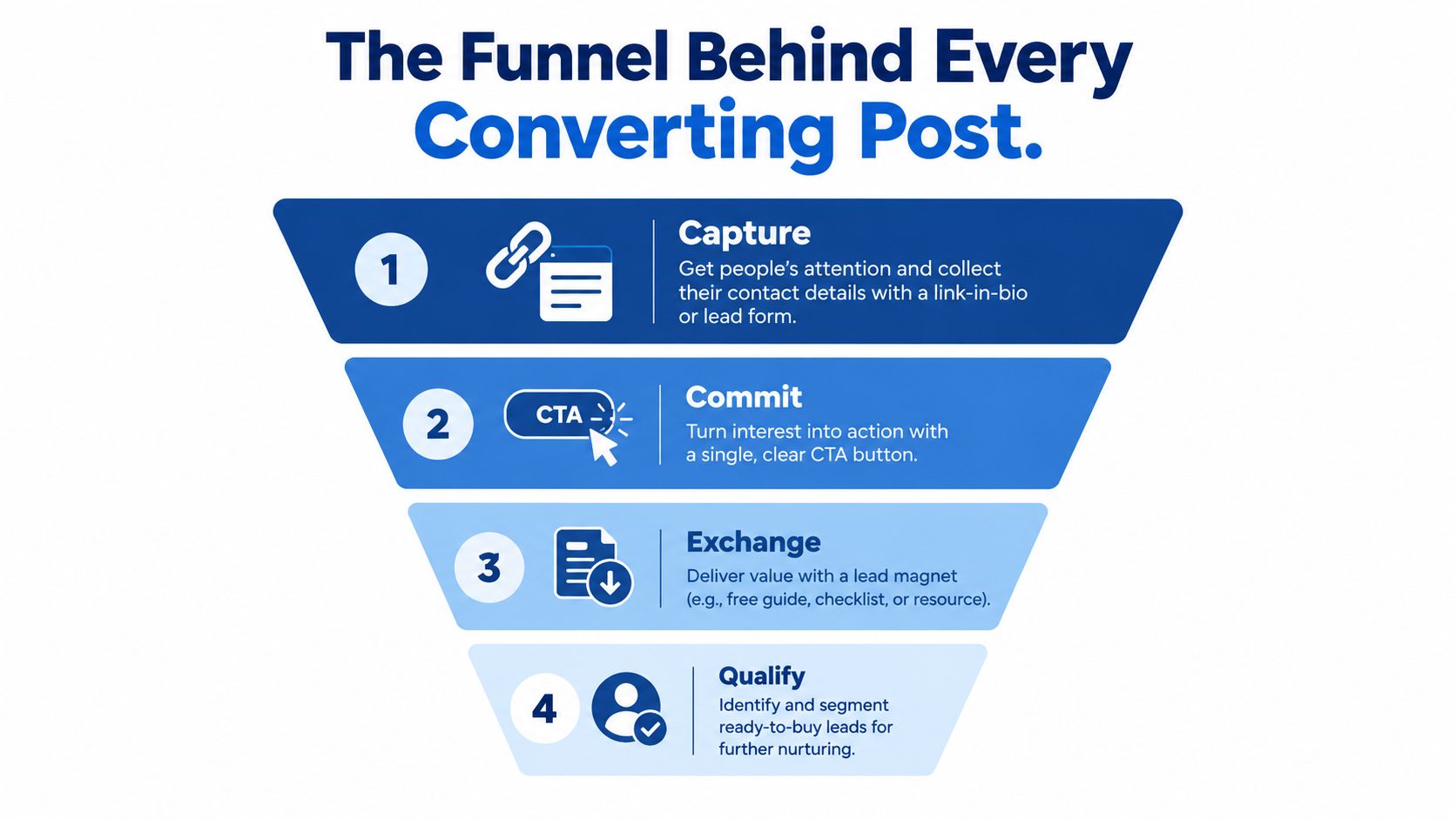
A converting social post needs four connected actions. Break one link and the post becomes awareness content.
Capture attention without forcing a click
Use a native lead form when the platform supports it. LinkedIn's Lead Gen Forms can remove the friction of a separate landing page. A benchmark cited in marketing summaries places LinkedIn Lead Gen Form conversion at about 13%, compared with roughly 2.35% for standard landing pages, according to LinkedIn B2B marketing benchmarks.
Use a link in the profile or post when the offer requires explanation, payment, or a richer qualification flow. The capture method should match the buyer's level of intent.
Give one clear next action
Every post needs one CTA. “Download the recording checklist” is stronger than “learn more.” “Request a sample content pack” is stronger than “contact the team.” The CTA should repeat the promise made in the post.
Ungated content works for broad awareness and trust building. Gate a checklist, benchmark, template, or diagnostic when the visitor has shown a specific problem and the sales team needs contact details.
Qualify before sales receives the lead
The form should collect only information that changes routing or prioritization. Useful criteria include company type, role, relevant problem, buying timeline, and whether the contact matches the ideal customer profile.
A marketing lead isn't automatically sales-ready. One benchmark summary places average Lead-to-MQL conversion around 20% to 35%, while only 20% to 21% of marketing leads become customers, according to SalesHandy's lead-generation statistics. The handoff needs a scoring rule, not optimism.
Route the lead immediately
Create an instant route from form submission to the owner, CRM, and nurture sequence. Follow-up within five minutes is 21 times more likely to qualify than follow-up after 30 minutes, according to DesignRush's lead-generation data. A daily batch process is too slow for high-intent social leads.
The sequence should acknowledge the request, deliver the promised asset, ask one relevant qualification question, and offer a logical next conversation. The first touch should feel like a continuation of the post, not a generic sales email.
Use this B2B sales funnel guide for a fuller structure around capture, nurture, and sales progression.
Metrics That Prove Social Is Producing Pipeline
Likes and impressions can explain distribution. They can't prove demand. A B2B or creator team should wire five KPIs during the first measurement setup.
| Metric | Category | Predicts Pipeline? | Action It Triggers |
|---|---|---|---|
| Profile-to-follower conversion | Audience growth | Weakly | Improve profile positioning and proof |
| Follower-to-MQL rate | Lead quality | Yes | Refine audience, offer, or CTA |
| Cost per lead by channel | Efficiency | Yes | Shift budget and production time |
| Lead-to-opportunity rate | Sales progression | Strongly | Improve qualification and handoff |
| Pipeline-influenced revenue | Business outcome | Directly | Fund channels tied to revenue |
Profile-to-follower conversion shows whether profile visitors understand the promise. Follower-to-MQL rate tests whether the audience contains likely buyers. Cost per lead compares channels, but it shouldn't decide investment alone. A cheaper lead with no opportunity value is still expensive.
Lead-to-opportunity rate exposes the quality gap after capture. Pipeline-influenced revenue connects social touches to deals that progressed after engagement, even when social wasn't the original source.
Build attribution before the first campaign
Use consistent UTM parameters across LinkedIn, YouTube, X, and Instagram. Record the platform, campaign, content format, asset name, and CTA. Connect those fields to the CRM so a lead keeps its original context after handoff.
Install the relevant platform pixels where consent and privacy requirements allow. Use a clear privacy notice and collect only data needed for the stated follow-up. The source data should remain consistent across native forms and external landing pages.
When closed-loop CRM attribution isn't available, use a simple working formula:
Social-attributed pipeline = qualified opportunities with a tracked social touch × opportunity value.
Label that figure as influenced pipeline, not sourced pipeline. It prevents inflated claims while still showing whether social participates in revenue creation.
A weekly dashboard should show channel, content format, reach, clicks, leads, MQLs, opportunities, response time, and pipeline. Sort by lead-to-opportunity rate first, then inspect volume. This guide to content marketing ROI measurement helps teams connect content activity to commercial outcomes.
If the dashboard stops at impressions, the team is measuring distribution, not demand.
The Done-For-You Alternative
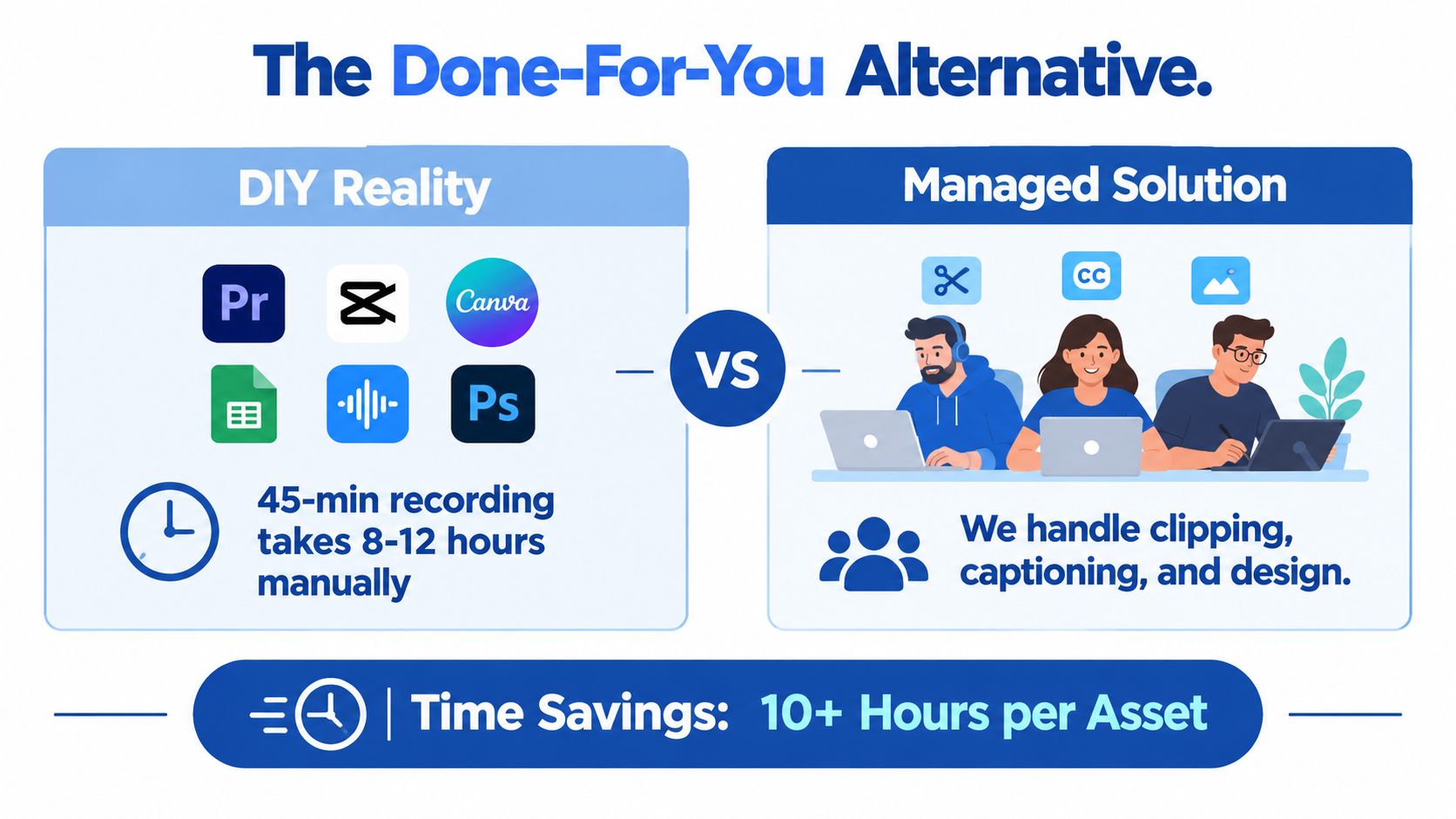
DIY production looks cheap until the full workflow appears on the calendar. A 45-minute recording can take 8 to 12 hours to clip, caption, design thumbnails, write supporting posts, schedule, and review across channels. That is roughly two workdays for one long-form source.
The labor isn't just editing. Someone must find the moments, protect the speaker's meaning, format each asset for the destination, write platform-specific copy, apply brand rules, check captions, and coordinate approvals. A founder doing this personally pays with selling time. A marketer doing it internally pays with campaign time.
The managed trade-off
A done-for-you service changes the input requirement. The client sends one podcast, interview, keynote, sales call, livestream, course session, or meeting recording. The service returns 20 to 30 ready-to-publish assets in 72 hours, including video clips, LinkedIn posts, quote graphics, carousels, audiograms, and a blog post.
The client's time is about 15 minutes for each recording. That covers sending the source, sharing the brand kit, clarifying the audience, and reviewing the delivery. RepurposeYourContent is one option that provides this recording-to-content workflow, with finished assets written in the client's brand voice and revisions available.
The commercial details matter. The service offers a 72-hour turnaround guarantee, or the client doesn't pay, pricing from $14 per finished asset, and a workflow where one 45-minute recording becomes 30 assets. Those terms make the comparison concrete, although the right choice still depends on internal capacity and quality requirements.
DIY can win when a team has a full-time editor, clear brand systems, and no budget ceiling. For a time-poor founder, podcaster, or demand-generation team, the main cost is usually opportunity cost. Two days spent formatting clips is two days not spent on sales, partnerships, product work, or customer conversations.
The managed workflow should start without a long onboarding project. The client needs three inputs:
- Raw recording: A file or recording link with usable audio.
- Brand assets: Logo, colors, fonts, visual examples, and voice guidance.
- ICP document: Target roles, industries, buying triggers, objections, and offer details.
The provider can then create the asset pack, return it for review, and revise until the team approves publication.
Your Next Step to Consistent Social Leads
Consistent social lead flow depends on four operating levers:
- The right channel: Put the message where the buyer already pays attention.
- Repurposed long-form content: Start with recorded expertise instead of inventing every post.
- A tight funnel: Match the CTA and offer, capture intent, qualify the contact, and route it quickly.
- Pipeline-grade tracking: Measure MQLs, opportunities, response time, and influenced revenue.
The gap between reading a strategy and running it is execution time. Teams often don't have enough weekly capacity to select clips, write posts, design graphics, schedule distribution, monitor responses, and maintain attribution.
The next step is practical. Book a 20-minute call to map the current social funnel, or request a free sample package built from an existing podcast, interview, keynote, sales call, livestream, course, or customer recording. A sample gives the team a direct quality check before committing to a managed workflow.
A recording-based service can return 20 to 30 ready-to-publish assets in 72 hours, with the client's review time kept to about 15 minutes. The first conversation delivers a prioritized 30-day lead-generation plan tied to the team's channel mix and sales cycle, with no deck required.
Book the 20-minute call or request a sample from an existing recording today. The team will identify the best channel, offer, follow-up route, and content angles for turning recorded expertise into qualified social leads.
Tags: