How Much Does Podcast Editing and Repurposing Cost in 2026
How much does podcast editing and repurposing cost? See 2026 price ranges for freelancers, agencies and retainers plus per-clip benchmarks and ROI math.

Podcast editing and repurposing cost usually falls into $50–$150 per episode for basic editing, $150–$360 for standard edits, and $450–$1,050+ for full production. Repurposing adds another layer, usually $10–$40 per clip or $400–$1,050+ per episode when you bundle clips, notes, transcripts, and publishing, while weekly editing alone often lands around $200–$700 per month.
That's the honest answer. The ugly part is that cheap editing can still become expensive once someone has to write clips, design graphics, and publish everything after the edit.
How Much Does Podcast Editing and Repurposing Cost Right Now
The market doesn't give you one clean number, because podcast editing cost depends on what you want delivered. Independent industry pricing guides put basic podcast editing at roughly $50–$150 per episode, standard edits in the $150–$360 range, and full-service production at $450–$1,050+ per episode because each extra deliverable adds labor and review time (Podcast Engineers). That's the right frame for buyers who keep asking for a simple quote.
The more useful question is whether you're buying editing only or editing plus repurposing. Editing only gets the audio clean and published. Repurposing turns one recording into clips, show notes, social assets, and blog content, which changes the unit economics fast. For business shows, the comparison is not “what does an edit cost?” It's “what does a publish-ready content engine cost per month?”
Practical rule: if a quote sounds cheap, check whether it includes clips, transcripts, publishing, and revision rounds. Those are the line items that move the bill.
For a recurring show, monthly pricing often makes more sense than one-off jobs. That's why weekly shows frequently end up budgeted around $200–$700 per month for editing alone, before repurposing enters the picture (Podvenues). If a team needs a broader view of repurposing spend beyond podcasts, the companion breakdown on content repurposing pricing gives a useful side-by-side benchmark.
The blunt takeaway is simple. Editing cost is a line item. Repurposing cost is a throughput problem. If one recording has to feed your social, blog, and sales channels, the cheapest per-episode edit is often the wrong deal.
What Drives Your Podcast Editing and Repurposing Cost

Five things move the price more than anything else. Format, edit depth, deliverable count, turnaround, and whether the job is audio or video. If a quote doesn't break those out, it's not a useful quote.
Format and runtime change the labor stack
A 20-minute interview is a different job from a 90-minute panel. More runtime means more cleanup, more selection work, and more review. That's why a one-hour episode often takes 2–4 hours of editing work, and why labor at roughly $45–$125 per hour can land around $120–$500 before any add-ons appear (Reddit podcast pricing discussion).
Edit depth decides whether you're paying for polish or production
Basic cleanup is usually silence removal, filler cuts, and leveling. Standard editing adds multitrack balancing, mastering, music beds, and show notes. Full production goes further, which is why the price climbs so sharply in the earlier benchmark.
Deliverable count is where repurposing really bites
One episode can become several outputs, but every output needs selection, copywriting, and formatting. Clipping alone often takes 2–3 hours per recording if someone has to find the right moments, shape the hook, and prep captions. Add graphics and layout, and the work gets longer fast. For broader context on sound quality work, the internal guide on best audio enhancement tools for webinars is useful because the same cleanup logic applies to recorded shows.
Turnaround and revisions cost money
Speed is not free. If a team wants a same-week delivery, someone has to drop other work. Revisions also add time, especially when the host wants a different clip selection or a tighter headline. The more stakeholders who review, the higher the hidden cost.
Audio versus video is a different workload
Video adds framing, captions, cropping, branding, and export versions. A helpful resource on content strategy is maximize content value with Contesimal, especially if the recording has to support multiple channels. The core point is simple, video takes more production work than audio, so the quote should reflect that.
Freelancer vs Agency vs Productized Service Pricing Compared
The right buying model depends on cadence. A one-off guest interview needs a different structure than a weekly founder-led show. If the work is irregular, freelancers can work. If the work is recurring and multi-format, a retainer or productized service usually makes more sense.
| Buying Model | Typical Price Range | What Is Usually Included | Watch Outs |
|---|---|---|---|
| Freelancer, basic cleanup | $25–$50 per episode or $25–$40 per hour | Cutting silence, basic cleanup, light leveling | Revision charges, rush fees, and weak consistency |
| Freelancer, standard interview edit | $45–$180 per episode or $45–$75 per hour | Balanced audio, mastering, basic show notes | Per-platform exports and clip work may cost extra |
| Agency or premium production | $200–$650+ per episode or $85–$150 per hour | Narrative polish, branded production, more review cycles | The scope can grow fast, and so can fees |
| Productized done-for-you service | Monthly quote based on volume | Editing plus clips, posts, graphics, and publishing support | Confirm ownership, turnaround, and revision policy |
| DIY tools plus your own hours | Low cash cost, high time cost | Software help, but you still do the work | Your time, learning curve, and quality risk |
That benchmark comes from a 2026 market snapshot showing how pricing clusters in recognizable tiers (Podvenues). It's also where a lot of buyers get fooled. A freelancer can look cheap until clips, graphics, and publishing have to be handled somewhere else.
For repurposing-heavy work, the internal comparison on best podcast repurposing services is the right lens because the buying model matters more than the nominal edit fee. A monthly package can be more expensive on paper and cheaper in practice if it replaces several vendors and a chunk of internal labor.
A low edit price is not a low workflow price. If the show still needs a second vendor for clips and posts, the “cheap” option usually isn't cheap.
Per Minute and Per Asset Benchmarks You Can Use to Budget

Per-minute pricing is useful when finance wants a clean math model. Per-asset pricing is useful when marketing wants to know what one recording produces. Use both, because they describe different parts of the bill.
A 2026 rate sheet puts audio podcast editing at $0.50–$2.50 per finished minute for freelancers and $150–$400 per episode for agencies, while video podcast editing rises to $530–$1,125 per episode from freelancers and $775–$1,750 per episode from agencies (Video Editing Company). That spread is normal. Video carries more deliverables and more export work.
For repurposing, the same math is simpler. Clip creation is often priced at $10–$40 per clip, so 8–10 clips from a single episode can add about $80–$400 before any other formats are included (SamFusion). That's why a bundle that includes clips, transcripts, thumbnails, and posting support usually costs much more than editing alone.
Budget formulas that actually help
- One episode, audio only: use the basic or standard editing range, then add clips if needed.
- One episode, with repurposing: add clip costs, then add copy, graphics, and scheduling time.
- Weekly show: multiply your per-episode cost by four, then compare that number with a monthly retainer.
The practical way to budget is to work backward from outputs. If a 45-minute episode becomes a full edit plus clips and graphics, the final price is driven by the number of assets, not just the recording length. For buyers comparing packaged support, the pricing context behind find your subscription can help frame how monthly support models usually work.
The mistake is to budget for the recording and forget the distribution layer. Editing gets the file ready. Repurposing gets the business value out of it. Those are not the same expense.
Total Cost of Ownership Including Your Time

Cheap editing can be expensive once the team's time gets counted. That's the part most buyers miss. The invoice is visible. The hours are hidden.
If a manager spends 30 minutes briefing the editor, another hour reviewing clips, and another hour approving copy, the “cheap” quote already grew. If the host also rewrites captions, chases revisions, and uploads content, the true cost climbs again. That's why total cost of ownership matters more than the edit fee alone.
A second cost layer appears when repurposing enters the workflow. Turning one recording into multiple assets requires clip selection, copywriting, graphics, and publishing support. In current market pricing, clip creation is often estimated at $10–$40 per clip, so 8–10 clips can add about $80–$400 before anything else is produced (SamFusion).
Use this simple ownership test
- Add the vendor fee.
- Add internal review time.
- Add publishing time.
- Add management time for revisions and coordination.
If the total is higher than a monthly retainer that removes most of those hours, the cheaper quote loses. That's the cadence break-even point many teams never model. Weekly publishing is where this gets obvious, because repeated handling creates recurring hidden labor.
For readers who want a structured repurposing workflow, the internal guide on podcast repurposing service is a good reference point. It clarifies how the service model differs from one-off editing and why the internal time burden changes.
Bottom line: if the subscription costs less than the hours it frees, it's cash-flow positive from month one.
That's the test worth using. Not “what's the lowest edit price?” but “what does the whole workflow cost after people time is included?”
From One Recording to 30 Assets A Realistic Workflow and Timeline

A single 45-minute recording can turn into a lot of content, but only if someone does the work. The DIY version is rarely fast. It usually eats half a day, sometimes more, because every output needs a decision.
Step 1 is ingest and edit. That means cleaning the raw file, removing mistakes, and shaping the full episode. In a normal workflow, this takes 1–2 days if someone is moving it through a queue.
Step 2 is clip selection. Someone has to find the best hooks, pull the strongest moments, and decide what's worth posting. That usually takes 2–3 hours for a single recording if the goal is 8–10 clips.
Step 3 is copy and visuals. Captions need to be written, graphics have to be built, and thumbnails or carousels need to match the brand. That easily runs 4–6 hours when the content is made properly.
A practical workflow example
- Review the recording. The editor marks the strongest moments and flags dead spots.
- Cut the clips. The team pulls out short segments for social and short-form video.
- Write the copy. Captions, post text, quote cards, and headlines get drafted.
- Package the assets. Carousels, blog copy, and audiograms get assembled.
- QA and schedule. Someone checks formatting, approvals, and posting order.
The internal guide on how to repurpose podcast episodes is relevant here because the workflow is the same whether the source is a podcast or another long-form recording. A practical extension for social output is turn blogs into Reels, especially when the original conversation already has strong narrative moments.
Step 4 is carousels and the blog post. That usually takes another 3–4 hours if the assets need to be clean and publication-ready. Step 5 is QA and publishing. That's another 1 hour when nothing breaks.
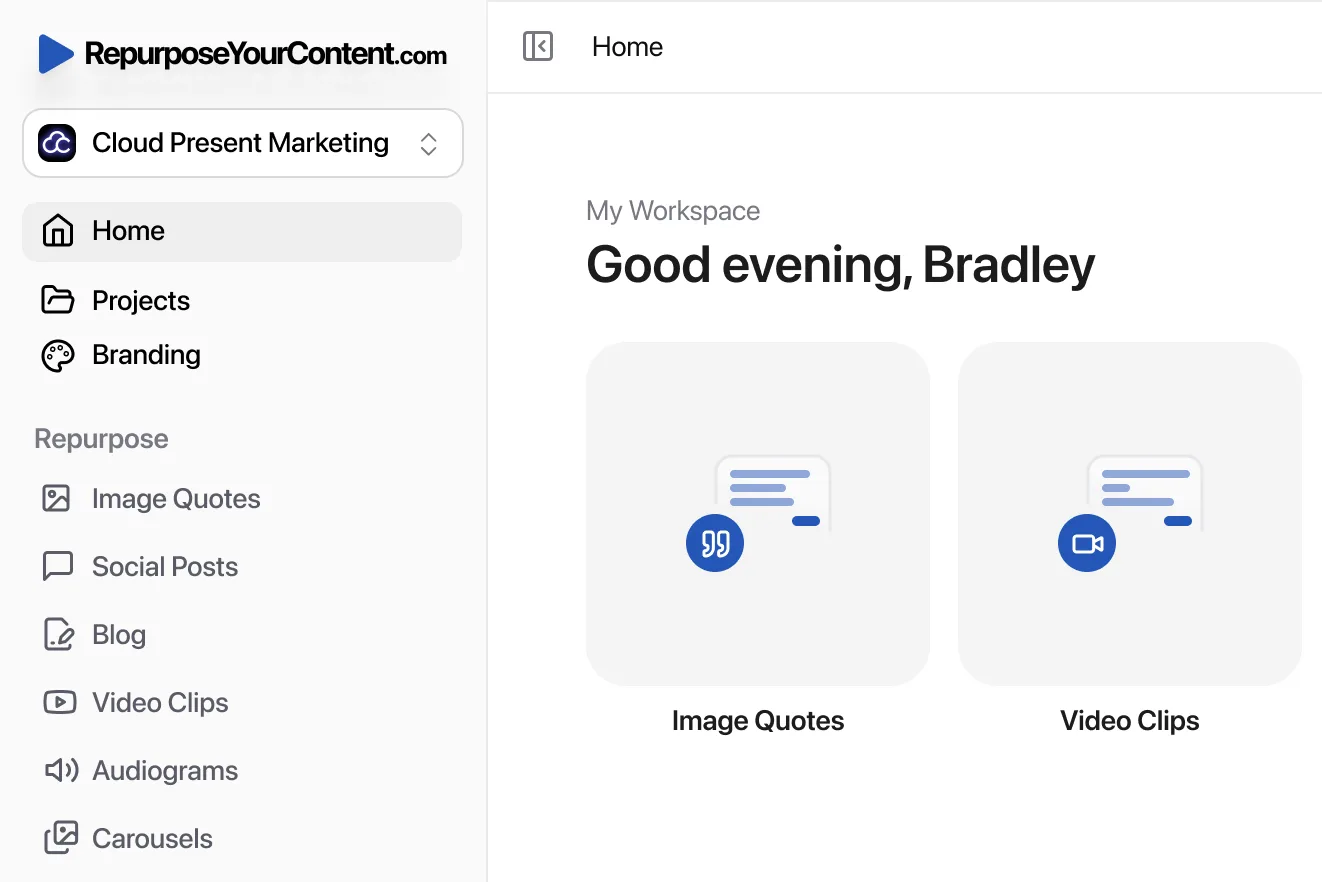
The done-for-you alternative is simpler. Send one recording, whether it's a podcast, webinar, keynote, interview, or meeting recording, and the output comes back as 20–30 ready-to-publish assets in 72 hours. That set can include video clips, LinkedIn posts, quote graphics, carousels, audiograms, and a blog post, all in brand voice with unlimited revisions. The client's time is roughly 15 minutes.
DIY comparison lives. DIY buys control and burns time. Done-for-you buys throughput.
How to Judge ROI and Choose the Right Option for Your Show
The smartest ROI anchor is the recording you already paid for. The guests were booked, the time was spent, and the episode exists. Repurposing should be judged against the value of creating 20–30 derivative assets from that sunk cost, not against the fantasy of producing everything from scratch.
That changes the decision. If in-house repurposing eats 4–6 hours of someone's loaded salary for each episode, the monthly cost can outrun a retainer. If a service turns the same episode into publish-ready assets with a tiny client time burden, the economics get easier to defend. The question is not whether content can be made cheaper. The question is whether the publishable output per dollar and per hour is better.
RepurposeYourContent frames its tiers by volume, not by vanity promises. Basic covers 1 recording per month with 72-hour turnaround. Core covers up to 2 recordings per month with 60-hour turnaround and weekly content planning. Growth covers 4–6 recordings per month with 48-hour priority and a monthly strategy call. All tiers include unlimited revisions, full ownership, and no hidden fees, with pricing quoted on a call.
What to ask any provider before you buy
- Revision charges: confirm whether edits are capped or included.
- Rush fees: ask what happens when a deadline moves up.
- Per-platform exports: check whether every format costs extra.
- Watermark removal upsells: make sure assets arrive clean and ready to publish.
Those four fees are the ones buyers most often overlook. They turn a fair quote into a frustrating one.
The right choice is the one that matches cadence and control. If the show is occasional, a freelancer may be enough. If the show is weekly and has to feed marketing, a bundled monthly workflow usually wins. For a direct conversation about volume-based repurposing support, book a call or request a sample from RepurposeYourContent, and compare the output against the hours your team is spending now.
Tags: