How to Choose the Right Webinar Repurposing Tool in 2026
Learn how to choose the right webinar repurposing tool for your B2B team. Our guide provides an evaluation framework, scorecard, and ROI model to find your fit.

Most webinar tool advice is wrong. It tells buyers to compare features, count templates, and watch polished demos of clip generation.
That's how teams end up with software that looks clever and still creates extra work.
The question in how to choose the right webinar repurposing tool is simpler. Will the tool remove meaningful production time from every webinar, or will it just shift the work from editing to reviewing, fixing, and reformatting? A webinar recording that sits untouched after the live session is dead budget. It's a content asset nobody finished.
That matters more in the UK than many teams admit. 43% of workers use hybrid arrangements and 23% work exclusively from home, according to the ONS data referenced by Affirma's webinar repurposing analysis. That changes consumption habits. B2B buyers often catch up later, on demand, and in fragments. They need clips, blog summaries, social posts, and email follow-up. Not just a replay page.
Many organizations don't have a webinar problem. They have a content velocity problem.
Stop Evaluating Features and Start Measuring Outcomes
A buyer can waste weeks comparing transcript editors, clip finders, subtitle styles, and brand presets. None of that answers the only question that matters. Does the tool create publishable assets fast enough to change the team's output?
A feature checklist is useful only after the outcome is clear. If a team needs one webinar to feed LinkedIn, email, blog, and sales follow-up, then a tool that only makes short clips is not efficient. It's partial automation. Partial automation often creates the worst workflow because someone still has to finish everything manually.
The wrong buying question
Most category buyers ask, “Does it make video clips?”
That's too shallow. Clips are table stakes. The better question is, “Can this tool turn a recorded webinar into the assets the team publishes every week?” UK marketers need content across LinkedIn, email, and search. That distribution fit matters more than clip count, as noted in Parmonic's guidance on repurposing webinar content.
Practical rule: If a tool solves only one downstream task, the team is still buying labour somewhere else.
That's why content velocity is the sharper lens. Content velocity means how quickly a team can move from webinar recording to approved, channel-ready outputs. A fast tool isn't one that generates text in seconds. A fast tool is one that reduces editing, review, design, and formatting across the whole workflow.
What buyers should measure instead
A better evaluation starts with operational outcomes:
- Time removed from production: How much manual editing disappears after each webinar?
- Asset breadth: Can one recording become blog content, social copy, email, clips, and supporting visuals?
- Publishing readiness: Do outputs need light review or total rewrites?
- Team fit: Can content, demand gen, and brand teams all use the output without extra handoffs?
There's a reason marketers keep asking whether content is paying off. The budgeting conversation usually comes back to throughput, efficiency, and impact. That's the logic behind stronger content marketing ROI measurement. Webinar repurposing should be judged the same way.
The webinar graveyard problem
There's often a backlog of content. Recorded webinars sit in Zoom, Vimeo, YouTube, or webinar platforms. They're full of useful insights. Nobody has time to extract them.
That archive becomes a graveyard when the tool choice is wrong. A tool that creates more approvals, more cleanup, or more formatting work doesn't fix the backlog. It just gives the backlog a shinier interface.
The Five Categories of Repurposing Tools
The market looks crowded, but most products fall into a few clear groups. That's useful because many teams compare tools that were never built for the same job.

A category match saves more time than a feature comparison. Buyers should narrow the field before booking demos. A broader roundup of the market is available in this guide to best content repurposing tools.
General AI video editors
These tools are built for editing first. Repurposing is secondary.
Examples include products that transcribe video, cut filler words, help with captions, and export clips. They're useful when a team needs tight control over the final edit and already has someone comfortable inside an editing workflow.
Best fit: solo marketers, creator-led brands, or teams with in-house video skill.
Pros
- Strong manual control
- Good for cleaning up source footage
- Useful when every asset needs custom editing
Cons
- Usually weak on written outputs
- Often built around clips, not campaigns
- Can become a bottleneck if one person owns all editing
Podcast-focused tools
These tools are designed around spoken content. They're often strong at transcription, summaries, show notes, quote extraction, and newsletter-style outputs.
They work well if the source material is mostly talking-head content with minimal visuals. They work less well when a webinar includes slides, screen shares, demos, or multiple speakers switching rapidly.
Best fit: podcast teams, founder-led content, interview-heavy formats.
A common mistake is buying one of these for webinar repurposing when the actual need includes branded carousels, sales emails, social cutdowns, and search-friendly blog articles.
B2B-specialised webinar tools
This is the most relevant category for demand gen and content teams. These tools start from the assumption that a webinar is not a media file. It is a campaign source.
That changes the workflow. The better products in this category support webinar links from multiple platforms, identify useful segments, create several output types, and keep the content close to how B2B teams publish.
Best fit: small B2B teams, webinar-led demand gen, agencies serving B2B clients.
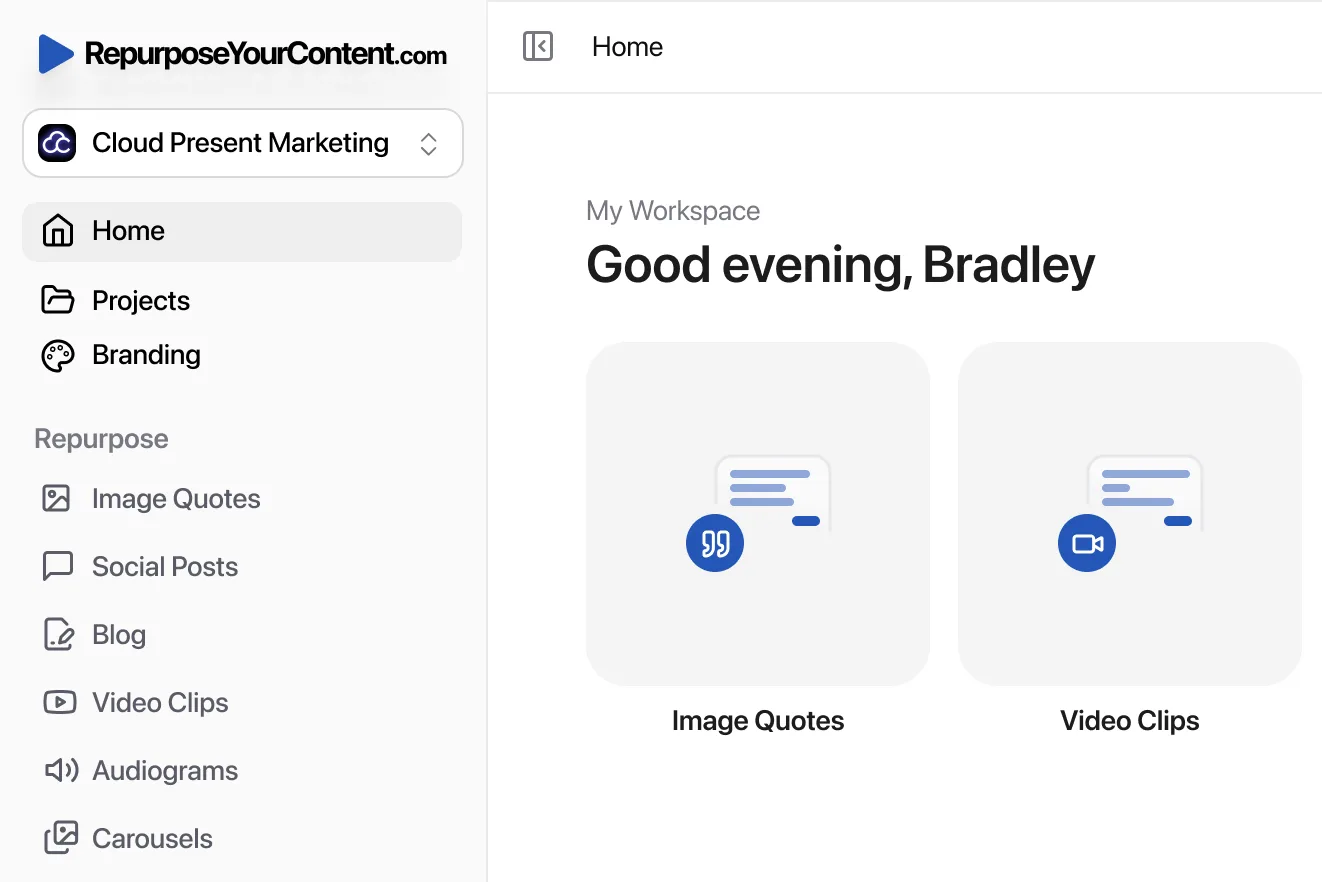
This is also where RepurposeYourContent sits. That's the right category for buyers who care less about fancy edit controls and more about converting one webinar into usable campaign assets.
Buyers usually don't need a better editor. They need a better post-webinar production system.
All-in-one event platforms
These platforms start with webinar hosting, registration, attendee management, and event analytics. Repurposing may be included, but it's often an add-on rather than the product's centre of gravity.
They can make sense if the team wants one vendor for live events and post-event follow-up. They make less sense when the buyer already likes their webinar platform and wants stronger repurposing.
Best fit: webinar programme owners who want one stack and can live with trade-offs.
Enterprise services and agencies
Some organisations don't need software. They need execution. Agencies and managed services can handle editing, writing, design, approvals, and publishing.
That model is valid when internal bandwidth is close to zero or content quality requires close human control across many stakeholders. The downside is slower turnaround, less internal ownership, and higher dependency on external process.
Best fit: enterprise teams, regulated sectors, global programmes with heavy review chains.
Quick category filter
| Team situation | Best starting category | Usually the wrong category |
|---|---|---|
| One marketer doing everything | B2B-specialised tool or general editor | Enterprise service |
| Small B2B team with webinar backlog | B2B-specialised tool | Podcast-only tool |
| Agency serving several clients | B2B-specialised tool or service hybrid | Single-user editing tool |
| Large enterprise with legal review | All-in-one platform or enterprise service | Lightweight clip-only app |
How to Choose the Right Webinar Repurposing Tool
Feature grids make buying feel rigorous. They rarely predict whether your team will publish faster.
Choose the tool that cuts production time per webinar and increases monthly output without adding review chaos. For a UK B2B team running two webinars a month, the difference between a weak tool and a strong one is often the difference between publishing four assets and publishing 20. That gap matters more than whether the vendor offers 40 output types nobody will use.

Start with a simple test. Ask each vendor to process the same 45-minute webinar and show what your team gets back in 24 hours. Then score three things: hours saved, number of usable assets, and amount of senior editing still required. If they cannot prove those three points in a live workflow, the rest of the demo is theatre.
For teams also thinking about whether repurposed written content can perform in AI search and answer engines, Algomizer's GEO framework is a useful reference. It helps buyers judge whether outputs are structured clearly enough to be reused, cited, and found.
1. Check input reality, not input claims
A vendor should handle the webinar formats you already use. That means direct uploads, hosted links, panel discussions, screen shares, and audio that is less than perfect.
If the tool only works cleanly inside one ecosystem, skip it unless you plan to change your whole stack. Procurement teams love platform consolidation. Content teams pay for it later with workarounds.
Ask these questions in the demo:
- Can you ingest a Zoom recording link without manual prep?
- Can you process webinars with multiple speakers and slides on screen?
- What breaks the workflow? Long sessions, poor audio, accents, product demos?
If the answer to any of those is fuzzy, expect friction every week.
2. Judge outputs by channel value
Buyers waste time counting formats. Count publishable assets instead.
A useful tool should produce assets that map to real distribution. For many UK B2B teams, that means LinkedIn clips, a blog draft, email follow-up copy, sales snippets, and quote graphics or carousel copy. If a vendor shows novelty outputs but your team still needs to write the post-webinar email and fix the article by hand, you are not buying speed.
Use this filter:
| Output type | Good question to ask |
|---|---|
| Video clips | Are the clip points strong enough to post without hunting through the full recording? |
| Blog draft | Does it read like a marketer wrote it, or like a transcript got tidied up? |
| Social posts | Are they channel-specific, or generic copy with hashtags added? |
| Email copy | Can demand gen send it with light edits on the same day? |
| Visual assets | Do they follow brand rules without extra design time? |
One good output beats five mediocre ones.
3. Audit quality where it actually costs money
Poor quality is expensive because senior people fix it. That is the hidden cost buyers miss.
Ask the vendor to show raw transcript, first-pass outputs, and final export side by side. Look for missed terminology, weak summaries, wrong speaker attribution, and generic headlines. In B2B, small errors destroy trust quickly. If your webinar covers pensions software, cyber insurance, or industrial procurement, the tool needs to preserve technical meaning without a human rebuilding every asset.
Branding matters too, but only if it reduces production work. Auto-applied captions, templates, intro cards, and visual consistency are useful. Cosmetic controls that still leave your designer rebuilding every social asset are not.
4. Measure automation by touches per webinar
Vendors love the word automation. Ignore it. Count touches.
A strong workflow gets a webinar from upload to review-ready asset pack in a few actions. A weak workflow asks your marketer to prompt repeatedly, export one item at a time, rewrite headlines, copy text into other tools, and chase formatting problems. That is not a platform. It is a pile of partial shortcuts.
Use this rule. If one webinar needs more than a few manual interventions before the team can review assets, the tool will slow down as volume rises.
5. Test approvals and team handoffs
Repurposing breaks when the workflow stops at generation. The critical test is handoff.
Can a content lead review the blog? Can brand approve clips without downloading files? Can demand gen lift approved copy into campaigns quickly? Can an agency and in-house team work in the same space without version confusion?
You also need a clean way to connect production with performance. Teams that track webinar metrics and KPIs to track can see whether faster repurposing is producing more pipeline content, not just more files.
6. Treat compliance and integrations as buying criteria
For UK teams, this is not admin. It affects speed.
Check where data is stored, how deletion requests are handled, whether transcripts are retained, and how captions and accessibility are managed. If legal or IT blocks the rollout after purchase, the tool has already failed.
Integrations matter in the same practical way. You do not need a long list. You need exports and connections that fit your publishing process, whether that is a CMS, Google Drive, a social scheduling tool, or your webinar platform.
A simple decision tree
Use this to narrow the shortlist fast:
- If your team already has editors and writers, buy for speed of clipping, drafting, and approvals.
- If one marketer owns the whole workflow, buy for automation and low manual touch count.
- If compliance review is heavy, buy for permissions, auditability, and controlled exports.
- If leadership wants ROI proof in one quarter, buy the tool that can show hours saved per webinar and assets published per month.
The right question is simple. Will this tool help your team turn one webinar into a repeatable content engine, or will it create another queue of half-finished drafts?
Your Downloadable Evaluation Scorecard and ROI Model
Most buying decisions get vague because nobody turns the shortlist into a working score. That's easy to fix.

A good scorecard forces the team to rank what matters before the demos start. A useful companion for operational planning is this content repurposing workflow diagram template, which helps map handoffs before a vendor gets involved.
A simple scorecard template
Use a weighted model. Importance should vary by team. A solo marketer may care most about automation. An enterprise team may weight compliance and approvals more heavily.
| Evaluation criteria | Weight 1 to 5 | Vendor score 1 to 10 | Weighted result | Notes |
|---|---|---|---|---|
| Input flexibility | ||||
| Output variety | ||||
| Written content quality | ||||
| Video clip quality | ||||
| Branding automation | ||||
| Ease of review | ||||
| Team collaboration | ||||
| Compliance and accessibility fit | ||||
| Integration fit | ||||
| Pricing clarity |
How to score vendors properly
Don't let the sales demo set the criteria. Internal workflow should set the criteria.
A solid method looks like this:
- Define the use case first. Example: one monthly webinar must produce LinkedIn posts, short clips, a blog article, and email follow-up.
- Assign weights by pain level. If editing time is the main problem, automation and quality should carry more weight.
- Use one real webinar for every trial. Demo content hides weaknesses.
- Score after review, not during the call. Sales energy can distort judgment.
Shortlist rule: Keep no more than three vendors in live evaluation. More than that wastes buyer time and slows decision-making.
A practical ROI model
The strongest business case isn't “this tool has AI.” It's “this tool removes repeatable production hours from every event.”
Use a basic model:
- Hours saved per webinar = manual repurposing time minus tool-assisted repurposing time
- Value saved per webinar = hours saved multiplied by blended hourly team cost
- Operational gain = faster publishing, fewer handoffs, less backlog
No extra numbers are needed to make the case. The point is consistency. If the same savings appear every month, the tool is creating budget room through time recovery.
During this process, many teams buy the wrong product. They optimise for subscription price instead of production economics. A cheaper tool that creates extra manual work can cost more than a pricier tool that cuts the workflow down properly.
A Real B2B Repurposing Workflow in Action
A practical workflow reveals more than any feature grid. Buyers should test whether one webinar can become a usable campaign package without rebuilding every asset by hand.

Consider a B2B team running a sixty-minute webinar on pipeline forecasting. The goal isn't to archive the replay. The goal is to produce enough follow-up content to support a month of distribution.
Step by step workflow
Step 1
A marketer uploads the webinar file or pastes in a recording link.
Step 2
The platform identifies key topics, extracts timestamps, and separates the strongest moments for follow-up use.
Step 3
The team selects the output mix. That might include video clips, blog posts, social posts, audiograms, image quotes, newsletters, LinkedIn carousels, and timestamp-based highlights.
Step 4
The first draft assets are generated. The marketer reviews naming, accuracy, speaker context, and brand fit.
Step 5
The team edits only where needed, then exports channel-ready assets for publishing.
A small-team operating model often matters as much as the software itself. This guide to a content repurposing workflow for small teams is useful because it shows where approvals and publishing should sit after generation.
To see the workflow shape visually, this product walkthrough helps:
What good workflow output looks like
The best workflow doesn't flood the team with drafts. It creates a coherent asset set.
For one webinar, a buyer should expect something like this:
- Short clips for LinkedIn: Highlight moments tied to one clear idea each
- A blog draft: Structured around the webinar's strongest insights, not transcript sludge
- Email follow-up copy: Useful for registrants and no-shows
- Carousel content: Built from the same argument, not random transcript fragments
- Social copy: Multiple post angles from the same source event
That's also why language quality matters. If AI-written posts sound stiff, teams will spend more time fixing tone than they save on drafting. Some marketers run final copy through tools that humanize chatgpt text to smooth phrasing before posting. That can help, but it should be the last polish step, not a rescue operation for weak output.
The key test during trials
Use one real webinar with slides, multiple speakers, and technical language.
Then inspect four things:
- Topic extraction: Were the core themes identified?
- Context accuracy: Did it confuse speakers or miss transitions?
- Brand consistency: Did visual and written assets feel aligned?
- Review burden: Did the team edit lightly or rebuild from scratch?
If the answer to the last question is “rebuild,” the tool failed the trial.
Red Flags and Critical Questions for Vendors
Vendors lose credibility fast when they dodge operational questions.
That matters because webinar repurposing sits inside your content workflow, your data policy, and your publishing process. If the tool saves five hours on drafting but adds two weeks of legal back-and-forth or forces manual reformatting before every post goes live, the ROI falls apart. UK buyers should treat vendor answers as a forecast of review burden after purchase.
Red flags that should slow the deal
- Platform lock-in: The product only works well with one webinar platform, one video host, or one publishing stack. That creates switching risk and procurement pain later.
- Clip-first output dressed up as repurposing: If the demo revolves around highlight clips and little else, expect your team to keep writing blogs, emails, and carousel copy by hand.
- Pricing that punishes content velocity: Volume caps, seat limits, and usage-based charges can turn a sensible monthly fee into an ugly quarterly surprise once the team starts publishing consistently.
- Weak transcript accuracy: Poor speaker separation, missed jargon, and bad timestamps will force your team to rebuild the output. That wipes out the time saving.
- Branding that stops at video templates: A polished clip frame is not enough. Written assets, visuals, and exports should all follow the same brand rules without manual cleanup.
- Vague compliance answers: If sales cannot explain storage location, deletion controls, subprocessors, or contract terms clearly, your legal team will stall the deal.
- No proof of end-to-end output: If the vendor cannot show one webinar turned into a usable set of assets, they are selling potential, not workflow improvement.
One rule is simple. If a vendor keeps returning to AI magic instead of showing the exact editing and approval workload, assume your team will pay for that gap in labour.
Questions worth asking in every demo
Ask questions that expose time cost, not presentation skill.
- How many minutes of human review does one 45 to 60 minute webinar usually need before assets are ready to publish?
- Which outputs come straight from the platform, and which still need prompting, copy-pasting, or export steps?
- Where is webinar data stored, and how can our team control deletion and retention?
- How does the platform handle transcripts that include personal data, customer names, or regulated topics?
- How accurately does it handle multiple speakers, panel discussions, and screen shares?
- How are brand rules applied across clips, blog drafts, emails, social posts, and visual assets?
- What breaks if we change webinar platform or recording source next quarter?
- Can we trial the product on one of our own webinars with technical language and more than one speaker?
- What does the first-month setup involve for a lean team?
- What does the invoice look like if we go from two webinars a month to eight?
A strong vendor answers these in plain English. A weak one pivots back to features.
Team-specific decision guide
Solo marketer
Prioritise automated branding across all asset types. If you still have to fix slide visuals, social formatting, and copy tone one by one, the tool is adding admin, not removing it.
Small B2B team
Prioritise review speed. Choose a tool that produces a blog draft, LinkedIn clips, email copy, and social posts from one webinar in one workflow, with light approval rather than handoffs across three tools.
Agency
Prioritise account separation, reusable templates, and export control. Your margin disappears when strategists spend time renaming files, reapplying client branding, or fixing inconsistent outputs across accounts.
Enterprise
Prioritise governance first. Look for clear permissions, retention controls, procurement-ready security answers, and predictable pricing. Output range matters, but it comes after operational reliability.
Here is the commercial test. If the platform cannot help your team publish more from each webinar without adding review hours, it is not a repurposing tool worth buying. It is just another content interface.
Choose Your Workflow Not Just Your Tool
The best buyer doesn't purchase software. The best buyer purchases a repeatable post-webinar workflow.
That's the core of how to choose the right webinar repurposing tool. Start with hours saved, output quality, and channel fit. Ignore vanity features. Shortlist by category. Test with a real webinar. Ask hard compliance and workflow questions before procurement gets involved.
A good tool turns a recording into active pipeline content. A bad one turns one manual process into six smaller manual processes.
If the goal is to turn one webinar into a month of usable B2B content, try RepurposeYourContent and review the comparison pages, RepurposeYourContent vs Goldcast, RepurposeYourContent vs Opus Clip, RepurposeYourContent vs Castmagic, and RepurposeYourContent vs Vidyard.
Tags: