How to Maintain Consistency: Practical Systems
Discover how to maintain consistency with practical systems, not willpower. This guide offers workflows & strategies for busy founders, podcasters, and
30 to 60 minutes of editing can be required for every finished minute of video, so a five-minute clip may consume 3 to 5 hours of manual work (RepurposeYourContent editing-time guide).
That workload makes consistency a systems problem, not a motivation problem. Founders, podcasters, and B2B marketers may have strong recordings and useful ideas, yet still miss publishing schedules because each asset starts from scratch. A defined repurposing process turns one recording into multiple formats, reducing repetitive production and creating a schedule that can scale.
Why Content Consistency Fails
73% of B2B marketers report that recordings such as podcasts and interviews are their number one source of quality leads. Yet only one in three teams have a scalable way to create consistent content from them (Sitecore's content repurposing research).
That gap changes the diagnosis. Teams often don't have a content shortage. They have a conversion problem between recorded expertise and finished assets.
A founder records a podcast episode, keynote, sales call, or interview. The recording then sits in a folder because someone must transcribe it, find usable moments, edit clips, write posts, create graphics, schedule everything, and review the final work. Each task seems manageable alone. Together, they create a production queue that grows faster than the team can clear it.

Motivation can't carry a production schedule
Motivation works for occasional effort. It doesn't support a recurring content operation with multiple channels, approvals, formats, and deadlines.
A team might publish consistently after a major event. The schedule then weakens when client work, sales priorities, or a product launch takes over. Asking the same people to “try harder” doesn't remove the production work. It only turns missed deadlines into a personal failure.
Operational rule: If consistency depends on someone finding spare time, the system already contains its own failure point.
The practical answer is to reduce decisions and repeated labor. One source recording should become a defined package of outputs. Each output should follow a documented path, with clear ownership and quality checks. Teams looking to formalize that structure can start with understanding standard operating procedures, especially for recurring editorial work.
Consistency means more than publishing on a schedule. It includes cadence, brand voice, format quality, and operational control. A team can post frequently and still sound inconsistent if every asset starts from a blank page. A scalable process protects all four dimensions.
The Foundation for a Consistent Habit
Consistency improves when the required action has a stable context, a realistic minimum, and a clear next step. It doesn't improve because someone makes a dramatic promise to work harder.
A University College London study found that forming a habit took participants 18 to 254 days, depending on the behavior and individual. The study also found that missing one opportunity didn't materially disrupt habit formation, while more consistent repetition improved the model fit (University College London habit study).
That evidence supports a useful operating principle: persistence matters more than perfection. A missed publishing day shouldn't cause a team to abandon the entire system. The recovery process matters more than the interruption.
Define the minimum viable cadence
Start with the smallest schedule the team can sustain during a busy month. That might mean one LinkedIn post each week, one newsletter segment, or one short clip from every recorded conversation.
The minimum isn't the final ambition. It's the baseline that keeps the workflow active while the team improves its capacity. A schedule that survives ordinary pressure is more valuable than an aggressive calendar that collapses after a few weeks.
A practical baseline includes:
- One source: Choose one podcast episode, interview, keynote, or sales recording.
- One owner: Assign responsibility for moving the source through production.
- One review path: Decide who checks accuracy, voice, visuals, and compliance.
- One publishing destination: Start with the channel that matters most commercially.
- One recovery rule: If an asset slips, reschedule it without rebuilding the entire queue.
A documented editorial calendar template for marketing teams can help connect these decisions to dates, owners, formats, and approval status.
Build around a source of truth
A single long-form recording gives the team a stable reference. The transcript, timestamps, approved terminology, and central themes all come from the same source.
That structure reduces contradiction across channels. The LinkedIn post, quote graphic, email, and blog can express the same idea without forcing several writers to interpret the subject independently.
The 2024 systematic review of habit interventions found that health-related habits typically took 2 to 5 months to become automatic, with individual timelines ranging from 4 to 335 days (2024 habit formation review). Content operations need the same patience. The first weeks should optimize for repeatability, not polish at any cost.
The Manual Workflow That Breaks Consistency
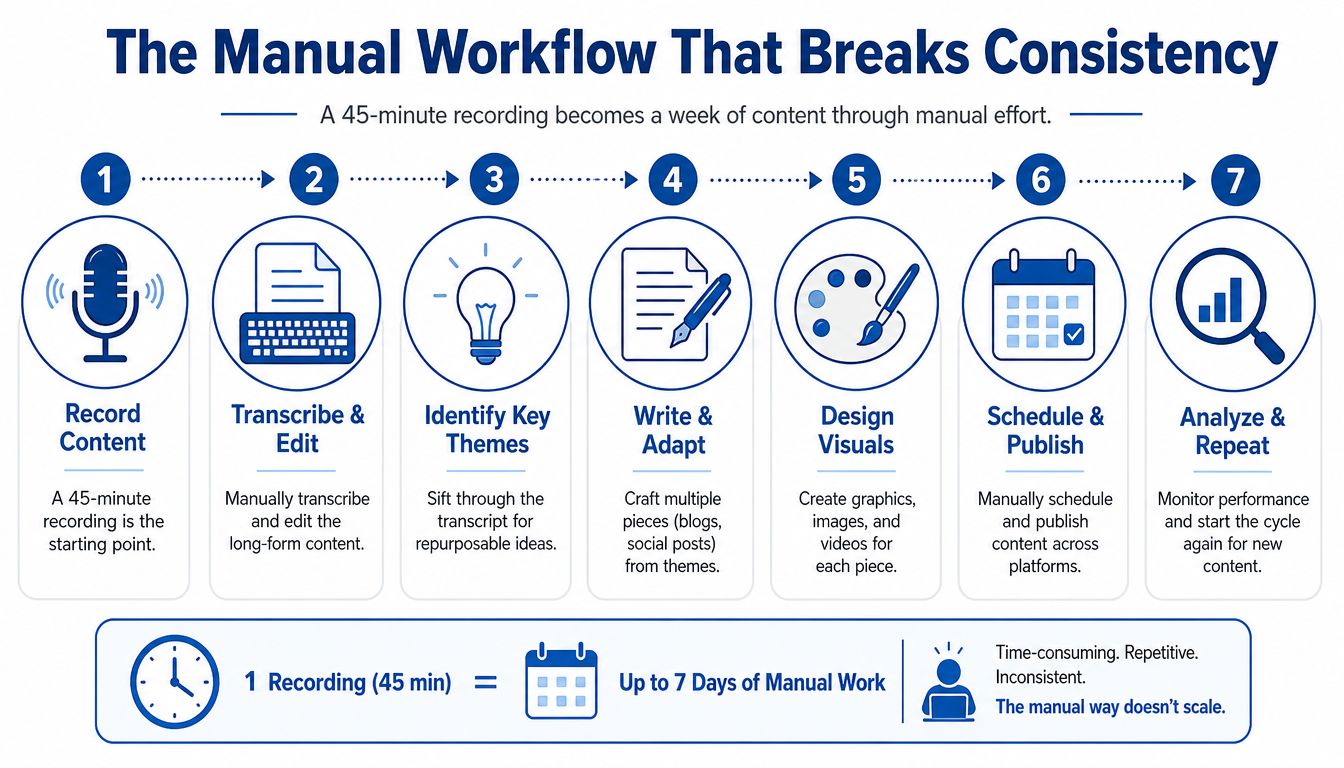
A 45-minute recording looks productive until the team prices every task required to turn it into a week of content. Without a defined process, the source becomes a queue of unpaid work rather than a reliable publishing asset.
Step 1 begins with review, not publishing
The recording needs transcription, cleanup, and review before anyone can select useful material. That first pass can take 2 to 3 hours, particularly when the editor checks names, terminology, unclear audio, and claims that need verification.
Theme discovery follows. Someone reads the transcript, marks clear explanations, identifies useful stories, and finds moments that can stand alone. The work overlaps with review because selecting a clip requires context, not just keyword searches.
Video production adds the largest time cost. Professional editing commonly requires 30 to 60 minutes per finished minute, according to the documented editing-time ranges. A five-minute clip can therefore consume 3 to 5 hours before captions, branding, resizing, and review.
Step 2 adds writing and design
After clips are chosen, a writer adapts the central ideas for each channel. Social copy across several platforms can take about 2 hours once the writer develops hooks, checks context, and writes suitable calls to action.
Graphics require another 2 to 3 hours. Quote cards, carousel slides, cover images, audiograms, and supporting visuals all involve different dimensions and layout decisions.
Scheduling creates a separate administrative queue. Files must be uploaded, copy pasted, links added, dates selected, previews checked, and approvals coordinated. Someone must also review results and decide which themes deserve another treatment.
Practical rule: Count every handoff, review, export, and approval. Those small tasks determine whether a schedule survives.
Guidance on how to streamline business processes applies directly to content operations. Editing skill matters, but so does the number of disconnected steps between recording and publication.
A manual workflow can produce a week of content from one recording, while spreading the labor across fragmented work blocks. A team member starts on Monday, pauses for client work, returns on Thursday, and publishes late. The next recording may arrive before the first is complete.
Teams can reduce some friction with a social media content batching workflow. Batching groups similar tasks, but it does not remove transcription, editing, writing, design, or approvals. Consistency requires fewer one-off decisions and repeated use of the same approved source.
How to Maintain Consistency with a Repurposing System
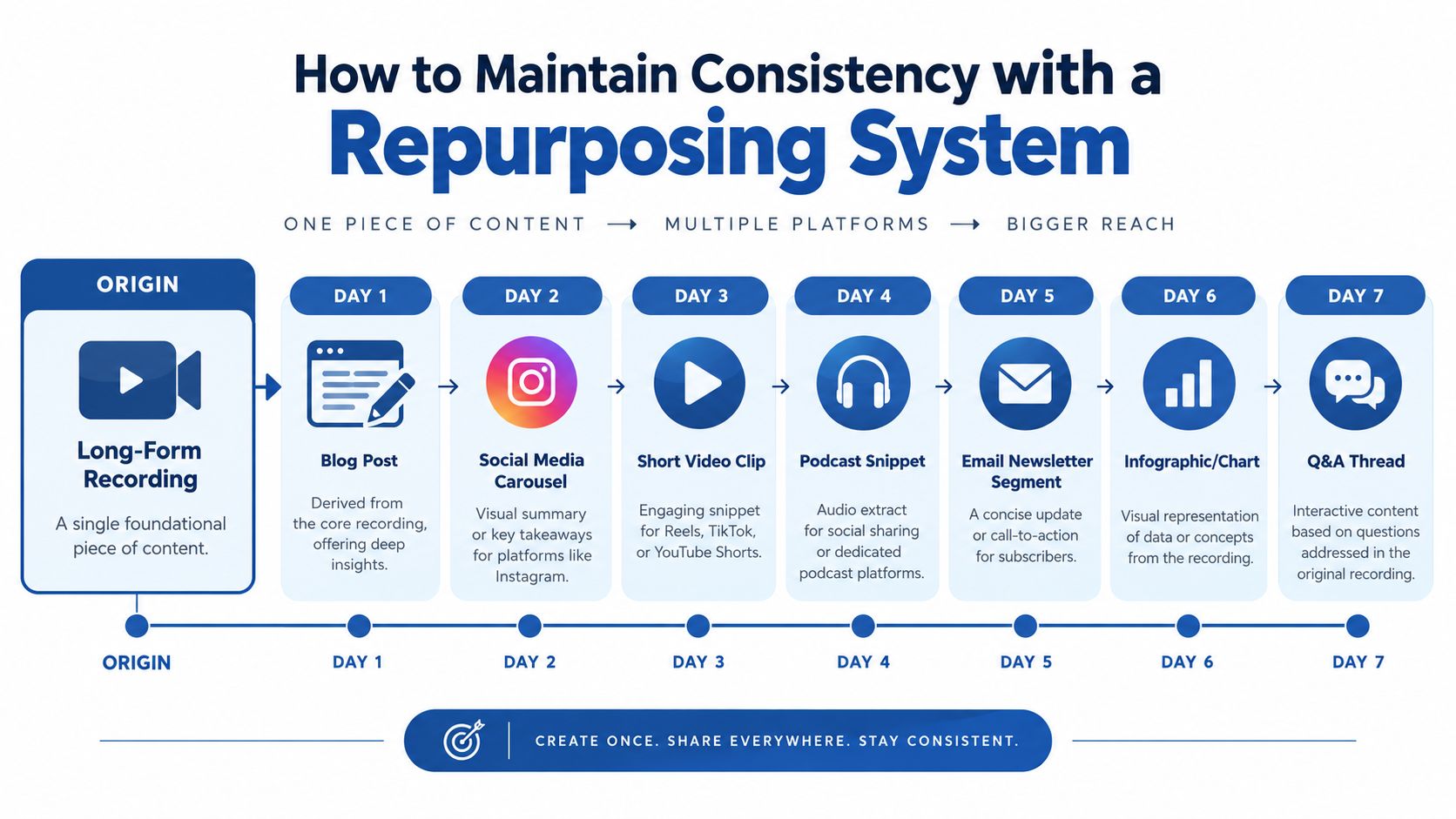
A repurposing system treats one long-form recording as the source file for an entire publishing cycle. The team doesn't invent seven unrelated ideas. It extracts, adapts, and distributes the strongest ideas in formats suited to each channel.
The model works for a podcast episode, founder interview, keynote, livestream, course lesson, customer conversation, or sales call. One recording can supply video clips, written posts, quote graphics, carousels, audiograms, and a blog post.
Repurposed content can generate up to 60% more engagement than single-format original content, based on Buffer data cited in a marketing statistics roundup on content repurposing. That figure is directional, not a universal guarantee, but it supports the central production decision. Multiply strong ideas before creating new ones.
A practical seven-day playbook
A podcaster can use this sequence after recording one substantial episode:
- Step 1, record the source. Capture the full conversation and preserve the original file, transcript, and episode notes.
- Step 2, publish the long-form episode. Use the recording as the primary reference for every later asset.
- Step 3, select short clips. Choose moments that explain one problem, answer one question, or challenge one assumption.
- Step 4, extract written ideas. Turn the strongest themes into LinkedIn posts, a newsletter segment, and a blog outline.
- Step 5, create visual derivatives. Adapt memorable statements into quote graphics and the main framework into a carousel.
- Step 6, schedule the package. Assign each asset a channel, owner, approval status, and publication date.
- Step 7, record learnings. Note which themes generated useful conversations, then feed those insights into the next recording.
A weekly schedule might publish the full episode on Monday, two clips on Tuesday, a quote graphic on Wednesday, a newsletter takeaway on Thursday, and a carousel on Friday. The team works from one source instead of beginning five separate creative projects.
Protect quality with operating rules
Repurposing doesn't mean copying the same paragraph everywhere. Each channel needs a different opening, length, visual treatment, and call to action. The source idea stays stable while the presentation changes.
A consistent system should include a brand kit, approved terminology, voice examples, visual standards, and a review checklist. It should also identify who owns final approval. Without those controls, higher output can create more inconsistency.
Small teams can adapt a content repurposing workflow for small teams by limiting simultaneous campaigns and assigning one person to manage the production queue. The system becomes easier to maintain when every recording follows the same path.
The Done-for-You Alternative
The manual workflow demands hours of transcription, editing, writing, design, scheduling, and review. A done-for-you service removes those production tasks while keeping the source material and brand direction with the client.
The process is straightforward. A client sends one recording, such as a podcast, webinar, keynote, interview, or meeting recording. The service returns 20 to 30 ready-to-publish assets within 72 hours, including video clips, LinkedIn posts, quote graphics, carousels, audiograms, and a blog post.
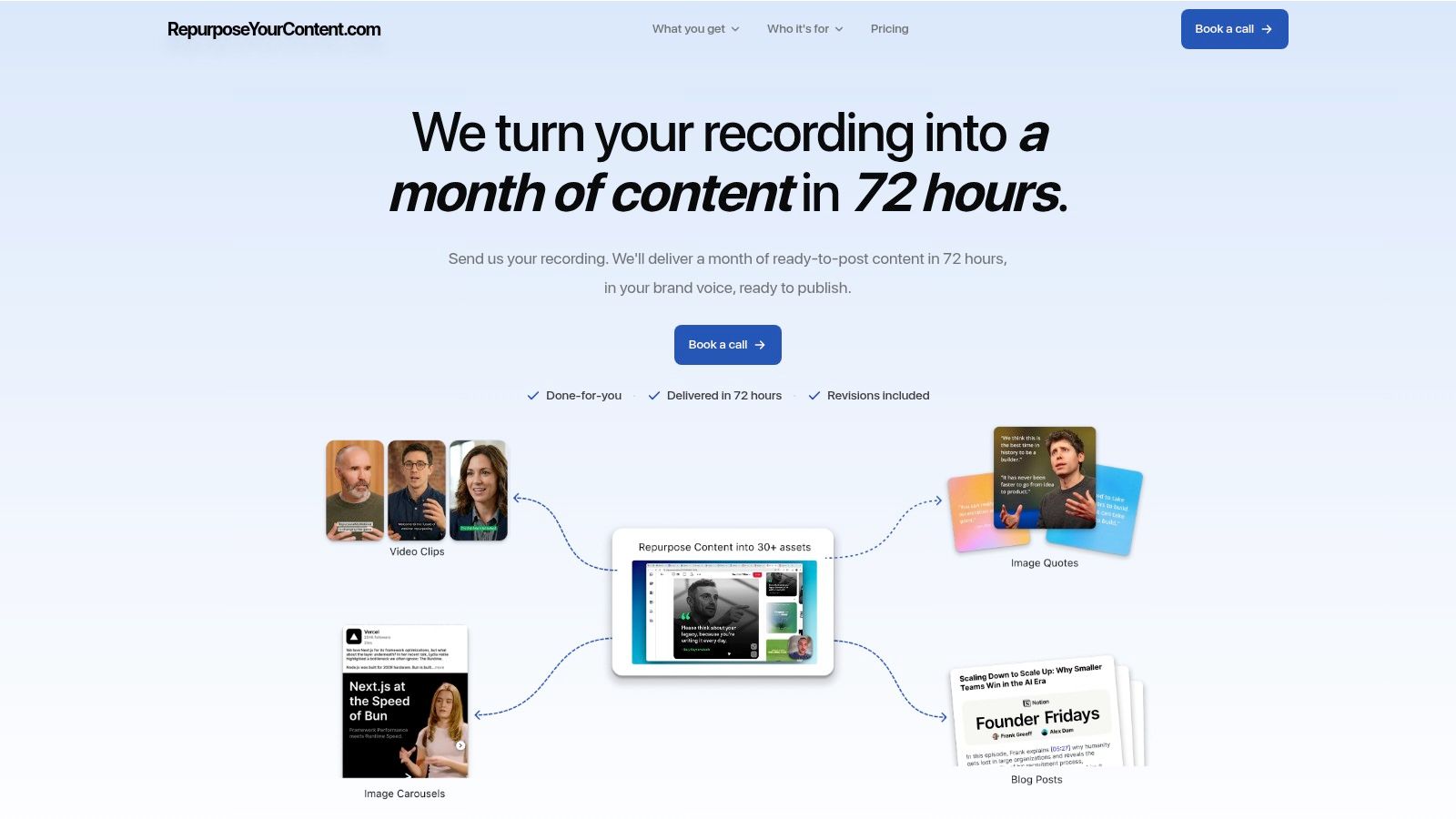
The client's time commitment is about 15 minutes. That time covers sending the recording, sharing brand guidance, and reviewing the delivered package. Unlimited revisions keep the team from accepting an asset that doesn't match its voice or standards.
The economics favor reuse
Repurposing can increase reach by up to 12x and reduce cost per piece by 80% compared with creating new content for each channel, according to a 2026 repurposing cost and reach comparison. These figures are broad directional benchmarks, not guarantees for every campaign. They still clarify why one-to-many production is more sustainable than constant original creation.
A 45-minute recording can become 30 assets when the team extracts multiple themes and formats. The service model starts at $14 per finished asset, giving a founder a way to buy production capacity without hiring separate editors, writers, and designers.
The workflow also creates accountability. A 72-hour turnaround guarantee, or the client doesn't pay, gives the publishing calendar a dependable delivery point. That matters when content must support a launch, sales campaign, podcast schedule, or executive posting cadence.
The service remains useful only when the source recording contains clear expertise and the client provides usable brand direction. It won't replace strategy, positioning, or subject-matter judgment. It handles the production layer that usually prevents those strengths from reaching the market.
The guide to outsourcing content repurposing can help teams compare internal production with external capacity. RepurposeYourContent is one done-for-you option. Clients send a recording, and the service returns finished content in the requested formats and brand voice.
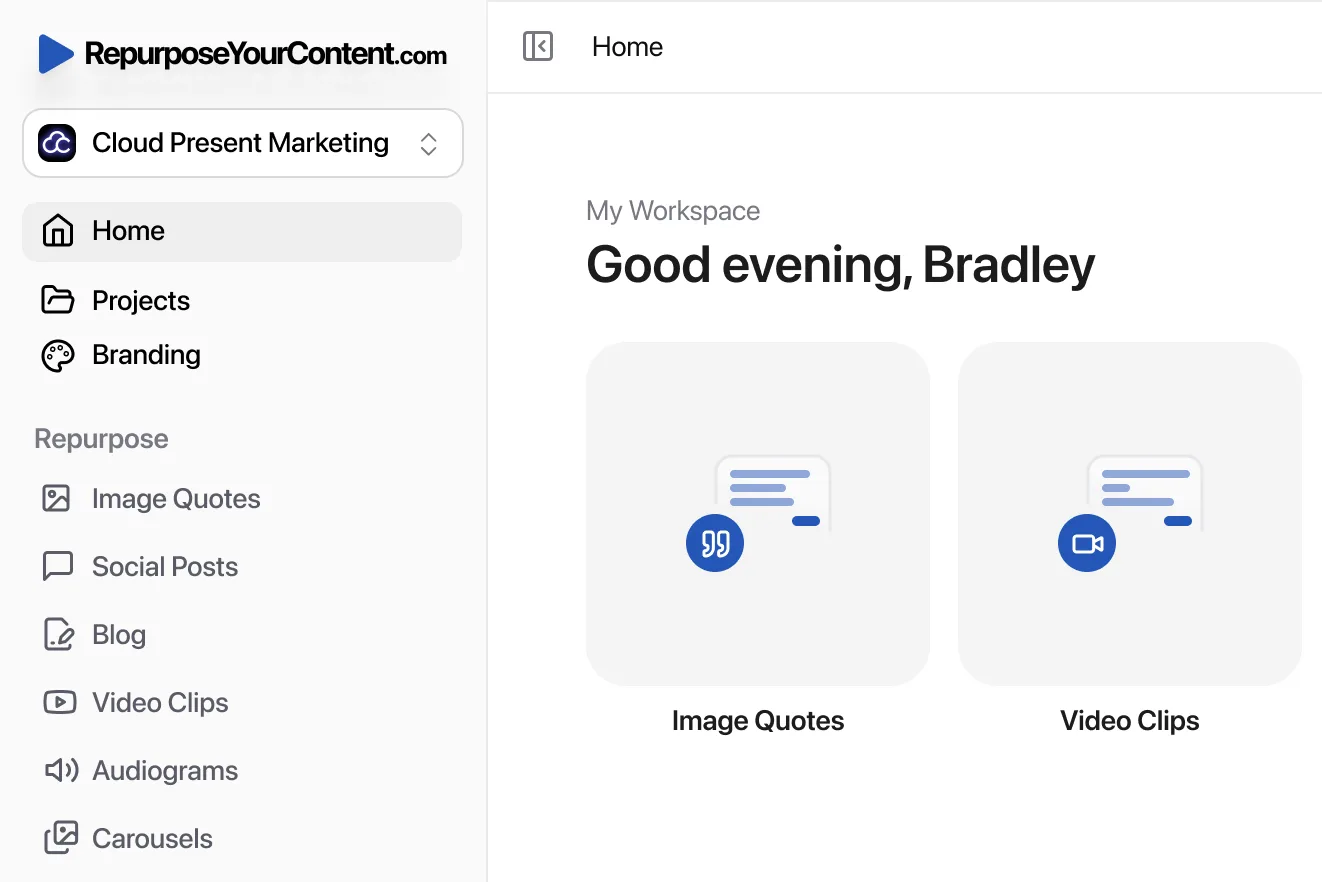
The supporting media below shows the type of recording-to-assets workflow a service can organize.
Stop Trying Harder and Start Building a System
Consistency comes from a workflow that makes the required action repeatable. It does not depend on a founder finding fresh motivation after every recording.
Manual production turns one recording into a chain of separate jobs. A founder or marketer must research, edit, write, design, schedule, and review each asset. That can suit occasional publishing, but the time cost becomes a direct threat to a dependable cadence.
A defined system begins with one source recording, a fixed asset package, brand guidance, assigned owners, and review rules. Those decisions reduce repeated judgment while keeping quality standards visible. The trade-off is front-loaded setup time, followed by less coordination for each publishing cycle.
Teams assessing the wider process can use Bulk Image Generation's marketing software guide to consider how visual production fits with other marketing operations. Tools support the workflow, but templates, approvals, and ownership keep output consistent.
A B2B content engine should distribute recorded expertise through a planned set of formats without creating another queue for the marketing team. Repurposing makes each source recording work harder, which is more sustainable for time-poor creators than producing every asset from scratch.
The decision is practical: continue paying the time cost of fragmented production, or build a repeatable process around content already being recorded.
RepurposeYourContent provides one done-for-you option. Clients send a recording, provide brand direction, and receive finished content in the requested formats and voice. The service handles production capacity, while the team retains control over strategy, positioning, and final review.
Tags: