How to Repurpose Livestream Recordings Into 30+ Assets
Learn how to repurpose livestream recordings into weeks of content. Our step-by-step guide for B2B marketers turns one stream into 30+ platform-ready assets.

One hour of live video is not one piece of content. It is a month of assets, if you treat the recording like source material from the start.
The practical workflow is straightforward, but it is not quick. Download the cleanest recording you have. Cut a master replay that removes countdowns, tech checks, repeated intros, and chat-only detours. Mark the sections that carry a clear opinion, lesson, story, or answer. Then turn those moments into shorts, quote posts, a recap article, email copy, and follow-up assets. If you need a clear framework for what that process covers, this guide to content repurposing lays out the model.
The mindset shift matters more than the editing tools. Founders and small marketing teams often treat the livestream as the finished product, then wonder why the replay underperforms and the recording sits untouched. The live session did its job by attracting attention in the moment. The recording has a different job. It has to carry the useful parts forward without the waiting room, housekeeping, awkward pauses, or side comments meant only for people who showed up live.
That is why I plan livestreams like content shoots with witnesses. The audience still matters. Their questions sharpen the material, and the live format pulls out stronger answers than a polished script often does. But the lasting value shows up after the event, when the best five to ten moments are cut, titled, formatted, and distributed with intent.
This is also where the DIY math gets uncomfortable. A one-hour stream can easily turn into several hours of review, clipping, rewriting, resizing, captioning, QA, and scheduling before a single asset goes out. The process works. It just costs more time than many teams expect.
Your Livestream Is a Content Shoot Not an Event
The biggest mental shift in how to repurpose livestream recordings is this: the livestream is not the final product.
It's a recording session with an audience present.
That audience matters. Live comments can shape the conversation. Q&A can produce better moments than the planned outline. Urgency helps attendance. But the live layer is temporary. The expertise inside the recording is what lasts.

Live value is real but short-lived
Live video creates a few things recorded content can't fully copy:
- Urgency: people show up because it's happening now.
- Interaction: comments and questions shape the conversation in real time.
- Energy: unscripted exchanges often feel sharper than polished scripts.
But those advantages expire fast. Once the stream ends, viewers who missed it don't care that it was live. They care whether the replay solves a problem, answers a question, or teaches something clearly.
Practical rule: Treat the live version as the rough cut. Treat the evergreen version as the publishable product.
Evergreen value is where the compounding happens
The marketers who get the most from long-form content don't post once and move on. They multiply the asset. That's now standard behavior, not a fringe tactic. In a survey of 48 marketers, 94% said they repurpose content for different mediums and channels, according to Intentsify's summary of content repurposing research.
That lines up with what busy B2B teams already feel in practice. Recording is only the first half of production. Distribution is the second half.
A useful livestream can become all of this without re-recording anything:
- Short clips for LinkedIn, Instagram, and YouTube
- Quote graphics built from punchy lines
- Carousel posts that teach one framework
- A recap article based on the transcript
- A newsletter section that sends people back to the replay
That's the whole point of content repurposing as a repeatable workflow. One recording should feed multiple channels and multiple consumption habits.
The recording is usually worth more than the live stream
Founders and marketers often judge a stream by live turnout. That's the wrong scoreboard.
A better question is this: did the recording capture enough usable expertise to produce a month of content?
If yes, the stream worked.
The large majority of potential viewers were not there live. They will meet the content later, in smaller, cleaner, better-packaged formats.
That's why smart teams stop treating the replay like leftovers. They plan the stream as a content shoot from the start. They expect the best moments to be clipped, captioned, rewritten, reformatted, and distributed after the event.
Phase 1 Prep Your Raw Recording for Repurposing
Before any clipping starts, the recording needs to be pulled from the source platform and cleaned into a usable master.
This is the part often underestimated. Not because it's hard, but because it's slow. Manual prep on a one-hour stream usually takes 1 to 2 hours if someone wants a clean file, clean audio, and a transcript that's worth using.

Where to download the recording
The exact path depends on where the stream was hosted, but the rule is the same. Download the original file, not a compressed social rip.
A practical checklist:
- LinkedIn Live: find the post or video in admin view, then look for the saved replay or exported recording if a third-party live producer handled the stream.
- YouTube Live: go to YouTube Studio, open Content, locate the live replay, then download the source file or export the edit from the saved video.
- StreamYard: open the broadcast in the studio dashboard, then download the local or processed recording. Teams using StreamYard for recurring shows should also review the StreamYard workflow details here.
- Restream: go to the video storage or recordings area, open the stream, and export the saved file. If the team streams regularly across channels, the Restream integration workflow is here.
- Instagram Live: this one is less friendly. Save the replay promptly and export the highest-quality version available before the window closes.
If there's an option, keep the biggest file. Compression can be done later. Detail can't be restored later.
Build the evergreen master
A livestream replay almost always includes parts that only made sense live.
Those parts need to go.
According to Switcher Studio's repurposing guidance, livestreams should be recorded at minimum 1080p, and leaving visible live overlays such as chat bubbles or “Live” badges can reduce engagement by 25–30% on non-live destinations like Shorts or LinkedIn. That one fix alone changes how professional the clip feels.
The evergreen edit usually removes:
- Pre-roll dead air: waiting rooms, countdowns, “we'll start in a minute”
- Tech checks: “can you hear me,” mic fixes, screen-share confusion
- Chat tangents: responses that depend on comments nobody can see later
- Soft endings: rambling wrap-ups after the useful point is already done
A replay shouldn't feel like a replay. It should feel like a piece made for the viewer who found it later.
Don't skip transcript prep
Once the master is clean, generate a transcript. Not for compliance alone. For editing speed.
Reading the conversation makes it much easier to spot complete ideas, quotable lines, and repeated themes. That's why transcript quality affects every later step. Teams that want a practical walkthrough can use this guide on how to transcribe video automatically.
A clean prep workflow looks like this:
- Download the highest-quality source file.
- Trim dead air and live-only clutter.
- Clean audio enough for clear listening.
- Generate the transcript.
- Save that version as the evergreen master.
Without that master, every downstream asset gets slower and worse.
Phase 2 Extract High-Value Moments Not Just Clips
Most bad repurposing comes from one lazy habit.
Someone takes a one-hour livestream and cuts it into random sixty-second chunks.
That produces clips. It rarely produces good clips.
Editorial moments beat timestamp slicing
Strong short-form content comes from editorial moments, not equal-length segments. The useful unit isn't “minute 12 to minute 13.” It's a self-contained idea with a clear beginning, a payoff, and an ending.
That usually means scanning the transcript first and marking moments like these:
- A contrarian take: a point that challenges common advice
- A complete answer: one question answered in a way that stands alone
- A story beat: a short example with tension and resolution
- An honest reaction: unscripted moments that feel human, not rehearsed
The clips that outperform are often not the polished headline sections. They're the side comments, Q&A answers, or sharp off-script reactions that sound real.
The best clip in a livestream often isn't the planned takeaway. It's the moment where the speaker stops sounding scripted.
Rebuild each clip for a new viewer
A repurposed clip has a different job than the original stream. It must make sense to someone who never saw the live event.
That's why this video guide on repurposing live content advises editors to choose the part that's relevant, omit unrelated live sections, add a relevant intro, and end with a closed statement. In other words, the clip has to be rebuilt around the core point.
That usually means:
- removing the host setup before the useful answer starts
- trimming references to chat that no longer matter
- adding one line of context at the front
- ending cleanly instead of fading out mid-thought
A practical clip target is 30 to 90 seconds with the hook in the first two seconds. For many teams, a one-hour livestream will yield 8 to 12 strong clips when selected this way. The manual work of transcript review, timecode marking, trimming, captioning, and export usually takes 2 to 3 hours.
A simple extraction workflow
This is the cleanest manual workflow for a one-hour stream:
- Read the transcript once and highlight self-contained moments.
- Mark in and out timecodes for each moment.
- Cut the selected sections from the evergreen master.
- Write a one-line setup if the clip needs context.
- Add captions and branding before export.
For written derivatives, the same marked sections can also feed quote extraction. This guide on how to extract quotes from a webinar uses the same logic, even when the source recording is a livestream, keynote, or interview.
A machine can split by interval. An editor finds what people will watch.
Phase 3 Build a Full Stack of Platform-Ready Assets
A livestream recording becomes valuable when it leaves the replay page and turns into assets built for specific channels, screen sizes, and attention spans. This is the point where the team either creates a month of distribution or ends up with a folder full of half-finished exports.

Build assets for platforms, not for your editing timeline
One strong answer from a livestream can become a short video, a text post, a quote graphic, a carousel, a newsletter section, and a blog paragraph. The raw idea stays the same. The packaging changes.
That shift matters because each platform rewards different behavior. LinkedIn needs a clean takeaway and a strong opinion. Instagram needs visual pacing. YouTube Shorts and Reels need tight framing and immediate context. Email needs a useful summary with a reason to click.
Copying the same clip everywhere usually saves time for about ten minutes. Then performance drops, comments are weak, and the team has to redo the work anyway.
A practical asset stack from one cleaned livestream usually includes:
| Asset type | What it's for | Typical adaptation |
|---|---|---|
| Short video clips | Reach and attention | Reframe for vertical or square, add burned-in captions |
| Quote graphics | Fast engagement and saves | Pull one sharp line and pair it with branded design |
| Carousels | Teaching a process | Turn one answer into clear step-by-step slides |
| Audiograms | Audio-first distribution | Use waveform visuals for spoken moments that stand alone |
| Blog recap | Search and long-form reading | Rewrite the transcript into a structured article |
| Newsletter summary | Owned distribution | Pull top insights and link to replay, clips, or article |
Packaging takes longer than founders expect
The editing work is only part of Phase 3. The actual time goes into adaptation.
A 45 to 60 minute livestream with 8 to 12 usable moments usually turns into several parallel tasks: resizing for vertical, writing hooks and captions, checking transcript errors, building static designs, drafting post copy, and naming exports so someone can publish them later. If one person handles all of that manually, this phase alone often eats another 3 to 5 hours after clip selection is done.
That is the mindset shift. The livestream was the shoot. Repurposing is the campaign build.
Captions, framing, and transcript cleanup decide whether the asset feels finished
Auto-captions are a starting point, not a final file. Names, jargon, product terms, and numbers break first. If those errors stay in the asset, the content looks rushed even when the original insight is good.
Burned-in captions also outperform plain subtitle files in many feed environments because viewers often watch with sound off. The text has to be readable on a phone, timed correctly, and styled consistently enough that every post looks like it came from the same brand.
Framing needs the same level of care. Be.Live's guide to repurposing livestreams notes that the replay can stay in 16:9, but short-form platforms usually need cropping and trimming before the clip feels native. Written assets need a separate editing pass too. Spoken language rarely works as publish-ready copy without restructuring.
One recording should produce native assets for different contexts. It should not produce one generic asset pasted across every channel.
A realistic stack from one stream
For a typical 45 to 60 minute livestream, the finished package often looks like this:
- 8 to 12 short clips built from the clearest points
- 3 to 6 LinkedIn posts written from opinions, lessons, or contrarian takes
- 2 to 4 quote graphics from lines that stand alone without explanation
- 1 to 2 carousels built around a framework, checklist, or process
- 1 blog recap rewritten from the transcript
- 1 newsletter summary that gives subscribers the best parts quickly
Teams that want all of that without absorbing the editing and production load usually compare DIY against a done-for-you video repurposing service. The trade-off is simple. DIY gives control, but it also gives your team every hour of production work.
For adjacent formats, teams that also work from webinar replays can compare this approach with a more webinar-specific workflow in this guide on how to repurpose a live webinar recording.
The Done-for-You Alternative 15 Minutes to 30 Assets
A livestream should be budgeted like a content shoot, not treated like a one-off event.
That shift changes the math fast. If a founder or marketer handles repurposing in-house, the actual cost is not the software bill. It is the half day, or full day, that disappears into selecting moments, editing for multiple formats, rewriting spoken language into usable copy, checking brand accuracy, and getting everything approved.

A realistic DIY timeline for one recorded stream usually looks like this:
- Download, organize, and clean the master file: 45 to 90 minutes
- Review the transcript and mark usable segments: 60 to 90 minutes
- Edit short clips, resize, caption, and export versions: 2 to 4 hours
- Write posts, shape quote graphics, outline a carousel, draft a recap, and prep email copy: 3 to 5 hours
- Quality control, revisions, and scheduling handoff: 30 to 60 minutes
That is the version where the team already knows what it is doing. If the person doing the work is also the founder, head of marketing, or content lead, the stop-start cost is usually worse than the production time on paper.
This is why so many recordings stall after the live session. The event is over, the calendar fills back up, and repurposing becomes "later" work.
What changes with a done-for-you model
A done-for-you service removes the post-production queue from your team. The operator records the session, sends the file, answers a few brand or positioning questions, and reviews the finished package.
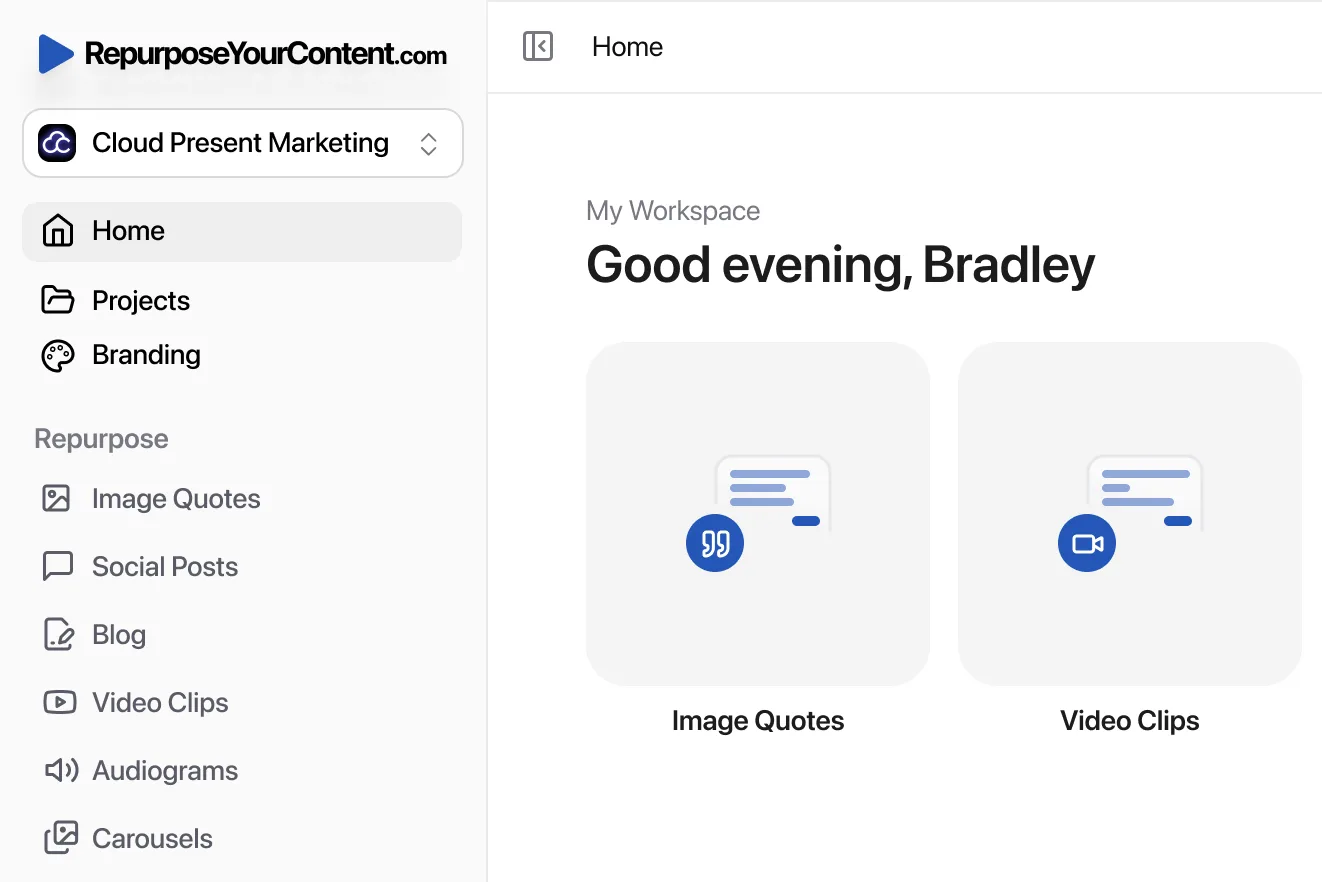
That operating model is why teams compare DIY against a done-for-you video repurposing service. RepurposeYourContent takes one recording from a podcast, webinar, meeting, interview, keynote, or livestream and turns it into finished assets. The offer is straightforward: one recording in, 20 to 30 finished assets back within 72 hours, with unlimited revisions. Client time is about 15 minutes.
That difference matters because output is only useful if it ships.
Why the economics usually break in favor of outsourcing
The question is rarely whether a B2B team can do the work internally. They can.
The better question is whether senior time should be spent inside editing software and transcript cleanup. In my experience, once a company wants consistent output from every livestream, internal repurposing starts to compete with strategy, sales follow-up, campaign planning, and distribution. Those jobs drive growth. Post-production supports growth, but it should not consume the same people who own the pipeline.
A simple comparison makes the trade-off clear:
| Approach | Time from your team | Typical result |
|---|---|---|
| DIY editing and writing | 7 to 12 hours per recording | Partial asset set, often delayed |
| Done-for-you service | About 15 minutes | 20 to 30 platform-ready assets |
The clip count is only part of the value. The bigger gain is consistency. The recording gets processed while the conversation is still fresh, the assets arrive in a usable batch, and the team can spend its time reviewing messaging instead of building every deliverable from scratch.
For a busy founder, that is the main appeal. DIY keeps control, but it also keeps every production task. Done-for-you keeps the original ideas and removes the labor.
Your 72-Hour Turnaround from Stream to Content
The process is easier to judge when it's shown as a timeline.
A typical post-stream workflow looks like this.
Day 0 after the livestream
The stream ends. The recording gets uploaded right away.
That takes about 5 minutes if the file is already downloaded from LinkedIn, YouTube, StreamYard, Restream, or the raw source. The transcript can start the same day. So can moment selection.
This speed matters because post-stream attention fades quickly. Fast turnaround keeps the clips and posts close to the original conversation while people still remember it.
Day 1 and Day 2 in production
Editors cut the clips, remove dead air and chat clutter, and add branded captions. Designers build quote graphics, audiograms, and carousels. Writers turn the transcript into LinkedIn posts, a recap article, and newsletter copy.
Every asset needs a human quality pass. That's where names, jargon, timing, and context get corrected.
For teams trying to reduce the manual burden, this article on how to automate webinar repurposing workflows is useful because the same production logic applies to livestreams, interviews, and sales conversations too.
Day 3 delivery
By the end of the 48 to 72 hour window, the finished package is ready for review.
That package can include:
- Video clips for LinkedIn, Reels, Shorts, or YouTube
- Written posts in the brand's tone
- Quote graphics and carousels built from the strongest moments
- A blog post based on the transcript
- A newsletter summary to keep distribution moving
The founder or marketing lead doesn't spend the week trimming waveforms or fixing subtitles. The team reviews assets and publishes.
That's the whole point of repurposing done properly. The live stream creates the raw material. The recording becomes a month of content while the original topic is still fresh.
If a backlog of livestreams, interviews, podcasts, or keynotes is sitting unused, book a call or request a sample and see what one recording can become in 72 hours.
Tags: