How to Use AI for B2B Marketing: A Strategic Guide
Discover how to use AI for B2B marketing with this strategic guide. Get actionable workflows for content, SEO, and email to drive real business results.

Your B2B marketing team spends 40-50 hours a week manually repurposing content. It's a soul-crushing production bottleneck. You need to use AI to amplify your team's expertise, not replace it. This is how to use AI for B2B marketing. It's about scaling your human insight and automating high-effort, low-reward work.
How to Use AI for B2B Marketing: Beyond the Basics

Nearly all B2B marketing teams are using AI. A recent report found 94% of UK marketers have adopted it. Most are stuck on surface-level tasks. They're missing the real opportunity. This is not another list of tools. This is a strategic framework to integrate AI across your B2B marketing. The goal is to save time and improve performance. Use these practical steps immediately.
The Problem with a Scattergun AI Approach
Many teams make the same mistake. They use AI to draft a blog post from a blank page. They generate generic social media captions. This saves minimal time. The result is bland content. It lacks your team's unique knowledge. This scattered approach creates random experiments, not a growth engine. The true value is in flipping this model.
AI’s best use case is not creating content from nothing. It is multiplying the value of expert content you already possess. Start with your highest-value, human-led assets.
For B2B companies, webinars are a goldmine. 73% of marketers see webinars as their top source for high-quality leads. Yet 68% struggle with content fatigue after the event. AI-powered automation offers a solution. Companies using it see a 20-30% higher ROI. They cut campaign launch times by up to 75%. This guide will show you how to build that system. Connect AI across content, email, social, and analytics. To learn more, see our guide on AI content generation.
Start with Expertise, Not a Blank Page
Most AI content tools create soulless articles. They start from zero and miss your company's unique point of view. You are a B2B marketer, not a content farm. Your expertise is your most valuable asset. Asking a machine to invent it is a mistake.
There's a smarter way to use AI in B2B marketing. It is not about creation. It is about multiplication. Start with your best human-led content. This could be a webinar, a founder's talk, or a customer presentation. Use AI as an amplifier to distribute that expertise everywhere.
A single one-hour webinar is packed with value. It contains your expert's best arguments and memorable quotes. Manually transcribing and repurposing this is a slow, painful process. AI can do the heavy lifting in minutes. This ensures every piece of content is rooted in genuine insight.
From Human Expertise to a Content Machine

The problem for marketing teams is not a lack of knowledge. It is the production bottleneck. You have subject matter experts. You run great events. You lack the time to turn that raw material into a content stream. This is where AI delivers the biggest impact.
Instead of prompting "write a blog post," feed the AI a webinar recording. The AI’s job is not to invent facts. Its job is to identify, package, and reformat your captured expertise. This flips the model from AI-generated content to AI-powered distribution.
Key Takeaway: The most efficient way to scale B2B content is to start with your team's knowledge. Use AI to turn one webinar into a complete multi-channel campaign. This maintains quality while you scale.
This strategy tackles a huge challenge. Reports show 58% of content marketers cite a lack of internal resources as a hurdle. AI-driven repurposing removes that barrier. It turns one person's hour-long event into a month of content for the team. See this case study on dominating the Generative AI space for an example.
A Practical AI Repurposing Workflow
Here is how a real workflow looks. You just finished a webinar.
- Step 1: Upload Your Source of Truth. Start with the video recording. Upload that single file to an AI repurposing tool.
- Step 2: AI Analysis & Extraction. The AI transcribes the session with timestamps. It analyzes the transcript to find key topics, questions, and compelling soundbites.
- Step 3: Automated Content Generation. From that analysis, it generates foundational content. You get a full-length, SEO-optimized blog post. You also get short, shareable video clips of the best moments. Then it creates more. You get social media posts, a LinkedIn carousel, and an email newsletter draft.
A single event becomes a cohesive campaign in minutes. For a deeper system dive, see our content repurposing strategy.
How RepurposeYourContent helps
Our platform runs this exact workflow. We built it for time-poor B2B marketers. You need to produce more high-quality content without burning out your team.
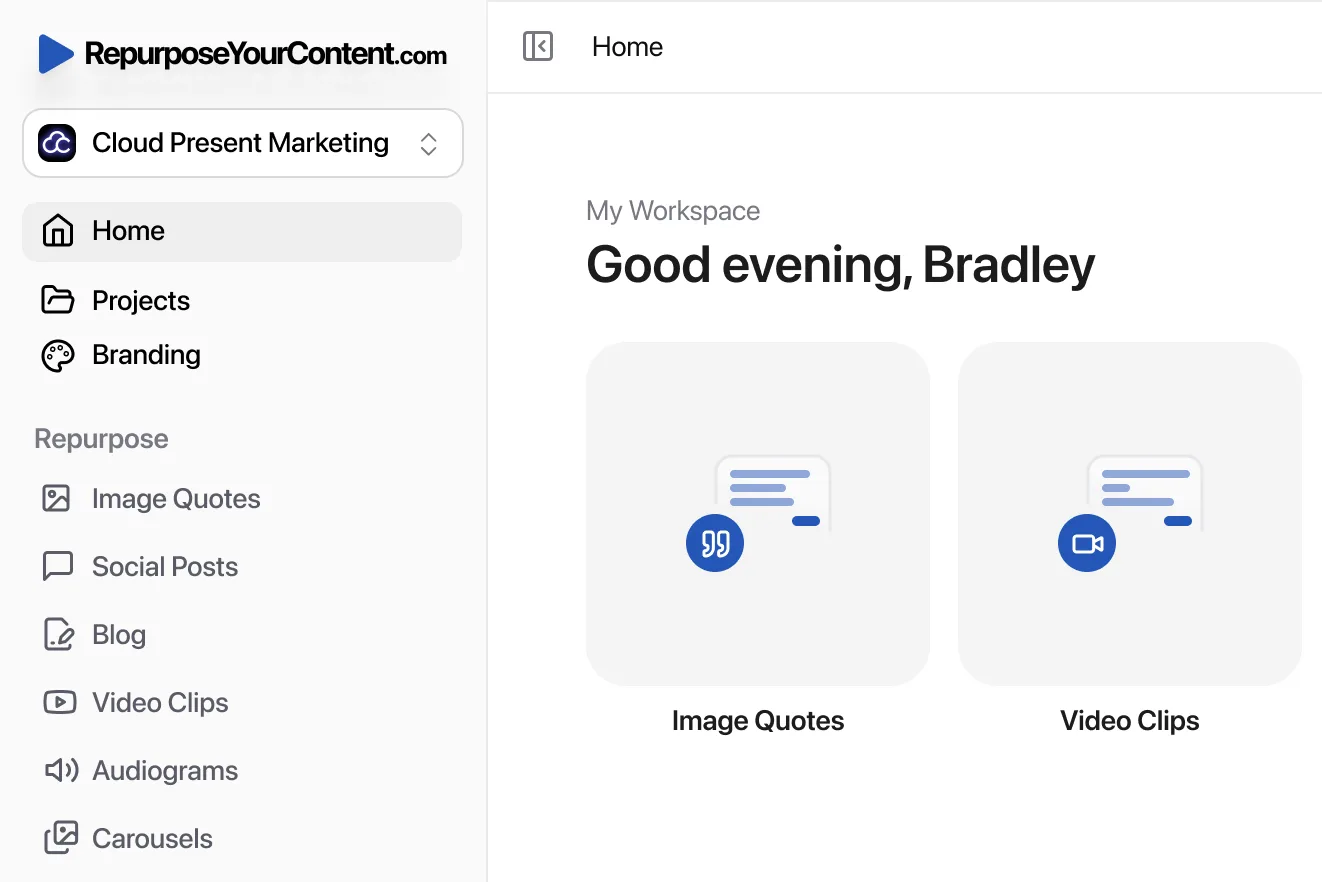
You upload one webinar recording. Our AI transcribes it and identifies valuable moments. In about five minutes, it delivers a complete package of on-brand content.
You get everything you need:
- Video clips for social platforms
- SEO-optimized blog posts
- Ready-to-publish social posts
- LinkedIn carousels
- Audiograms for audio-first platforms
- Image quotes from your speakers
- Email newsletters
- Detailed timestamps
Instead of your team spending days clipping videos, you can turn 1 webinar into 47 pieces of content. It solves your content pipeline problem. You can focus on strategy and promotion. Stop staring at a blank page. Start with your expertise.
Automate and Personalize Your Email Marketing
Your email list is your most valuable marketing asset. Much of it is likely collecting digital dust. Most B2B emails are generic and get ignored. AI gives you the tools to stop sending one-size-fits-all blasts.AI lets you see how subscribers behave. It tells you who attended your last webinar. It knows which topics they found interesting. It tracks resources they downloaded. Segmentation is no longer just about static job titles. It's about segmenting automatically based on demonstrated interest.
Beyond Basic Segmentation
We have segmented emails for years by industry or company size. This was a start. The messages often felt written for someone else. AI uses a different path. It focuses on behavior and intent.
Imagine two prospects from different industries. They both watch the same 20-minute segment of your webinar on cloud security. A smart AI tool spots that shared interest instantly. They should both get a follow-up sequence about that specific topic. Managing this detail by hand is impossible. For an AI, it is simple.
Stop guessing what your audience wants. Use AI to listen to their actions. Behavior-based segmentation drives higher open rates and better leads. The content is always relevant.
One powerful workflow is turning a single webinar into a library of follow-up content.
A Practical AI Email Workflow
You can build effective automated sequences that nurture leads. Here’s a simple way to start:
- Get Your Tech Talking: Connect your CRM and email platform to an AI-powered analytics tool. This is crucial for data flow.
- Set Your Behavioral Triggers: Tell the AI what to look for. For example, create a rule to tag anyone who watches more than 75% of a webinar.
- Spin Up Email Variations: Use an AI writing assistant to draft three email variations. Each can tackle a different pain point from the webinar.
- Test, Learn, and Optimize: Launch an A/B test to the new segment. The AI sends the versions and tracks what works.
This process turns a passive list into an engaged audience. Get a head start with our webinar follow-up email sequence template. Laser-focused campaigns deliver real value.
Optimize Your B2B Social Media with AI

B2B social media is a relentless grind. You are under pressure to post, engage, and show ROI. AI is taking over the heavy lifting. Forget guessing the best time to post on LinkedIn. AI tools analyze your data. They tell you exactly when your content will have the biggest impact. Give an AI one idea and ask for five different caption hooks. This is a brilliant way to test what resonates. AI swaps guesswork for data.
Turn Expertise into High-Engagement Content
Transform your deep-dive content into platform-specific posts. Your LinkedIn audience does not want a wall of text. They want sharp, visual content like a carousel.
Teams spend hours manually building a 10-slide carousel from a webinar. It is a painful process. You have to re-watch the recording and pull quotes. You have to write copy and fight with a design tool.
AI flips this process. Feed it a webinar video. It intelligently extracts compelling points and visuals. In minutes, it generates a professional, on-brand carousel. This saves you significant design time.
This approach means you can publish high-quality content consistently. A system that multiplies your content without burning out your team. Our guide on B2B social media strategy covers this philosophy.
A Practical AI Workflow for Social Media
Here’s how this works in practice. You finished a webinar. You want to create a LinkedIn carousel with the top three takeaways.
- The Source: You start with your webinar recording.
- The AI Assist: Upload it to an AI tool. It transcribes and analyzes the content. It pinpoints the main arguments and pulls out the three takeaways for you.
- The Content Creation: The AI arranges these points into a branded carousel. It creates a title slide, a slide for each takeaway, and a final CTA slide.
A task that took a marketer and designer half a day is now done in 15 minutes. This frees your team for human work. They can engage with your community and think strategically about distribution.
Sharpen Your SEO and Analytics with AI
Your competitors are using AI to get an edge in search. SEO can feel complex. AI is the analytical assistant you need. Forget manual keyword research. AI tools find long-tail opportunities your rivals miss.
AI analyzes search intent at scale. It helps you find the exact questions your audience is asking. You can create content that gives them answers. Search engines reward this. AI can also run a full technical audit of your site. It flags problems and suggests clear fixes to help you climb the rankings. Connect your analytics platforms to an AI tool. Get back clear, actionable reports on what is working.
Find the Hidden Patterns in Your Data
AI can see patterns we would miss. It processes huge amounts of data in seconds. It can pinpoint which content formats drive the most conversions. It can find which channels bring in the highest-quality traffic. An AI might discover prospects who read a specific technical post are 40% more likely to convert. That insight is gold. It tells you where to double down on your promotion budget. Explore these essential AI SEO tactics to get ahead.
This data-driven approach removes guesswork. You stop making decisions based on feelings. You start investing budget and effort for the greatest revenue impact.
This analytical power improves your content strategy. AI can spot gaps in your topic clusters. It shows which articles are underperforming. It suggests ways to optimize them. This is more efficient than creating new content from scratch. Our guide on turning a webinar into a high-performing blog post applies these principles from the start.
A Practical AI Workflow for SEO Analysis
Here is a simple workflow to find high-potential content topics.
First, feed the AI your data. Connect an AI SEO tool to Google Search Console and Google Analytics. This gives it the raw performance data it needs.
Next, define your core topics. Give the AI your main product categories. These are the "seed" topics that guide its research.
Now, run a content gap analysis. Instruct the tool to compare your keyword rankings against your top three competitors. Ask it to find keywords they rank for, but you do not.
Finally, cluster and prioritize. The AI returns a huge list of keyword opportunities. Ask it to group these into thematic clusters. Then prioritize them based on search volume, keyword difficulty, and commercial intent. This process takes less than an hour. You are left with a data-backed roadmap for your content team.
Implement AI Personalization Across the Funnel

B2B buyers have had enough of generic outreach. They expect you to know who they are. True personalization is more than a {{first_name}} tag. AI helps deliver relevant experiences at scale.
Think about your website. For most, it is a static brochure. With AI, it can become a dynamic asset. A visitor from the finance sector sees fintech case studies on your homepage. Someone from manufacturing sees content for their industry. AI-driven personalization makes your site instantly more valuable. It is not just your website. In paid ads, AI optimizes campaigns in real-time. It shifts budget to the best-performing audiences and creative.
A Workflow for Website Personalization
Getting started with website personalization is not difficult. You do not need a team of data scientists.
- Slice up your audience. Define your key visitor groups. Use a tool like Mutiny or Intellimize. Segment visitors by industry, company size, or tech stack.
- Craft your custom content. Write different headlines and CTAs for each segment. A large enterprise might respond to "Request a Demo." A smaller business might prefer "Start Free Trial."
- Let the AI take the wheel. Once you launch, the AI gets to work. It serves different content variations and measures what works. It doubles down on winning combinations to maximize conversions.
This process transforms your website into an active sales tool.
B2B buyers seek partners who understand their challenges. AI-driven personalization is the fastest way to show that understanding. It proves you have done your homework.
Data backs this up. UK marketers see engagement lifts over 30% from AI personalization. A 2026 BIMA report shows 52% of B2B firms now prioritize this strategy. UK SaaS companies see a 22% jump in LinkedIn CTR with AI-generated video clips. They also see a 28% SEO gain from AI-derived blogs. See more findings on AI's impact in B2B marketing from Socialinsider. Targeted communication is a competitive must.
Frequently Asked Questions About AI in B2B Marketing
You probably have some questions. They are the same questions B2B marketers always ask. Let's tackle them directly.
Do I Need to Be a Coder to Make This Work?
No. You do not need to be a data scientist or programmer. Most of today's AI marketing tools are built for marketers. This includes our own RepurposeYourContent. They have simple interfaces. You will not write a single line of code. Your real skill is your strategic mind. You guide the AI, and it handles the heavy lifting.
Is AI Going to Take My Job?
The short answer is no. AI is here to make you better at your job. Think about repetitive tasks that consume your week. Manually transcribing webinars. Slicing a video into social posts. Drowning in spreadsheets. AI is designed to take over that work. This frees your team for work that moves the needle. Strategic thinking, creativity, and building customer relationships.
AI doesn't replace marketers. It makes good marketers more effective. It automates the manual work that gets in the way.
How Do I Measure the ROI?
Look at the metrics you already track. Measure the before and after.
- For content creation: You should see a huge drop in the time and cost to produce content. Look for a jump in content output and a climb in organic traffic and leads.
- For email marketing: Check for uplift in open rates, click-throughs, and conversions. Are your AI-powered sequences outperforming the old manual ones?
- For analytics: The first win is time saved on reporting. The real ROI is the insights you gain. Are those insights leading to better campaign results?
Always compare new numbers against old benchmarks. The goal is clear improvement in efficiency and performance.
Stop staring at a blank page. Start with your expertise and let AI do the rest.
Tags: