Podcast Clipping Service: A Guide to Choosing the Right One
Looking for a podcast clipping service? This guide covers what they do, pricing, and how to choose a provider that turns episodes into social content.

A podcast clipping service turns one episode into short, platform-ready clips. It handles moment selection, captions, vertical reformatting, hooks, and exports for TikTok, Reels, Shorts, and LinkedIn.
That matters because the category is no longer niche. The podcast clip tools market was valued at $410 million in 2024 and is projected to reach $1.23 billion by 2033 at a 12.7% CAGR ResearchIntelo market report. More shows are also being published in video form, which gives clipping services far more material to work with.
What Is a Podcast Clipping Service
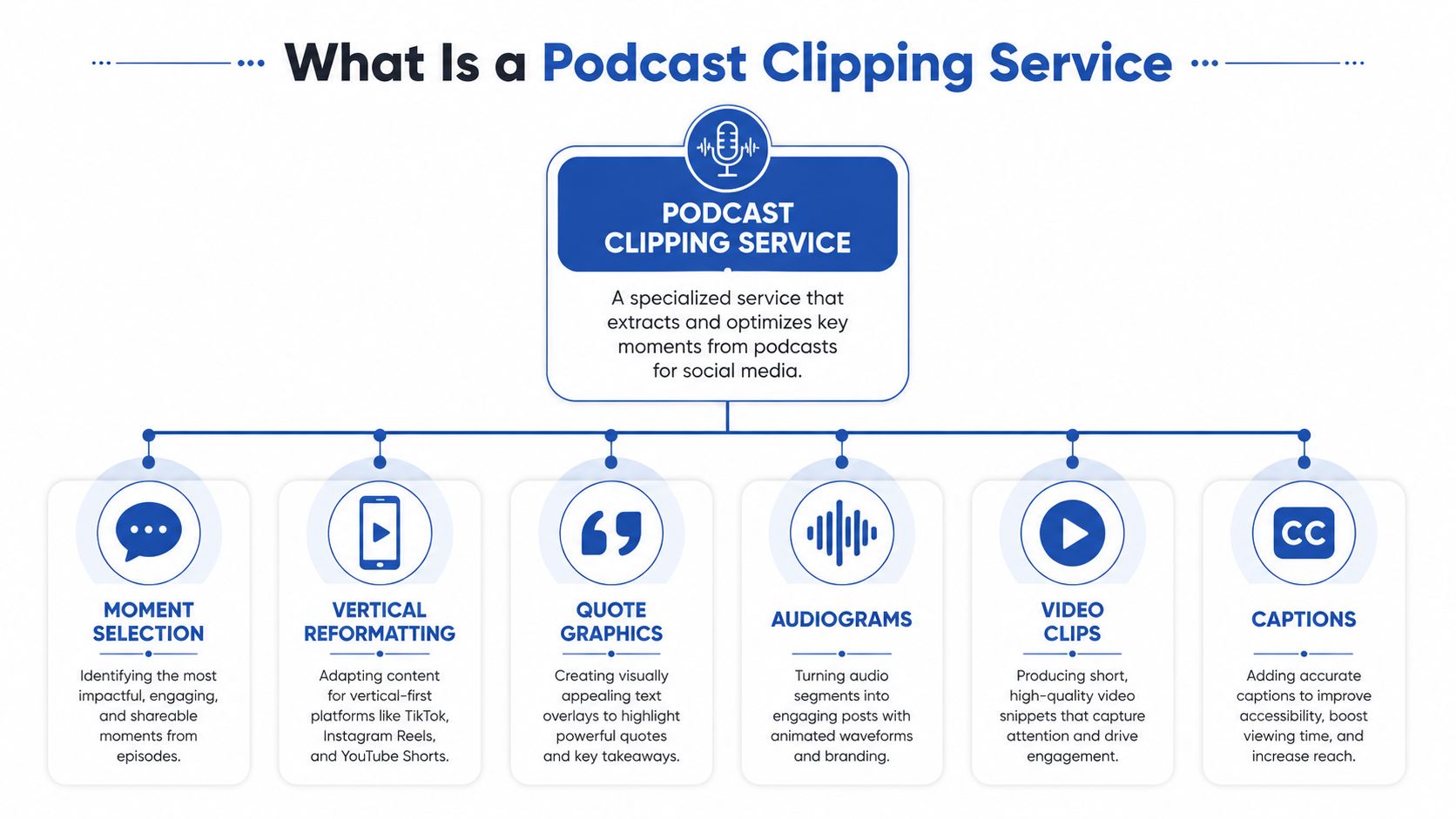
A podcast clipping service is a done-for-you service that turns full episodes into short, shareable assets. The job usually includes selecting the right segment, adding branded captions, reframing the video for vertical feeds, and exporting versions that fit each platform.
The core value is not the cut itself. It is the editorial judgment behind the cut. A strong clip starts with a moment that can survive the hook test, which means the first two seconds need to stop a scroll. That often means a contrarian take, a specific result, a surprising story beat, or a complete answer to a strong question.
Practical rule: software can find audio segments. It cannot reliably decide which sentence will make a founder or buyer keep watching.
That is why selection matters more than editing software. The strongest clips are often unscripted asides, sharp Q&A answers, or a quick comment that adds tension. Interval-based clipping misses those moments because it starts with time, not meaning.
More shows now publish full video to YouTube, which creates the raw material clipping services package into shorter assets. The broader short-form video category is still expanding, so the demand is not isolated to podcasts. It is part of a larger distribution shift.
For a plain-language definition, the term also fits the broader repurposing workflow described in this podcast clip glossary entry. In practice, a real service should give you finished content, not just timestamps.
The True Cost of DIY Clipping in Hours and Dollars
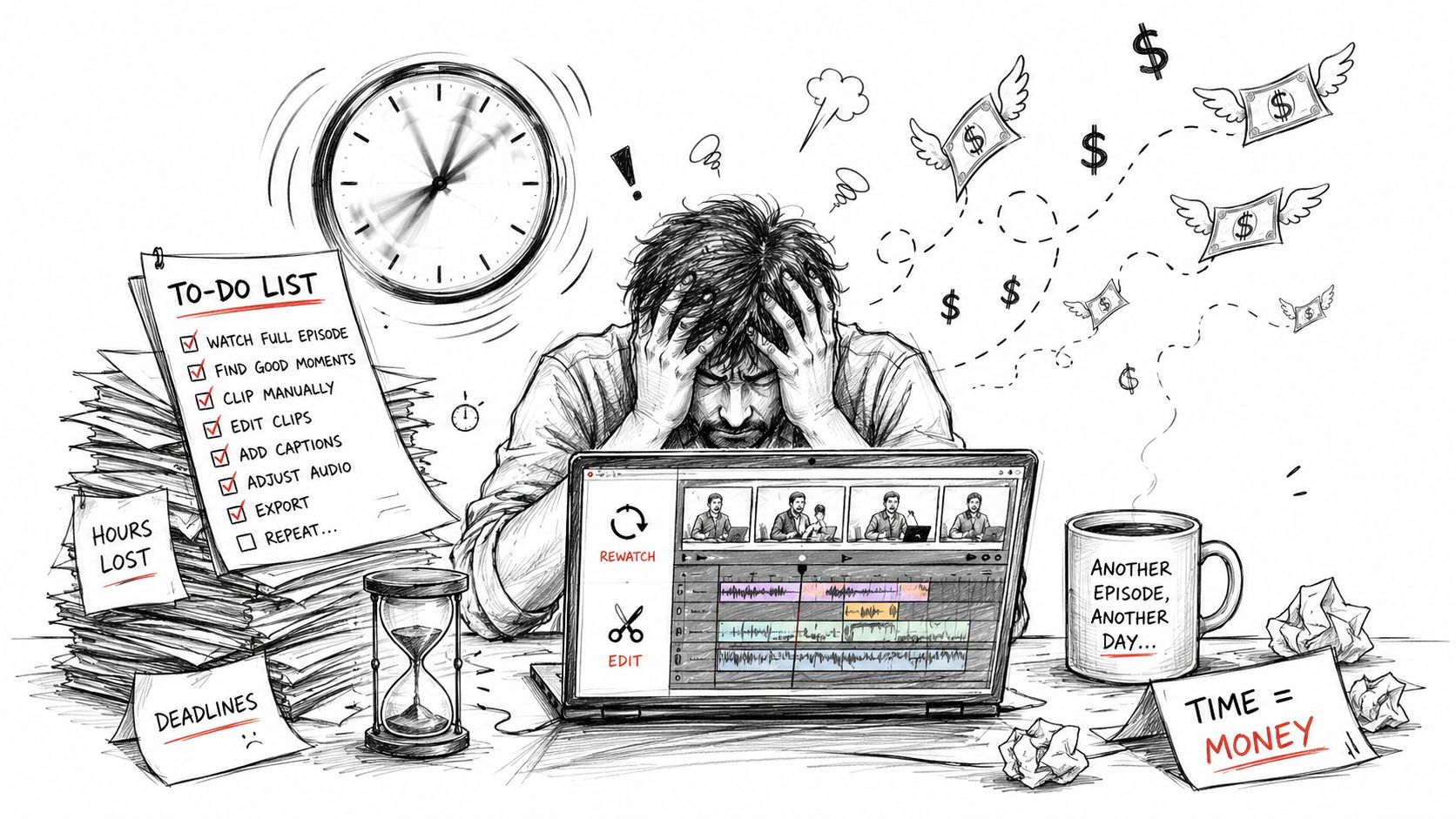
DIY clipping looks cheap until the work starts. A single 45-minute recording can produce 20 to 30 publish-ready assets, but manual repurposing still takes 10 to 16 hours per recording RepurposeYourContent statistics. That is not a quick edit. It is a full production job, and the actual cost shows up in the editor's attention, the founder's calendar, and the delay before those clips can start working.
What the manual workflow actually costs
A realistic DIY process usually looks like this:
- Rewatch the episode. Expect 45 to 90 minutes just to find usable moments.
- Mark timestamps and shortlist clips. That often takes another 60 to 120 minutes.
- Edit the video. Clean cuts, crop changes, and pacing can take 2 to 4 hours.
- Write captions and hooks. Good captions take another 1 to 2 hours.
- Create versions for each platform. TikTok, Shorts, and LinkedIn need different trims and formatting.
- Export, review, and fix errors. That last pass always takes longer than planned.
The hidden cost is founder time. A recording should not take an entire day from someone who should be selling, hiring, or planning the next episode. RepurposeYourContent's own post on content repurposing cost treats this as an operations problem, which is the right frame. Once clipping becomes repeat work, the issue is not software. It is how much senior attention gets spent on selecting moments, trimming versions, and fixing small misses that do not move revenue.
A clip is rarely the expensive part. The expensive part is the repeated decision-making around each clip.
Manual post-production gets expensive fast. RepurposeYourContent says the manual cost for a single recording often lands around $500 to $800 RepurposeYourContent outsource guide. That number is easy to dismiss until the same workflow shows up every week, the backlog grows, and the team starts trading strategic work for repetitive editing tasks.
How a Professional Clipping Workflow Actually Works
A professional workflow starts with the transcript, not the timeline. Long files are first broken into manageable chunks, then transcribed, then scored for moments that feel self-contained and worth shipping. That structure matters because it reduces failure risk on long recordings and keeps clip selection tied to actual language, not guesswork workflow example.
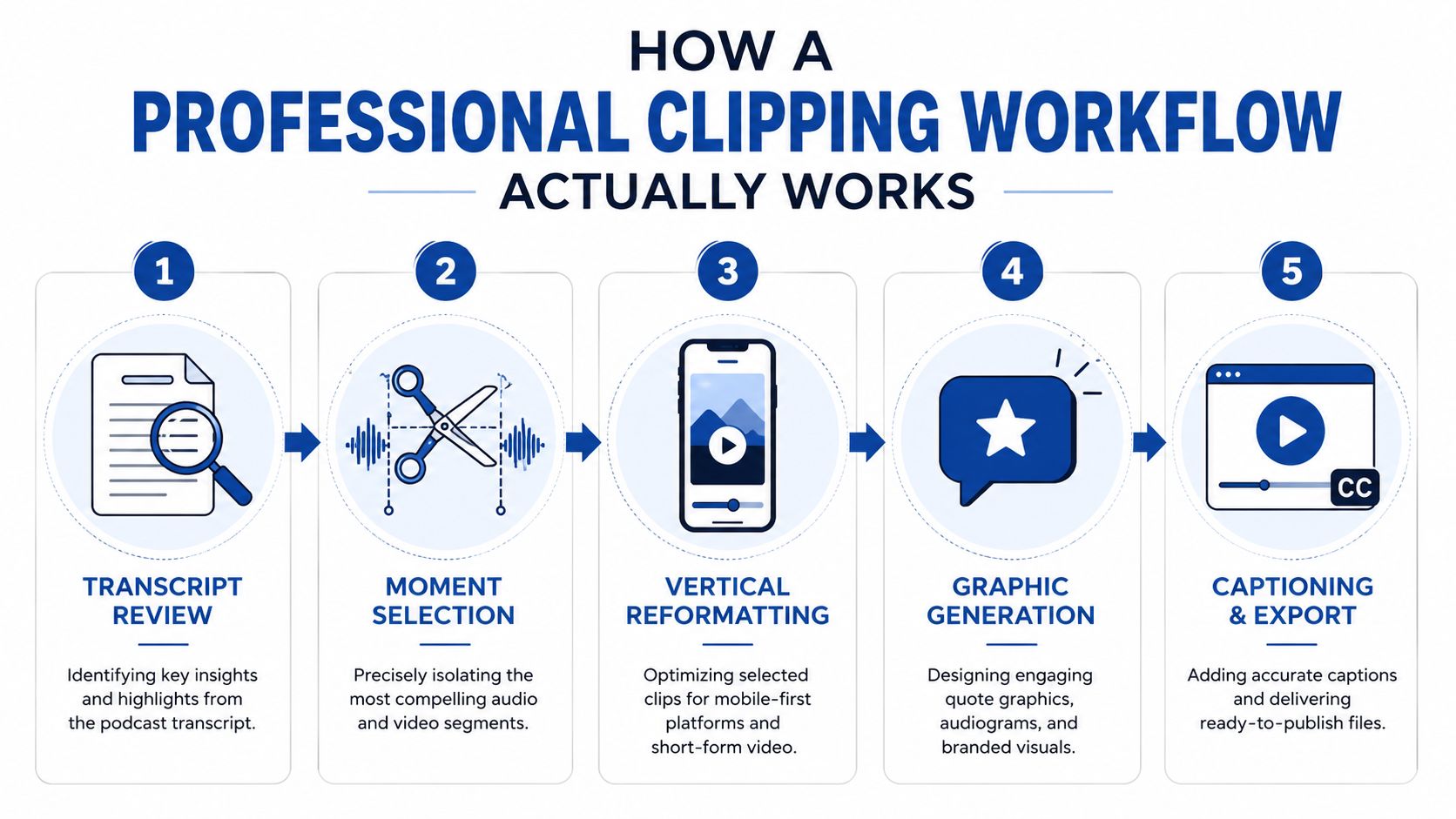
The sequence that separates professional clips from random cuts
The strongest services follow a clear editorial path.
- Transcript review. The team scans for tension, useful claims, and moments with a complete thought.
- Moment selection. They choose the segment based on novelty, quotability, and audience fit.
- Vertical reformatting. The clip is cropped for mobile-first viewing.
- Graphic generation. Captions, quote cards, and branded visuals are built around the moment.
- Captioning and export. The final files go out ready for each platform.
The technical part matters, but the selection part matters more. A clip can be perfectly edited and still flop if the moment is flat. That is why a good provider starts with narrative value, then uses editing to support it.
Why the vertical crop needs human judgment
For multi-person episodes, the hardest problem is framing. One engineering write-up describes active-speaker-aware vertical reframing using speaker diarization and word-level transcription to keep the 9:16 crop on the current speaker Overdigital Podsplit article. That avoids awkward crops when the conversation moves quickly or when a guest is off center.
Clean output is not just about sharp captions. It's about showing the right face at the right moment.
For lean teams, a documented workflow like the one in this small-team repurposing guide is the standard to look for. If the provider can't explain their selection process, the output will usually feel generic.
Evaluating Providers What to Look for in a Portfolio
A portfolio should show judgment, not just motion graphics. The fastest way to judge a provider is to watch for four things. First, the clip should open on a moment that makes sense without context. Second, the captions should be accurate on names, jargon, and numbers. Third, the audio should sound clean, with no clipped words or awkward jumps. Fourth, the subject and captions should stay inside platform safe zones.
The visual frame matters too. A good clip feels intentional. A bad one looks like a hurried crop with text squeezed into the corners. If the guest's face is cut off or the captions overlap the subject, the editor probably does not understand vertical composition.
Quick portfolio checklist
- Caption accuracy: Names and technical terms should be spelled correctly.
- Clean in and out points: No half-cut words or abrupt starts.
- Brand consistency: Fonts, colors, and layout should match the client's voice.
- Platform fit: The same moment should feel native on TikTok, Shorts, and LinkedIn.
- Reading pace: Captions should be easy to follow on a phone.
The better services also vary style by destination. A LinkedIn clip usually needs a more professional frame and a stronger insight angle. TikTok and Reels usually need faster pacing and bolder captions. If every output looks identical, the provider is probably recycling the same template across every channel.
The main question is simple. Does the portfolio prove that the team knows which moments deserve clipping, or does it only prove that someone can press export? That distinction is the difference between a real content repurposing service and a basic editing shop.
Podcast Clipping Service Pricing Explained
Pricing is all over the map because buyers are paying for different things. A 2026 survey says AI tools sit around $12 to $49 per month, freelancers charge $50 to $150 per clip, and full-service agencies land at $997 to $4,997 per month Clipscartel pricing survey. The same source says many B2B buyers cluster in the $3,000 to $8,000 per month retainer band.
What each pricing tier really buys
At the low end, AI pricing buys speed and volume, but not strong editorial judgment. It can be useful when the goal is merely to test output. It usually breaks down when the source content needs nuance, especially for interview-heavy or thought-leadership shows.
Freelancer pricing works better when one person can stay hands-on with every cut. That can be a fit for one-off batches, but it can become inconsistent if the workload rises. A per-clip model also tends to reward quantity over strategic selection.
Agency pricing usually includes more than a cut. It often brings editorial review, formatting, and delivery discipline. That's why the monthly retainer model fits recurring shows better than one-off edits. Buyers are paying for consistency, not just a finished file.
For budget planning, RepurposeYourContent pricing is best read against the broader market, not in isolation. The primary concern is whether the provider returns clips you'd publish.
The Low-Effort Option Your Content Engine on Autopilot
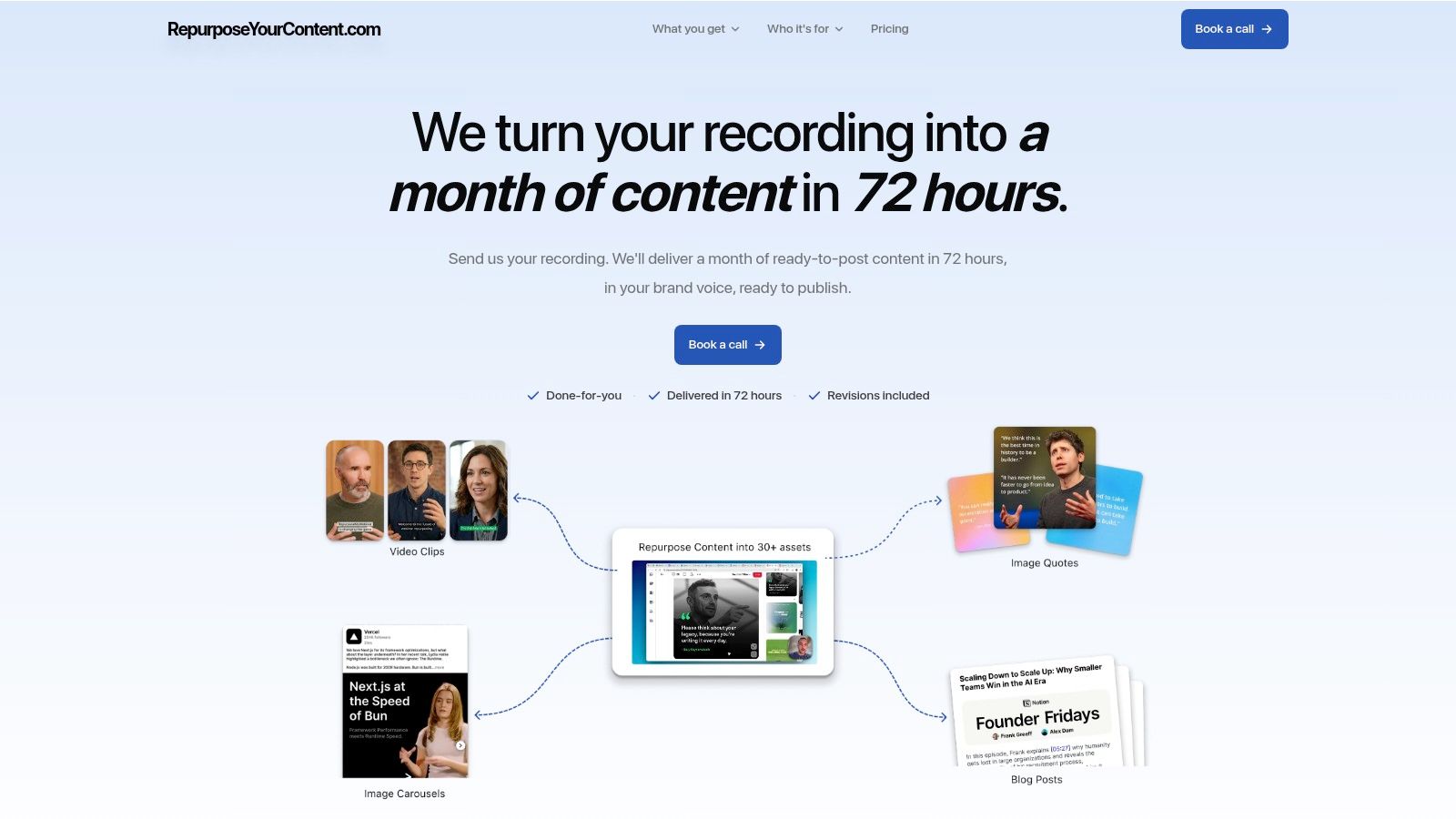
A done-for-you clipping service changes the workload fast. You send over a recording, podcast, webinar, keynote, interview, or meeting recording, and the team turns it into publish-ready assets without making your staff build the process from scratch. The handoff should be light, and in some workflows it can take about 15 minutes of your time RepurposeYourContent outsource guide.
Editorial judgment is the primary value. Good clips do not come from software alone. They come from someone who can spot the strongest moment, trim the dead space, and choose a line that stands on its own on LinkedIn or in a short-form feed. One strong recording can become a stack of usable assets, including video clips, LinkedIn posts, quote graphics, carousels, audiograms, and a blog post. RepurposeYourContent describes that workflow as a fast turnaround with unlimited revisions, which suits teams that need recurring output without hiring an in-house editing bench.
The business case is easier to see when the output is measured as assets, not hours. A single editor or marketer can spend a long stretch finding moments, cutting variations, formatting captions, and cleaning up exports. A service shifts that load off the internal team and gives you a repeatable system for turning one recording into multiple pieces of content. That matters most when the show is consistent and the publishing plan depends on having clips ready every week.
The practical test is simple. Choose a provider that returns clips you would publish, not just clips that were technically edited. Review whether the sample work shows clear selection, clean framing, and a sense of what a busy audience will stop for. If those pieces are in place, outsourcing can keep the content pipeline moving without pulling attention away from the work that drives revenue.
Tags: