Podcast Content Marketing Strategy: The Repurposing Playbook
Build a podcast content marketing strategy that turns one recording into 30 assets. Learn the repurposing flywheel and KPIs driving real growth.

A single podcast recording can become 20 to 30 marketing assets, but manual repurposing usually consumes 10 to 16 hours per recording (Repurpose Your Content). That gap explains why many strong shows still publish once, share a link, and lose the rest of the episode's marketing value.
A practical podcast content marketing strategy treats every episode as a content engine. One recording can produce clips, LinkedIn posts, quote graphics, carousels, an SEO article, audiograms, and newsletter content, all tied to audience questions and business outcomes.
Why Your Podcast Is a Content Engine and Not Just a Show
Where does the value of a 45-minute recording disappear after publication? For many B2B teams, it disappears in the hours required to find usable moments, edit them, write supporting copy, and prepare each channel. The episode goes live, one link gets shared, and the remaining material sits in a folder.
Podcasting has reached mainstream scale. A 2026 industry snapshot estimated 619.2 million global podcast listeners, compared with 546.7 million in 2024, with annual growth projected at roughly 5% to 6% through 2027. Edison Research's Infinite Dial 2026 also reported that 58% of Americans aged 12 and older listened to podcasts in the past month, representing about 167 million people, while weekly listening reached 45% (Data Globe Hub).
That reach gives a podcast value beyond awareness. A planned episode can support search visibility, trust-building conversations, email campaigns, and sales enablement for later-stage buyers. Advertising demand reflects the same commercial potential. The U.S. podcast advertising market generated about $2.862 billion in 2025, while global podcast ad revenue was projected to reach about $4.02 billion in 2026. A 2026 marketing summary reported that 69% of listeners said podcast ads introduced them to new products, and 28% said they purchased a product they heard about on a podcast (Podcast Advertising).

The recording isn't the bottleneck
Useful conversations are rarely the constraint. The hidden cost is extracting and packaging the useful parts afterward, often requiring 10 to 16 hours per recording when handled manually.
That workflow covers transcription, topic selection, clip editing, captioning, copywriting, design, article drafting, review, scheduling, and reporting. Each task requires a different skill, so production can stall even when the source material is strong.
Operational reality: A podcast becomes a marketing asset when the team turns the recording into useful formats for specific channels, not simply when the episode goes live.
The practical model is a quarterly content engine. Choose a small set of business-relevant pillars, record episodes against those themes, then route each recording into formats that support discovery, education, and conversion. The B2B content engine framework connects one source recording to multiple publishing outputs.
That workflow shifts attention from production polish alone to distribution, cadence, and measurable business actions. Downloads can show reach, but qualified conversations, influenced opportunities, and content-assisted pipeline show whether the engine is doing useful work.
Building a Quarterly Content Plan: Pillars, Templates, and Workflows
A quarterly plan turns a podcast into a repeatable content system instead of a sequence of disconnected conversations. Start with two or three content pillars tied to recurring audience questions, commercial priorities, and search demand. The quarter sets the themes. Each episode then supplies material for the publishing calendar.
Start with audience questions
Review sales calls, customer interviews, support conversations, search queries, and listener comments. Repeated questions are better planning inputs than broad topics because they reveal the problems people already want solved.
A B2B marketing show might organize a quarter around:
- Content operations: How teams create consistent output without adding headcount.
- Demand generation: How content supports pipeline and inbound conversations.
- Founder-led marketing: How subject-matter experts turn expertise into public content.
Each pillar should produce several episode angles. Keep the pillar broad enough to support a quarter, while giving every episode one specific promise. “Content repurposing workflow” gives the production team clearer direction than “marketing productivity,” and it provides language that can carry through the episode title, show notes, article, and clips.
The planning goal is also capacity control. DIY repurposing can consume 10 to 16 hours per recording once transcription, selection, editing, captions, copy, design, review, scheduling, and reporting are included. A pillar plan reduces wasted production by deciding in advance which topics deserve that effort.
Use a copy-ready quarterly template
| Content pillar | Episode topic | Target keyword | Guest | Asset count |
|---|---|---|---|---|
| Content operations | Building a weekly repurposing workflow | podcast content repurposing workflow | Content lead | 20 to 30 |
| Demand generation | Turning expert interviews into inbound content | podcast content marketing strategy | Demand generation director | 20 to 30 |
| Founder-led marketing | Recording one conversation for multiple channels | founder content strategy | B2B founder | 20 to 30 |
The asset count connects strategy to production capacity. It also exposes problems before recording begins. If the planned output exceeds the team's editing, writing, or review capacity, the calendar will fail before the quarter ends.

Plan quarterly, execute weekly
Assign each episode to a pillar before recording. The host can prepare questions around the target search topic, customer objections, and the business action the content should support.
Use this weekly workflow:
- Assign the episode to a quarterly pillar.
- Record around one primary question and several supporting questions.
- Mark strong moments during review, including opinions, frameworks, objections, and examples.
- Create the planned asset set from those moments.
- Place the assets into the distribution calendar.
- Review performance monthly, then adjust the quarterly plan at the next strategic checkpoint.
The result is a schedule built around deliberate themes rather than a fresh idea for every post. Reach still matters, but qualified conversations, influenced opportunities, and content-assisted pipeline are stronger tests of whether the system supports the business.
The Repurposing Flywheel From One Recording to 30 Assets
Your team has finished a 45-minute recording. The next question is operational: which moments become clips, search content, email, and sales-enablement material, and who will produce them?
DIY repurposing often consumes 10 to 16 hours per recording. Clipping may take two to three hours, social copy another two hours, graphics one to two hours, and an SEO article three to four hours. Those tasks compete with planning, editing, approvals, and distribution. A quarterly content engine must account for that capacity before promising a large asset package.
A practical episode workflow
Take an episode about building a B2B content calendar.
Step 1: Review the recording.
The producer tags one definition, one contrarian opinion, one process explanation, audience objections, and a clear call to action. Tagging these moments against the episode's quarterly pillar keeps production tied to the broader plan.
Step 2: Cut discovery clips.
The editor creates 3 to 5 short clips for TikTok, Instagram Reels, and YouTube Shorts. Each clip opens with a hook in the first 2 to 3 seconds, develops one complete idea, and includes captions (That Toronto Podcast Studio).
Step 3: Build professional insight assets.
One clip becomes a LinkedIn video. Its central argument becomes a text post. A separate observation can support a quote graphic, while the process explanation becomes an image carousel. Distinct source moments prevent the weekly schedule from repeating one idea in several formats.
Step 4: Draft the search asset.
The writer turns the episode's core argument into an SEO landing page. It answers the target question directly, adds supporting context, and links to the full episode. A structured ChatGPT keyword analysis workflow can organize audience questions before recording, while editorial judgment determines which questions reflect genuine expertise and buyer relevance.
Step 5: Create the email version.
The newsletter gets a concise summary, one useful takeaway, and a link to the article or episode. Email gives the strongest idea a route back to an owned audience instead of leaving discovery to social platforms.
Step 6: Package the library.
Label every asset by platform, pillar, topic, publishing date, and call to action. A content repurposing matrix maps each source moment to an appropriate format, reducing duplicate posts and exposing missing search, email, or conversion assets.

The flywheel assigns each format a job. Video clips create discovery. LinkedIn posts add context. Articles capture search demand. Email returns the idea to an owned audience. Quote graphics and carousels make the argument easier to remember and share.
A finished package can contain 20 to 30 ready-to-publish assets. That range is a planning target, not a requirement to publish every sentence. Select distinct ideas, assign each a useful context, and compare the production time with the business value each asset can support.
Building a Weekly Distribution Calendar Across Channels
Why do podcast distribution plans collapse after week two? The recording is finished, but the team has not assigned owners, deadlines, formats, or review steps. DIY repurposing can consume 10 to 16 hours per episode, so a calendar must protect production time as well as publishing cadence.
One recording can support five channels in a week when each asset has a separate job:
| Day | Asset Type | Platform | Goal |
|---|---|---|---|
| Monday | Short-form clips | TikTok, Instagram Reels, YouTube Shorts | Discovery |
| Tuesday | Insight clip and text post | Professional engagement | |
| Wednesday | Carousel | LinkedIn or Instagram | Explain a framework |
| Thursday | SEO article | Company website | Capture search demand |
| Friday | Key takeaways | Email newsletter | Build owned-audience engagement |
The schedule should follow the quarterly pillar behind the episode. A clip can introduce the problem, a LinkedIn post can explain the operating decision, a carousel can show the framework, and the article can answer the search question. Use a B2B content calendar guide to assign owners, deadlines, calls to action, and approval status.
Match format to audience behavior
Video supports discovery and platform-native reach. Audio remains important for the core episode. Cumulus Media and Signal Hill reported that audio remains the primary mode for 58% of podcast consumption, while 44% of new podcast audiences started on YouTube (Cumulus Media).
Use video clips to reach new people, while keeping an audio-first workflow for the main episode. A full video production may increase editing, review, and storage demands. Strong hooks, accurate captions, and consistent publishing often provide more practical value than elaborate visual treatment across the entire recording.
Protect the publishing sequence
Release the full episode first, then let later assets expand the argument. A scheduling tool or workflow for Post To All Social Media At Once can reduce repetitive coordination, but each channel still needs a native edit. A LinkedIn post should sound different from a TikTok caption, even when both use the same insight.
The calendar should list every asset, not only the episode title. That view exposes gaps before publication, shows whether the pillar has enough material for the week, and prevents the team from spending another workday searching through one recording for usable moments.
Measuring Success Beyond Download Numbers
A podcast can attract strong listening numbers and still produce no qualified conversations. Measure the system in three layers, production, audience, and business outcomes, then connect each layer to the quarterly pillar it supports.
Layer one is production
Production metrics show whether the content engine is running. Track assets completed per episode and the number of weeks with an unbroken publishing cadence.
This operational layer deserves attention because missed production creates downstream gaps. If clips, articles, or email content stop appearing, audience growth and business results weaken later.
Ask:
- Asset completion: How many planned assets were finished?
- Publishing cadence: Did the team publish every scheduled week?
- Format coverage: Did the episode reach video, social, search, and email channels?
- Review speed: Did approvals delay distribution?
Cadence is the leading indicator. Protect it before optimizing individual posts.
Layer two is audience
Audience metrics show whether distribution is reaching the intended people. Track aggregate reach, follower growth, email list growth, and engagement by format.
Assign each format a job. Short clips can support discovery, while articles and newsletters may signal stronger intent. Compare assets within that role instead of ranking every channel by raw reach. A high-view clip may create awareness, while a lower-reach article may send a prospect to a service page.
Episode-level reporting is more useful than show-level averages. Magellan AI analyzed 95,612 episodes in its Q1 2026 benchmark and 94,724 episodes in its Q3 2025 benchmark, illustrating the industry's focus on granular episode analysis (Magellan AI).
Layer three is business
Business metrics connect the podcast to demand. Track site traffic from episode articles, inbound inquiries, and booked calls per month. Use unique links, clear calls to action, and form fields that ask how prospects found the company.
Independent benchmark reporting covers post-exposure actions across more than 97,000 campaigns and over 30 billion impressions, including response, lead generation, purchases, listener growth, and retention (Ad Results Media). The operating requirement is clear: conversion tracking must sit beside play counts.

Review execution tactics monthly. Adjust clip length, hooks, and platform emphasis using completion and engagement data. Review the strategy quarterly, when pillar performance, platform mix, and cadence can be changed with enough consistent evidence.
Weekly pivots create noise. Short-form performance fluctuates, so give the system several weeks before treating a pattern as reliable. Use a content marketing ROI measurement framework to connect publishing activity with pipeline indicators.
The Done-for-You Alternative to DIY Repurposing
For teams doing this manually, 10 to 16 hours per recording is the cost of DIY repurposing. Editing, writing, design, scheduling, and quality assurance quickly compete with campaign work, making a quarterly content plan difficult to sustain.
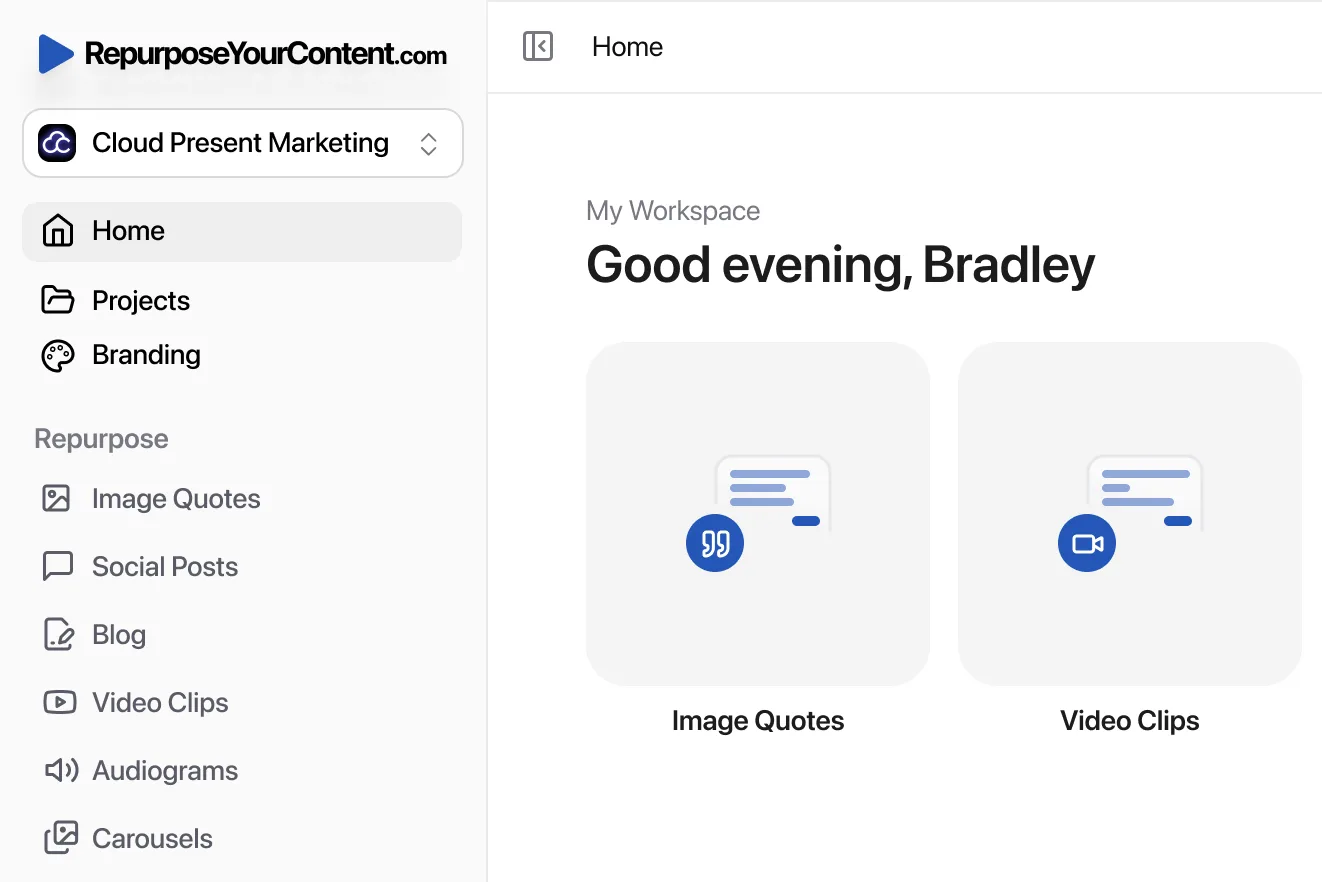
RepurposeYourContent handles the execution. A client sends one podcast, keynote, interview, sales call, livestream, course, or meeting recording. The service returns 20 to 30 ready-to-publish assets in 48 hours, including video clips, LinkedIn posts, quote graphics, carousels, audiograms, and a blog post.
Clients spend about 15 minutes per recording on context and feedback. Assets follow the client's brand voice, unlimited revisions are included, plans start from $14 per finished asset, and the service offers a 48-hour turnaround guarantee, or the client doesn't pay.
A 45-minute recording becomes 30 assets when the workflow is built around distinct content moments rather than repeated announcements. That output can support a quarterly pillar plan, with each episode assigned to an audience need and its assets scheduled across social, search, email, and business channels.
The done-for-you podcast content service shows how this execution layer fits an existing recording process. The trade-off is straightforward: DIY preserves direct control, while outsourcing preserves the team's time for strategy, distribution, and pipeline work.
A podcast should produce more than a playable episode. Plan the quarter around two or three audience-led pillars, then assign episodes and assets to each pillar.
Tags: