Podcast Growth Strategy: A 90-Day Action Plan
A practical podcast growth strategy using clips, SEO, guesting, and newsletters. Follow this 90-day plan to boost downloads.

Podcasting has crossed into the mainstream, yet many shows still stall because distribution never catches up with production. Podcasting reached 53% of the U.S. population monthly in 2026 according to Triton Digital, while global listenership kept climbing from 506.9 million in 2023 to 619.2 million projected for 2026 per Podcast Statistics. That means the market is still adding listeners at scale, and the shows winning aren't the ones publishing the most. They're the ones distributing each episode better.
A strong podcast growth strategy starts with a blunt correction. One recording should not live and die as one episode. It should become clips, posts, articles, newsletter material, and search-friendly assets that keep working after publish day. That is where growth compounds, and it's where most shows fall behind.
Why Most Podcasts Stall Before They Start Growing
The audience is still expanding, but many shows stop compounding because the release itself is treated as the finish line. Global podcast listenership rose from 506.9 million in 2023 to 546.7 million in 2024, then 584.1 million in 2025, with 619.2 million projected for 2026. That is not a flat market. It is a category still adding listeners while many creators act as if growth has already run out.
The issue is typically a distribution gap rather than the episode theme alone. A show publishes once, gets a small spike, then disappears until the next upload. That rhythm wastes the one asset the creator already paid for, the recording.
Growth Fails When the Episode Is Treated as the Product
A weekly show can be solid and still go nowhere if each episode gets one post and a prayer. The market now rewards repeat exposure across formats, not one-time announcements. Podcast advertising revenue reached $2.862 billion in 2025, up 17.6% year over year Search Lab Netherlands, which points to a simple reality, attention now follows repeatable distribution systems, not casual posting.
Practical rule: a podcast rarely stalls because the host lacks ideas. It stalls because the show lacks a content system.
That changes the growth job. The goal is not to record more for the sake of it. The goal is to turn each episode into a small campaign. If a show publishes weekly and then stops, it leaves audience growth to chance. If it turns each episode into clips, posts, and search content, it keeps working while new listeners enter the category every month.
Define the Listener Before You Promote the Show
Most growth advice skips the most important decision. It assumes the show already knows who it serves. That's why so many podcasts sound competent and still feel forgettable. A show grows faster when the promise is specific enough that the right listener recognizes themselves in one sentence.
Write the One-Sentence Listener Promise
Start with three prompts. Who is the show for, what problem or curiosity does it serve, and what outcome should the listener expect? Keep the answer tight. A useful version fits in one sentence and avoids audience mush like “leaders,” “creators,” or “people who care about growth.”
A fast ICP exercise can be done in under an hour.
- Name the listener: write one real role, such as SaaS founder, demand gen manager, or independent consultant.
- Name the pain: identify the one friction point the show helps them think through.
- Name the promise: state what changes after they listen, in plain language.
That sentence becomes the filter for titles, guest choices, clips, and newsletter copy. If it is broad, the show becomes easy to ignore. If it is sharp, the right people lean in.
Validate the Angle Before It Costs Too Much
Validation does not need to be elaborate. It can happen through guest outreach, social listening, and a short pilot. Search what people already ask around the topic. Watch which post angles get replies. Book a few guests who speak to the same problem and notice which framing creates the strongest reaction.
A crowded category does not punish specificity. It punishes vague positioning.
This is also where most shows save time. A one-month pilot with a clear angle is cheaper than six months of unfocused publishing. If the audience fit feels thin, fix the promise before pouring effort into promotion. Growth tactics work better when the show already has a clear reason to exist.
Episode-Level Moves That Actually Move Downloads
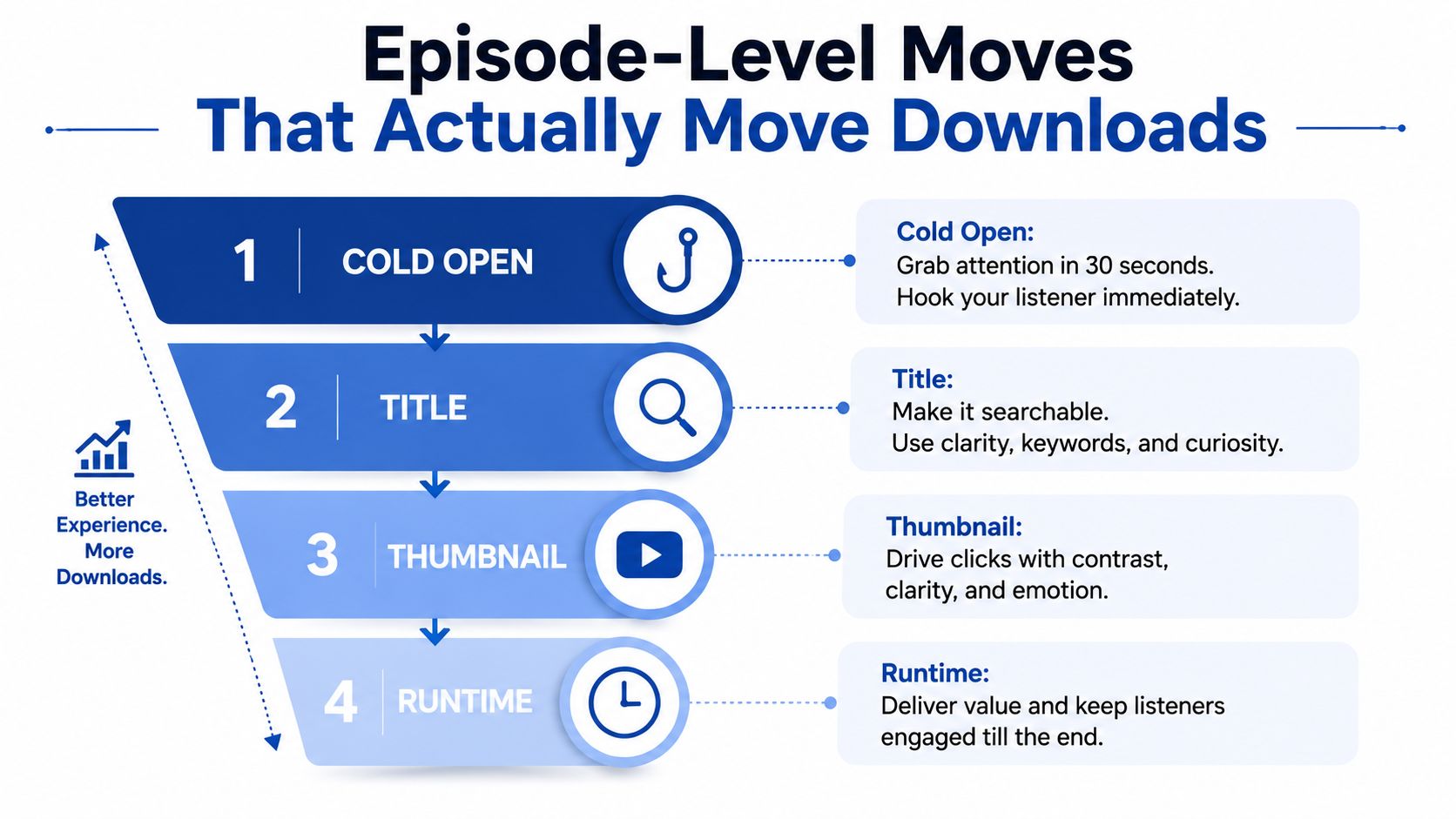
An episode should behave like a mini-funnel. The cold open earns attention. The title gets the click. The thumbnail supports the click. The runtime decides whether people stay. Industry guidance treats downloads per episode as the broadest reach signal, unique listeners as audience size, completion rate as engagement, and consumption per episode as how much of the episode was heard Springcast. That sequence matters because a show can inflate reach and still fail to build loyalty.
Cold Opens and Titles Do More Work Than Most Hosts Think
A weak cold open wastes the first 20 seconds. A strong one lands the promise fast. That usually means cutting the long intro, skipping the housekeeping, and getting to the point before attention slips. Doing that in-house can take 30 to 60 minutes per episode once the host, editor, and producer finish aligning on the rewrite.
Titles deserve the same care. A vague title gets buried. A specific title gives search and curiosity something to work with. The safest title test is simple. If the title sounds like “Episode 23,” it is probably too soft. If it states a problem, angle, or tension clearly, it has a better shot.
Runtime and Chapters Affect Retention
Runtime is not about being short for its own sake. It's about matching audience patience to topic depth. For a DIY team, tightening runtime often means a 20 to 40 minute edit review, plus another pass on structure. Chapters help too, because they make a long episode easier to follow and easier to quote later.
The workflow is practical, not glamorous.
- Rewrite the first minute: cut introductions that don't earn their place.
- Tighten the title: make it searchable and curiosity-led.
- Check the thumbnail: make sure the topic reads instantly on mobile.
- Trim the middle: remove repetition, detours, and filler.
The internal promotion piece matters after publish, too, which is why many teams keep a post-launch checklist like this podcast episode promotion guide. But the episode itself still has to hold attention before any repurposed asset can help.
Short-Form Clips Are the Discovery Channel That Matters
Podcast growth now runs through video and audio together. Edison Research's 2026 consumer data says weekly podcast consumers are now just as likely to watch a podcast as listen to one, with 82% actively watching video podcasts and 78% listening to audio-only podcasts in Q3 2025 via YouTube. The same report estimates 167 million monthly podcast consumers in the U.S. aged 12+ and 55% of the U.S. 12+ population consuming a podcast in the last month Edison Research. If discovery starts in feeds, short-form clips are the first door people walk through.
The Viral-Candidate Test for Picking the Right Moment
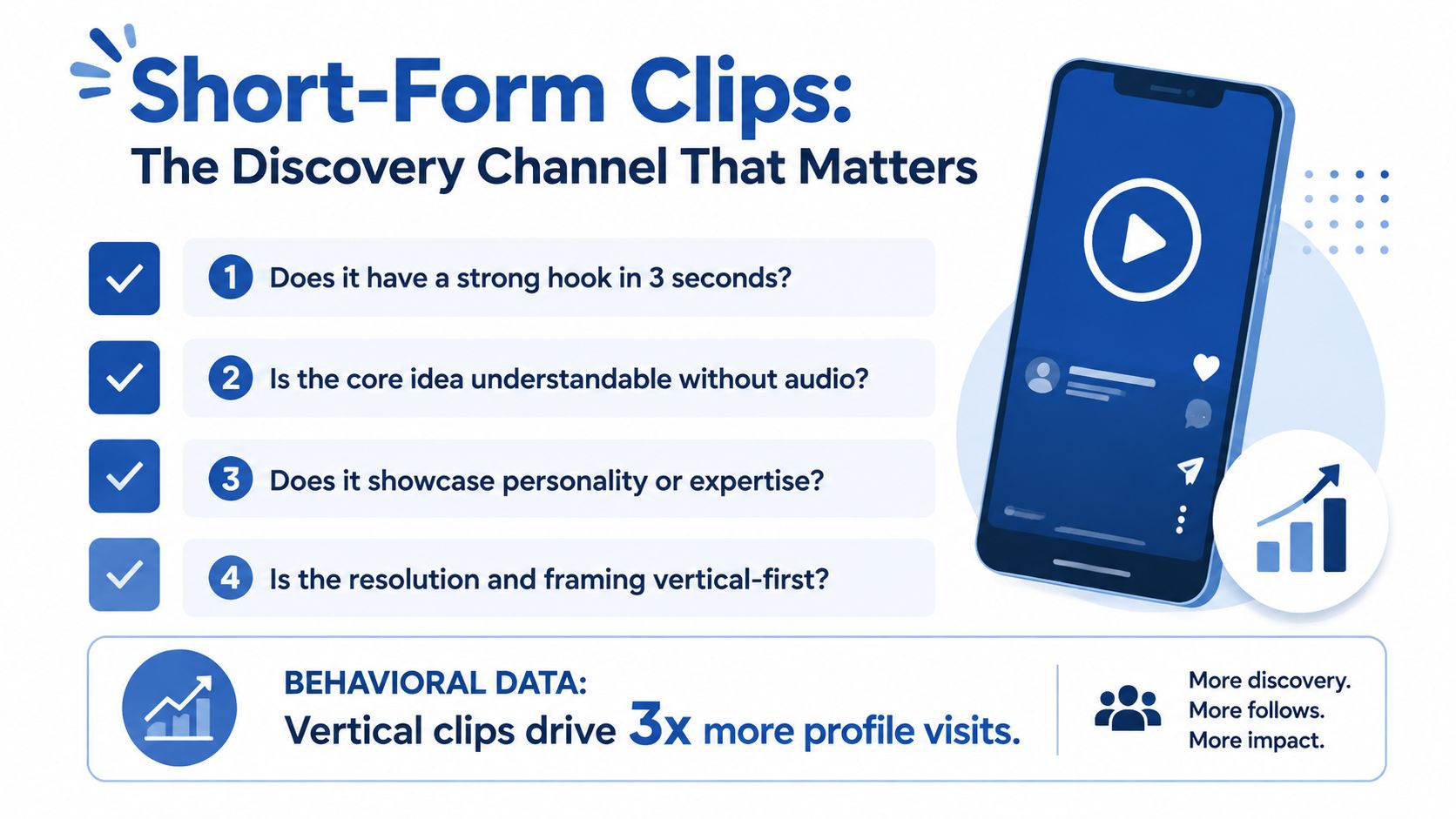
Not every segment deserves a clip. The best candidates usually pass four checks.
- Specific and arguable: people want to agree or disagree.
- Standalone: it makes sense without a long setup.
- Strong first sentence: the hook lands immediately.
- Emotion: surprise, humor, conviction, or tension is present.
That test saves time, and it keeps clipping teams from spending hours on moments that look great in context but go nowhere in a feed. The most polished moment is often not the most shareable one. Many clipping teams prioritize the most polished moment over the most shareable one, and those two choices lead to very different results.
Turning One Recording Into a Real Content Set
A single 45-minute recording can become 8 to 12 short clips, 6 to 8 text posts, 4 to 6 quote graphics, 1 to 3 carousels, and one SEO article when it is repurposed properly. That is the asset math that keeps a show present all week without new recording time. It also shows why short-form clips matter most, because they create the initial spike.
The article and newsletter do a different job. They convert interest into durable subscribers. Clips pull new viewers in, but search content and owned email help keep them. A show that posts only the full episode is leaving distribution on the table.
A workable weekly clip process looks like this:
- Mark the strongest 3 to 5 moments during the episode review.
- Cut vertical versions first, because feed behavior starts there.
- Write supporting text posts that carry the same idea in a different format.
- Publish the article and newsletter so the spike has somewhere to land.
The same logic is covered in this deeper note on podcast clips for social media. Short-form clips should be judged by subscriber delta in the 48 hours after posting, not just by views.
Video Proof Matters More Than Polished Promos
The strongest clip is usually the one that feels like a sharp point of view, not a trailer. The clip should carry the idea in full, even if the episode link sits in the caption. A viewer should understand the claim without context.
A clip that lands on its own gives the show a better shot at repeat watches, saves, and shares. That is the practical job of short-form video, not acting as a glossy teaser.
Short version: clips open the door. The rest of the content closes the deal.
The Channels That Move Downloads
A good podcast growth strategy does not worship one channel. It picks the ones that fit the show's stage. The five channels that matter most are short-form clips, guest cross-promotion, SEO episode articles, newsletter capture, and paid promotion. The practical filter is effort versus impact, not channel hype.
The hardest mistake is assuming every channel should work immediately. It won't. Paid promotion usually works best after the positioning, clip framing, and episode packaging already pull attention. Guesting helps when the audience overlap is real. Search compounds more slowly. Newsletters build ownership. Clips drive discovery.
| Podcast growth channels ranked by effort versus impact | |||
|---|---|---|---|
| Channel | Effort | Impact | Time to First Result |
| Short-form clips | Medium | High | Fast |
| Guest cross-promotion | Medium | Medium | Fast to medium |
| SEO episode articles | Medium to high | High over time | Slow |
| Newsletter capture | Medium | High over time | Medium |
| Paid promotion | High | Variable | Fast if the message is already working |
What Each Channel Is Good For
Short-form clips are the discovery engine. Guest cross-promotion borrows attention when the audiences overlap. SEO episode articles compound because old episodes can keep attracting search traffic, especially when titles and descriptions get updated. Newsletter capture creates ownership, which matters when platform reach gets noisy.
Paid promotion works best after the core message is already getting traction. Once the show is proving that clips, titles, and episode packaging can pull attention on their own, paid spend has a cleaner job to do. Without that signal, the budget just amplifies weak assets.
For B2B shows, a useful reference point is this B2B podcast marketing strategy guide. The pattern holds across categories. Distribution works better when the same recording is turned into several formats instead of treated like a single export file.
Guesting Works Best When the Fit Is Real
Guest swaps get overrated as a growth shortcut. They help most when both audiences already care about the same problem and both hosts can make a clear case for why the episode matters. If the overlap is thin, the lift is usually shallow. Guesting should support the show, not carry it.
A 90-Day Execution Plan a One-Person Team Can Run
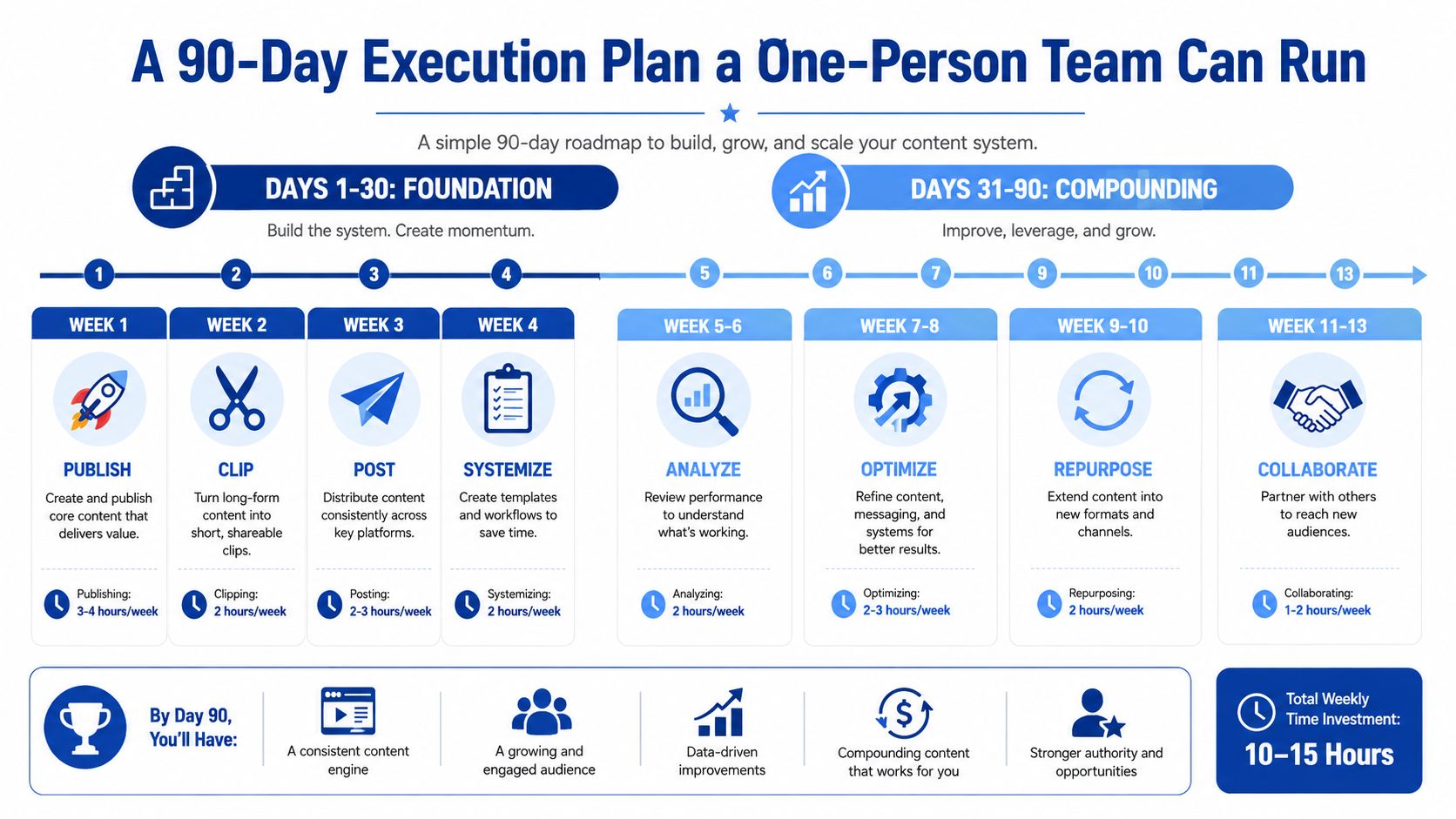
A one-person show does not need a giant content calendar. It needs a repeatable weekly loop. The first month should establish the cadence, the second should sharpen the best-performing formats, and the third should make the whole system easier to repeat. A steady weekly rhythm beats a launch burst that burns out.
Days 1 to 30
Week 1 should focus on packaging. Rewrite the show promise, tighten episode titles, and set a clip review process. Week 2 should lock the repurposing rhythm. Week 3 should add the first guest cross-promo outreach. Week 4 should review the numbers and cut whatever isn't being used.
A sustainable cadence from one weekly episode looks like this:
- 3 to 5 clips spread across the week.
- 2 to 3 text posts or quotes.
- 1 carousel.
- 1 article.
- 1 newsletter.
That creates roughly one asset per day without creating new recordings. The DIY time cost is real. Clipping alone can take 2 to 3 hours per recording once selects, edits, and exports are finished. Writing the article and newsletter can take another 2 hours. Designing graphics and scheduling posts adds more time.
Days 31 to 90
The second half is about pattern recognition. Track follower delta in the 48 hours after each clip, completion rate, and first-week download velocity. Those three numbers tell the team more than raw impressions do. A clip that gets views but no subscriber movement is not the winning format.
The weekly review can stay simple.
- Check the strongest clip and note the hook.
- Check retention and find the drop-off point.
- Check first-week velocity and compare episode packaging.
The fastest way to waste 90 days is to keep posting the same clip style and hoping the audience changes its mind.
The article and newsletter should keep carrying the winners forward, while guest outreach becomes more selective. The goal is not more output. It is tighter output that gets distributed in more places. That is also why repurposing podcast episodes usually outperforms chasing a bigger recording schedule.
The Done-For-You Alternative to All of This
The DIY plan works, but it consumes time fast. Clipping, writing, designing, posting, and revising can eat several hours every week. For a founder or solo podcaster, that is often the bottleneck, not ideas. The work gets done late, or it gets skipped.
RepurposeYourContent takes one recording, whether it's a podcast, webinar, keynote, interview, or meeting recording, and turns it into 20 to 30 ready-to-publish assets in 72 hours. That package includes video clips, LinkedIn posts, quote graphics, carousels, audiograms, and a blog post, all written in the brand's voice. Client time is about 15 minutes. The finished assets can come from any long-form recording, not just a podcast.
The practical value is simple. One 45-minute recording becomes roughly 30 assets, which means the same episode can carry a week of distribution instead of a single launch post. The service also includes a 72-hour turnaround guarantee, or the client doesn't pay. Pricing starts from $14 per finished asset based on the provided plan structure, which is far easier to compare against the hidden cost of in-house editing time and design labor.
RepurposeYourContent is one option for teams that want a content engine without building one internally. The process is straightforward, the revision loop stays open, and the output is built for consistency across channels. For teams that want to see the format first, request a sample here or book a call with RepurposeYourContent and get a feel for what a single recording can become.
Tags: