How to Repurpose Podcast Guest Appearances Into Content
Learn how to repurpose podcast guest appearances into 30+ content assets. This guide covers getting rights, creating clips and posts, and converting attention.

To repurpose podcast guest appearances, a guest needs two things first: permission to reuse the recording and a clear process for extracting clips, quotes, and ideas into new assets. The practical version is simple. Secure rights from the host before recording, then turn the episode into short video clips, social posts, a blog article, and a newsletter feature on channels the guest controls.
Most guest appearances disappear because the guest treats the episode link as the deliverable. It isn't. It's raw material.
A founder spends an hour on someone else's show, shares the host's post, gets a short burst of attention, then watches the whole thing vanish down the feed. That's the default outcome. The host keeps the archive. The guest keeps a memory.
The smarter move is to treat guesting as borrowed attention. The interview gives access to someone else's audience for an hour. Repurposing is what turns that borrowed attention into owned assets that keep working after the episode scrolls away.
Your Podcast Appearance Vanishes in 48 Hours
A guest episode usually gets one brief moment of visibility. The host publishes it. The guest reshares it. Then newer posts push it down the feed.
That's why how to repurpose podcast guest appearances matters so much for founders and executives. The appearance itself is not the endpoint. The appearance is the source file.
A single conversation can support weeks of output if the guest controls the follow-through. That means clips on LinkedIn, a native post that expands the best argument, a blog article on the guest's own site, and a short note to the email list. The host still gets credit. The guest gets durable content.
Borrowed audience without owned assets is rented attention.
The mistake is simple. Most guests only promote the host's episode page. That helps the host, but it doesn't build the guest's library. A better approach is to create derivative assets that point back to the show while living on channels the guest owns.
For practical ideas on extending an episode after launch, this guide on how to promote a podcast episode after launch is useful. The key difference here is perspective. The host is not the reader. The guest is.
The Pre-Interview Playbook to Secure Your Content
The hardest part of podcast guest repurposing often happens before the record button goes live. If the guest waits until after the interview to ask for video files or permission to cut clips, the answer can be slow or negative.
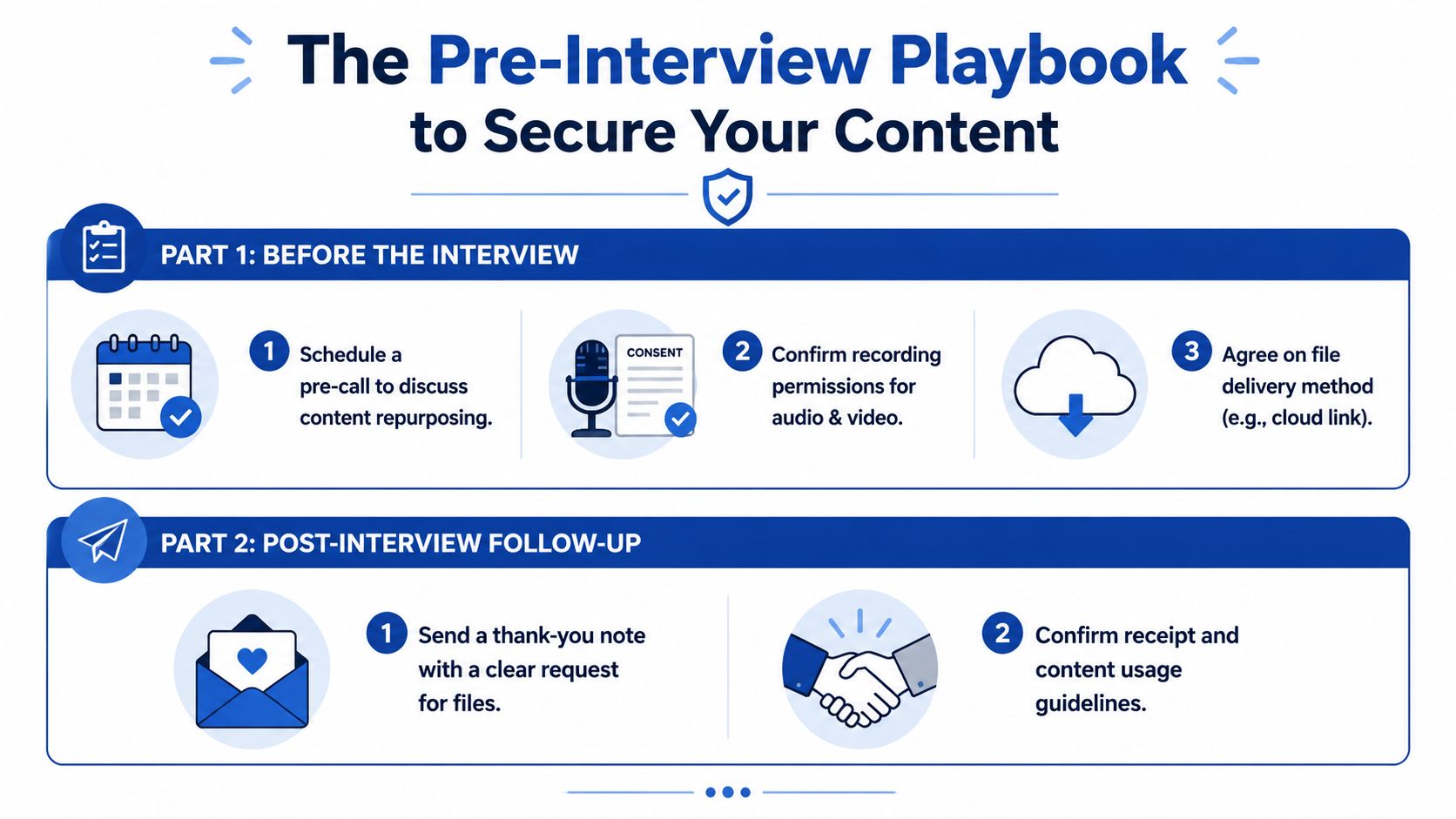
Ask for rights before the interview
This issue gets ignored in most advice for guests. Yet research summarized by Content 10x notes that 40–60% of hosts decline or delay file sharing, while guests using standardized guest asset agreements before recording reduce denial rates by 75% in this workflow context, as cited in this summary of repurposing guest appearances.
That changes the order of operations. A guest should settle two points early:
- Clip rights: Can the guest reuse short excerpts of the appearance on personal or company channels?
- Credit conventions: How does the host want the show name, host tag, and episode link presented?
Without those answers, post-production becomes messy.
What a guest can ethically reuse
There's a practical line here.
A guest can usually ask to reuse short clips of their own appearance, create posts based on ideas they shared, write a blog article that expands their own answer, and feature the appearance in a newsletter with clear credit to the host and show.
A guest should not assume ownership of the host's full episode, artwork, intro, outro, or branded edits. The host owns the episode package. The guest owns the ideas and can create derivative content from their own contribution, subject to the agreed permission terms.
A useful principle is this: respect the host's episode as their property, and build your own assets around your contribution to it.
Practical rule: Ask for permission to republish excerpts, not to repost the host's entire episode file as if it were your own.
A polite email a guest can send
This works best before recording, not after:
Hi [Host Name], Looking forward to the conversation.
After the episode goes live, would you be comfortable with me reposting short excerpts from my appearance on my own channels, with full credit to your show and links back to the episode?
If you record video, it would also help to know whether you can share the final guest-ready files or short raw segments after publishing.
Happy to follow any tagging, naming, or brand guidelines you prefer.
Thanks again, [Name]
Short. Respectful. Specific.
Build a guest one-sheet that makes this easier
A guest one-sheet isn't just a booking asset. It should also make repurposing frictionless.
Include:
- A short and long bio: So the host doesn't rewrite positioning badly.
- Preferred headshot and company description: This keeps branding consistent.
- Three to five talking points: These shape more quotable answers.
- Social handles and website link: So the host tags correctly.
- Repurposing note: A simple line stating that the guest would appreciate access to approved clips or final files for credited reposting after publication.
- Credit preferences: Exact company name, show tag format, and any legal naming requirements.
Guests who want better host outreach can borrow structure from this resource on podcast guest outreach.
The Extraction Workflow How to Find Your Best Moments
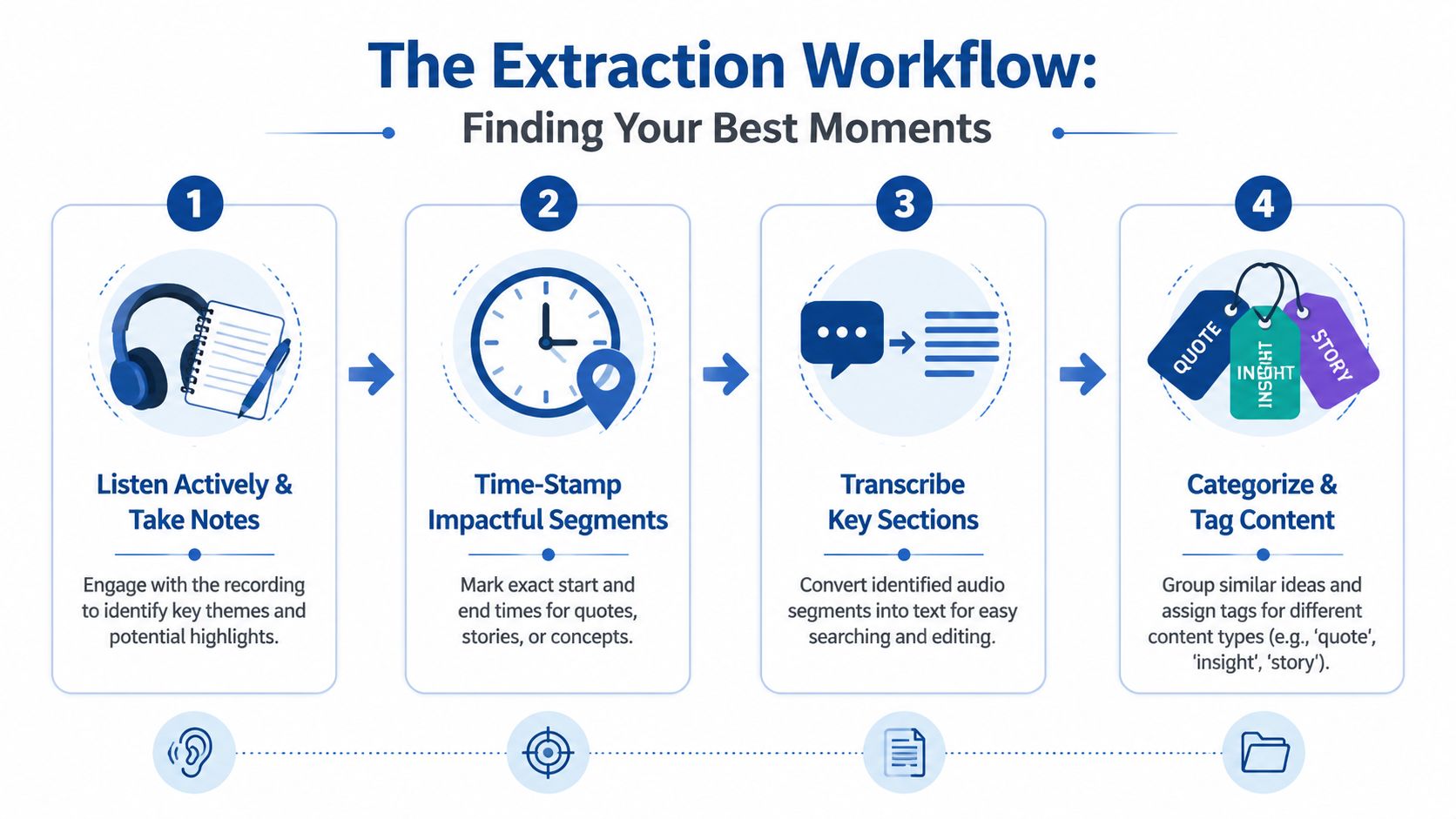
Once the guest has the recording, the next job is extraction. Significant time is often lost during this stage. They think they'll “pull a few clips” in half an hour. They won't.
Manual extraction usually means 2–3 hours per recording if someone is doing it properly. That includes watching or listening, scanning the transcript, marking timestamps, and deciding which lines can stand alone.
What to look for in the transcript
The strongest reusable moments are not polite transitions. They are complete thoughts.
A guest should mark lines that are:
- Self-contained: The sentence makes sense without the previous three minutes.
- Defensible: It states a real point, not a vague platitude.
- Specific: It sounds like a person with an opinion, not committee language.
- Delivered with energy: Better if the speaker's voice or face shows conviction.
A useful illustration comes from the Shopify example work. Vanessa Lee's line, “You have to just understand your domain really, really well”, works because it's clear, complete, and unmistakably her. It doesn't need a paragraph of setup. That's what a portable quote looks like.
A simple manual workflow
Here is the cleanest extraction process:
Do a first pass on the transcript
Read for claims, stories, and memorable phrasing. Mark anything that feels portable.Do a second pass on the video or audio
Check delivery. Some good lines read well but land flat on camera.Timestamp every keeper
Note exact start and end times for clip editing later.Tag each moment by asset type
Mark one as “video clip,” another as “LinkedIn post,” another as “blog seed.”
This walkthrough on podcast clips for social media helps with the clip-selection side once the raw moments are identified.
The process below shows the principle in motion.
Why extraction comes before design
Research summarized in this LinkedIn article notes that a systematic workflow starts with extracting the best 5–10 quotes, which can yield at least 10–15 unique social assets per appearance in under 4 hours, and creators report 85% higher engagement when quotes are paired with visual branding in that workflow example, as described in this repurposing method for podcast guest appearances.
That's the right order. First extract. Then produce.
If a guest jumps straight into editing clips, writing captions, and building graphics without a highlight list, the process drags. The transcript becomes the map. The timestamp list becomes the production brief.
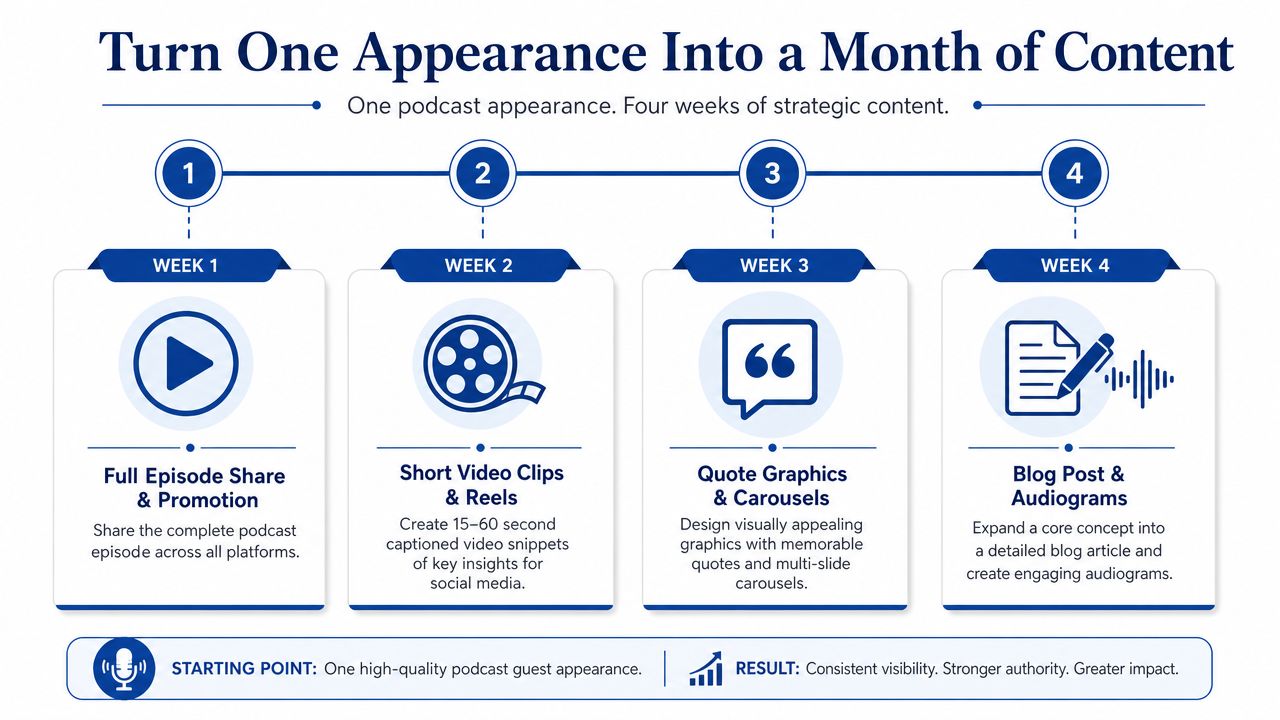
Turn One Appearance Into a Month of Content
Once the usable moments are tagged, the guest can turn one interview into a small content series. Different formats do different jobs. The mistake is using one format for everything.
Video clips for reach and recognition
For guests, short video usually travels furthest. A viewer sees the guest's face, hears the line in the guest's own voice, and gets immediate context from captions.
For B2B channels, the strongest clips are the moments where the guest makes a strong claim. Research summarized by Podmuse says those clips drive 85% of viewer engagement on silent social platforms, and it also stresses that transcripts must be turned into structured blog posts with new insights, not dumped in raw form, as outlined in this guide on repurposing one recording into multiple social posts.
A guest clip should usually have:
- A sharp first line: The best point needs to land immediately.
- Captions: Many people watch muted.
- Host credit: Name the show clearly.
- A short caption from the guest's angle: Not “great chatting with…” but “On X show, this was the point worth arguing.”
Native social posts for conversation
Text posts do a different job. They let the guest restate the argument in sharper language and invite replies.
A simple pattern works well:
| Asset | What the guest posts | Why it works |
|---|---|---|
| Clip post | A short captioned excerpt from the interview, credited to the host | Carries presence and authority |
| Text post | “On [show], the argument was simple…” followed by an expanded point | Starts discussion on the guest's terms |
| Carousel | A framework or breakdown based on one answer from the episode | Makes the idea easier to save and share |
| Quote graphic | One self-contained line with branded design and host credit | Gives the idea portability |
A guest should not stop at reposting the host's launch graphic. That asset belongs to the host's publishing cycle. The guest's job is to make the idea native to personal channels.
For teams building a repeatable process, this guide on turning a podcast into LinkedIn posts is a useful companion.
Blog posts for durability and search
The guest's best long-term asset is usually the article on the guest's own site. Unlike the episode page, the guest controls the framing, CTA, internal links, and follow-up path.
A good blog adaptation does not paste in the transcript. It should:
- Use subheadings
- Expand the strongest point from the interview
- Add examples or clarification that didn't fit in the episode
- Link to relevant service or resource pages
- Embed the original episode if allowed
That structure matters. The guest is not archiving audio. The guest is turning spoken expertise into owned written content that can keep getting found.
For a broader framework, see how to repurpose expert interviews into content and this guide to a thought leadership content strategy.
The clip gets the guest seen. The text post gets the point discussed. The article gets the idea found later.
One practical weekly rollout
A guest doesn't need to publish everything at once. A staggered release works better.
Step 1
Share the full episode once, with a real point of view in the caption.
Step 2
Publish the best short clip with host credit.
Step 3
Turn the strongest answer into a native LinkedIn text post.
Step 4
Publish a blog article expanding that answer.
Step 5
Send a short newsletter note featuring the episode and the deeper article.
That's how one guest spot stops being a one-day event.
The Done-for-You Alternative 5 Hours of Work in 15 Minutes
The manual workflow is clear. It's also slow.
A guest has to secure permissions, request files, review the transcript, pull timestamps, edit clips, write captions, design quote graphics, draft LinkedIn posts, and shape an article. Even when the process is organized, that stack of work eats a big chunk of a week.
Research from HubSpot, cited in this summary of content repurposing statistics, says 60% of marketers find that repurposed content generates more leads than original content. That's the business case for doing this at all. The issue isn't whether repurposing matters. The issue is whether a founder should personally do the production.
The real trade-off
DIY works if someone on the team can absorb the hours and has editing judgment.
That means:
- Clipping and selecting moments: usually a few hours
- Writing posts and captions: often another block of focused time
- Design and formatting: more time if brand consistency matters
- Review cycles: slower than expected, especially with executives
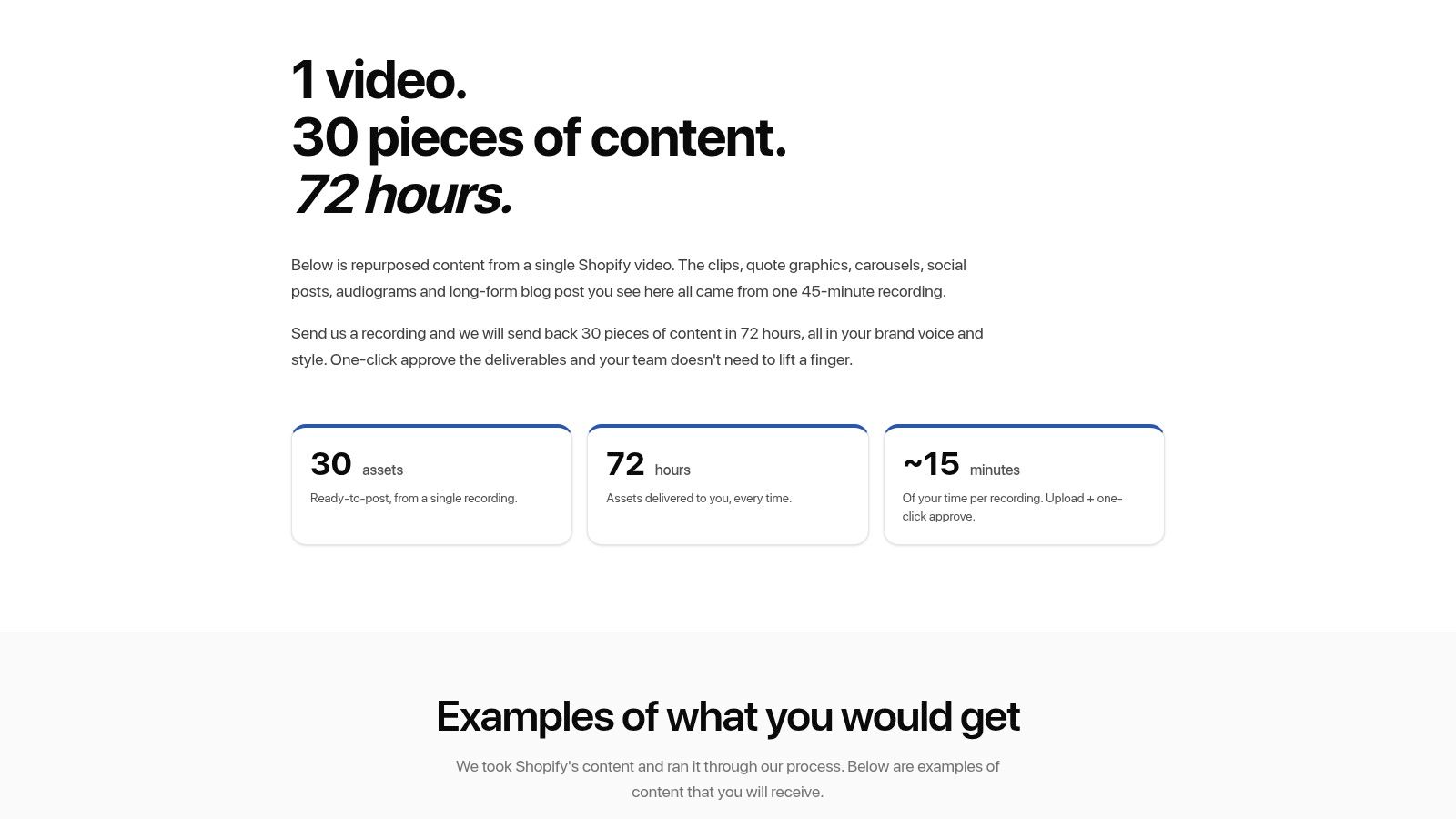
The alternative is straightforward. Send one recording, whether that's a podcast, webinar, keynote, interview, meeting recording, or sales call, and get finished assets back.
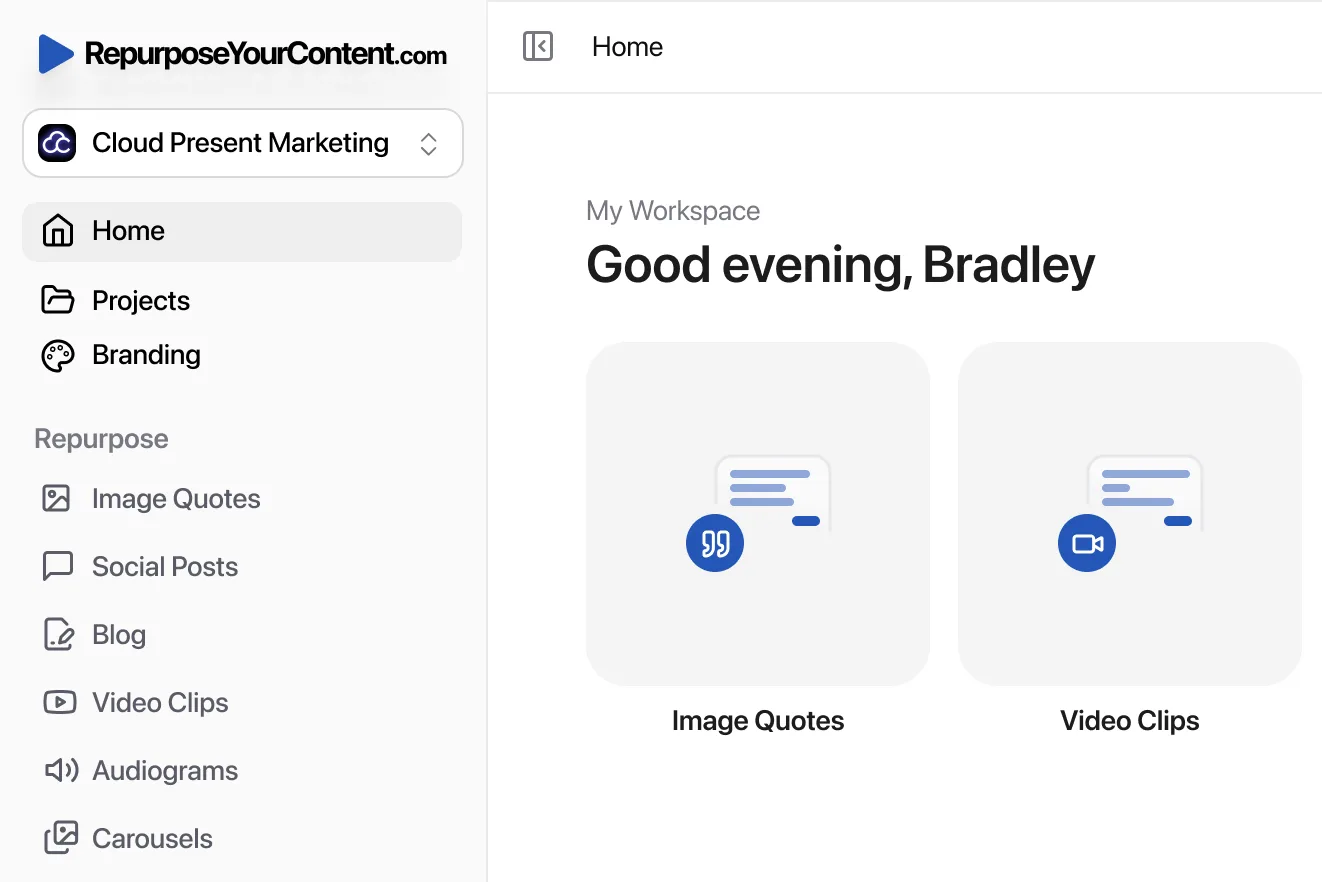
A done-for-you service can turn one 45-minute recording into 30 assets. The practical offer is simple: send one recording and receive 20–30 ready-to-publish assets in 72 hours, including video clips, LinkedIn posts, quote graphics, carousels, audiograms, and a blog post. Everything is produced in the client's brand voice, with unlimited revisions. The client's time is about 15 minutes.
The economics are clear too. Pricing can start from $14 per finished asset, with a 72-hour turnaround guarantee or the client doesn't pay.
For teams comparing routes, this overview of a podcast repurposing service shows what that outsourced workflow looks like.
Outsourcing doesn't remove the strategy. It removes the production drag.
Stop Letting Your Best Content Evaporate
A guest appearance should not end as a single reshare. It should become a repeatable content source.
That's already standard practice. In a Referral Rock survey of 48 marketers, 94% said they repurpose content for different mediums and channels, which shows how normal this has become in real marketing operations, as cited in this summary of content repurposing strategies.
For founders and executives, the principle is simple. Guesting borrows attention. Repurposing turns that attention into assets the business owns.
The manual route works, but it takes time teams often don't have. If the goal is to turn the next guest appearance into clips, posts, graphics, carousels, audiograms, and a blog article without losing a day to post-production, book a call with RepurposeYourContent or request a sample.
Tags: