Rapid Response Marketing That Moves at Market Speed
Learn rapid response marketing, when to act, and how to launch on-brand campaigns in hours with workflows, examples, metrics, and checklists.
A competitor announces a category shift at 9:30 a.m. By lunch, the support inbox is asking for answers, LinkedIn comments are challenging the company's position, and sales calls are carrying the same objection.
Rapid response marketing gives the team a way to respond within hours without publishing half-checked opinions. It means identifying a relevant trigger, deciding whether the brand should participate, and producing useful content before attention moves elsewhere.
The strongest system isn't a race to publish everything. It combines fast judgment, brand safety, measured attribution, and a reliable way to turn existing recordings into finished assets.
Why Rapid Response Marketing Matters
Rapid response marketing matters because delay changes the commercial context around a message. A buyer who asks a question at 10 a.m. may have formed a view by the afternoon. A prospect who raises an objection on a sales call may already be comparing vendors before marketing produces a response.
A widely cited analysis of 1.25 million sales leads found that companies contacting prospects within 1 hour were nearly 7 times more likely to qualify a lead than companies waiting even one hour longer, and more than 60 times more likely than companies waiting 24 hours or longer. The same source also cites an average response time of 42 hours across more than 2,000 companies, exposing the gap between buyer urgency and business execution. The speed-to-lead analysis concerns sales follow-up, but the operating principle applies to market moments too.
A fast response doesn't need to be loud. It needs to be relevant, accurate, and useful enough to earn attention.
The response window is commercial
Three pressures make timing important:
- Attention decays quickly: News cycles, social feeds, and search behavior move rapidly. A strong point published after the conversation peaks may receive less attention than a modest point published while the question is active.
- Customers expect accessible brands: Always-on service has trained buyers to expect timely answers. A silent brand can look uncertain, even when its internal team is still reviewing the facts.
- The first useful explanation shapes the narrative: Whoever explains a market change clearly often becomes the reference point for later conversations.
Teams can improve instant decision making with data by connecting monitoring, context, and agreed decision rules rather than relying on instinct alone. Orbit AI's guide to instant decision making with data offers useful context for that operating model.
Speed needs guardrails
Speed without judgment creates its own costs. A rushed post can contain an unsupported claim, contradict a public position, or force legal and communications teams into an expensive correction.
The practical model is selective. A prepared team uses pre-approved templates, named reviewers, and clear thresholds to decide whether to respond in two hours, adapt within 24 hours, or hold. That discipline matters because content repurposing statistics for 2026 shows why systematic reuse has become operationally relevant. Existing source material gives teams a factual base, rather than forcing every response from a blank page.
Practical rule: Fast publishing only creates value when the brand can defend the message after the attention window closes.
How the Rapid Response System Works
A useful rapid response system resembles airport operations. Radar detects a developing signal, the control tower decides whether movement is safe, ground crews prepare the aircraft, the flight takes off across selected routes, and the post-flight log records what happened.
Each stage consumes part of the available response window. A brilliant message still fails if monitoring is late, approval stalls, or distribution starts after the conversation has cooled.
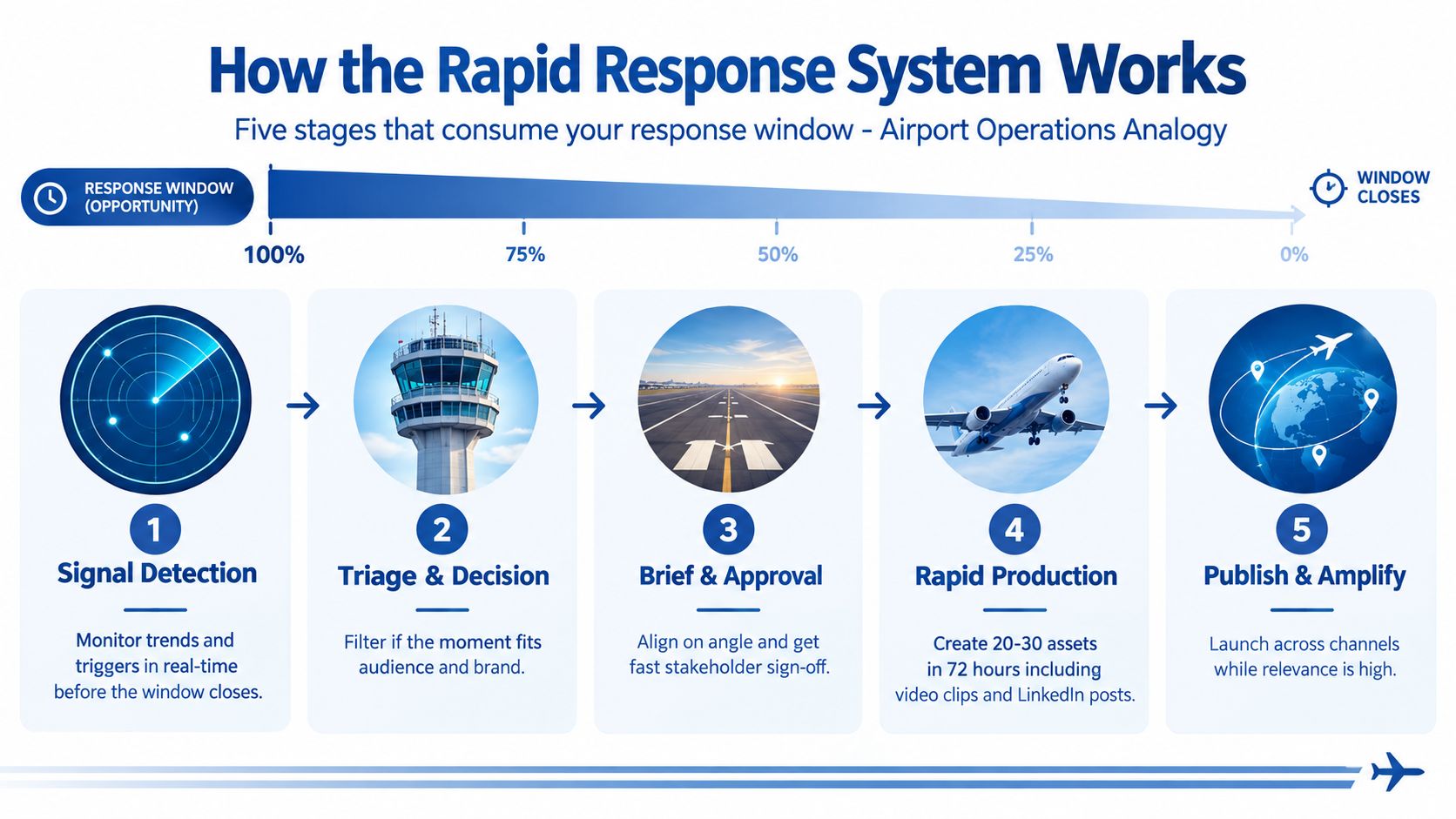
Five stages and their owners
Signal detection is the radar. A demand generation manager monitors keywords, social mentions, competitor announcements, customer questions, and sales feedback. The output is a short trigger note with the source, timing, audience, and initial context.
Decision is tower clearance. A marketing lead applies the brand-fit, evidence, and risk filter. The output is a decision to respond, adapt, or hold, plus a named owner and deadline.
Production is gate preparation. A content producer turns the approved angle into copy, clips, visuals, or a short article. A source recording can provide language, examples, and proof points. Manual teams often lose the response window during this stage because clipping, editing, design, and writing happen in separate queues.
Distribution is takeoff. A channel owner adapts the campaign for LinkedIn, email, the website, sales enablement, or a podcast feed. The message stays consistent, but the opening, format, and call to action change by channel.
Measurement is the post-flight log. Marketing operations adds UTM parameters, records the publication time, tracks engagement and pipeline activity, and documents response quality. The team should capture what changed because of the response, not just how many people saw it.
Bottlenecks multiply across handoffs. A decision made quickly still produces a late campaign if the source review waits until the next day.
Teams assessing automation should separate faster execution from useful outcomes. A practical overview of automation ROI for SaaS companies helps frame the business case around process value, not automation for its own sake. A documented content repurposing workflow for small teams also helps clarify ownership before a trigger arrives.
When to Respond and When to Hold Back
Not every trend deserves a reply. Popularity alone doesn't give a brand permission to enter a conversation, especially when the facts remain unclear or the audience has no reason to trust the company's view.
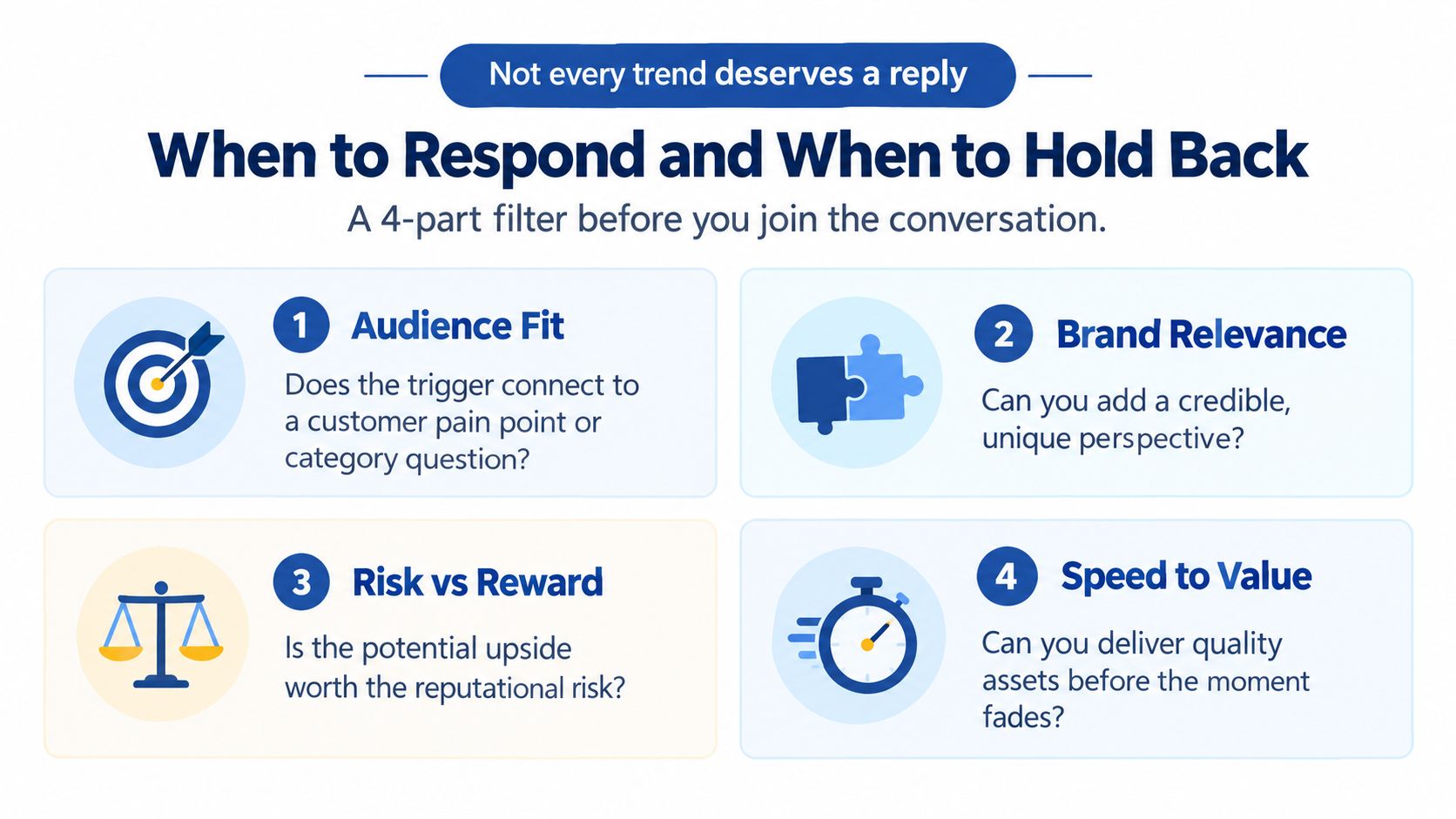
A fast decision filter should answer four questions before production begins.
The four-part filter
Audience fit comes first. Does the trigger connect to a customer pain point, buying objection, or category question the brand can answer credibly? A security company may respond to a new risk disclosure. It probably shouldn't comment on an unrelated celebrity controversy.
Brand relevance asks whether the company has a distinct point of view. Repeating the headline adds little. A useful response explains the operational consequence, the buyer implication, or the decision teams should make next.
Risk versus reward covers factual, legal, regulatory, and reputational exposure. A high-risk response needs stronger evidence and more senior review. Some topics should move to a private customer note rather than a public post.
Speed to value tests whether the team can produce something useful before the moment fades. A response that needs several days of research may be better as an evergreen article. A short, verified clarification may work immediately.
Three possible decisions
- Respond immediately: Audience fit is clear, evidence is strong, risk is manageable, and the topic is still developing. Use a short point of view, a verified source, and a direct next step.
- Adapt within 24 hours: The opportunity is relevant, but the message needs nuance, stakeholder review, or additional context. Publish a considered response instead of forcing a premature take.
- Stay silent: Fit is weak, evidence is thin, risk is high, or the topic has become saturated. Silence protects trust when the brand has nothing useful to add.
A five-minute scoring prompt keeps the filter practical. Rate each area as strong, uncertain, or weak. If audience fit or evidence is weak, pause. If brand risk is high, escalate. If all four areas are strong, open the production workflow.
A useful response isn't the fastest possible response. It's the fastest defensible response.
Rapid Response Marketing in Practice
The same operating model can support different recording formats. The trigger changes, but the team still needs a source, an angle, a set of assets, and a distribution path.
The examples below are composite scenarios. They show workflow choices, not performance claims.
Scenario comparison
| Scenario | Source Recording | Core Deliverables | Manual Time | Primary Channel |
|---|---|---|---|---|
| Industry claim | B2B podcast episode | Short clips, quote cards, blog post, email, LinkedIn posts | Recording review takes 1 to 2 hours, then editing and writing add several hours | LinkedIn and email |
| Conflicting statistic | Keynote talk | Source-checked clip, explainer carousel, executive post, blog update | Fact review takes 1 to 2 hours, with production continuing after approval | LinkedIn and website |
| Unexpected use case | Customer interview | Customer clip, anonymized quote graphic, sales post, case-study draft | Interview review takes about 1 hour, followed by writing, design, and approvals | Sales enablement and LinkedIn |
In the first scenario, a podcast guest makes a bold claim about a category shift. The producer marks the exact passage, checks whether the claim reflects the guest's opinion, and builds the response around a question rather than presenting the statement as established fact. The campaign can include a short clip, a quote card, a blog post explaining the issue, and an email inviting prospects to discuss the implication.
The keynote scenario requires stricter source handling. If the speaker contradicts a widely reported statistic, the team shouldn't publish the contradiction as a correction until the original data and context are checked. The safer asset plan uses the speaker's reasoning, identifies the uncertainty, and sends the audience toward a fuller explanation.
The customer interview offers a different advantage. An unexpected use case can become a sales enablement post, a customer-approved clip, and a draft case study. The production team should confirm permission, remove sensitive details, and preserve the customer's meaning instead of forcing a polished claim.
A structured micro-content strategy from recordings can help teams reuse one source without making every channel sound identical. The value comes from preparation and reuse, not improvisation under pressure.
Build a Scalable Response Workflow
A small team needs ownership at every stage. Without it, the campaign becomes a group chat with no deadline, no final approver, and no clear definition of done.
The following workflow works for a one-person marketing function or a small pod. A single operator may spend 10 to 16 hours per recording on manual repurposing, according to 2026 repurposing workflow data. That time includes review, editing, writing, design, and coordination.
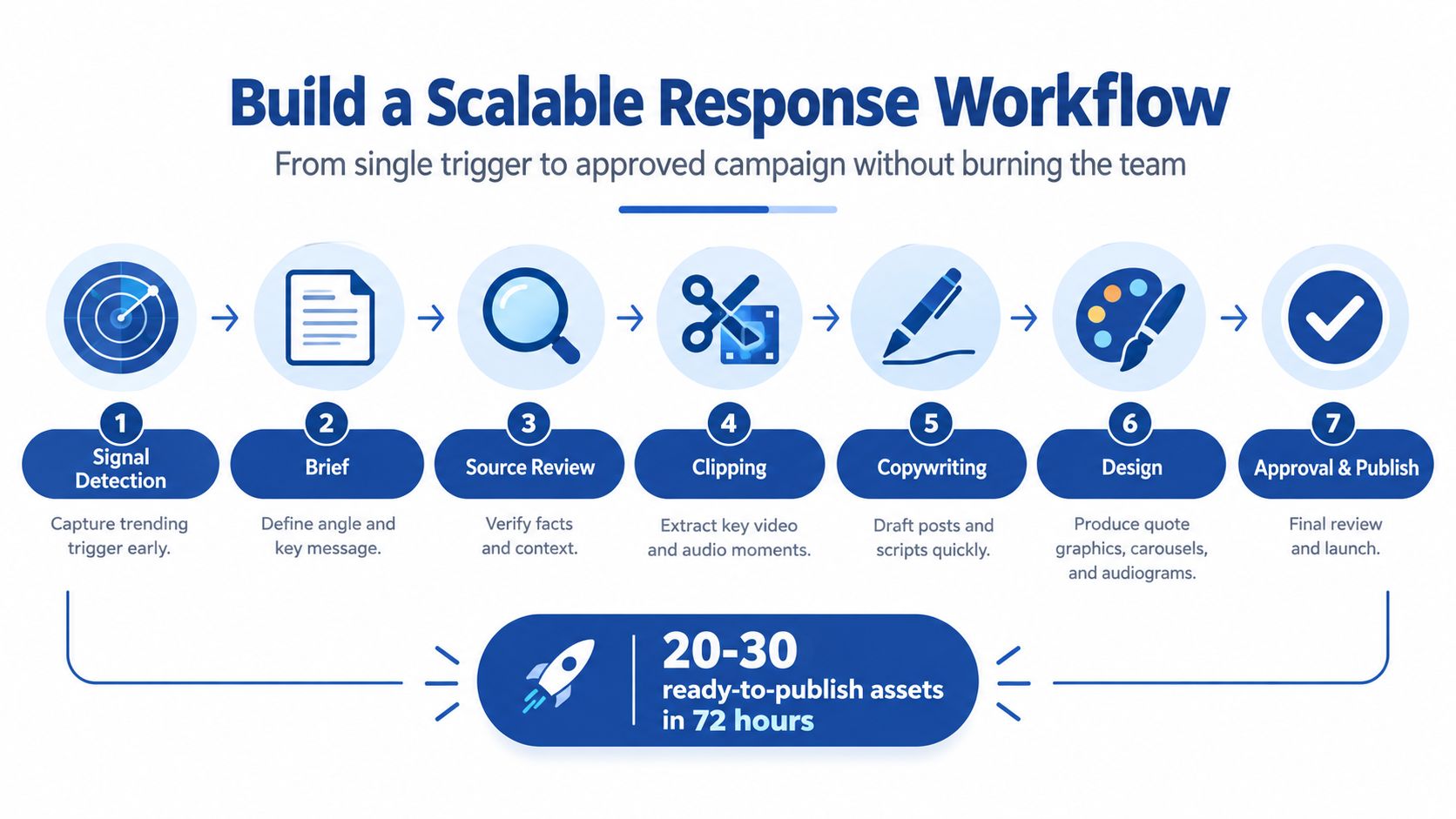
Eight operating steps
Signal detection: A demand generation owner captures the trigger, source, audience, and timestamp. This should take minutes, not a research afternoon.
Brief: A marketing lead writes the angle, audience, proof requirement, channels, and call to action. A short brief prevents production from expanding into unrelated commentary.
Source review: A subject matter expert checks the recording, transcript, data, permissions, and context. This is the main factual safeguard.
Clipping: An editor selects relevant video or audio moments, removes dead space, adds captions, and exports channel-ready versions. Manual clipping often takes several hours per recording.
Copywriting: A writer creates the LinkedIn post, email, blog draft, sales note, and supporting captions. The writer should keep one central argument across formats.
Design: A designer applies the brand kit to quote graphics, carousels, and audiograms. Templates reduce repeated layout decisions.
Review: One approver checks brand voice, factual accuracy, legal exposure, permissions, links, and calls to action. High-risk claims need subject matter or legal review.
Scheduling: The channel owner adds tracking parameters, schedules the approved assets, and records the launch time. The campaign scorecard begins before publication.
A one-person team can spend roughly 30 minutes on the brief, 1 to 2 hours reviewing the source, several hours clipping, several hours writing, several hours designing, and additional time reviewing and scheduling. A small pod reduces elapsed time by working in parallel, but handoffs still need a single owner.
Controls that prevent drift
Set a same-day approval window. Define a cutoff after which the team moves the campaign into an evergreen queue. Use an approval matrix:
- Low risk: Content lead approves.
- Moderate risk: Marketing lead and subject expert approve.
- High risk: Senior leadership, legal, or compliance approves.
The scorecard should track reach, engagement, pipeline contribution, and response quality. Response quality includes factual corrections, useful sales feedback, customer questions, and whether the message supported the intended conversation.
An operations playbook for B2B content teams can help document the handoffs. Recording-based production removes the worst bottleneck, starting with a blank page. The source already contains language, examples, objections, and ideas that can be shaped into a campaign.
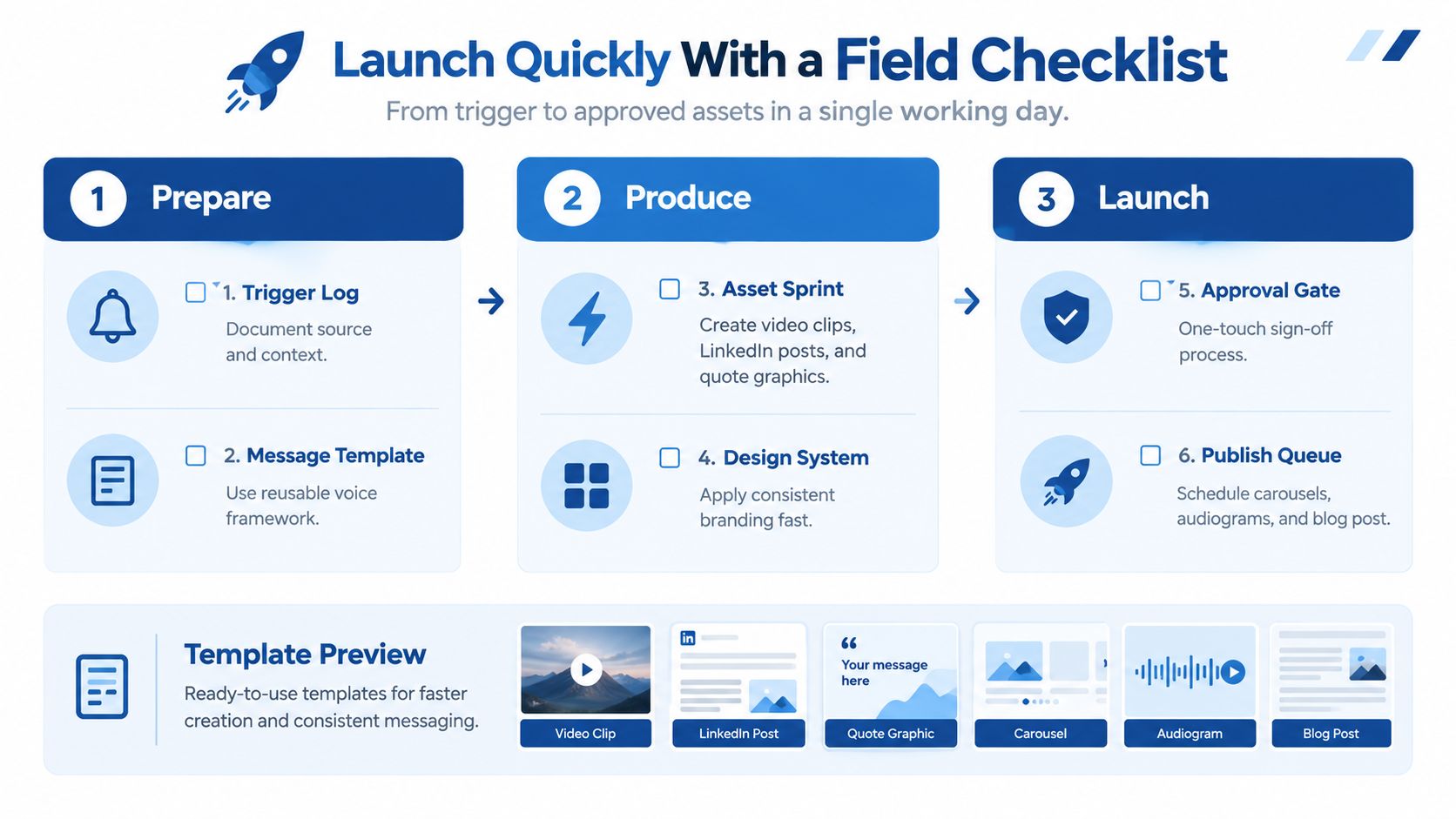
Launch Quickly With a Field Checklist
A small team can move from trigger to approved assets in one working day if preparation happens before the trigger. The checklist should reduce decisions, not eliminate judgment.
Before the trigger
- Create an asset library: Store approved logos, fonts, colours, speaker permissions, headshots, transcripts, and source recordings.
- Prepare templates: Keep formats ready for LinkedIn posts, email notes, quote graphics, carousels, audiograms, and blog drafts.
- Name approval contacts: Record one primary approver and one backup for factual, brand, and legal questions.
- Define stop rules: Document topics that require escalation or silence.
During the response
- Capture the trigger: Log the original source, context, time, audience, and evidence.
- Apply the filter: Check fit, relevance, risk, and speed to value.
- Write the brief: State the point of view, proof needed, formats, channels, and deadline.
- Select source moments: Mark clips that support the point without changing the speaker's meaning.
- Create variants: Draft one central message, then adapt the opening for LinkedIn, email, and the blog.
A reusable message template
Subject line or hook: [The market change or customer question]
Context line: [What happened, with a verified source]
Point of view: [What the audience should understand or do]
Proof element: [Recording clip, customer observation, source detail, or example]
Call to action: [Read the explanation, ask a question, book a conversation, or review the recording]
LinkedIn can lead with the opinion. Email can lead with the buyer implication. The blog should preserve the full context and evidence. The team shouldn't rewrite the argument from scratch for each channel.
The Done-for-You Alternative
Manual production is often the hidden constraint in rapid response marketing. A single recording may contain enough material for a complete campaign, but finding, editing, writing, designing, reviewing, and scheduling every asset can consume most of a workday.
A done-for-you service changes the handoff. The client sends one podcast episode, keynote, customer interview, sales call, livestream, course session, or meeting recording. The client also supplies a brief and one approval contact. Review takes about 15 minutes per round, rather than requiring the client to manage every production task.
One recording, many outputs
A 45-minute recording can become 30 assets. The package can include:
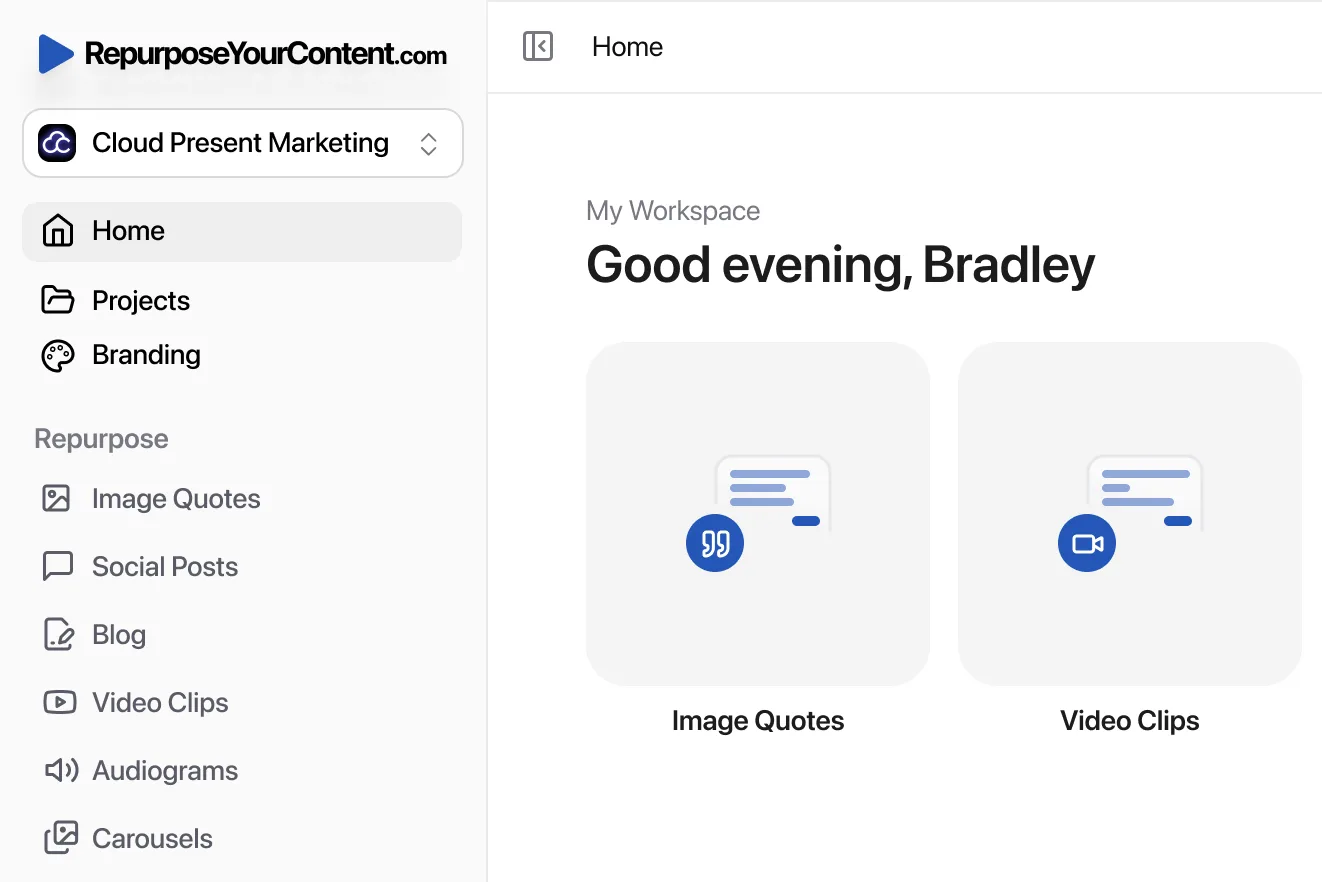
- Video clips: Short, captioned moments for social channels.
- Audiograms: Audio-led assets for audiences that prefer spoken content.
- Quote graphics: Pull quotes built from the speaker's original language.
- Carousels: Structured explanations for complex points.
- LinkedIn posts: Brand-voice commentary connected to each asset.
- Email copy: A concise message for subscribers, customers, or prospects.
- A blog post: A longer explanation that captures search intent and provides context.
The stated delivery model is 20 to 30 ready-to-publish assets within 72 hours, including video clips, LinkedIn posts, quote graphics, carousels, audiograms, and a blog post. A 72-hour turnaround guarantee applies, or the client doesn't pay. Pricing starts at $14 per finished asset, based on the publisher's service information.
This 72-hour delivery should be distinguished from a separate 48-hour priority plan described in the broader business offering. The standard rapid-response campaign described here uses the 72-hour cycle.
The practical trade-off
The client owns the finished assets and can request unlimited revisions. The team works from the client's brand voice and visual identity, then sends content for review before publication. The client keeps final approval, but doesn't control every day-of creative decision.
That trade-off suits teams that value predictable output and lower coordination cost. It suits less when a campaign needs live creative changes every hour or requires an executive to rewrite each post personally. Outsourcing can improve growth team efficiency when ownership and approval rules are clear.
Outsourcing content repurposing works best when the recording already contains useful expertise. The service can't manufacture credible insight from an empty source. It can turn captured knowledge into a coordinated campaign while the internal team focuses on decisions, customer conversations, and distribution.
For podcasters, founders, speakers, and B2B teams, RepurposeYourContent is one done-for-you option. Clients send a recording, and the service returns finished content in the formats described above.
Book a call with RepurposeYourContent or request a sample from a podcast, keynote, interview, sales call, or livestream recording. The team will show how one source can become 20 to 30 ready-to-publish assets within 72 hours, with about 15 minutes of client review.
Tags: