How to Repurpose YouTube Videos Into Shorts That Drive Views
Learn how to repurpose YouTube videos into shorts with a proven workflow. Turn one long-form recording into 30+ platform-ready Shorts in 72 hours.

YouTube Shorts now reach over 2 billion monthly users and generate more than 200 billion daily views. With 74% of Shorts views coming from non-subscribers, repurposing YouTube videos into Shorts gives creators a direct discovery layer beyond their existing audience.
The opportunity is obvious. The workflow is not.
A 30-minute podcast, interview, keynote, sales call, livestream, course lesson, or tutorial can contain several strong Shorts. Finding them, rewriting the openings, reframing horizontal footage, correcting captions, checking rights, and publishing consistently takes real production time.
This guide shows how to turn long-form YouTube content into Shorts that attract new viewers without turning every clip into a substitute for the original video.
Why Repurposing YouTube Videos Into Shorts Is a Discovery Engine
The Shorts feed gives long-form creators access to viewers who may never discover a full YouTube upload through search, browse, or subscriptions. Shorts now reach more than 2 billion monthly users and produce over 200 billion daily views worldwide, according to industry summaries citing YouTube's public figures (YouTube Shorts distribution data).
That reach creates a strategic choice. A Short can act as a discovery bridge to a longer video, or it can become a complete substitute that satisfies the viewer and ends the journey. A self-contained tip may earn attention but offer no reason to watch the source. A sharper clip can reveal the problem, make a strong claim, and point viewers toward the longer explanation.
The distinction starts during clip selection, not after publishing.

Bridge clips versus substitute clips
A bridge clip gives viewers a useful reason to continue. It might introduce a counterintuitive argument, show the result of a process, or expose a mistake without explaining every detail. The related video then supplies the full framework.
A substitute clip delivers the complete answer in isolation. That format can still build awareness and subscribers, but it usually gives viewers less motivation to visit the long-form source.
Practical rule: Give the Short a complete idea, but leave the larger argument worth watching.
The Shorts feed rewards viewer behavior rather than the fact that a clip came from a long-form upload. Stayed-to-watch behavior, swipes, viewing duration, and percentage viewed all matter. A repurposed video still needs a native hook, clean pacing, and a clear payoff.
Creators looking for more packaging angles can review this guide on how to repurpose videos into Shorts effectively. The useful principle is simple: treat each Short as a new piece of programming, not a random excerpt.
Finding Shortable Moments in Long-Form Recordings
The fastest way to scan a 30-minute YouTube video is to read the transcript, not scrub the timeline. A 30-minute transcript can be reviewed in about five minutes, while timeline scanning forces the editor to listen to every pause, transition, and setup.
The transcript reveals where the speaker makes a claim, reaches a payoff, tells a story, or explains a process. The retention graph then shows whether viewers stayed engaged at that moment.

A practical transcript-first workflow
Export the transcript. Use YouTube Studio or the transcript from the original production workflow. Keep timestamps visible.
Mark self-contained moments. Highlight stories, contrarian opinions, surprising numbers, claims, payoffs, and short explanations. Each candidate should make sense without the sentence before it.
Write a provisional hook. Replace introductions such as “Today, we're going to discuss…” with the most interesting statement in the segment. The opening should establish tension or value immediately.
Check the retention graph. Look for spikes, strong plateaus, and sections where viewers stayed longer than surrounding material. These are behavioral signals worth checking, not automatic guarantees.
Score each candidate. Rate hook strength, standalone clarity, visual potential, and connection to a longer video. Prioritize clips that score well across all four.
A 45-minute source recording often contains several candidates on a first pass. A second review can uncover different clips by searching for a new theme, such as mistakes, objections, frameworks, or surprising lessons.
What makes a segment shortable
- A self-contained story: The viewer understands the problem, turning point, and lesson.
- A contrarian take: The speaker challenges a familiar belief and supports the challenge.
- A step-by-step explanation: The clip gives a compact process with a clear outcome.
- A strong visual moment: The footage includes a screen demonstration, product detail, gesture, or reaction that survives vertical cropping.
A strong clip doesn't need the entire conversation. It needs enough context to make the viewer care.
A creator who wants a broader clipping reference can use this YouTube clipping guide. For a deeper content-mapping process, see how to repurpose long-form video into short clips.
Reframing and Editing for Vertical Attention
A horizontal recording rarely becomes a good Short through trimming alone. The editor must rebuild the frame for mobile viewing.
Start every project on a 9:16 canvas at 1080×1920 pixels. YouTube recommends vertical output, and square video can also qualify as a Short. A 16:9 horizontal video doesn't qualify as a Short, even when the duration is short enough (YouTube Shorts aspect ratio guidance).

Reframe the subject before styling
Auto-reframe can track a single speaker effectively. It still needs manual review. Check faces, hands, product shots, screen recordings, lower-thirds, and any slide content that matters to the argument.
Keep the subject inside the center-safe area. Key information near the edge can disappear under interface elements or become awkwardly cropped. Black bars are another warning sign. They tell viewers that the clip came from a horizontal source and wasn't rebuilt for mobile.
Captions should be burned into the video. Use a readable font, strong contrast, and consistent positioning. Avoid covering the speaker's face or important demonstrations. Caption styling should support comprehension, not compete with the footage.
Tighten the opening
The first three seconds create the swipe-or-stay decision. Remove greetings, logos, long pauses, and setup that only makes sense in the full recording.
A useful opening might begin with:
- “Most creators choose the wrong clip first.”
- “This sales call exposed the actual objection.”
- “The fastest way to find Shorts is hiding in the transcript.”
- “That feature isn't the reason viewers leave.”
The edit should then remove dead air and repeated phrasing. Small visual changes can help maintain attention, but unnecessary zooms and effects make serious content feel synthetic.
YouTube now categorizes eligible square or vertical videos up to 3 minutes as Shorts for applicable uploads from October 15, 2024 onward (YouTube's current Shorts classification rules). That expanded ceiling doesn't mean every clip should become long. A longer Short still needs a fast setup and a self-contained payoff.
For further guidance on vertical composition, review these vertical video best practices for LinkedIn. The framing principles also apply to YouTube Shorts.
Batching Your Shorts Production by Stage
Editing one Short from start to finish feels organized. It usually creates unnecessary delays.
The hidden time cost is stage-switching. The editor moves from selecting a clip to writing a hook, then to cropping footage, fixing captions, choosing music, and checking exports. Each switch requires a new creative decision and a new technical context.
Batching removes that friction.
A staged production sequence
Step 1, select every moment first. Build a clip map from the transcript and retention data. Write the working hook, source timestamp, destination video, and intended call to action.
Step 2, make all rough cuts. Focus only on context, pacing, and the first line. Don't style captions yet. Don't choose music while the structure remains unsettled.
Step 3, reframe every clip. Move through the batch with the same 9:16 template. Check subject placement, screen content, and safe margins in one focused pass.
Step 4, apply captions and branding. Use a saved caption preset with the approved font, colors, word timing, and placement. Consistency matters more than novelty across a channel.
Step 5, finish sound and exports. Apply sound design where it supports the edit, then export with the saved YouTube preset. Review every file before scheduling.

Why presets matter
Four presets cover most recurring needs:
- Caption style: Font, brand colors, size, contrast, and timing behavior.
- Vertical reframe: 9:16 dimensions, safe margins, and standard subject positioning.
- End card: Channel branding and a relevant next step.
- Export settings: The correct format for each publishing destination.
A staged batch of 6 to 10 Shorts takes a fraction of the time required to create each Short separately because the editor stays inside one type of decision. A weekly creator workflow can then select moments on one day, edit them in a batch, and schedule them across the following days.
The process described in this social media content batching workflow works best when the clip map is created before editing begins.
DIY Tools Versus the Done-for-You Alternative
AI-assisted clipping services such as Opus Clip, Munch, and Vidyo.ai can identify likely highlights quickly. They work reasonably well for static podcast conversations with clear speaker framing.
They struggle more with tutorials, multi-camera interviews, product demonstrations, livestreams, and clips where the important meaning depends on surrounding context. Auto-generated captions also need review. A machine can find a sentence. It can't reliably decide whether that sentence creates curiosity or removes it.
A fair comparison looks like this:
| Workflow | Time per Short | Monthly Hours for 15 Shorts | Monthly Cost | Quality Control |
|---|---|---|---|---|
| AI-assisted DIY | 25 to 40 minutes of cleanup | Qualitative, depends on review depth | Subscription and staff time | Human review still required |
| Manual DIY | 45 to 90 minutes | Qualitative, often a substantial editing block | Editor labor or internal opportunity cost | Strongest when an experienced editor handles it |
| Done-for-you specialist | Client time is about 15 minutes per recording | Minimal client production time | Service fee varies by provider and scope | Specialist editing, brand review, and revisions |
A tool can reduce the first pass. It doesn't remove decisions about hooks, context, cropping, captions, copyright, or calls to action. Those decisions determine whether a Short feels native or like an exported fragment.
Teams evaluating adjacent AI video services can also review the ShortGenius AI video ad maker, although ad creation and editorial repurposing solve different production problems. A creator producing regular long-form content should compare the complete workflow, not just the speed of automatic clipping.
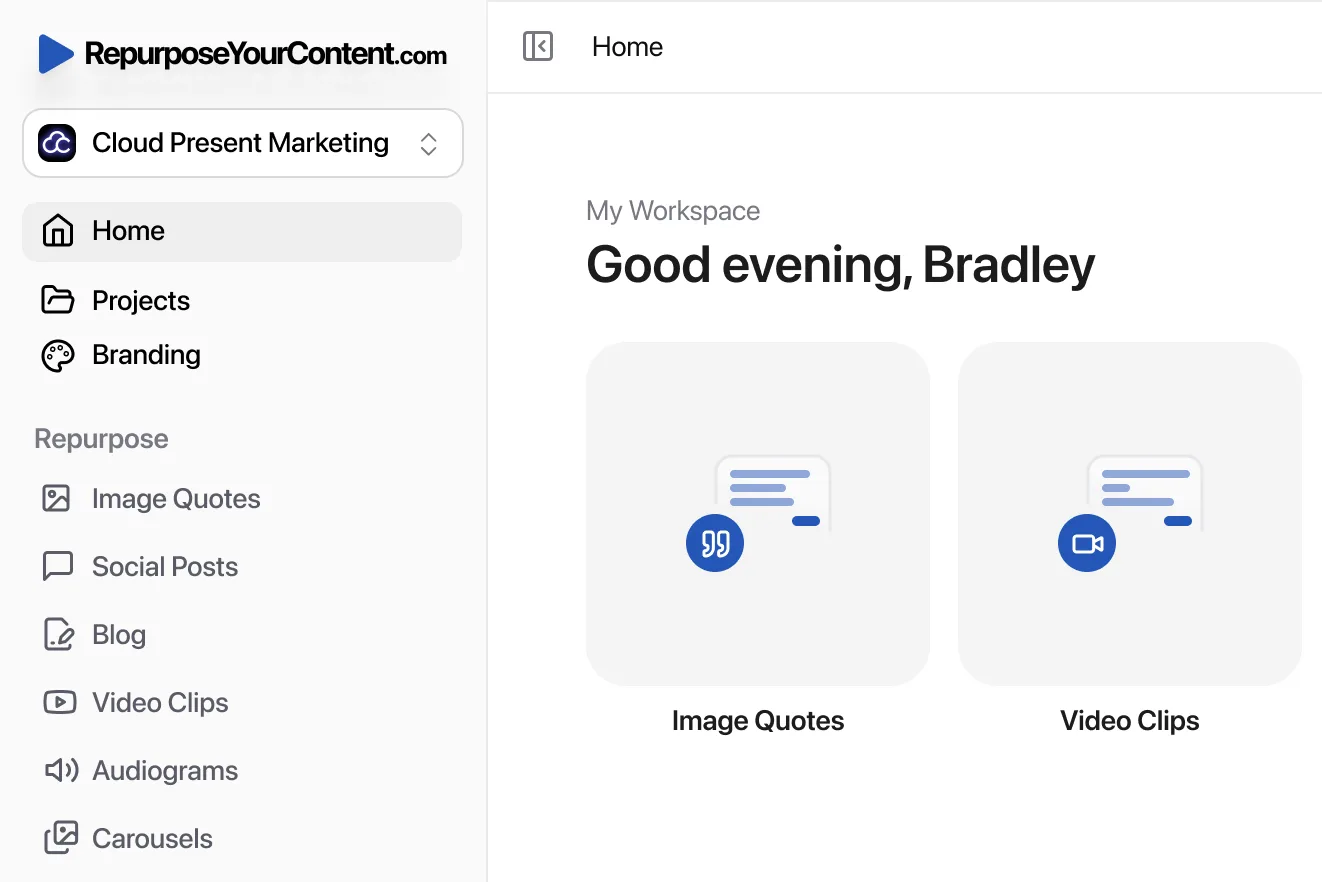
RepurposeYourContent is one done-for-you option. Clients send a podcast, interview, keynote, meeting, livestream, course, or other recording, and receive 20 to 30 ready-to-publish assets within 72 hours, including Shorts, LinkedIn posts, quote graphics, carousels, audiograms, and a blog post. The service uses the client's brand voice and includes unlimited revisions. Packages can work out to from $14 per finished asset, depending on the plan and delivery volume.
The broader decision framework appears in this comparison of a content repurposing agency versus DIY tools.
Measuring Shorts Performance and Long-Form Conversion
Views are useful for distribution. They aren't enough to judge whether a Short supports a YouTube channel.
The central question is whether Shorts viewers move into the long-form library. Track the related-video click-through rate in YouTube Studio, then compare those viewers with subscriber activity and long-form watch behavior.
Retention needs its own review. YouTube Studio provides stayed-to-watch versus swiped-away behavior, average view duration, and average percentage viewed. The calculation is:
APV = (Average View Duration / Video Length) × 100
Independent benchmark summaries often place strong Shorts performance around 70% or higher average percentage viewed, with 80% or higher described as exceptional. The first three seconds remain the critical retention point, and many creators target 70% to 80% or higher retention there (Shorts retention benchmarks).
| Metric | Where to Find It | Healthy Benchmark | Red Flag |
|---|---|---|---|
| Stayed to watch versus swiped away | YouTube Studio audience retention | Favorable stayed-to-watch behavior | Fast swipes at the opening |
| Average percentage viewed | YouTube Studio audience retention | Around 70% or higher is strong | Early drop-off |
| Related-video click-through | Short analytics and linked video data | No universal public benchmark | Views without downstream activity |
| Subscribers from Shorts | Advanced Mode analytics | Compare against the channel's own long-form baseline | Subscribers who never watch longer videos |
| Long-form traffic from Shorts | Video reach and traffic sources | Clear contribution from linked Shorts | No measurable source movement |
A good Shorts-to-long-form ratio isn't a universal percentage. It depends on the channel's goal, topic, audience intent, and call to action. A discovery channel may prioritize reach, while a course creator, consultant, or B2B YouTuber may prioritize qualified viewers entering a deeper video.
Run a controlled publishing test around one source video. Publish a consistent group of linked Shorts, then compare related-video traffic, subscriber quality, and long-form watch time against the channel's normal pattern. If viewers watch the Short but ignore the source, change the clip strategy. Use open loops, unresolved tensions, and specific reasons to continue.
For a broader measurement framework, see this guide to content marketing ROI measurement.
A sustainable workflow gives each long-form recording a clear job. One 45-minute recording can become 30 assets, including Shorts and supporting text and visual content, without forcing the creator to edit every evening. The creator's time can stay focused on recording, audience development, and the next valuable idea.
If a YouTube recording is sitting unused, request a sample from RepurposeYourContent or book a call to discuss the workflow. Send one podcast, interview, keynote, sales call, livestream, course, or meeting recording, spend about 15 minutes on the handoff, and receive finished, on-brand content with a 72-hour turnaround guarantee, or you don't pay.
Tags: