How to Turn Customer Interviews Into Marketing Content
Learn a step-by-step workflow to turn customer interviews into marketing content. This guide covers prep, extraction, and distribution for 20+ assets per call.

Teams that repurpose a single customer interview often spend 10 to 16 hours on the full workflow, from cleanup to approvals to distribution. That is why so many strong calls die in a folder after one clipped quote or a rushed case study draft.
Customer interviews can produce 20 to 30 usable assets from one recording, but only if the process is built for marketing use from the start. That means getting consent before the call, capturing clear before-after-number detail during the interview, verifying the transcript, tagging proof points, editing clips, routing approvals, and packaging the final assets for both marketing and sales.
The opportunity is bigger than a formal case-study program. B2B marketing teams already have source material across onboarding calls, customer success reviews, win-loss interviews, implementation retrospectives, and renewal conversations. In practice, the customer's words usually outperform polished brand copy because they carry specifics your team would never write on its own.
The bottleneck is operations. One interview can easily turn into half a day of transcript cleanup, another few hours of quote selection and clipping, then several rounds of customer and internal approval. If the recording quality is poor, the transcript work gets slower fast. Teams that need a cleaner starting point should use an automatic video transcription workflow before they touch messaging.
Handled well, customer interviews become proof assets for demand gen and closing assets for sales. Handled casually, they become another content backlog item nobody has time to finish.
The Pre-Interview Checklist for Marketing-Ready Answers
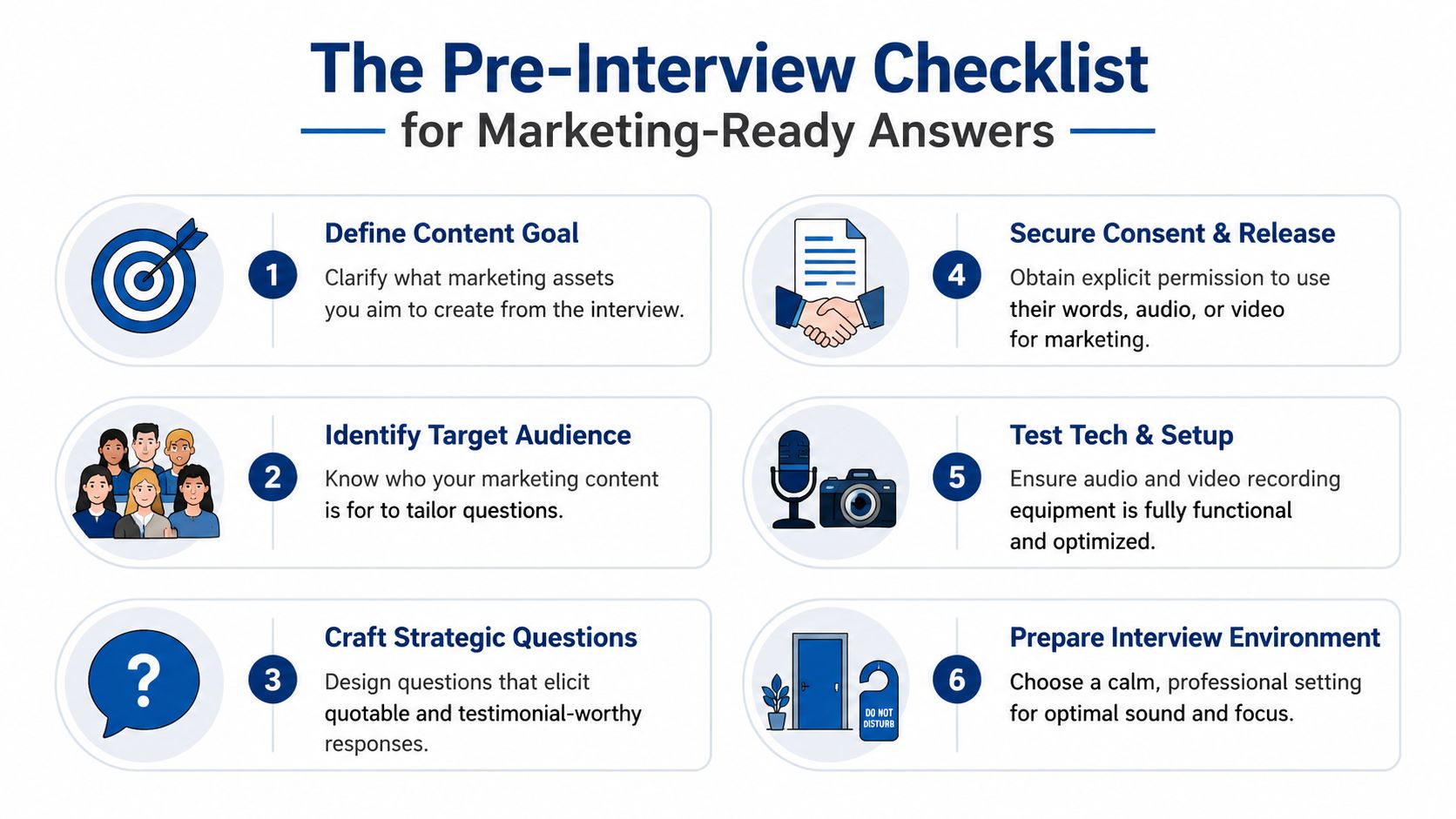
Interviews that produce publishable proof usually win or fail in the 24 hours before the call. The expensive mistake is treating prep like admin work. On a DIY workflow, weak prep adds hours later through transcript cleanup, approval chasing, quote rewrites, and legal review.
Start with permissions. If usage rights are vague, the interview may still be useful for internal research, but it will not move cleanly into ads, sales decks, clips, or a case study. That is where teams lose time. One unclear approval can stall four or five downstream assets and force a second customer review cycle.
Lock the approval workflow before recording
The practical order is compliance first, interview guide second, recording setup third. Creative teams often want to jump straight to questions. That is backwards if the goal is marketing-ready material.
Use a five-part approval checklist:
- Scoped consent: Get written approval before the call for the exact formats you plan to produce, such as short video clips, pull quotes, blog excerpts, social posts, sales one-pagers, and case studies.
- Verbatim review standard: Decide up front that any published quote will be checked against the transcript word for word.
- Sensitive detail screening: Flag customer names, internal process details, pricing terms, roadmap mentions, and anything else that may need removal or anonymizing.
- Final asset signoff: Send the customer the asset for approval, not a summary or a paraphrase.
- Removal process: Set a clear path for taking assets down later if the customer changes role, changes policy, or withdraws permission.
A simple rule saves a lot of rework. Ask for the full usage scope once, in writing, before the interview.
This prep work is not glamorous. It is what keeps one 45-minute call from turning into 3 extra hours of approvals and rewrite requests. Recording setup matters too. Teams that want cleaner transcripts should use an automatic video transcription workflow before they start editing quotes.
Ask for stories, not opinions
Marketing content needs a usable narrative. Opinion-heavy interviews produce vague praise, feature comments, and filler lines that sound nice on a call but die on the page.
A reliable interview guide pulls three things in the customer's own words:
The before-state
What was slow, risky, expensive, manual, or frustrating before the change?The trigger
What made the issue urgent enough to act?The measurable outcome
What changed after adoption in terms of time, cost, speed, conversion, handoffs, error rate, or team capacity?
Questions that consistently get better material include:
- Before-state question: “What was happening before this became a priority?”
- Trigger question: “What changed that made you act now?”
- Outcome question: “What is different now in practical terms?”
- Objection question: “What nearly stopped the project?”
- Language question: “How would you explain this problem to someone in your role?”
These prompts produce quotes with tension, detail, and proof. They also keep the conversation away from generic praise. Interviewers should avoid spending the call on pricing opinions, feature wish lists, or leading prompts that put brand language into the customer's mouth, as explained in this guide on practical customer interview skills.
Keep the customer talking
Usable quotes come from customer language, not interviewer framing. A good operating target is simple. The interviewer asks short prompts, then gets out of the way.
That sounds obvious, but many B2B marketing teams still run interviews like stakeholder meetings. They explain too much, confirm too often, and rush to the next question before the customer finishes the interesting part. The result is a transcript full of setup and very little proof.
Interview volume matters too. One strong call can give the team a few good lines, but pattern recognition takes repetition. For teams building messaging by segment, this customer interview guide is a useful reference for planning enough interviews to hear recurring themes instead of isolated anecdotes.
The operational trade-off is straightforward. DIY teams need to handle intake, scheduling, consent, prep, recording quality, transcript review, quote extraction, approvals, and packaging for distribution. Even before writing the final assets, that workflow can consume 10 to 16 hours across one well-run interview. That is why a done-for-you process often costs less than handling it in-house with a senior marketer and a crowded calendar.
From Raw Recording to Actionable Insights
A recording is not content. It's source material. The true work starts after the call ends.
Build the transcript first
Word-for-word transcription comes first because exact phrasing is the whole point. Notes won't capture tone, timing, hesitation, or the odd little phrases that make a quote believable.
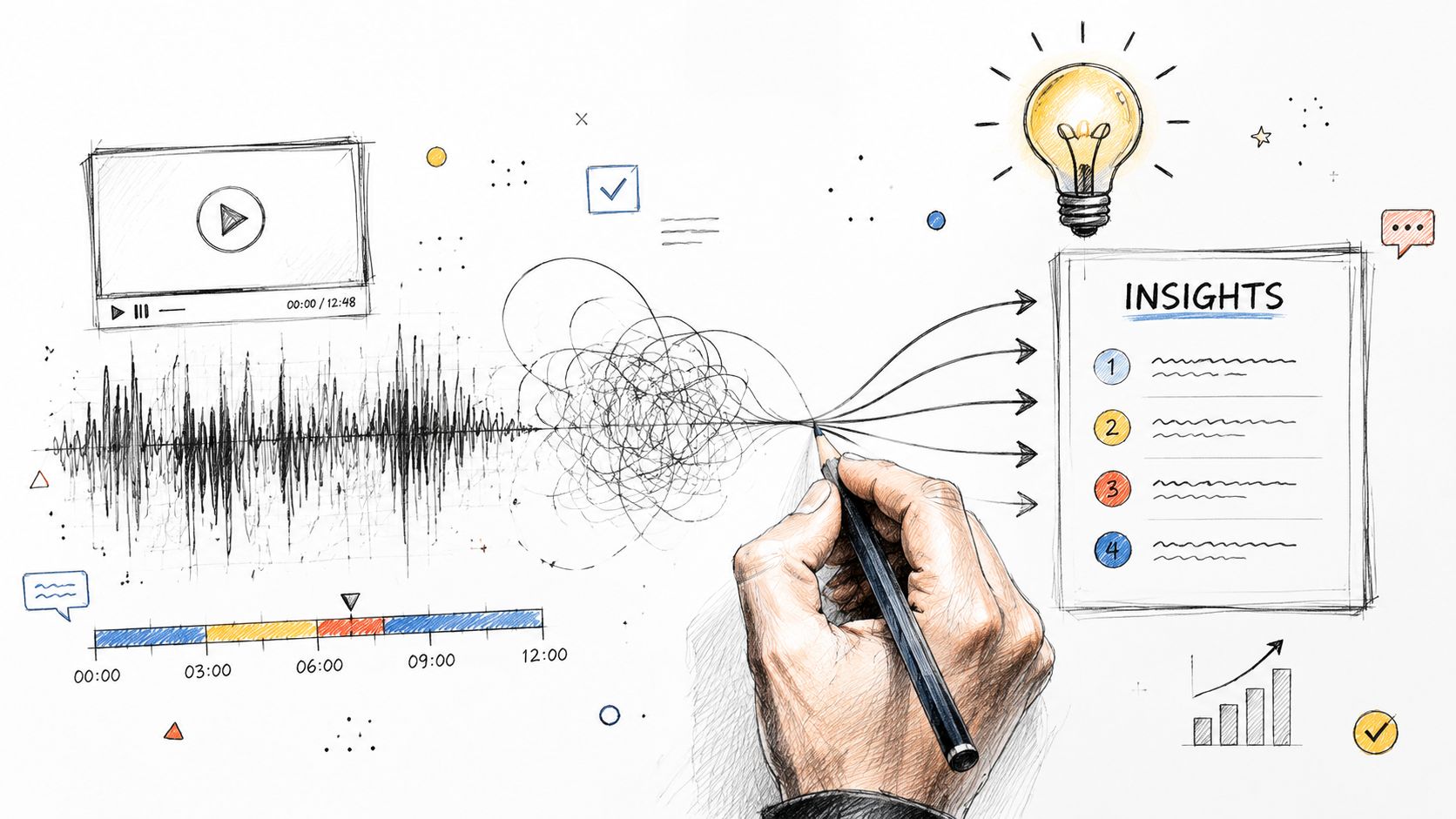
A typical manual workflow looks like this:
| Step | What happens | Realistic time |
|---|---|---|
| Transcript cleanup | Fix speaker labels, remove obvious errors, mark sensitive lines | 45 to 90 minutes |
| First pass review | Highlight quotes, objections, and turning points | 60 to 90 minutes |
| Theme tagging | Categorize sections for content use | 60 to 90 minutes |
| Clip selection | Mark exact in and out points for video or audio snippets | 2 to 3 hours |
That means a team can spend half a day before writing a single post.
Notes miss the exact wording that makes customer content persuasive. Record with permission, then work from the transcript.
For teams dealing with this manually, this quote extraction workflow is useful because the same clipping logic applies to interview recordings.
Tag for downstream use
Merely highlighting “good quotes” and stopping there isn't enough. Quotes need tags tied to actual content plays.
A practical tag set looks like this:
- Before-state pain for problem-aware posts and testimonial openers
- Objection for sales rebuttal snippets
- Value prop for landing page and ad copy
- The turn for clips and mini-story posts
- Quantified outcome for case studies and customer proof
- Surprise factor for hooks that stop a scroll
- Search phrase for terms prospects use
Here, “atomic research” gets built. One transcript becomes a library of small, reusable evidence. Sales can use it. Product can use it. Marketing can use it.
Validate patterns before publishing claims
A single quote can be memorable and still be an outlier. That's why tagging matters. It helps a team see which themes repeat across interviews and which ones don't.
Branch-based guidance is useful here: when 7 out of 10 interviewees share the same behavior, that's a significant pattern worth acting on, according to this article on turning one customer interview into multiple content pieces. That's a smarter threshold than treating one dramatic quote as strategy.
The trade-off is simple. Manual tagging is slow. But without it, a team publishes anecdotes and calls them positioning.
How to Turn Customer Interviews Into Marketing Content Assets
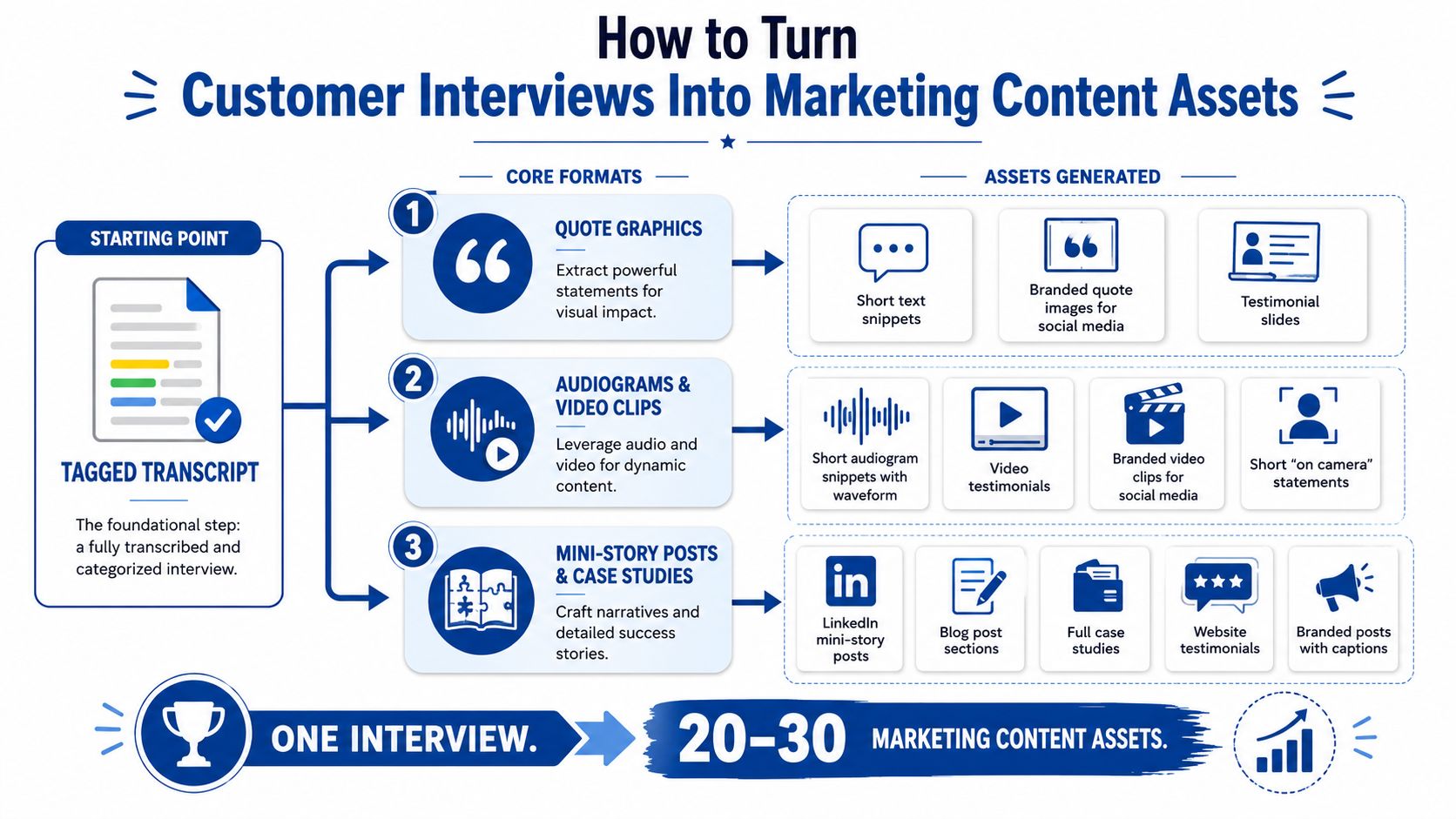
A single 30-minute customer interview usually creates 6 to 10 usable assets. Producing them in-house still takes another 4 to 6 hours after tagging, even with a clean transcript and clear approvals.
The work is not creative first. It is operational first. Someone has to pull the right quote, trim the clip, check brand usage rights, confirm title and company naming, write the post, build the sales version, and route it for approval. That is why DIY customer content often stalls after the transcript.
Start with the three assets that cover the most ground
Every strong interview should become three core assets before the team tries anything bigger.
1. Testimonial clip
Keep it to 30 to 60 seconds. The best segment is usually the turn. What changed, why they acted, and what happened after. Add captions, light branding, and a clean intro card. Leave the delivery natural. Prospects trust speech that sounds like a real customer, not a polished script.
2. Quote graphic
Use one sharp line with clear attribution. Full name, title, and company are part of the proof. If legal or procurement blocks public attribution, skip the graphic and route that quote into sales-only material.
3. Mini-story LinkedIn post
Write a short narrative in the customer's language. Aim for 120 to 180 words. The structure is simple: before-state, buying trigger, result. If the post reads like vendor praise, rewrite it until the problem is specific enough that a prospect can recognize themselves in it.
A practical benchmark is this: if sales can drop one of those assets into a live deal thread the same week, the interview produced real marketing value.
For teams building that workflow from recorded conversations, this process for repurposing expert interviews into content maps closely to customer interviews too.
Build the assets sales and pipeline teams will actually use
After the first three, the next layer should support active deals and conversion pages. Meeting these demands begins to significantly increase the workload for an internal team.
The highest-return formats are usually:
- Case study page blocks: before-state, implementation friction, time-to-value, outcome
- Objection clips: 20 to 40 second answers on price, rollout effort, internal buy-in, or switching risk
- Deck-ready proof slides: one quote, one number, one use case
- Voice-of-customer email copy: customer phrasing reused in follow-up emails and nurture
- Before-and-after story posts: one problem, one decision point, one result
This is also where phrase fidelity matters. The wording that shows up in interviews is often closer to how buyers explain the problem internally than anything a brand team writes from scratch. Good marketers do not smooth that language out too early. They keep the sharp edges that make the claim believable.
M1 Project's guide on user interviews for marketers makes the same point from a conversion angle. Specific user phrasing often improves copy because it matches the buyer's own logic.
Use a monthly production workflow, not ad hoc repurposing
Ad hoc repurposing wastes time because the team recreates the process every month. A repeatable production run is faster and easier to manage.
A workable monthly cycle looks like this:
Choose one pipeline goal
Example: stronger proof for onboarding speed or easier internal adoption.Select one customer who fits that story
Prioritize recent wins with clean outcomes and approved brand usage.Pull one master clip and one transcript
Budget about 45 minutes for clip review and transcript cleanup.Draft the three core assets
Budget 90 minutes to 2 hours for the clip, quote graphic, and LinkedIn post.Create two sales assets from the same source
Usually one objection snippet and one slide. Budget 60 to 90 minutes.Route approvals and publish
Legal, customer success, and the customer contact can easily add 3 to 5 business days if the process is not already set up.
That is the calculation. One interview can create a strong asset pack, but the full path from recording to approved distribution often costs 10 to 16 hours across marketing, design, customer success, and sales. That is why done-for-you execution is attractive to lean B2B teams. The value is not only better editing. It is the removal of production drag.
This video gives a useful visual on the kind of multi-format output strong interviews can support.
For teams focused specifically on testimonial content, this guide to repurposing customer testimonials is a practical companion.
A Distribution Plan That Actually Converts
A strong customer interview usually has two distribution paths. Public promotion builds reach. Sales distribution drives pipeline.
B2B teams often spend the bulk of their time polishing the LinkedIn post, then leave reps to hunt through folders for proof they can use in live deals. That choice weakens the return on the interview. The better workflow is to package every approved asset for one-to-many distribution and one-to-one sales use at the same time.
Sales distribution should be built first
The highest-value use case is still a rep sending a relevant customer clip, quote, or slide to a prospect who is working through the same problem. Timing matters more than polish here. A 30-second proof clip in a follow-up email can do more than a well-written social post because it answers a live objection inside an active deal.
That only works if the library is usable in under a minute.
Sort customer interview assets by the filters sales needs:
- Problem: slow approvals, weak content output, too much internal production work
- Objection: price, rollout effort, timing, stakeholder buy-in
- Stage: first call follow-up, late-stage validation, renewal support
- Format: short clip, quote card, email snippet, deck slide
If a rep has to watch five videos to find one proof point, the asset will not get used. In practice, each item needs a clear filename, a one-line summary, and a note on where it fits in the sales cycle.
Teams that want a tighter operating model can apply these content distribution strategies for repurposed content to customer interviews as well.
LinkedIn works best for the public layer
For public distribution, LinkedIn usually gives B2B teams the cleanest fit. Customer stories can carry detail, show real outcomes, and still feel native to the feed.
The post structure is simple:
- open with the customer's starting point
- show the change in one or two lines
- end with the specific result
- tag the customer and company if approval is already in place
- attach the clip or quote graphic as the main asset
The quality bar is different on social. If the customer barely spoke in the original interview, the post will read like marketing copy with a customer name attached. Public customer content works best when it sounds like the customer said it first, because they did.
Keep strong proof private when it should stay private
Some of the best material should never go on LinkedIn. Pricing comments, implementation details, internal evaluation criteria, and blunt competitive comparisons usually perform better in sales decks, battlecards, renewal narratives, and one-to-one follow-up emails.
That is where distribution discipline matters. One interview can support public awareness, outbound follow-up, late-stage deal support, and customer expansion, but each asset needs a defined lane, owner, and approval status.
For a deeper operational model, this guide to sales enablement content from recordings maps closely to customer interview distribution.
The Done-For-You Alternative
A single customer interview can produce strong marketing and sales assets. It can also disappear into a folder because nobody has half a day to process it.
For an in-house team, the work is not just writing. It starts with transcript cleanup and quote checking, then moves into clip selection, copy drafting, design, approvals, revision rounds, and handoff to the people who will publish or use the assets in sales. In practice, one recording often turns into a 10 to 16 hour job across marketing, design, and stakeholder review.
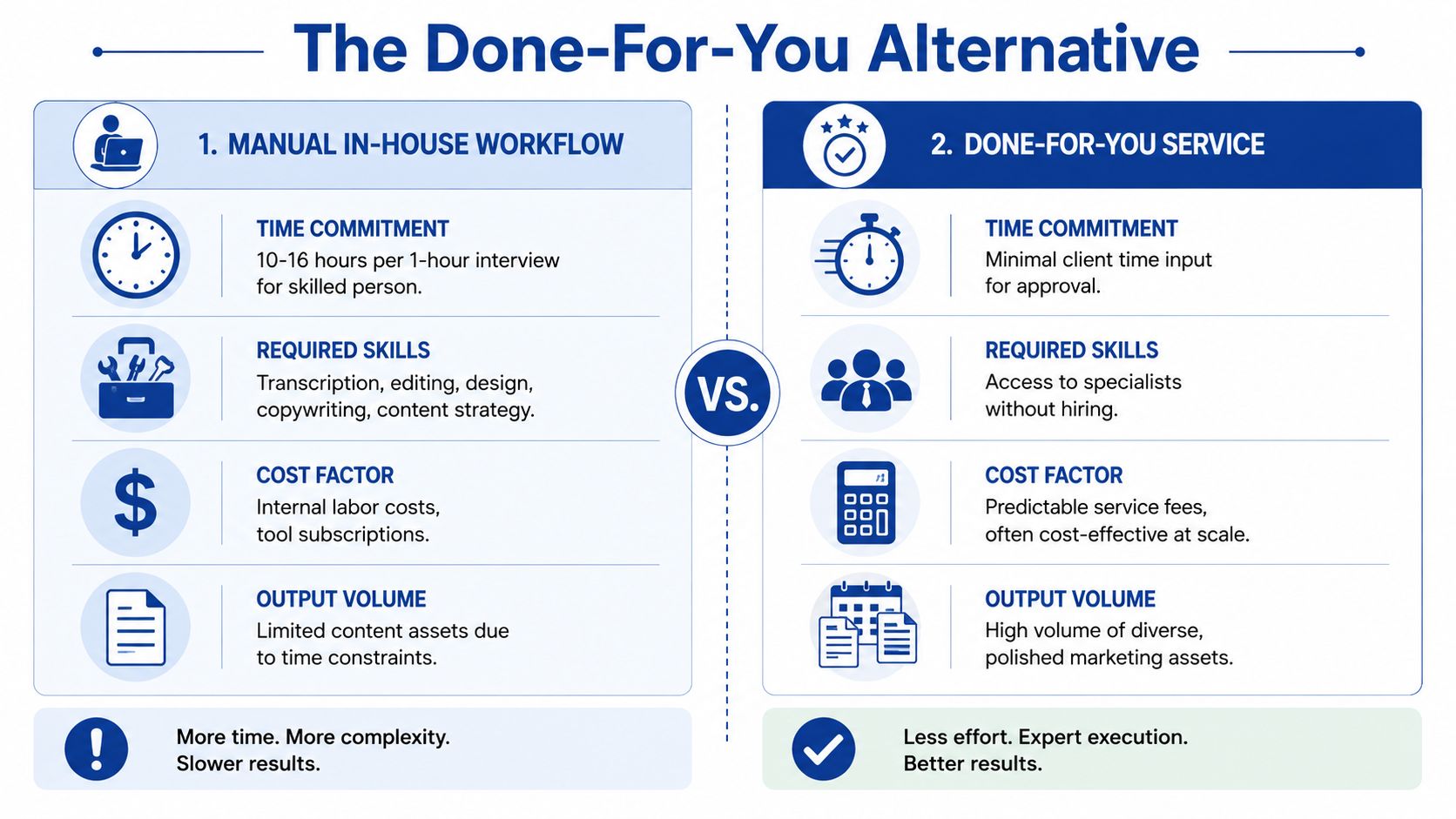
What the trade-off looks like
| Manual in-house | Done-for-you service |
|---|---|
| One skilled person spends most of a day or more per recording | The client sends one recording and spends about 15 minutes |
| Requires transcription, editing, design, copywriting, and QA | Finished assets come back ready to publish |
| Output usually shrinks because the team runs out of time | One recording can become 20 to 30 assets |
| Approvals and revisions create internal drag | Unlimited revisions keep the output usable |
The hidden cost is context switching. A marketer starts with good intent, gets pulled into campaign work, and the interview sits untouched for a week. Then legal needs a quote checked. Then sales asks for a clip from the same call. DIY can work, but it works best when a team already has spare production capacity, clear approvals, and someone who owns the workflow end to end.
That is why a done-for-you model fits time-poor B2B teams. The bottleneck is usually post-production.
What the alternative should deliver
The service model should be simple. You send one recording. That can be a customer interview, sales call, webinar, podcast, keynote, or internal meeting. You get finished assets back, sorted by channel and use case, with the customer language preserved and the proof points cleaned up for marketing.
A strong package should include:
- Video clips
- LinkedIn posts
- Quote graphics
- Carousels
- Audiograms
- A blog post
The operational standard matters more than the pitch. A useful offer gives the team a low-lift handoff, fast turnaround, brand-voice matching, and revision coverage so the assets do not die in review. If your source material includes customer calls and internal recordings, this guide to repurposing meeting recordings for marketing shows the kind of inputs that can feed the same workflow.
The benchmark to look for is clear: 20 to 30 ready-to-publish assets in 72 hours, with client time held to about 15 minutes and unlimited revisions built in. A 45-minute recording can become 30 assets. At scale, pricing can work out from $14 per finished asset. The strongest offers also include a 72-hour turnaround guarantee or the client doesn't pay.
For teams with a backlog of interviews, that is usually a better use of budget than forcing the work into an already full in-house schedule.
Start Mining Your Customer Calls
Customer interviews already contain the raw material for better marketing. They contain the pain language, the objections, the turning points, and the outcome phrasing that prospects trust.
The hard part isn't finding source material. It's building a workflow that protects the customer relationship and still gets content shipped. That starts with consent scoped at recording time. Then transcript verification. Then tagging. Then asset production. Then sales-first distribution.
When a team does that well, one recorded conversation can support public proof, private sales enablement, and stronger conversion copy. The customer ends up saying what the brand has been trying to say, only better.
For teams sitting on unused calls, interviews, and meeting recordings, this guide on repurposing meeting recordings for marketing is a good next step.
If there's already a folder full of customer interviews and no time to process them, book a call with RepurposeYourContent or request a sample pack. Send one recording and get 20 to 30 ready-to-publish assets in 72 hours. That includes video clips, LinkedIn posts, quote graphics, carousels, audiograms, and a blog post, all in brand voice, with unlimited revisions.
Tags: