Turn Podcast Into LinkedIn Posts: Boost Your Reach
Learn the workflow to turn podcast into LinkedIn posts. Extract insights, create clips, and use proven templates to grow your audience on LinkedIn.

To turn a podcast into LinkedIn posts, the work starts in the transcript. The fastest approach is to extract stand-alone insights and quotes, then shape them into proven formats like contrarian text posts, carousels, and short clips. One 45-minute recording can yield 3 to 7 clips when transcript semantics are used to find the strongest moments, which is enough material for a full week of LinkedIn publishing.
Most advice on this topic is too shallow. It tells teams to “promote the episode” with a teaser, a link, and maybe one clip. That's not a content system. That's a one-post habit that leaves most of the episode unused.
A strong podcast already contains the raw material for authority content. The host has opinions. The guest has stories. The conversation has tension. The mistake is treating the episode as the asset. On LinkedIn, the asset is the extractable idea.
For B2B podcast owners and the marketers writing on their behalf, that shift matters. A weekly show can solve the hardest LinkedIn problem: having something authentic to say five days a week. The challenge isn't idea generation. It's extraction, editing, and formatting.
Your Podcast Is a LinkedIn Content Engine
A weekly podcast already solves the problem most LinkedIn teams struggle with. It gives the host a steady stream of real opinions, examples, and language patterns. That means the content doesn't need to be invented from scratch. It needs to be pulled apart properly.
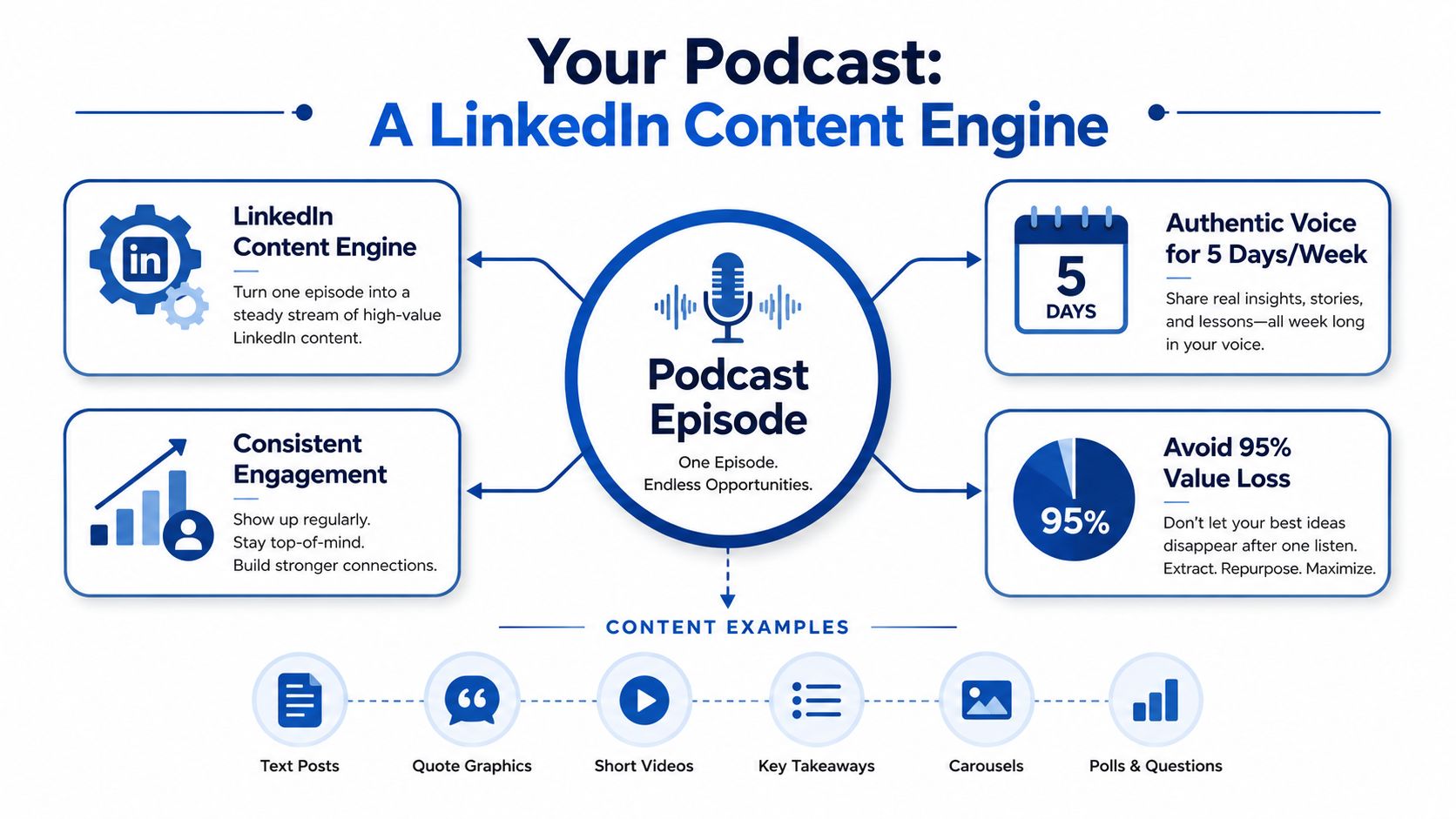
LinkedIn is built for this distribution model. It has more than 1 billion members globally, and Company or Showcase Pages can turn a podcast RSS feed into automated posts, which makes the platform structurally suited to repurposing at scale, as outlined in this guide to sharing a podcast RSS feed on LinkedIn Pages.
Why podcast episodes outperform blank-page content
Blank-page LinkedIn writing usually sounds generic because it starts with a topic, not a real conversation. Podcast content starts with spoken expertise. That changes the texture of the post.
A good episode gives the writer several things at once:
- Real language: The host has already said the idea out loud.
- Built-in tension: Guests often disagree, qualify, or challenge assumptions.
- Specificity: Spoken examples are usually sharper than post-first writing.
That's why episode-derived posts often read with more conviction. They come from something said under pressure, not something assembled to fill a calendar slot.
The job isn't to advertise the podcast. The job is to publish the strongest ideas inside it.
The strategic shift
Most hosts publish once and move on. That's the waste. The better model is to treat every episode as a source file for the rest of the week's LinkedIn output.
That's also how a show becomes part of a wider LinkedIn content strategy for B2B in 2026. The recording becomes the origin point. The posts become the distribution layer. The episode link becomes secondary.
The Manual Workflow and Its Real Cost
Turning a podcast into LinkedIn posts manually is possible. It's also slower and more expensive than commonly assumed.
The hard part isn't clipping software. It's judgment. Someone has to find what matters, shape it into post-worthy angles, and edit it so it reads like a human said it on purpose.
What manual repurposing actually involves
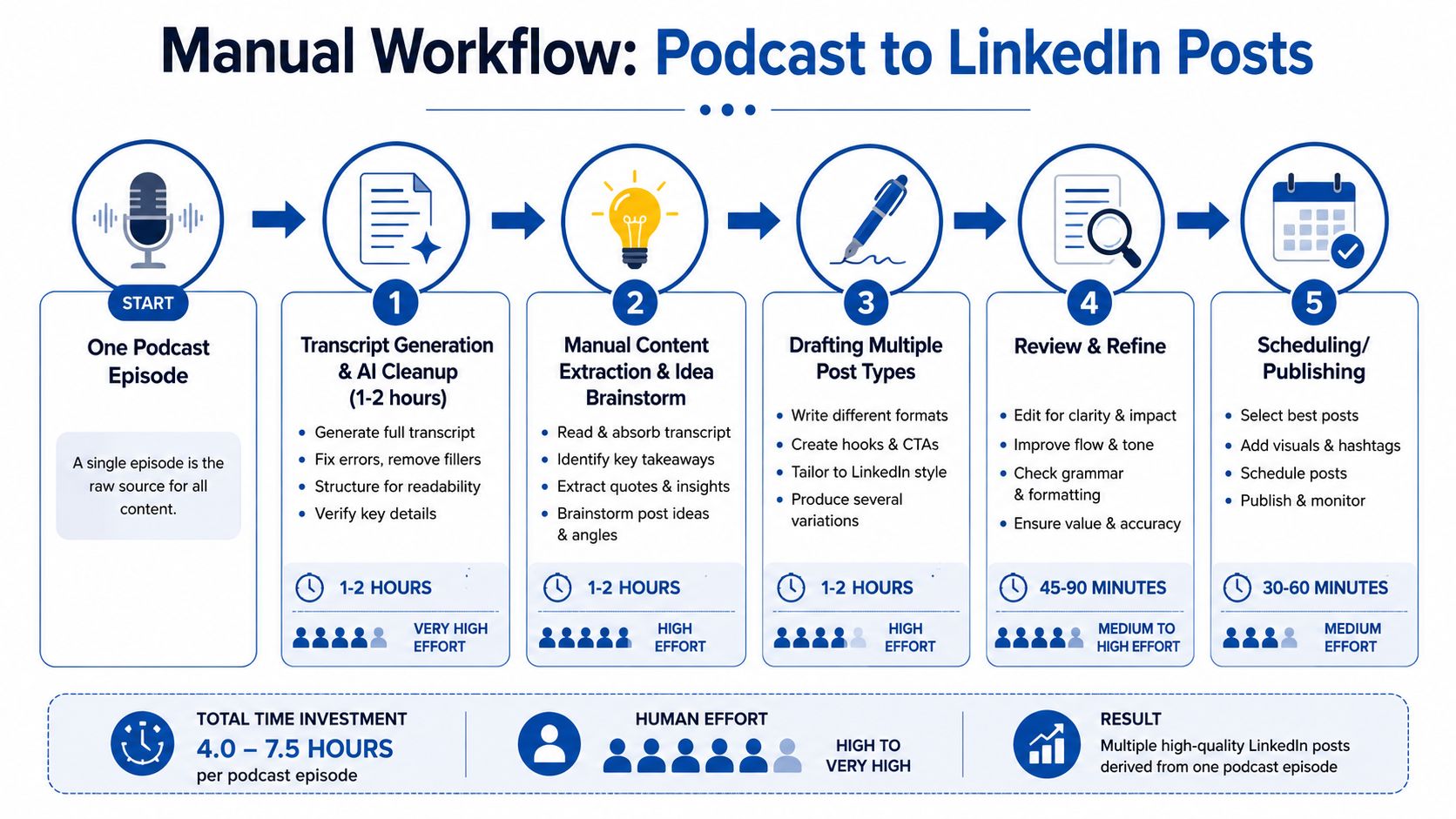
For one episode, the workflow usually looks like this:
Transcript cleanup
Raw transcripts are messy. Spoken language has filler words, interruptions, and broken sentences. Cleaning that enough to work from usually takes 1 to 2 hours.Transcript review and extraction
Someone has to read the whole conversation and mark claims, stories, quotes, and moments with tension. That's usually about 1 hour if the person knows what they're looking for.Clip finding and editing
Many teams underestimate the work involved. Finding timestamps, cutting clean starts and stops, formatting for LinkedIn, and adding captions often takes 2 to 3 hours per recording for a handful of clips.Writing the posts
Turning spoken points into text posts that feel native to LinkedIn takes another 1 to 2 hours.Design work
Quote graphics and carousels don't appear on their own. Even simple visual assets usually add about 2 hours.
That's why DIY often turns into a content graveyard. The episode is recorded. The post-production backlog piles up. Then nothing ships.
What works and what slows teams down
The strongest extraction workflow uses AI to analyze transcript semantics, not just timestamps, so it can flag “bold statements” and “clear insights.” In that model, a 45-minute episode can yield 3 to 7 clips, while manual timestamp hunting typically finds 1 to 2. Failing to reformat clips to vertical 9:16 can reduce mobile engagement by 30 to 40%, based on the implementation benchmarks in the verified data provided for this article.
Practical rule: If the team is scrubbing a timeline from start to finish to “see what sounds good,” the workflow is already too slow.
There's another drag on manual workflows. Generic post writing. When the writer didn't hear the conversation closely, the final copy turns into episode summary text. It says what was discussed, but not what was said.
A realistic manual example
A marketer receives a new interview recording on Monday morning.
- Step 1: Generate and clean the transcript before lunch.
- Step 2: Review the transcript and highlight usable moments in the afternoon.
- Step 3: Cut clips and caption them the next day.
- Step 4: Draft text posts and a carousel after that.
- Step 5: Revise everything once the host says, “This doesn't sound like me.”
That's why teams looking for a repeatable content repurposing workflow for small teams usually hit the same conclusion. DIY can work. It just costs far more skilled time than the first pass suggests.
Six Proven Post Patterns from a Single Episode
Guesswork wastes good recordings. Patterns solve that. The fastest way to turn podcast into LinkedIn posts is to extract the conversation into repeatable post types that work even when the reader never listens to the full episode.
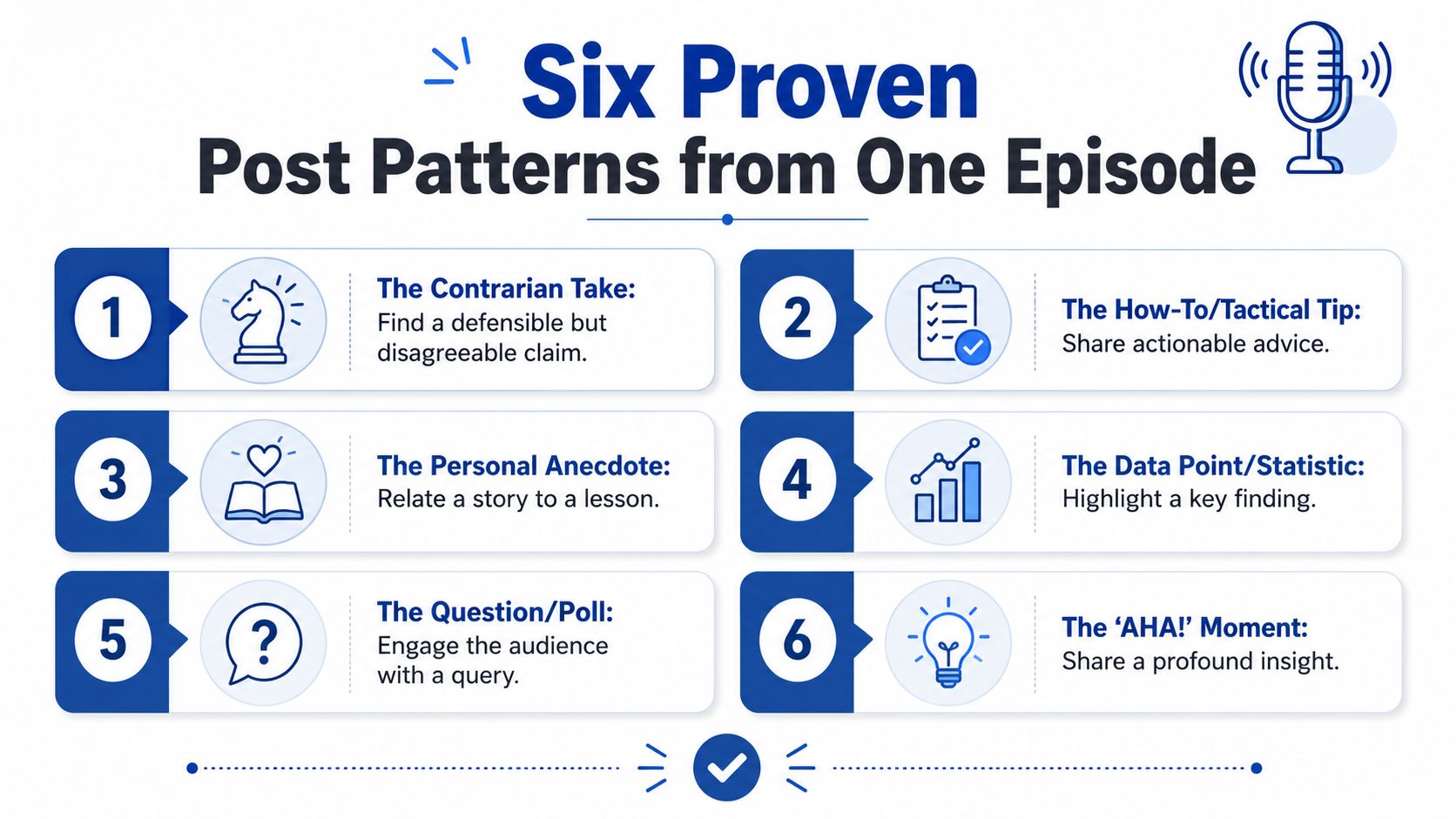
Operationally, one long recording can be atomized into multiple assets. A single episode can yield 3 to 7 clips, usually formatted in vertical 9:16 or square 1:1, which can turn one recording into a full week of posts, as described in this podcast-to-LinkedIn shorts workflow.
1. The insight breakdown
This is the most reliable format for B2B expertise. It takes one core claim from the episode and supports it with a few tight points.
Formula
- Claim
- Three supporting points
- Punchline
Worked example
Claim: Most companies start content too late in the sales process.
Supporting points:
- They publish feature updates instead of buyer problems.
- They rely on campaign bursts, not a weekly point of view.
- Their subject experts already talk clearly in meetings and recordings.
Punchline: The issue usually isn't expertise. It's extraction.
This post works because it reads like a point of view, not a recap.
2. The guest quote post
A LinkedIn-friendly quote must survive on its own. If it needs setup, it isn't the quote yet. Scan the transcript for claims, not context.
A strong public example appears on the Shopify repurposing example page: “You do not start by building a platform. You start by solving a real problem.” It stands alone, and it still sounds spoken.
Read the quote to someone who hasn't heard the episode. If they need backstory, keep looking.
Worked example
Post opening:
You do not start by building a platform.
You start by solving a real problem.
Follow with two short lines on why that matters, then tag the guest and their company. Guest quote posts often travel further because the guest has a reason to reshare them.
3. The contrarian take
This one drives comments when done properly. The structure is simple: contrarian claim, short proof, honest open end.
What matters most is the first line. It shouldn't introduce the episode. It should create friction.
Worked example
First line: The best clip is rarely the main point.
Support:
→ The obvious soundbite is usually too broad.
→ The strongest post often comes from a sentence with tension.
→ Readers engage with disagreement, not with tidy summaries.
Ending: The moments people argue with are often the moments they remember.
That first line earns the “see more” click because it contradicts what the reader expects.
Here's the embedded example video mentioned in the brief:
4. The story post
Most episodes contain at least one short narrative. A mistake. A turning point. A client moment. A decision that changed the company. Those stories often outperform abstract advice because they give readers something concrete to follow.
Worked example
Opening: A founder spent months refining a product before speaking to buyers.
Middle: Early feedback showed the market wanted something narrower.
End lesson: Speed didn't fix the issue. Listening did.
This format needs a light edit, not heavy polish. Keep the spoken cadence where possible.
5. The carousel
When the episode includes a framework, sequence, or list, turn it into a carousel. This works especially well for interviews with operators who explain process clearly.
A simple format might look like this:
| Slide | Content |
|---|---|
| 1 | Bold claim or tension line |
| 2 | The problem |
| 3 | Point one |
| 4 | Point two |
| 5 | Point three |
| 6 | Sharp closing takeaway |
Carousels work best when each slide carries one idea. Don't cram transcript language onto design slides. For structure ideas, this guide on how to create LinkedIn carousels is the right companion.
6. The clip post
This is the obvious one, but it is still often handled badly. The clip should be short, visually reformatted for the feed, and paired with copy that adds context instead of duplicating what's already in captions.
Worked example
- Clip: A guest delivers a sharp claim in under ninety seconds.
- Caption line one: Many teams believe they need more content.
- Caption line two: They usually need better extraction from what they already record.
The clip isn't the post by itself. The post is the clip plus the framing.
Write in the Host's Voice Not a Bot's
The fastest way to ruin episode-derived content is to make it sound like meeting notes. LinkedIn posts from podcasts should read like the host talking clearly, not like software summarizing a file.
Clean spoken language without flattening it
Spoken language is messy by nature. People restart thoughts. They hedge. They add side roads. Cleaning that up is necessary. Rewriting it into polished corporate copy is where the damage happens.
The right edit is light:
- Remove filler: Cut “um,” “you know,” and repeated starts.
- Keep cadence: Preserve the host's phrasing where it carries personality.
- Tighten intent: Edit toward the sentence the speaker meant to say.
A spoken line can become sharper in text without becoming fake. The point is to preserve the speaker's word choices and rhythm while removing the friction that speech carries.
The quote test
A useful filter is simple. A quote should survive with zero setup. If a reader needs the previous two minutes of conversation to understand it, that line belongs inside a longer post, not as a standalone quote card.
A good extracted quote feels spoken, complete, and slightly dangerous.
That's also why generic AI summaries underperform. They flatten edge, remove cadence, and smooth away disagreement. The result is accurate enough to be boring.
Writers handling this well usually work from transcript first, then compare against the original audio before finalizing. That extra pass protects tone. It also keeps the post from drifting into polished language the host would never use. For teams evaluating that workflow, this breakdown of how AI content repurposing works is useful context.
The Done-for-You Alternative
The manual route works. It's just slow, skill-heavy, and hard to sustain every week.
The practical alternative is simple. Send one recording. Get the finished content back without spending days on extraction, editing, writing, and design.
What the service model changes
Instead of managing transcript cleanup, clip selection, post drafting, visual design, and revisions internally, the client sends over one source file. That can be a podcast, webinar, keynote, interview, or meeting recording.
Within 72 hours, the delivery includes 20 to 30 ready-to-publish assets:
- Video clips
- LinkedIn posts
- Quote graphics
- Carousels
- Audiograms
- A blog post
The copy is written by humans in the client's brand voice. Assets are designed to match the brand kit. Revisions are unlimited. The client's time investment is about 15 minutes.
Why this is cheaper than it looks
When evaluating done-for-you content, a common comparison is made against software pricing. That's the wrong comparison. A more apt comparison is against internal labor, delayed publishing, and the opportunity cost of recordings that never get reused.
A single 45-minute recording becomes 30 assets under this model. Pricing starts from $14 per finished asset. There's also a 72-hour turnaround guarantee, or the client doesn't pay.
That's why the service behaves more like a fractional content team than a freelance editing task. The recording already exists. The value comes from turning it into a consistent publishing pipeline.
Distribution and Measurement That Matters
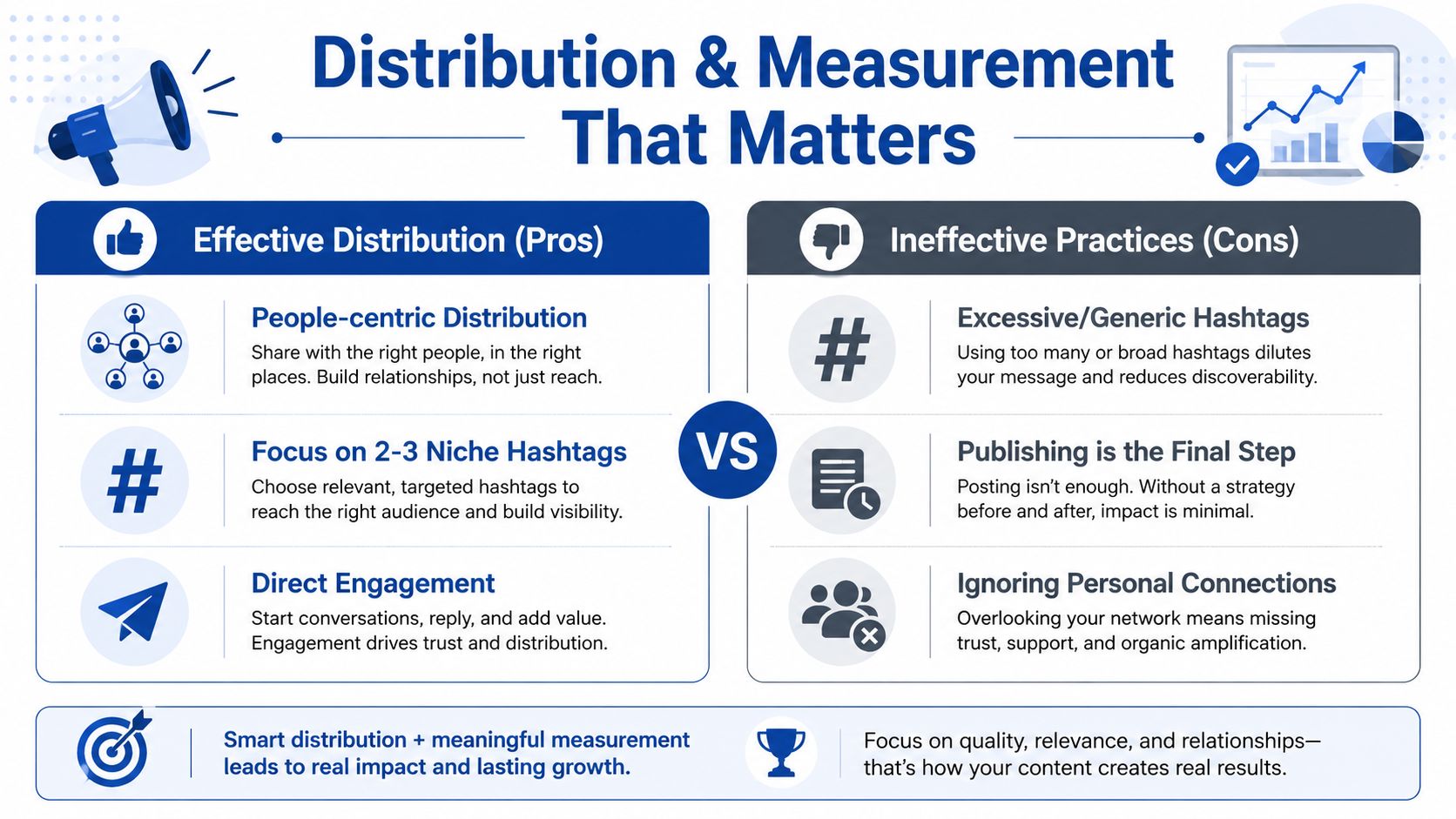
A strong post can still underperform if distribution is weak. On LinkedIn, many organizations overfocus on hashtags and underfocus on people.
People tags beat hashtag walls
Hashtags now sit near the bottom of the priority list. If used at all, keep them limited to a few niche terms. A wall of broad tags makes a post look automated and desperate.
What consistently matters more is tagging the right people:
- Tag the guest: They're directly relevant and likely to engage.
- Tag the company: If the episode discusses the business, the tag adds context.
- Stay precise: Courtesy-tagging irrelevant people trains them to ignore future mentions.
That's especially important for guest episodes. A notified guest often comments or reshares. That exposes the post to their network, which is a much better distribution mechanic than decorative hashtags.
What to measure
Likes are pleasant but shallow. Better signals sit earlier in the reader journey.
A better scorecard includes:
| Signal | Why it matters |
|---|---|
| See more clicks | The opening line created enough curiosity to continue |
| Comments | The post triggered response, disagreement, or added perspective |
| Guest engagement | The tagged participant helped distribution |
| Saves and shares | The post had enough utility or resonance to keep moving |
Publishing isn't the finish line. Distribution starts after the post goes live.
For teams tightening their reporting, this guide to content marketing ROI measurement gives a useful framework for looking beyond vanity signals.
A weekly podcast can absolutely become a LinkedIn content engine. The episodes already contain the raw material. What matters is extracting the right moments, shaping them into native post formats, and distributing them through people, not noise.
If the goal is to stop treating podcast episodes like one-and-done uploads, book a call with RepurposeYourContent or request a sample package. Send one recording. Get back a month of ready-to-publish content in 72 hours.
Tags: