Video Podcast Repurposing Service: A Complete Guide
Find the right video podcast repurposing service. Learn how they work, what you get (clips, articles, posts), pricing, and how to choose the best partner.

YouTube reported 1 billion monthly podcast viewers in early 2025, and about 27% of U.S. consumers were watching video podcasts weekly. A video podcast repurposing service turns one long-form episode into 20 to 30+ ready-to-publish assets, usually within 72 hours.
That shift matters because the episode itself is only the raw material. The value comes from turning one recording into clips, posts, articles, and platform-native assets that keep working after publishing day. If you've ever finished a great interview and then watched it disappear after one upload, the problem isn't content quality. It's distribution.
Why Top Podcasters Turn One Episode into 30 Assets
A single recording can carry a show for days, not minutes. That's the appeal of a video podcast repurposing service. It takes one long-form episode and turns it into a stack of assets that fit how people consume content on YouTube, LinkedIn, and short-form feeds.
YouTube's scale makes that hard to ignore. The platform reported 1 billion monthly podcast viewers in early 2025, and about 27% of U.S. consumers were watching video podcasts weekly, which makes short clips and highlight reels a direct response to audience behavior rather than a gimmick. The broader market story matches that shift too, with repurposing now looking like a distinct category instead of an occasional editing task.
For podcasters, founders, and B2B teams, the business case is simple. You already paid for the guest booking, prep, recording, and editing. Repurposing keeps that investment alive longer and gives every strong quote a second, third, and fourth chance to be discovered. If you're mapping a broader distribution plan, it also helps to transform content for social media instead of treating each post as a one-off.
Practical rule: If one episode can't feed your feed, your blog, and your email for a week, too much of the recording is going unused.
The simplest internal test is this, does the episode create enough useful moments to become multiple formats. If yes, a repurposing service turns that single source into a repeatable system. If not, the problem is usually the content angle, not the service model. For a deeper framework on turning one source into many formats, see this breakdown of content multiplication.
How a Video Podcast Repurposing Service Works
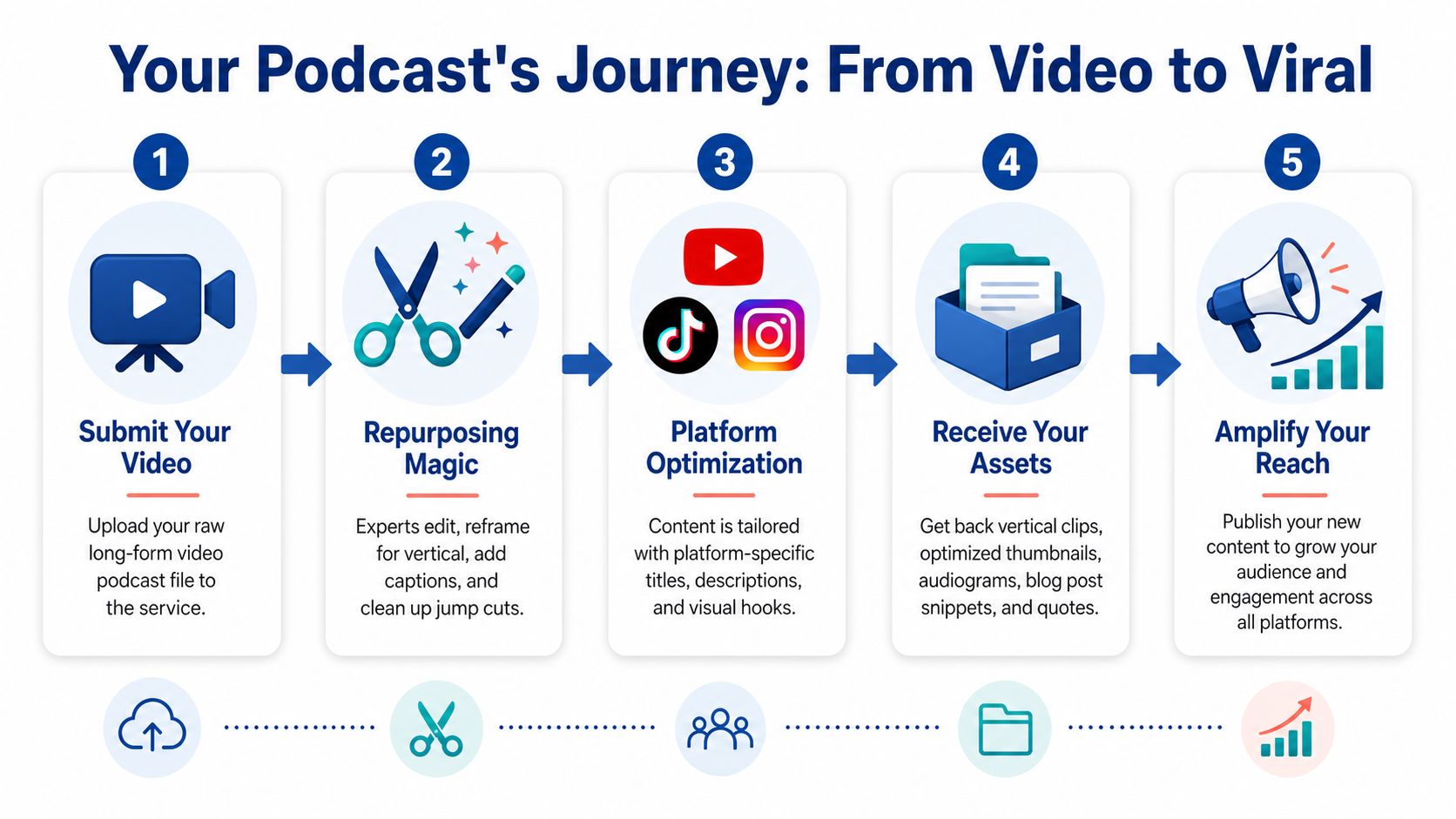
A strong workflow starts with one recording and ends with platform-ready assets. The work moves from transcript review to moment selection to format-specific delivery, with human review at each stage so the final clips, posts, and edits feel native to each channel.
Step 1, Submit the recording
The client sends one long-form video file, usually a podcast, interview, keynote, meeting, or livestream. No trimming is needed upfront. The service receives the raw recording, checks the source, and works from the full conversation so useful material is not cut away too early.
Step 2, Find the moments worth keeping
The recording gets transcribed, then high-value segments are identified. That can mean strong hooks, clear opinions, crisp explanations, or good quote moments. The technical pipeline matters here because the service has to identify the right moments before it can shape them for shorts, posts, or articles.
Step 3, Rebuild each asset for the platform
Video work differs from audio work. The editor reframes for vertical layouts, cleans jump cuts, adds captions, and prepares platform-specific titles and descriptions. For teams that want a closer look at the process, this workflow breakdown shows how the editing stage goes beyond simple trimming.
The same logic shows up in the other direction too. converting YouTube videos to podcasts follows the same core principle, one source recording can be redesigned for a different channel instead of recreated from scratch.
What DIY actually costs
Manual repurposing is possible, but it is slow. A common workflow can turn one one-hour episode into eight ready-to-post clips in 30 to 45 minutes only if the editor already has a strong process and the right tools. That still leaves brand-kit application, caption checks, framing fixes, and copy cleanup.
A more realistic DIY stack looks like this.
- Clipping and selection: 1 to 2 hours if the episode has multiple usable moments.
- Captioning and cleanup: 30 to 60 minutes, longer if speakers overlap.
- Branding and aspect-ratio fixes: another 30 to 45 minutes.
- Copy for titles, posts, and descriptions: 30 to 60 minutes more.
That means a single episode can consume a half day or more, especially once revisions start. For a busy podcaster or small content team, that time is not just labor, it is time pulled away from booking, guest prep, publishing, and promotion.
A service only feels expensive until someone on the team spends an afternoon aligning captions, adjusting crops, and rewriting post copy.
A Breakdown of Standard Deliverables and Formats
A real video podcast repurposing service should deliver more than a pile of clips. The output needs to cover discovery, authority, search, and social distribution. That's why the strongest packages combine video, text, image, and audio formats instead of stopping at the edit.
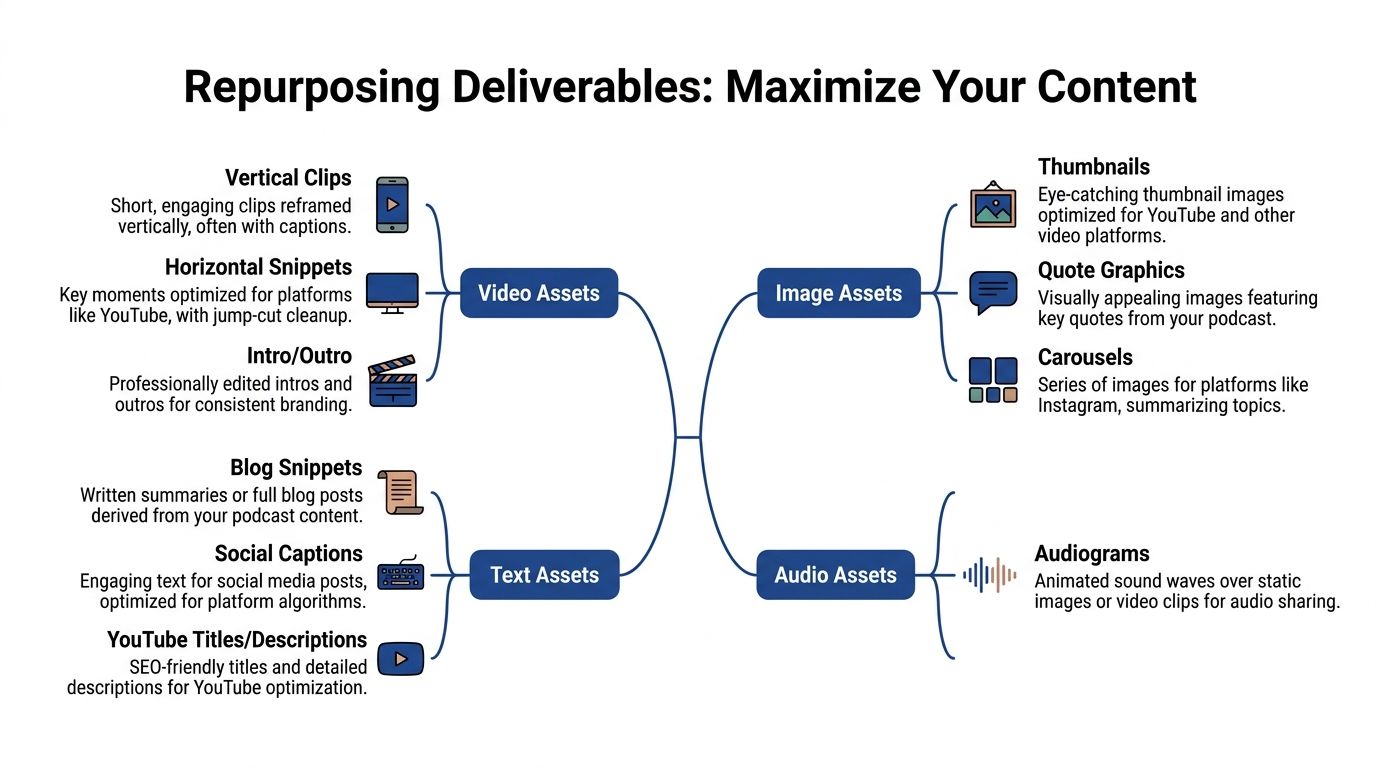
A full benchmark package is 20 to 30 publish-ready assets per episode in about 72 hours, including 8 to 12 clips, 6 to 8 social posts, 4 to 6 quote graphics, 1 to 3 carousels, plus an SEO blog and a posting playbook. That kind of mix gives a podcast multiple entry points instead of one publish moment.
What each format is doing
Vertical clips are the discovery layer. They're built for YouTube Shorts, Reels, and similar feeds, where fast hooks and captions matter most. If the framing is wrong or the speaker drifts out of frame, the clip feels amateur immediately.
YouTube optimization is the long-form layer. Titles, descriptions, and thumbnail frames help the episode live well on the platform that already dominates podcast viewing. A service should understand both search and retention, not just cutting cadence.
Written articles and blog posts serve search. They make the episode findable beyond social feeds and give the team a source for internal linking, newsletter content, and sales support.
Newsletters, social captions, and quote graphics extend the message across channels. They're especially useful for founders and B2B teams that need a steady cadence without inventing new topics every week.
For a closer look at what a clip-only deliverable should include, this product page is a useful reference point for scope.
The reason this mix works is simple. One format catches attention, another builds trust, and another keeps the content searchable. A podcast that only ships clips is leaving the rest of the source file untouched.
Understanding Service Costs and Expected Returns
Pricing usually depends on who is doing the work and how much of the workflow they own. A freelancer can look cheaper on a quote, but the comparison is the amount of cleanup, coordination, and rework your team absorbs afterward. Agencies and productized services cost more, yet they usually bundle editing, writing, branding, and QA into one handoff.
The market is clearly growing because buyers want more than a cut file. Analysts tracking podcast repurposing point to rising demand for services that turn a single recording into a steady flow of publishable assets, and that is consistent with what buyers pay for in practice, speed, consistency, and distribution depth. Those are operational advantages, not just editing labor.
For agencies and productized providers, the constraint is turnaround economics. The value comes from compressing a 45- to 60-minute recording into 20 to 30+ publishable assets inside a short SLA. That is why content repurposing cost should be judged per finished asset, not only by monthly retainer size.
What the price should be doing
A strong pricing model should cover more than clip assembly. It should include transcription cleanup, moment selection, branding, copywriting, and revisions, because those are the steps that keep the output usable without extra handholding. If a provider only charges for cutting, the client often ends up paying elsewhere in time or rework.
A simple way to assess return is to ask what the service replaces. A founder no longer has to brief a freelancer for editing, another writer for the article, and a designer for graphics. A team also avoids the hidden cost of missing a consistent posting rhythm, which often shows up as weaker reach and fewer assets to reuse later.
For a broader view of the economics behind creator distribution, this Sponsorradar resource on YouTuber sponsorship earnings helps frame how premium audiences can support content investment. Rather than chasing sponsorships, remember that repeat visibility has commercial value.
Return doesn't come from one clip going viral. It comes from repeated publishing that keeps the brand visible across multiple feeds.
Evaluating Vendors and Questions to Ask
A vendor should show clip judgment, not just editing skill. Random highlights are easy to produce. Choosing the moments that make someone stop, watch, and keep going takes editorial taste, platform awareness, and a sense of what the clip is supposed to do for the business. That is the difference between a clipping shop and a real content partner.
The fastest way to judge a provider is the portfolio. Look for clips with a hook in the first seconds, a clear point of view, and an ending that feels complete. If every sample starts late, cuts off awkwardly, or feels disconnected from the topic, the service is probably picking moments by length instead of value.
What good clip selection looks like
A useful clip usually has a visible setup, not just a random middle section. The strongest examples often open with a sharp claim, a practical framework, or a clear question, then carry enough context for the viewer to understand why the moment matters.
Bad selection is easy to spot. The topic drifts, the speaker never lands the point, or the clip needs a long caption to make sense. If that shows up in the portfolio, it will show up in your delivery too.
Questions that expose weak operators
- How do you choose which moments become clips? A good answer should mention hooks, narrative value, and platform fit.
- How do you handle branding? The provider should explain how logos, colors, fonts, lower thirds, and intro treatments are applied once and reused consistently.
- What does revision coverage look like? Unlimited or clearly defined revisions matter when brand tone and framing need fine-tuning.
- How do you decide where each asset should live first? A strong provider thinks about YouTube, Shorts, LinkedIn, and email as different destinations, not interchangeable bins.
- How fast is delivery, really? Vague turnaround promises are a warning sign. The buyer should get a specific SLA and a clear handoff process.
For a broader agency lens, this guide to choosing a content repurposing agency is useful when the decision comes down to workflow and consistency. The right partner should feel like part of the publishing system, not another vendor to manage.
One more red flag. If the provider talks mostly about software and barely about editorial judgment, the service is probably not built for podcast-native content. A recording can be processed automatically, but making it strategic requires human decisions.
Your 15-Minute Workflow for Weekly Content
The cleanest model is simple. Send one recording, get back a full week or more of publish-ready content. That's the value of a done-for-you service, because the client's job is only to hand over the source file and approve the results.
For RepurposeYourContent, that means one podcast, webinar, keynote, interview, or meeting recording goes in, and 20 to 30 ready-to-publish assets come back in 72 hours. The package includes video clips, LinkedIn posts, quote graphics, carousels, audiograms, and a blog post, all in brand voice with unlimited revisions. The client's time is about 15 minutes.
The onboarding flow is built to stay simple. The brand kit gets collected once, logo, colors, fonts, intro and outro treatment, lower-third style. After that, each new delivery should look consistent without the client re-explaining anything.
The weekly workflow
- Send one recording. The source can be a podcast, keynote, interview, livestream, or meeting.
- Provide the brand kit once. The service applies the same styling across every asset.
- Review the delivery. Human QA checks framing, captions, and copy before handoff.
- Publish across channels. The assets are ready for LinkedIn, YouTube, email, and the blog.
- Repeat next week. The team keeps publishing without rebuilding the process.
This model matters most for time-poor founders and B2B marketers. A Monday recording can fuel that same week's posting without a scramble on Tuesday night.
Advantage isn't just speed. It's consistency. A show that goes from posting only the full episode to posting 8 to 12 platform-native clips each week multiplies its surface area in discovery feeds. Each clip is a new chance to be found, and the service keeps that output steady.
For teams that want a podcast-native, done-for-you option, RepurposeYourContent is one provider that handles the recording-to-asset workflow end to end. Book a call or request a sample pack to see what a full delivery looks like for your next episode.
Tags: