A Video SEO Strategy for B2B Webinar Content in 2026
Build a video SEO strategy for B2B webinar content that ranks on Google and YouTube. This guide covers optimisation, repurposing, and distribution.

A common pitfall is treating webinar SEO as a mere posting task. This often involves uploading the replay to YouTube, pasting it on a landing page, adding a short description, then moving on.
That approach wastes the strongest search asset in the room. A good video SEO strategy for B2B webinar content doesn't start with the upload. It starts with the idea that the recording contains spoken answers buyers search for, especially when they want an expert to explain something in plain language rather than skim another article.
Written posts still matter. Standalone videos still matter. But the format that usually does the most work is the hybrid asset: a transcript-led article on your site, supported by short embedded clips from the webinar. That gives Google text to index, gives buyers video to watch, and gives your team a practical way to rank for long-tail queries that a standard blog post often misses.
The Unseen SEO Power of Your Webinar Recordings
The replay page is rarely the asset that wins search.
For B2B webinar content, the stronger format is a transcript-led article on your site, built from the recording and supported by short embedded clips. That asset gives search engines indexable text, gives buyers faster access to the useful moments, and gives your team more than one way to rank from a single event.

That matters because webinar recordings capture the kind of language buyers use. They ask half-formed questions. They describe messy internal processes. They want someone to explain the setup, the mistake, or the trade-off in plain English. A polished article can answer that. A webinar often surfaces it more naturally, especially in the Q&A.
The mistake is treating the recording as a finished asset. It is raw material.
Once you turn that raw material into a transcript-driven post, the SEO value changes. The transcript expands topical coverage. The clips improve engagement because readers can watch the exact two-minute answer they care about instead of scrubbing through a 45-minute replay. The page starts serving mixed intent well. Some visitors want a written explanation. Others want proof that a real practitioner can walk through the process.
Why standalone blog posts leave value behind
A standard blog post usually smooths out the messy parts. That makes it cleaner. It can also make it less useful.
Webinars contain definitions, objections, examples, implementation details, and audience questions in one source file. That is why I prefer building the article from the transcript first, then choosing clips that reinforce the sections with the highest buyer intent. The result is usually stronger than publishing a separate blog post and embedding the full replay at the bottom as an afterthought.
The format does more work because each element has a job:
- The transcript-led article captures long-tail search demand and gives Google enough text to understand the topic fully.
- Short embedded clips prove expertise fast and keep readers on the page when text alone would lose them.
- The full recording supports visitors who want the complete session, demo, or Q&A before they convert.
This is the practical middle ground between blog-first and video-first publishing. If you need a broader operating model, these video SEO best practices for webinar-based content in 2026 cover the supporting mechanics.
What usually performs best
The highest-performing webinar SEO asset is not the video alone, and it is not the article alone. It is the combined page.
A transcript-driven post with embedded clips, clear subheads, internal links, and a relevant CTA creates multiple entry points into search while still feeling useful to a human reader. It can rank for the broad problem, the specific sub-question, and the comparison query that comes up late in the buying process.
That is the hidden value in webinar recordings. They are not leftovers from an event. They are one of the few B2B content formats that can produce a strong written asset, a strong video asset, and a stronger hybrid asset from the same source.
Build SEO into Your Webinar from Day One
The replay does not become an SEO asset after the event. It becomes one during planning.
If the session is built around a fuzzy theme, broad positioning language, or a speaker who rambles, the post-production work gets harder fast. You end up forcing structure onto material that was never designed to rank, clip cleanly, or support a transcript-led article.

Start with one keyword theme
Pick the search intent before you pick the webinar title.
For this format, the goal is not just a live registration page or a replay. The goal is a strong hybrid asset later. That means one primary topic with enough depth to support a transcript-driven post, several useful clip moments, and a full recording that still makes sense in context.
The best topics usually come from buyer language, not campaign messaging. Pull from sales call notes, implementation questions, stalled deal objections, customer success escalations, and product onboarding friction. If a prospect asks the same question in three different deals, that is often a better webinar subject than a polished thought-leadership theme.
A simple planning model works well:
Choose one core query
Examples: webinar attribution setup, CRM handoff process, demand capture reporting.List the sub-intents behind that query
Cover setup steps, common mistakes, team ownership, tooling choices, and reporting questions.Name each segment before the webinar happens
Those labels often become clip titles, transcript subheads, chapter names, and on-page sections later.
I usually pressure-test the topic with one question. Can this session turn into a post that answers a real search query without sounding like event leftovers? If the answer is no, the topic is still too broad or too branded.
Structure the webinar for transcript reuse
A webinar built for live delivery is not always built for search.
The transcript-driven post and embedded clips work best when the session has clean verbal signposts. Speakers should state the problem early, move through a planned sequence, and label transitions out loud. That gives the transcript a usable structure before editing starts. It also makes it much easier to transcribe webinar recordings automatically for SEO repurposing without creating a messy wall of text that an editor has to rebuild from scratch.
Useful sessions usually include:
- A direct opening that explains the problem in plain language
- Named sections that map to clear search subtopics
- A Q&A block with specific questions phrased the way buyers ask them
- Repeated terminology for frameworks, steps, and mistakes, so the transcript stays consistent
One sentence is a good test. If the speaker cannot explain a segment in one clear line, that segment usually produces a weak clip and an even weaker subheading.
Choose the host based on the job
Hosting is a workflow decision, not just a publishing preference.
| Hosting option | Best use | SEO upside | Main trade-off |
|---|---|---|---|
| YouTube | Discovery and platform search | Strong visibility in YouTube search and good support for chapters and descriptions | Less control over the conversion path on your site |
| Vimeo | Cleaner embedded experience | Better on-page presentation with fewer distractions | Limited native search discovery compared with YouTube |
| Self-hosted player | Full control on your site | Strong connection to your article, schema, internal links, and CTA flow | Discovery depends on your site authority and distribution |
For most B2B teams, the strongest setup is role-based. Put the full recording where it can be discovered, then build the main SEO value on your site with the transcript-led article and selected clips. That model gives search engines more context, gives readers faster access to the useful moments, and keeps conversion activity on a page you control.
Directive makes a similar point in its guide to B2B SEO content trends in 2026. One platform rarely does everything well. Discovery, authority, and conversion usually need different surfaces.
A Video SEO Strategy for Your B2B Webinar Content Recording
The replay is not the asset. The asset is the page you build from it.
A standalone webinar video rarely ranks well on its own for B2B topics unless the brand already has strong authority on YouTube or a large subscriber base. A plain recap post has the opposite problem. It gives Google text, but it loses the proof, nuance, and trust that come from hearing the expert answer the question. The format that consistently does more work is a transcript-driven article on your site with short clips embedded at the exact points where the reader wants confirmation.

Optimise the recording for retrieval, not just replay
Start by making the full recording understandable to both search engines and busy buyers. The goal is retrieval. Someone should be able to find the webinar, skim it, and jump straight to the part that answers their question.
Title the replay around the problem first
Lead with the search topic, not the campaign name. If the webinar covers pipeline attribution for SaaS teams, say that clearly.Write a description that helps qualification
Summarise who the webinar is for, what problems it addresses, what viewers will learn, and what action to take next.Add chapters and timestamps based on intent shifts
Good chapters separate definitions, process steps, objections, examples, and Q&A. That structure also makes later clip selection faster.Use a thumbnail that communicates the topic fast
Speaker headshots alone are weak. Topic-led text and a clean visual hierarchy usually perform better for B2B replays.
This example shows the kind of video asset many teams start with before turning it into a stronger search package.
Build the real SEO asset from the transcript
Once the webinar ends, the most important optimisation starts.
The transcript gives you raw material for the page that should rank. It captures the language buyers use, the objections they raise, and the exact framing your subject matter expert used to answer them. That is far more useful than a thin embed page with a generic summary.
Raw transcripts still need editing. Clean them up, remove filler, merge repeated points, and turn loose conversation into sections built around search intent. Then embed short clips inside those sections instead of dropping one full recording at the top and hoping readers will scrub through an hour of video.
That page structure works because it serves both behaviors. Readers who want speed can scan headings and read the distilled answer. Readers who want proof can watch the 30 to 90 second clip beside that answer.
For teams tightening up transcript production, this guide on how to transcribe video automatically is a practical place to start.
Turn one webinar into an anchor page with clip-level intent
This is the part B2B teams often skip. They publish the replay, maybe add a summary, then move on. That leaves a lot of searchable value on the table.
Treat the webinar as source material for a long-form page focused on one primary query and several related subtopics. Each section should answer a distinct question, include edited transcript copy, and embed a short supporting clip. In practice, that means one webinar can rank for the main topic, support related long-tail terms, and help sales with a page that is actually useful after the event.
Add VideoObject schema to the page so search engines can parse the video details correctly. Then support the article with internal links to product pages, service pages, and related posts. That is usually a better use of the recording than sending all value to a third-party video platform.
This format also helps with conversion. A transcript-led page with clips keeps the reader on your site longer, gives them context before they book a demo, and supports streamlining your sales funnel without forcing them to watch the full session first.
A replay page with no transcript, no clip support, and no internal links is a storage page. A transcript-led article with embedded clips is a search asset.
Your Automated Video SEO Content Engine
The workflow above is straightforward. It's also slow if a team does everything by hand.
One recording has to become an article, clips, timestamps, social posts, and follow-up assets. That's where operations usually break. The strategy is sound, but the production load kills consistency.

A repeatable workflow that teams can actually run
A practical example looks like this:
Upload the webinar recording
Start with the final session file or replay link.Generate the anchor article
Turn the transcript into a long-form blog post built around the main keyword theme.Extract short clips from key moments
Pull answers, objections, and memorable teaching points into clip-length assets.Embed the clips back into the article
Place them beside the relevant transcript sections, not in a random gallery.Create supporting distribution assets
Social posts, audiograms, image quotes, newsletters, and LinkedIn carousel content all come from the same source recording.
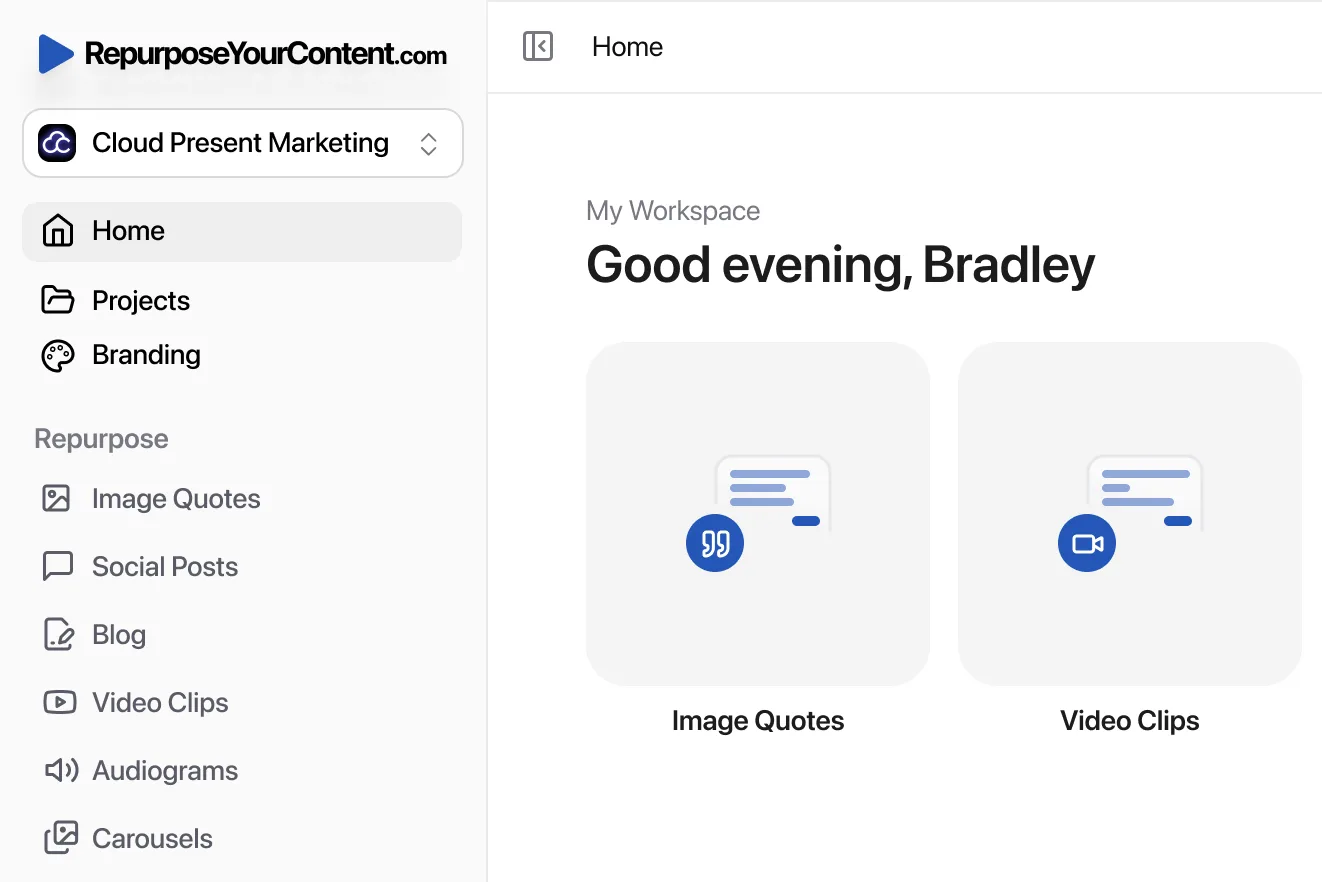
One product built for that workflow is RepurposeYourContent, which converts a webinar into video clips, blog posts, social posts, audiograms, image quotes, newsletters, LinkedIn carousels, and timestamps from one upload. For teams building the anchor article first, its blog post workflow and video clips workflow fit this exact asset model.
Why the hybrid asset matters commercially
This isn't only about rankings. It's also about conversion path design.
UK marketing evidence reported by Kiwi Creative says adding video to landing pages improves conversion rates by 80–86%, and 47% of webinar attendees become qualified leads, with 5–20% eventually converting to paying customers in its piece on maximising SEO with B2B tech video marketing. That supports a direct operational point. A transcript-led article with embedded clips isn't just richer content. It's a better path from discovery to action.
Teams also need the process to connect with pipeline work, not sit in a content silo. That's where webinar automation can help with streamlining your sales funnel, especially when follow-up content and lead routing depend on speed.
Workflow test: If publishing one webinar takes a week of manual editing, the process won't survive a real webinar calendar.
For teams trying to cut that production drag, this article on automating webinar repurposing shows how to build a more repeatable system.
Syndicate and Distribute Your Assets for Maximum Reach
Distribution is where webinar SEO programmes usually break. Teams spend days producing a strong transcript-led article with embedded clips, then push the same asset package to every channel with minor caption changes. That wastes the format's biggest advantage. The hybrid asset only works when each platform sends the right kind of attention back to the page that can rank, explain the topic properly, and convert.
The website should carry the full argument. Other channels should create entry points into it.
Assign one job to each channel
A channel plan gets simpler once the anchor asset is clear.
Company blog
Publish the transcript-driven post here first. It should contain the cleaned-up narrative, the embedded short clips, internal links to related pages, and the CTA that matches buying intent.YouTube
Upload the full replay with chapters, a search-focused title, and a description that points viewers to the article for the structured version. YouTube is useful for discovery, but the article usually does the heavier commercial work because it gives buyers text, context, and the next action in one place.LinkedIn
Publish short clips built around one objection, one insight, or one takeaway. Each clip needs to feel complete on its own. The caption should explain why the point matters and send interested viewers to the article, not just to the replay.
That split matters because audience behaviour changes by platform. A buyer on your site is willing to read, skim headings, and click deeper. A buyer on YouTube is deciding whether the topic matches current intent. A buyer on LinkedIn gives you a few seconds to prove the clip is worth attention.
Package for the click you actually want
The goal is not broad exposure for its own sake. The goal is qualified traffic landing on the transcript-led post.
That changes how distribution should be written:
- On YouTube, the description should frame the article as the organised version of the webinar.
- On LinkedIn, the post should promise a specific answer and link to the article where the full explanation lives.
- On the blog, embedded clips should support the text at the exact moment the reader wants proof, nuance, or a product example.
I usually avoid posting the full replay natively to every channel. Full replays create friction outside YouTube and your site because they ask for too much time upfront. Short clips earn attention faster. The article then captures that attention in a format built for search and buying research.
Build a repeatable distribution chain
A practical workflow looks like this:
- Publish the anchor article first
- Embed the strongest webinar clips inside the article
- Upload the chaptered full replay to YouTube
- Schedule short LinkedIn clips over the following days or weeks
- Point each post back to the article when the viewer needs depth, transcript context, or the next step
Teams that want a cleaner process can tighten the handoff with these content distribution strategies for repurposed webinar assets.
Good syndication does not mean copying the same message everywhere. It means adapting the asset to the way each channel is used, while keeping the transcript-led article with embedded clips as the centre of gravity. That is the page that compounds search value and gives sales-ready visitors enough substance to act.
Measure and Iterate Your Webinar SEO Performance
Views don't prove the strategy worked. Qualified action does.
A webinar SEO programme needs metrics that show discoverability, consumption, and conversion together. If the team only reports replay views, it won't know which topic, clip, or page structure moved someone closer to a pipeline event.
Track the signals that change decisions
Useful measurement usually sits in four buckets.
| Area | What to review | Why it matters |
|---|---|---|
| Search visibility | Impressions, clicks, and click-through rate on video-supported pages | Shows whether titles, thumbnails, and page packaging are working |
| Engagement quality | Audience retention, chapter drop-offs, on-page behaviour | Shows whether the content structure matches intent |
| Page performance | Organic traffic to the transcript-led article, internal click paths, CTA engagement | Shows whether the anchor asset is doing more than hosting a replay |
| Lead impact | Form fills, demo clicks, and qualified lead attribution from webinar-derived pages and clips | Shows whether the format contributes to revenue activity |
Use the results to shape the next webinar
Performance review should change production, not just reporting.
If viewers repeatedly drop after the intro, the next webinar needs a faster opening. If one objection-based clip sends better traffic than product overview clips, future sessions should include more direct objection handling. If the article gets search traffic but weak CTA engagement, the problem is likely page design or offer fit, not topic choice.
The goal isn't to prove every webinar was good. The goal is to make the next one easier to rank and easier to convert.
This loop is where webinar content starts behaving like an engine instead of a one-off event. The recording informs the article. The article informs the clips. The clips reveal which ideas deserve more depth next time.
Teams that want a stronger reporting baseline should start with these webinar metrics and KPIs to track. The key is consistency. Measure the same decision-driving metrics every time, then tighten the format, topic, and distribution model based on what the audience responds to.
If the goal is to turn each webinar into a searchable, reusable content package instead of a forgotten replay, try RepurposeYourContent.
Tags: