Webinar Email Nurture Sequence Complete Guide 2026
Webinar email nurture sequence complete guide - Unlock powerful strategies with this webinar email nurture sequence complete guide for 2026. Master cadence,

Most webinar programmes don't fail because the event was weak. They fail because the email plan ends with a replay link.
UK data shows 78% of B2B webinar leads go cold within 7 days, yet repurposing webinar content into a nurture sequence can boost ROI by 4x according to Thrive Themes' webinar nurture sequence guide. That gap is where pipeline gets lost.
A proper webinar email nurture sequence complete guide isn't about writing one better follow-up email. It's about building a system that starts before the webinar, captures intent during the event, and keeps working for months after. Busy demand-gen teams need a repeatable programme, not another one-off campaign.
Why Your Webinar Follow-up Fails
The standard playbook still looks like this. Promote the webinar. Send confirmation emails. Run the event. Email the recording. Move on.
That approach wastes the asset you already paid to create. One recording contains the problems buyers care about, the language they use, the objections they raise, and the proof points your team can recycle across email.
The replay email isn't the strategy
A replay email has one job. It gives access to the recording.
It does not nurture interest, qualify intent, address objections, or create multiple conversion points. That's why teams see an early spike in clicks, then silence.
The failure is structural. Every webinar email is often treated as a fresh writing task. That creates inconsistent messaging, weak cadence, and content gaps after the first week.
Most webinar sequences break because the marketer writes email by email instead of designing a programme.
The better model is simple. Treat the webinar recording as a content library, not a single asset. Pull out clips, quotes, timestamps, FAQs, objections, stories, and proof. Then map those assets across a full lifecycle sequence.
What a working system looks like
A working sequence does five things:
- Builds intent before the event: Invitation emails frame the problem and promise a clear outcome.
- Protects attendance: Confirmation and reminder emails reduce drop-off and keep the session on the calendar.
- Recovers missed attention: Follow-up emails give no-shows and partial viewers an easier path back in.
- Extends the conversation: Long-term nurture emails keep the topic alive with smaller, useful content assets.
- Creates repeated conversion moments: Demo CTAs, resource offers, and response prompts appear at the right time.
Teams that want stronger attendance mechanics should also review these webinar reminder email best practices, because reminder structure shapes what happens after the event too.
The Complete Webinar Email Nurture Sequence Strategy
Teams often plan the webinar, then improvise the emails. That sequence should be reversed. The webinar is one moment inside a longer email journey.
UK B2B organisations using multi-email nurture sequences post-webinar achieve a 45% higher lead-to-customer conversion rate than those using a single replay email, according to this CMI-based webinar nurture sequence analysis. That result makes sense. Buyers rarely move from one webinar to one buying decision.

Stage one builds demand before the webinar
The pre-webinar phase needs 3 to 5 emails. The purpose isn't just registration. It's audience filtering.
A strong promotion sequence usually includes:
- Problem-led invite: Focus on one operational pain point, not a broad topic.
- Angle shift email: Reframe the problem with a new insight, objection, or cost of inaction.
- Speaker credibility email: Show why this person can teach the topic.
- Last-chance registration push: Add urgency without sounding generic.
- Segment-specific variant: Optional, but useful for different industries or roles.
What works:
- A clear promise tied to one problem.
- Plain-language copy.
- CTA above the fold.
- Copy that sounds like a practitioner wrote it.
What doesn't:
- Agenda-heavy emails.
- Long speaker bios.
- Generic subject lines.
- Trying to cover every benefit at once.
Stage two secures attendance
Confirmation and reminders usually need 1 to 2 confirmation emails and 2 to 3 reminder emails.
The confirmation email should answer practical questions fast. What is it, when is it, how to join, and what will the attendee get? The reminder emails then restore urgency and reduce no-shows.
A useful structure looks like this:
| Email type | Purpose | Content angle |
|---|---|---|
| Confirmation | Lock in the registration | Calendar link, webinar promise, logistics |
| Reminder 1 | Rebuild intent | Main takeaway and who it's for |
| Reminder 2 | Raise urgency | Starts soon, expected outcomes |
| Optional final reminder | Capture late opens | Join link and one-line value hook |
For broader planning, this drip campaign strategy for webinar follow-up is a helpful companion to the lifecycle model here.
Stage three converts the event into follow-up fuel
Post-event follow-up needs 5 to 7 emails, a point at which most programmes stop too early.
The first email delivers the replay. The rest should break the webinar into smaller reasons to re-engage. That can include a key clip, one strong quote, a transcript excerpt, a summary blog, a customer proof point, or a direct CTA.
Practical rule: If every post-webinar email asks people to watch the full replay, the sequence is too lazy.
The sequence should move from access, to insight, to proof, to action.
Stage four extends the buying window
Long-term nurture needs 8 to 12 emails. This is the part most teams skip, even though many buyers won't act right after the webinar.
This stage should reuse the same webinar themes in different formats:
- Clip-led education: One idea from the webinar, explained clearly.
- FAQ emails: Turn live questions into short answers.
- Point-of-view emails: Share a clear stance on the problem discussed.
- Use-case emails: Show how different teams apply the lesson.
- Offer emails: Invite a demo, audit, or conversation after enough value has been delivered.
Stage five re-engages or routes out
Not everyone should stay in the same workflow forever. Add a re-engagement branch at the end.
If someone clicks repeatedly, route them toward sales or high-intent offers. If someone stops engaging, either simplify the CTA or move them to a lighter newsletter track. Good programmes don't just send more. They route better.
How RepurposeYourContent Fills Your Email Calendar
Strategy fails when the team can't produce content fast enough. That's the primary bottleneck.
78% of UK marketing agencies cite time constraints in creating nurture content from webinars, averaging over 90 minutes manually. Automated tools reduce this to about 5 minutes, according to Woodpecker's email nurture sequence analysis. That difference matters when one webinar needs to feed weeks of email.

One recording should feed the whole sequence
The efficient workflow isn't "write email, then hunt for supporting content." It should be the opposite. Extract the assets first. Then assign each asset to a specific email job.
A webinar usually gives you:
- Video clips for no-show recovery and high-engagement follow-up
- Blog post summaries for educational nurture emails
- Social posts for reminder support and retargeting alignment
- Audiograms for mobile-first follow-up
- Image quotes for proof-led emails
- LinkedIn carousels for post-webinar authority building
- Newsletters for long-term nurture
- Timestamps for replay emails that remove friction
A practical workflow example
A workable process looks like this:
Upload the webinar recording Pull in the full session once the event ends.
Choose formats by email role Select clips for no-shows, quote cards for thought-leadership emails, and summary copy for educational follow-up.
Map assets to the calendar Assign one asset to each planned send instead of writing from a blank page.
Build segment variants Use different content for attendees, no-shows, and partial viewers.
Load into the ESP Push the final assets into ActiveCampaign, HubSpot, Klaviyo, or the platform your team already uses.
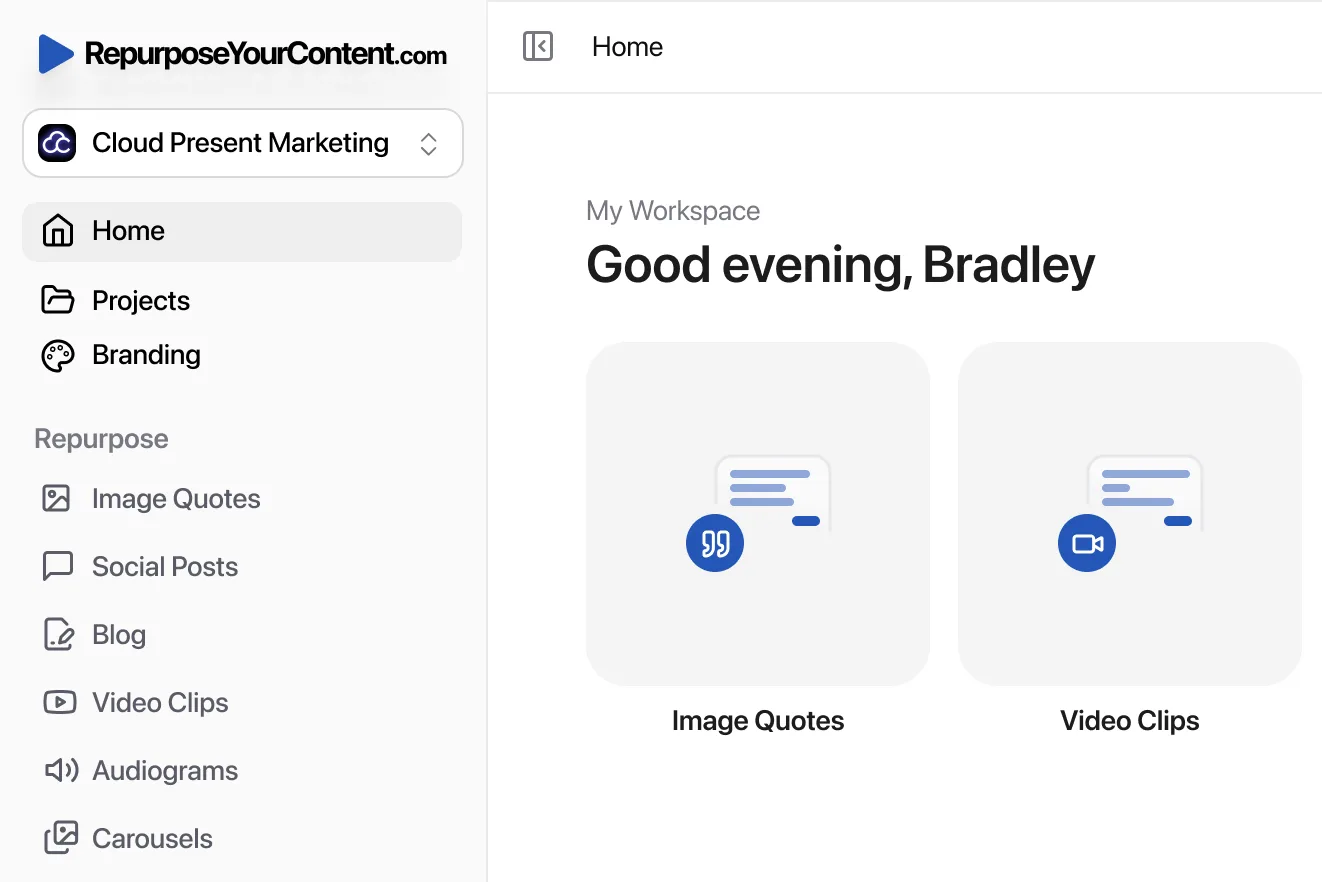
One tool built for this workflow is RepurposeYourContent's email sequence product, which turns a webinar recording into assets such as video clips, blog posts, social posts, audiograms, image quotes, newsletters, LinkedIn carousels, and timestamps for email use.
Match formats to email intent
Not every asset belongs in every email. That's where teams often overdo it.
Use this decision guide:
| Email type | Best asset | Why it fits |
|---|---|---|
| Invitation | Short speaker clip | Builds authority quickly |
| Confirmation | Agenda summary and timestamp list | Sets expectations |
| Reminder | Teaser quote or stat from the webinar topic | Rebuilds urgency |
| Replay | Timestamped summary | Removes friction |
| Value email | Blog-style takeaway | Easier to consume than full video |
| Social proof email | Quote card or customer example clip | Builds trust |
| Conversion email | Product walkthrough clip or CTA summary | Narrows to action |
The point isn't volume for its own sake. It's making sure the webinar funds the whole programme instead of dying after one replay email.
Audience Segmentation for Higher Conversions
Sending the same webinar sequence to every registrant is a fast way to flatten performance.
UK sequences that use if/then branching based on engagement achieve a 42% uplift in demo bookings when personalisation is applied using registration data, according to this lead nurturing sequence analysis from Chameleon Sales. The logic is simple. Relevance creates motion.

Start with behaviour, not list labels
Basic attendee versus no-show segmentation is useful, but it isn't enough. Better programmes branch based on what the person did.
A practical model uses three core paths:
- Attendees: They showed up. Send deeper content, implementation guidance, and stronger CTAs.
- No-shows: They had intent but missed the session. Send highlights, not just the full replay.
- Partial viewers: They started but dropped off. Send the most useful missed section first.
Registration data should also shape the path. Job role, company type, stated challenge, and selected interests can all inform what content shows up next.
A simple if/then framework
Good branching doesn't need to be complicated. It needs to be useful.
| Segment | Trigger | Next email angle |
|---|---|---|
| Attendee watched most of session | High engagement | Advanced takeaway and direct CTA |
| Attendee clicked replay resources | Continued intent | Case-study style follow-up |
| No-show | Registered, did not attend | Missed highlights email with short clip |
| Partial viewer | Left early | Timestamped replay to the section they missed |
| Opened but never clicked | Weak engagement | Shorter email with one CTA |
| Clicked product-related CTA | Buying signal | Demo invitation or sales handoff |
This video gives a useful visual explanation of branching logic in nurture programmes:
Use webinar data to make emails feel specific
The best segmentation inputs are already inside the webinar workflow.
Use:
- Registration form answers to align the pain point.
- Poll responses to route by maturity or challenge.
- Q&A topics to trigger FAQ follow-ups.
- Replay behaviour to identify active evaluation.
- CTA clicks to separate researchers from buyers.
A no-show doesn't need another calendar reminder after the event. That person needs a reason to care again.
What usually fails is over-personalisation without a content plan. Teams collect rich webinar data, then send generic copy because they don't have enough customized assets. That's why content extraction and segmentation need to be designed together.
Your 90-Day Webinar Nurture Blueprint and Templates
Most sequences are too short because the team runs out of content, not because the buyer is ready. A webinar can support months of follow-up if the content is broken into smaller assets and assigned to clear jobs.
This blueprint covers the full journey. It includes promotion: 3 to 5 emails, confirmation: 1 to 2, reminders: 2 to 3, follow-up: 5 to 7, and nurture: 8 to 12. The exact count can flex by sales cycle and list quality, but the structure should stay intact.
90-day webinar nurture blueprint
| Day/Week | Email Focus | Example Subject Line | Content Asset (from RepurposeYourContent) |
|---|---|---|---|
| Day -21 | First invite | The operational problem this webinar will fix | Speaker intro clip |
| Day -14 | Value-led invite | Why most teams still get this wrong | Short teaser social post adapted for email |
| Day -7 | Speaker credibility | What the webinar will actually cover | Image quote from speaker |
| Day -3 | Final registration push | Registration closes soon | Short summary block |
| Day 0 | Confirmation | You're in. Save your seat | Calendar-ready confirmation copy |
| Day -1 | Reminder | Tomorrow's session and what you'll leave with | Agenda summary |
| Day 0 morning | Reminder | Starting today. Join link inside | Logistics block with CTA |
| Day 0 one hour before | Final reminder | We start in one hour | Short plain-text reminder |
| Day 1 | Replay delivery | Replay and key timestamps | Replay email with timestamps |
| Day 3 | Best insight | The strongest takeaway from the session | Highlight clip |
| Day 5 | No-show recovery variant | Missed it? Start with this 2-minute section | Short clip for no-shows |
| Day 8 | FAQ follow-up | The question that came up most often | FAQ email from transcript |
| Day 12 | Resource email | The framework behind the webinar | Blog post summary |
| Day 16 | Social proof | How teams apply this in practice | Quote card or testimonial-led snippet |
| Day 21 | Soft conversion | Want help applying this to your workflow? | Demo-oriented email block |
| Day 28 | Newsletter-style nurture | Three ideas from the webinar worth revisiting | Newsletter draft |
| Day 35 | Objection handling | Still unsure if this fits your team? | Q&A excerpt |
| Day 42 | Use-case email | How this looks for a lean demand-gen team | Role-specific email copy |
| Day 49 | Point-of-view email | The mistake most teams repeat after webinars | Thought-leadership clip |
| Day 56 | Asset round-up | The best resources from the session in one place | Curated asset recap |
| Day 63 | Mid-funnel CTA | Ready for the next step? | Product explainer snippet |
| Day 70 | New angle | One insight from the webinar that still matters | Audiogram |
| Day 77 | Comparison email | Manual follow-up versus automated content flow | Carousel turned into email frames |
| Day 84 | Direct ask | Should this stay on your radar? | Plain-text check-in |
| Day 90 | Re-engage or route out | Still interested in better webinar follow-up? | Preference or next-step email |
Subject line patterns that hold up
Subject lines work better when they match the email's role. A reminder should sound different from a nurture email.
Useful patterns include:
- Problem-first: Why webinar follow-up breaks after week one
- Outcome-first: Turn one webinar into months of nurture content
- Curiosity-first: The most useful two minutes from the session
- Direct utility: Replay, timestamps, and next steps
- Soft CTA: Want the same system for your team?
What usually underperforms:
- Vague hype
- Forced urgency on every send
- Repeating "webinar replay" across multiple emails
- Subject lines that promise insight but deliver logistics
Content structure inside each stage
A practical format by stage looks like this:
Promotion emails
- Problem
- Why this matters now
- One clear outcome
- Registration CTA
Confirmation emails
- Thank you
- Date and time
- Calendar action
- What to expect
Reminder emails
- One fresh reason to attend
- Simple join details
- Reduced friction
Post-event follow-up
- Replay access
- Key takeaway
- Shorter asset version
- CTA matched to intent
Long-term nurture
- One lesson per email
- Small proof point
- Low-friction next step
Teams that want a wider content planning system around this sequence should review this virtual event content repurposing guide alongside the blueprint.
Build the calendar first. Then assign assets. Don't ask a marketer to invent twenty emails from scratch.
For teams that need a lighter starting point, it's also useful to pair this longer blueprint with a dedicated webinar follow-up email sequence template on the site before expanding into the full 90-day model.
Measuring Performance and Optimising Your Sequence
Open rate can tell you whether the subject line earned attention. It can't tell you whether the sequence created pipeline.
The stronger view tracks movement through the funnel. Did the sequence influence MQLs, create SQLs, accelerate opportunities, and generate conversion actions that sales can trust?

Start with business metrics
Multi-channel webinar nurture sequences using email plus LinkedIn increase pipeline velocity by 35%, and using UTM parameters helps track a 27% better MQL-to-SQL progression, according to this webinar nurture measurement discussion on YouTube. That matters because attribution gets clearer when the sequence is designed to be measured.
The most useful metrics are:
- Pipeline velocity: Are nurtured leads moving faster than non-nurtured leads?
- MQL to SQL progression: Which emails and assets influence qualification?
- Demo conversion rate: Which branch creates the strongest hand-raise?
- Reply quality: Are sales-relevant conversations increasing?
- Content-assisted opportunity creation: Which webinar-derived assets appear before opportunity creation?
Use UTM structure that sales can trust
Every link in the sequence should carry a consistent UTM approach. That includes replay links, clip clicks, CTA buttons, and linked assets.
A practical structure might include:
- Source: webinar-nurture
- Medium: email
- Campaign: webinar-topic-name
- Content: replay-email, clip-email, faq-email, demo-cta
This allows the team to isolate not just campaign influence, but asset influence. A replay click and a demo CTA click should never be lumped together.
For teams that need a broader framework beyond webinar programmes, this guide on measuring ROI for mid-market brands is a useful resource because it connects campaign reporting to commercial outcomes instead of vanity metrics.
Optimise the sequence in layers
Don't test everything at once. Optimisation works better when each layer has one clear question.
| Layer | What to test | What the result informs |
|---|---|---|
| Subject line | Problem-led vs utility-led | Attention |
| CTA copy | Demo vs watch clip vs get resource | Intent level |
| Asset format | Clip vs text summary vs quote card | Consumption preference |
| Send timing | Short gap vs longer gap | Cadence tolerance |
| Branch rules | Attendee path vs no-show path | Relevance and conversion |
If reporting stops at opens and clicks, the team is measuring email activity, not buying progress.
The strongest teams also review where the sequence loses people. If no-shows don't click the replay, the problem may be format. If attendees click but don't convert, the issue may be offer timing. If long-term nurture gets ignored, the sequence may be repeating the same angle too often.
Stop Sending Emails Start Building an Engine
One webinar contains far more than one email. It holds a month's worth of buyer language, objections, stories, clips, and teaching moments. This material is often still treated like a disposable event asset.
That's why the old model keeps underperforming. It depends on manual effort, scattered writing, and one replay link carrying too much weight. The better model is operational. Build the sequence once, assign content assets to each stage, segment by behaviour, and measure against pipeline.
The shift that matters
The useful change isn't "send more emails." It's this:
- Stop treating the webinar as the campaign
- Treat the webinar as the source material
- Treat the email programme as the revenue system
That shift changes how the team plans, writes, segments, and reports. It also reduces the pressure to invent fresh content every week because the webinar itself becomes the content reservoir.
Teams building a repeatable programme should also study this guide on how to build a content engine for B2B, because webinar nurture performs best when it sits inside a wider content operating model.
A proper webinar email nurture sequence complete guide isn't really about email copy. It's about programme design. Once the structure is right, the content gets easier, the reporting gets clearer, and the webinar keeps producing value long after the live session ends.
Ready to turn webinar recordings into a full email programme instead of another one-off follow-up? Try RepurposeYourContent and build your next nurture engine faster.
Tags: