Virtual Event Content Repurposing Guide: 90-Day Plan
Use this virtual event content repurposing guide to turn a multi-session event into 90 days of content. Get a step-by-step workflow and calendar template.

A large virtual event often gets treated like a live moment with a replay attached. That's the mistake.
Event teams can spend six figures on production and then leave the post-event workflow to chance. The result is familiar. A polished keynote sits in an on-demand hub, a few clips go out on LinkedIn, and the rest of the footage disappears into a recording folder. For a multi-session event, that can mean 40+ hours of expert content left idle.
A better model is simpler. Treat the event like raw material for an owned media library. One day of programming can support months of blog content, social posts, follow-up email, sales enablement, and evergreen on-demand assets. This virtual event content repurposing guide is built for event marketers running flagship virtual conferences, customer summits, and multi-track broadcasts who need a system that scales.
Your Virtual Event Content Is a Wasted Asset
The waste usually starts after applause, not before.
A flagship virtual event can cost more than £100,000 to produce, yet many teams spend nothing on systematic content extraction after the event. That's hard to justify when the recordings contain the exact material marketing teams need next quarter: expert takes, product proof points, customer language, and category commentary. If the event ran all day across multiple tracks, the recording archive can easily stretch past 40 hours.
Posting the full recordings isn't enough. Most buyers won't watch full sessions unless they already know what they need. They will, however, consume shorter, better-packaged assets pulled from those sessions.
Most event teams don't have a content problem. They have an extraction problem.
That's why the right question isn't “How did the event perform?” It's “How much media value is still trapped inside the footage?”
A strong event programme usually contains several layers of reusable content:
- High-intent education from keynotes and workshops
- Sharp opinions from panels and fireside chats
- Social proof from customer sessions
- Sales language from audience questions and objections
This is also where event comms and post-event content should connect. Teams planning announcement coverage or post-event publicity can borrow structure from this guide to writing event press releases, then extend that thinking into a longer content programme rather than stopping at a recap.
Many teams already know they should do more with recordings. The problem is that “do more” isn't a workflow. A repeatable process matters more than good intentions. The practical shift is to move from event archive thinking to content library thinking, then build operating rhythm around it. For a related mindset on extending the life of recorded sessions, this playbook for getting more value from webinars is a useful companion.
Strategise Your Content Library Before You Repurpose
A large virtual event can generate months of marketing output, but only if the team decides in advance what belongs in the library. Broad repurposing is common. In the UK, 94% of marketers actively repurpose content to extend its lifecycle and boost ROI, according to UKTI's roundup of content repurposing statistics. The gap is not intent. The gap is selection.
Trying to process every session from a six-figure event usually creates a backlog, not a library. The better approach is portfolio thinking. Pick the sessions that can keep producing value 30, 60, and 90 days after the live date, then build around those first.

Start with attendance data
Attendance is not a verdict on quality, but it is a useful commercial signal.
If one breakout session held viewers for 38 minutes while another lost half its audience in the first 10, the first session is the better candidate for clips, blogs, email follow-up, and sales enablement. It has already proved it can hold attention. That lowers editorial risk.
Useful signals include:
- Live attendance quality. Sessions with strong average watch time usually adapt better to on-demand formats.
- Engagement concentration. Chat spikes, poll responses, and dense Q&A often point to segments worth clipping.
- Drop-off patterns. If retention rises around a specific section, that section usually contains the strongest hook or clearest teaching.
Add speaker notability
Distribution matters as much as substance.
A known customer, category operator, or senior executive often gives the asset a second audience after publication. Their name can improve click-through rate, increase repost probability, and help the content travel beyond your house list. That matters more for a content library than for a one-off recap, because library assets need repeated use across channels and campaigns.
Speaker notability usually shows up in three ways:
- Recognisable brand association
- Existing LinkedIn following or community presence
- Willingness to repost and comment on derived assets
Prioritise insight density
Some sessions perform well live because the speaker is charismatic. That does not always translate into reusable assets. The best library sessions contain clear frameworks, sharp claims, concrete examples, and audience questions that expose buying concerns.
Use a simple rule. If one 45-minute session cannot produce at least three short clips, one article angle, one email theme, and several usable quotes, it should not be in the first production batch.
A quick triage grid keeps this practical. Score each session from 1 to 5 across attendance strength, speaker notability, and insight density. Any session with a combined score of 12 or more goes into tier one. That gives the team a manageable shortlist and ties repurposing effort to production cost, which is the only way to protect ROI on a large event programme.
For teams mapping these assets into a longer editorial system, this content pillar strategy for webinar marketing is a useful framework for organising selected sessions into repeatable themes instead of publishing disconnected fragments.
The Event-to-Content-Library Workflow
A large virtual event can leave you with 20, 40, or 80 hours of recorded material. If production spend is already in six figures, that footage is not post-event overflow. It is the raw inventory for the next quarter of pipeline content.
Once the shortlist is set, the job shifts from session selection to controlled production. Teams often lose margin at this point. One hour of usable event footage can turn into several hours of editorial, design, review, and distribution work if the process is loose.

Step 1 with transcript and cleanup
Start with a production-ready transcript.
That means corrected terminology, named speakers, readable paragraph breaks, and filler removed where it affects clarity. It also means marking legal or brand risks early. If a customer example needs approval or a speaker went off script, flag it before anyone starts clipping or writing. Every mistake left in the transcript gets copied into blogs, carousels, quotes, captions, and emails.
For larger event programmes, I treat this as quality control, not admin. The transcript becomes the source file for the whole library.
Step 2 with insight extraction
The next step is editorial selection. The goal is not to capture everything said. The goal is to identify the ideas worth publishing more than once.
For one strong keynote, the first pass usually produces:
- Five quote candidates for image cards or pull quotes
- Three short clip windows with exact timestamps
- One blog angle built around the session's central claim
- One follow-up email theme tied to a clear audience problem
- One carousel structure that turns the session into a concise argument
A simple working sequence keeps this fast:
- Clean the transcript
- Identify the core claim and supporting proof
- Mark clip moments with timestamps
- Draft a blog outline from the strongest argument
- Pull exact speaker phrasing for social posts and quotes
This is also the point where data should connect back to distribution. Teams that streamline attendee data for B2B startups can map high-interest sessions to follow-up sequences faster, which makes each asset more useful than a generic post-event recap.
Step 3 with format-specific production
Each format needs its own editing standard. A transcript turned into paragraph blocks is not an article. A random 60-second excerpt is not a social clip. A carousel filled with speaker sentences will usually underperform because the structure is wrong for the channel.
The earlier draft cited BIMA figures on LinkedIn engagement and format fatigue without a direct source link. Those numbers should not be used here. The practical point still stands. Generic clipping creates volume, but it rarely builds a library people want to reuse across campaigns.
Use format rules that match how each asset will be consumed:
- Clips need a strong first sentence, captions that read cleanly on mobile, and a runtime short enough to hold attention.
- Blogs need a clear thesis, subheads, and context that makes sense for readers who never attended the event.
- Carousels need one idea per slide and a sequence that earns the swipe.
- Emails need one audience problem and one call to action.
- Audiograms need clean audio, accurate captions, and a reason to listen without the visuals.
At scale, consistency matters as much as creativity. The team needs naming conventions, approval rules, file ownership, and a publishing queue. Without that, assets get produced but never reused, and the library never compounds.
Teams documenting handoffs across editors, designers, and demand gen managers can speed up execution with a repeatable content repurposing workflow diagram template.
How RepurposeYourContent Automates Your Workflow
The manual process breaks down at event scale. That is the fundamental problem.
A single event can produce more source material than is typically processed before the next campaign starts. The work isn't just editing. It's decision-making, formatting, polishing, and staying consistent across channels. That's why many post-event libraries never get built. The content isn't weak. The workflow is too heavy.

What the automation layer changes
RepurposeYourContent is built for the exact bottlenecks that stall event teams after a big recording day.
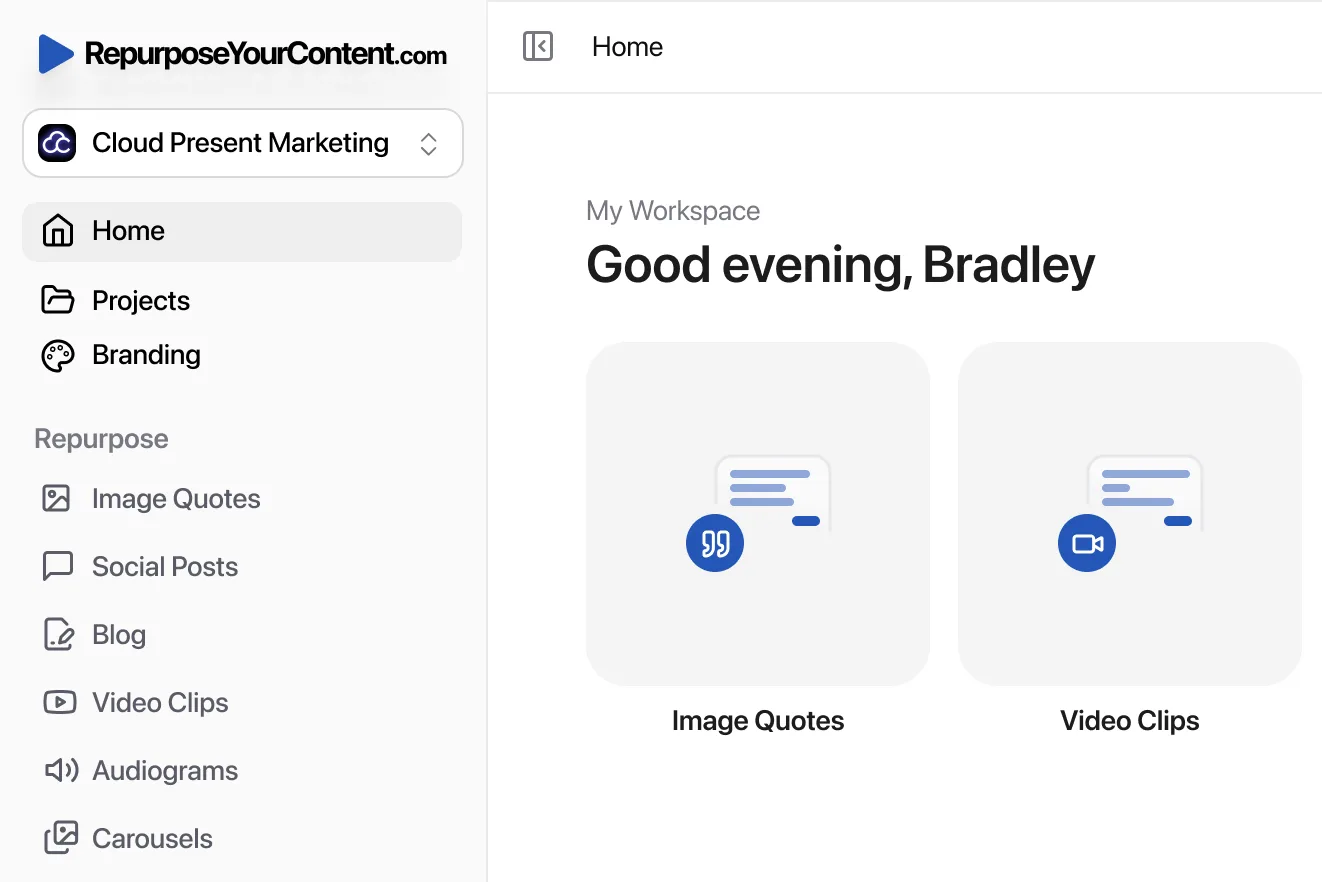
The workflow is straightforward. Upload a session file or pull in a link from a hosting platform. Choose the formats needed. Set volume. Generate the output package. The tool then turns a recording into platform-ready assets such as video clips, blog posts, social posts, audiograms, image quotes, newsletters, LinkedIn carousels, and timestamps.
That matters because event marketers usually need coordinated output, not one isolated asset type. A content library only works when each important session can become multiple publishable formats without requiring a separate production chain for each one.
How product features map to real event needs
The most useful part isn't speed by itself. It's removing repetitive editorial and production work that blocks scale.
A practical event team use case often looks like this:
- One keynote recording goes in
- Short clips come out for LinkedIn and paid retargeting
- A blog post draft appears with a search-friendly structure
- A carousel is generated for skimmable thought leadership
- An email newsletter version is prepared for segmented follow-up
- Image quotes and audiograms are created for lighter distribution slots
- Timestamps are surfaced so editors can review faster
For teams using event platforms and CRM workflows together, clean data flow matters as much as content creation. Anyone dealing with registration records, attendee segments, and follow-up logic will find useful operational context in this guide on streamline attendee data for B2B startups, because content repurposing works best when it connects to audience data rather than sitting in a separate silo.
A short product walkthrough helps make the workflow concrete:
Where this fits in the event stack
RepurposeYourContent isn't an event platform. It's the post-event extraction layer.
That distinction matters. Teams can keep using the platforms they already run events on, then feed the recordings into a workflow designed for content production. For demand gen teams, that means the event stops being a one-day spike and starts feeding the broader demand generation workflow. For teams already hosting in Goldcast, the handoff is even clearer through the Goldcast integration path.
Your 90-Day Virtual Event Content Repurposing Guide Calendar
A six-figure virtual event can produce 30 to 80 usable content assets. Teams that publish half of them in the first week usually burn through attention before the market has time to absorb the message.
The better approach is a 90-day release schedule tied to asset value, buying stage, and production cost. Month one handles fast-turn distribution while the event still has momentum. Month two keeps your channels active without repeating yourself. Month three turns the best sessions into evergreen assets your team can keep using in nurture, search, and sales follow-up.
That shift matters if the goal is a content library, not a replay graveyard.

Days 1 to 30 with extraction and relaunch
The first 30 days set the ceiling for the rest of the program. If the team sends one replay email, posts a few clips, and stops, the event never pays back its production cost.
Start with the sessions that carried the highest investment or the strongest audience response. Keynotes, customer panels, and product-adjacent sessions usually belong at the front of the queue because they can feed more than one channel. Package those first, then release them in sequence.
Strong first-month outputs usually include:
- Thank-you email with curated replay links tied to session interest
- Two or three hero clips from the keynote, customer story, or strongest panel
- One recap blog that gives the event a clear narrative and search value
- Speaker quote graphics for social distribution and retargeting audiences
- Sales-ready snippets mapped to common objections or follow-up use cases
Days 31 to 60 with higher-frequency distribution
Discipline is particularly important. The event is no longer new, so each asset has to work on its own without the event brand carrying it.
Use format rotation on purpose. A short clip can drive reach, but a carousel explains frameworks better. A blog post gives the SEO team something durable. A segmented email can bring back people who registered but never showed up. Treat each top session as a content lane with its own mix of formats, owners, and publish dates.
One rule helps here. Do not release three assets in a row that say the same thing in different packaging.
Days 61 to 90 with long-tail capture
By month three, the strongest material should move out of campaign mode and into infrastructure.
This is when a session becomes a pillar article, a resource center page, a sales leave-behind, or part of a nurture track for new pipeline. Customer clips can support late-stage proof. Educational segments can keep bringing in search traffic long after attendance data stops mattering. That is how a single event starts building a reusable content library instead of a short-lived promo burst.
Here's a practical template to adapt.
| Timeframe | Channel | Content Format | Objective |
|---|---|---|---|
| Week 1 | Thank-you email with curated replay links | Capture immediate post-event intent | |
| Week 1 | Hero clip from keynote | Extend event visibility | |
| Week 2 | Speaker quote graphic | Build authority and shareability | |
| Week 2 | Sales outreach | Session clip with tailored note | Support pipeline follow-up |
| Week 3 | Blog | Event recap article | Consolidate core themes |
| Week 3 | Newsletter | Top insights round-up | Re-engage registrants and non-attendees |
| Week 4 | Carousel from keynote framework | Make complex points skimmable | |
| Month 2 | Blog | Session-derived thought leadership post | Capture search demand |
| Month 2 | Email nurture | Topic-specific follow-up sequence | Move buyers deeper into consideration |
| Month 2 | Social | Audiograms and short clips | Maintain channel cadence |
| Month 3 | Resource hub | Curated content library page | Create evergreen destination |
| Month 3 | Sales enablement | Objection-handling snippets and quotes | Support late-stage conversations |
Teams running this at scale need a publishing system, not a loose list of post-event tasks. A practical editorial calendar template for marketing teams helps assign owners, pace distribution, and keep high-value sessions working for a full quarter.
Measure Impact and Optimise Your Engine
A six-figure virtual event can produce dozens of assets and months of follow-on distribution. If finance asks what that content returned, "good engagement" is not an answer.
The operating model matters here. Teams need one reporting view for event performance and another for library performance, because those assets keep working long after the live date.
Separate event ROI from library ROI
Start with the event itself. Measure registrations, attendance rate, live session engagement, meetings booked, pipeline created during the event window, and influenced opportunities tied to attendee activity.
Then measure the content library as its own system. Track how the repurposed assets perform over 30, 60, and 90 days, and compare that return to the production cost already sunk into the event. That is how a leadership team sees whether the event generated a reusable media asset or just a one-time spike.
The second layer should include:
- Time on page for session-derived articles
- Scroll depth and CTA clicks on recap and thought leadership posts
- Shares, saves, and comments on clips, quote cards, and carousels
- Email click-through rate from post-event nurtures
- Replay conversions compared with live attendee conversions
- Content-influenced pipeline tied to specific sessions, speakers, or topics
Asset-level tracking is where this usually breaks. Every clip, post, article, and nurture email needs consistent UTM structure and naming rules. Without that discipline, demand gen gets the credit, sales gets the anecdote, and the event team cannot prove which parts of the library created pipeline. If you need a tighter framework for attribution and reporting, this guide to content marketing ROI measurement covers the models in more detail.
Optimise the assets that can still earn
Do not judge the whole library by top-line averages. Judge formats against their role.
A keynote clip may be built for reach. A blog post may be built for search and assisted conversions. A customer panel excerpt may be built for sales follow-up. Different assets earn in different ways, so optimisation should match the job.
In practice, underperformance usually comes from packaging, not source material. The opening line on the clip is weak. The article headline is too generic. The social post does not identify the buyer problem fast enough. The transcript was published with light editing, so the argument reads like spoken language instead of a clear written point of view.
A practical review pass looks like this:
- Strengthen attribution and expertise signals with speaker bios, role context, and clear sourcing.
- Rewrite clip hooks so the first sentence states the problem, stake, or surprising point.
- Retitle assets by buyer intent instead of session title.
- Split broad assets into narrower versions for different segments, funnel stages, or industries.
- Retest distribution channels when the asset is strong but the channel fit is wrong.
The trade-off is straightforward. Better editing takes time, but pushing average assets through more channels usually wastes that time anyway.
Measure permissions with the same discipline as performance
Compliance problems usually show up after a team has built momentum and starts publishing at volume. That is why permissions need to sit inside the same workflow as reporting.
The two biggest risk areas are predictable:
- Audience Q&A reused in public content
- Speaker remarks republished outside the original agreed scope
- Customer comments repurposed into promotion or sales collateral
- Email and social edits that remove the context attached to the original consent
Cvent notes that 97% of event organisers are planning virtual or hybrid events in 2024, which makes consent handling a scale issue, not a legal footnote. Teams publishing at that volume need clear speaker release terms, documented approval paths, and rules for whether attendee questions can be quoted, summarised, or only used internally.
I treat permissions as metadata. Every asset should carry status on speaker approval, attendee consent, customer usage restrictions, and channel limits. If that information lives in someone else's inbox, the library will eventually slow down or create risk.
For additional perspective on building a repeatable repurposing operation, review these ReachLabs.ai content insights.
Turn Your Next Event Into a Content Library
A large virtual event shouldn't disappear after the replay email goes out.
The footage, transcripts, arguments, and audience questions can support months of owned media when they're handled like a library instead of an archive. That's the shift that makes a six-figure production budget work harder. The event delivers live value first. The content system extracts the rest over time.
Teams looking to sharpen that system can compare approaches with these ReachLabs.ai content insights on repurposing strategy, then put a repeatable process around their own post-event workflow.
If the goal is to turn one virtual event into a structured library of clips, blog posts, audiograms, social posts, image quotes, newsletters, LinkedIn carousels, and timestamped highlights, try RepurposeYourContent. It gives event marketers the automation layer needed to turn recordings into publish-ready content in minutes, not days.
Tags: