A Webinar Replay Strategy for Lead Generation That Works
Stop letting webinar recordings die. Learn a systematic webinar replay strategy for lead generation that turns one asset into an evergreen pipeline machine.

A common approach involves treating the replay like admin. Teams send one follow-up email, paste in a recording link, and move on.
That wastes a high-intent channel. Around 44% of webinar viewers engage on-demand, which means a large share of total webinar consumption happens after the live session, not during it, according to Univid's webinar statistics summary. A proper webinar replay strategy for lead generation isn't a tidy archive page. It's an evergreen funnel built to convert missed intent into pipeline.
Why Your Webinar Replay Is a Missed Pipeline Opportunity
A webinar does not stop being a pipeline asset when the live session ends. For many teams, the replay is the part that should carry more of the revenue target.
The reason is simple. Live attendance is constrained by calendars, time zones, internal meetings, and last-minute conflicts. Replay viewing happens when a buyer has enough interest to come back and give you 20 to 40 minutes on their own time. That is not passive consumption. It is a strong intent signal.
I see the same mistake over and over in B2B programs. Teams put serious effort into registration, speakers, and reminders, then treat the recording like admin work. They send one generic follow-up, drop the replay into the webinar platform, and call the campaign finished. Pipeline gets left on the table because the highest-intent post-event behavior has no funnel behind it.
The weak replay model
The problem usually shows up in four places:
- Distribution is shallow: One email goes out, then traffic stops.
- The replay has no real conversion path: Viewers can watch, but they cannot take the next logical buying step.
- Sales cannot act on intent: A replay viewer often looks identical to a casual content consumer in the CRM.
- Attribution breaks: Pipeline gets credited to the original webinar, branded search, or direct traffic instead of the replay program that influenced it.
That setup undercounts demand and underfunds the channel.
Practical rule: If the replay has no page, no form, no CTA, and no CRM tracking, it is not a demand-gen asset.
The better model treats the replay as a second campaign with its own traffic plan, conversion logic, and reporting. That is how teams go from "we hosted a webinar" to "we built an evergreen source of qualified pipeline." The recording already exists. The real work is turning it into a system that can capture intent week after week.
This also explains why teams focused on getting more value from webinars after the live event outperform teams that measure success by attendance alone. The live event creates the asset. The replay program determines how much pipeline that asset produces.
For organizations serious about scaling pipeline with automated webinars, this is the shift that matters. Automated and replay-based programs work because they extend reach, standardize follow-up, and create a cleaner handoff between content engagement and sales action.
The missed opportunity is not the recording itself. It is the lack of funnel design around it.
How to Design Your Evergreen Replay Funnel
A replay funnel needs structure. Without that, the recording becomes another buried asset in the content library.
The core path is simple. Discovery brings the right visitor in. The replay page captures intent. The follow-up sequence qualifies it. The offer turns interest into pipeline.

Start with a dedicated replay destination
The replay needs its own page. Not a calendar page. Not a webinar platform archive. A proper landing page.
That page should do four jobs:
- Set context: Tell the visitor exactly what problem the webinar solves.
- Filter intent: Make clear who the session is for.
- Capture or qualify demand: Through a gate, a CTA, or both.
- Route next action: Demo, consultation, product signup, or the next educational asset.
A broader evergreen model is useful here, especially for teams building recurring campaigns instead of one-off replays. This guide to evergreen content strategy for B2B is a good companion for that planning.
Choose gating on purpose
A lot of teams gate because that's what webinar software expects. That's not strategy.
A practical B2B approach is to gate lightly with just name and email, then push that data into the CRM so replay engagement can be tied to influenced pipeline. That matters because registration-to-attendance benchmarks sit at 35 to 50% for B2B webinars, which means there is usually a large no-show audience ready for replay follow-up, according to Winston Francois' webinar strategy guide.
Gated vs. Ungated Replay Strategy
| Factor | Gated Replay | Ungated Replay |
|---|---|---|
| Primary goal | Capture known leads | Maximise reach and consumption |
| Best use case | High-intent demand capture | Broad awareness and SEO support |
| Friction level | Higher | Lower |
| CRM visibility | Stronger | Weaker unless paired with CTA clicks |
| Sales follow-up | Easier to trigger | Depends on downstream action |
| Best form length | Light gate only | No form, stronger CTA placement |
| Main risk | Form abandonment | Anonymous consumption |
The decision usually comes down to campaign intent.
- Use gated replay when the webinar addresses an active buying problem and sales can act on qualified interest.
- Use ungated replay when the topic is category education and the priority is reach, search visibility, or partner distribution.
- Use hybrid access when the page is open but the extras are gated. Examples include templates, checklists, or benchmark summaries tied to the replay.
Add in-replay CTAs
A replay without an in-video CTA underperforms. Viewers should not have to hunt for the next step.
Useful placements include:
- Early CTA: For buyers who already know what they want.
- Midpoint CTA: For viewers who are persuaded by the problem framing.
- End CTA: For those who watch through and need a clean handoff.
The CTA itself should match the webinar's intent. Product-led sessions can push trial or signup. Problem-led sessions often convert better with a diagnostic, consultation, or related asset.
Replay viewers don't need more navigation. They need one obvious next action.
For teams planning to scale this beyond one campaign, this resource on scaling pipeline with automated webinars is worth reading because it shows how replay logic fits into a larger always-on demand engine.
Your Webinar Replay Strategy for Lead Generation Needs Assets
A replay program stalls when the only deliverable is a 45-minute recording on a landing page.
Pipeline comes from asset coverage. Different buyers enter from different surfaces, at different levels of intent, and in different formats. A VP might watch seven minutes after clicking from an email. An IC might find a search-optimised summary post two weeks later. A champion might forward a clipped moment internally because it explains the problem better than a sales deck.

Build an asset set around the replay
Treat the replay as the source file for an evergreen funnel, not a one-off event recap. The goal is coverage across discovery, evaluation, and conversion. If a team only publishes the full video, it forces every prospect into the highest-friction format. That is a distribution mistake, not a content problem.
A practical asset set usually includes:
- Short video clips: Use these for paid social, organic LinkedIn, retargeting, and outbound follow-up.
- Blog post summaries: Capture search demand and give text-first buyers a faster way into the topic.
- Email follow-up copy: Segment for attendees, no-shows, and late-stage nurture.
- Audiograms: Useful when the strongest point is verbal and does not depend on slides.
- Image quotes: Good for partner sharing and low-lift social distribution.
- LinkedIn carousels: Turn the webinar's argument into a skimmable sequence.
- Timestamps: Reduce drop-off by letting viewers jump to the section tied to their pain point.
- Newsletter copy: Extend reach through owned channels without rebuilding the message from scratch.
The asset mix matters because replay viewers behave differently from live registrants. They arrive later, often from a secondary touchpoint, and they need clearer paths into the content. As noted earlier, on-demand viewing is a meaningful share of webinar consumption. Teams that do not build for that audience leave qualified demand sitting in the archive.
How RepurposeYourContent helps
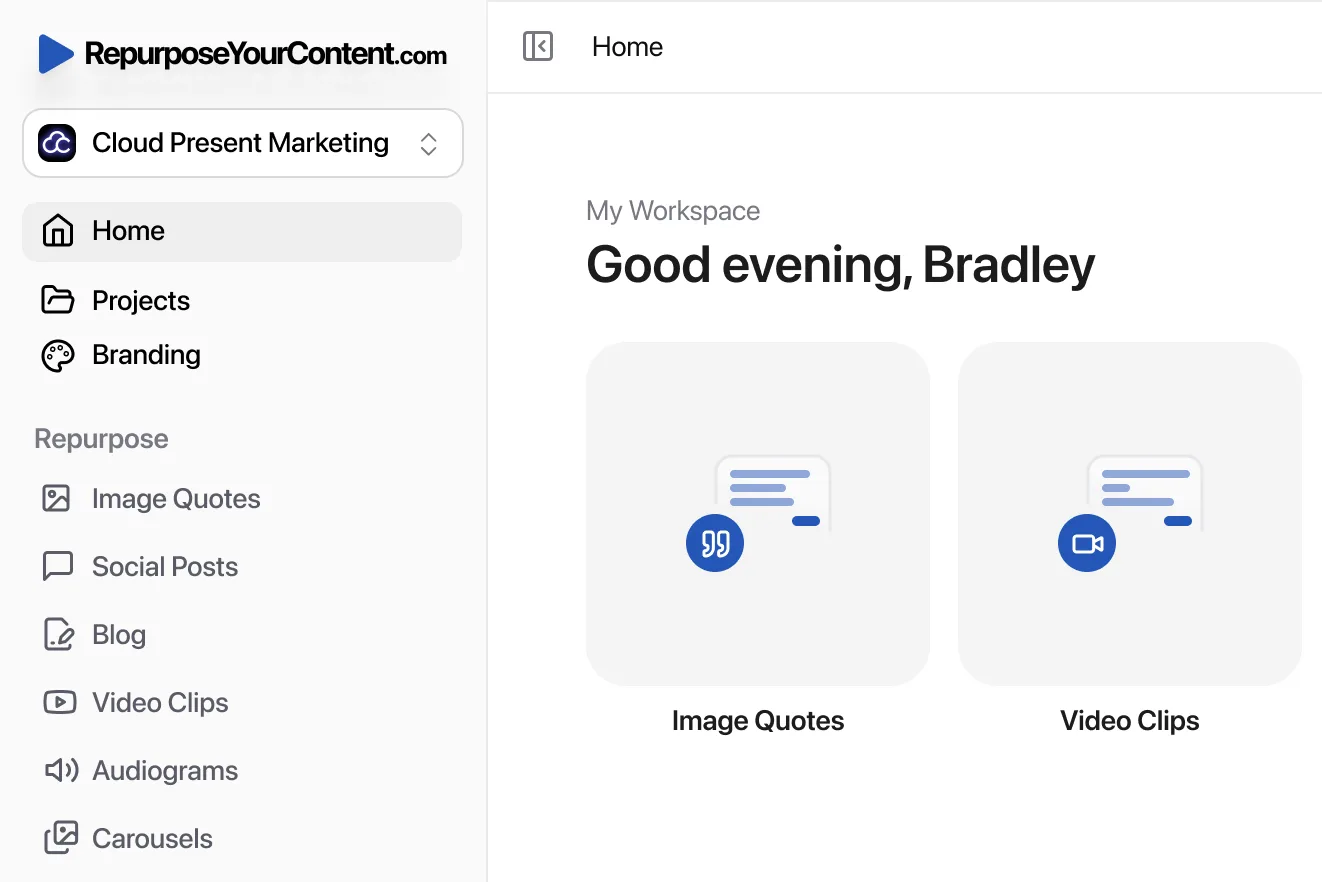
RepurposeYourContent helps teams turn one recording into multiple working assets, including video clips, blog posts, social posts, audiograms, image quotes, newsletters, LinkedIn carousels, and timestamps. That matters in practice because the constraint after a webinar is rarely ideas. It is production time, editorial bandwidth, and speed to distribution.
I have seen replay programs underperform for a simple reason. Marketing published the recording, then moved on to the next campaign. The teams getting more pipeline from webinars usually do the opposite. They treat the recording as the input for a 30-day asset engine and keep shipping variants until reach, engagement, and conversion flatten.
For teams building a full content mix around a single session, this post on how to repurpose a webinar into multiple content formats shows where each format fits.
A useful operating model has three layers:
- Traffic assets bring new people into the replay funnel. Clips, carousels, and quote graphics do that job.
- Conversion assets move interest toward action. Summary posts, newsletters, and follow-up emails usually carry more of that load than the video itself.
- Navigation assets reduce friction once someone lands. Timestamps and chaptering help buyers self-qualify fast instead of bouncing.
If the team needs a repeatable editing workflow, this guide on how to create short YouTube video clips is useful because the same clipping decisions apply to webinar highlights.
The replay page captures intent. The asset library creates enough entry points for intent to show up consistently.
Your 30-Day Replay Promotion and Distribution Plan
Most replay campaigns die because promotion stops after day two.
A stronger approach is to spread distribution across a month. That keeps the replay active long enough to capture no-shows, delayed buyers, internal pass-alongs, and search traffic.
A simple visual plan helps keep the cadence organised.

Week 1 gets the obvious demand
The first week should focus on people who already raised their hand.
- Attendees: Send a thank-you email with the replay, key moments, and the next CTA.
- No-shows: Send a separate message. Don't pretend they attended. Lead with the problem they signed up to solve.
- Sales team: Give sales the replay link, timestamps, and one-line positioning so they can use it in follow-up.
- Landing page: Publish the dedicated replay page immediately.
This is also the right point to build a simple nurture path. Teams that need a structured follow-up workflow can pair the replay with email sequences built for webinar follow-up.
A short operational example works well here:
- Step 1: Publish the replay landing page with one CTA.
- Step 2: Send separate emails to attendees and no-shows.
- Step 3: Add engaged viewers into a nurture or sales follow-up path.
Week 2 turns the recording into distribution
The second week should widen reach through derivative content.
Post a clip focused on one sharp takeaway. Then post a carousel that reframes the webinar as a written argument. Follow with an image quote or audiogram for a different audience segment.
This is also where social lead capture discipline matters. Teams refining that channel can use this guide for better social media leads to tighten post structure, CTAs, and follow-up.
Before moving into paid support, a practical content workflow helps:
Weeks 3 and 4 keep the replay working
By week three, the campaign should shift from launch momentum to sustained visibility.
- Week 3: Amplify the posts that already pulled replies, clicks, or strong watch behaviour. Use paid support carefully, not blindly.
- Week 4: Push through partner newsletters, customer marketing, sales outreach, and related website placements.
- End of month: Review asset performance and keep the replay active if the topic stays relevant.
For a broader content system around this cadence, this demand generation content playbook gives a useful planning model.
How to Measure Replay Performance and Attribute Pipeline
Webinar replays lose budget for one simple reason. Teams can see live registrations in the CRM, but replay influence sits in a blur of page views, video data, and unattributed conversions.
That reporting gap changes decisions. If leadership cannot tie the replay to sourced pipeline, influenced opportunities, or shorter sales cycles, the replay gets treated like leftover content instead of an evergreen acquisition channel.

Track the right replay KPIs
Start with funnel metrics that explain progression, not vanity numbers.
A replay page can attract plenty of visits and still produce very little pipeline if viewers never start the video, abandon after two minutes, or skip the CTA. The job is to measure each handoff from visit to view to action to opportunity.
Track these six first:
- Replay landing page views: Shows whether distribution is driving qualified traffic.
- Form conversion rate: Matters for gated replay and tells you whether the value exchange is strong enough.
- Replay starts and watch behaviour: Confirms whether the headline, page copy, and opening minutes match buyer intent.
- In-replay CTA clicks: Measures commercial movement, not just content consumption.
- Lead creation by source: Separates replay-generated demand from live webinar demand.
- Opportunity creation and influenced pipeline: Shows whether replay leads enter the sales process.
In practice, I care most about the middle of the funnel. Page views are easy to get. CTA clicks, meetings booked, and opportunity creation tell you whether the replay is functioning like a pipeline asset.
Use attribution logic your team will actually maintain
Replay attribution does not need a complicated model. It needs a clean one.
A setup that works for most B2B teams includes:
- A dedicated CRM campaign for the replay, separate from the live webinar campaign.
- UTM-tagged links for each channel, including email, paid social, organic social, partner traffic, and sales outreach.
- A replay form field or source marker that assigns new leads to the replay campaign at conversion.
- A CTA destination mapped to revenue actions, such as demo requests, contact sales, or consultation bookings.
This structure answers the operational question that matters. Did the replay create pipeline on its own, or did it influence pipeline that would otherwise be hidden under generic content or direct traffic?
There is a trade-off here. First-touch attribution makes replay look stronger for net-new leads. Opportunity influence gives replay more credit in longer sales cycles. I usually use both, then report them separately. That keeps the conversation honest and prevents one model from overstating performance.
One rule should stay fixed: keep live webinar reporting and replay reporting separate. If both sit inside one campaign, the live event absorbs the credit and the replay never earns more investment.
If your team needs a broader framework, this guide to webinar metrics and KPIs to track is a useful reference.
Your Replay Lead Generation Checklist
A replay programme works when the recording becomes a system, not a follow-up task.
Use this checklist before the next webinar goes live.
Build the funnel before the event ends
- Create the replay landing page early: Don't wait until after the webinar.
- Decide the CTA upfront: Demo, consultation, signup, or a next-step asset.
- Set up CRM tracking: Campaign structure should exist before traffic arrives.
Pick access based on intent
- Use gated replay for high-intent topics: Keep the form short.
- Use ungated replay for reach-first campaigns: Let the CTA do the qualification.
- Use hybrid access where needed: Open video, gated bonus asset.
Produce the asset set, not just the recording
- Create clips for social: The replay needs top-of-funnel entry points.
- Create follow-up emails: Separate no-shows from attendees.
- Create text assets: Blog summaries, newsletter copy, and carousel copy expand reach.
- Create timestamps: They reduce friction for buyers who only need one section.
Run distribution for a full month
- Week 1: Follow up with registrants and attendees.
- Week 2: Push clips, carousels, and quote graphics.
- Week 3: Amplify what already worked.
- Week 4: Extend through partners, sales, and owned channels.
Prove impact in the CRM
- Track replay page visits and form conversions
- Track in-replay CTA clicks
- Track lead creation from replay sources
- Track opportunity creation and influenced pipeline
Many teams already have the webinar. What they don't have is the replay system.
Try RepurposeYourContent to turn one webinar recording into the clips, posts, emails, carousels, audiograms, quotes, newsletters, and timestamps needed to run a real replay programme.
Tags: