YouTube Content Repurposing Workflow from Webinars
Build a YouTube content repurposing workflow from webinars. Turn 1 hour of video into a full YouTube library of clips, Shorts, and SEO-driven assets.

Most webinar teams still treat YouTube like cold storage. The replay gets uploaded, the thumbnail is whatever YouTube grabs, and the channel goes quiet again.
That wastes more than distribution. Industry analysis says only about 20% of webinar content ever gets repurposed, which means roughly 80% of the prep time, speaker expertise, and audience insight often goes unused, according to Affirma's webinar repurposing analysis. For B2B teams, that unused material should become a searchable YouTube library, not a forgotten recording.
Your Highest-Value Content Is Hiding in Plain Sight
A webinar already contains the raw material for a YouTube channel. It has a core topic, clear audience intent, speaker credibility, objections, examples, and audience questions. Content producers frequently package all of that into one long video and stop there.
That's the mistake.
A proper YouTube content repurposing workflow from webinars turns each session into an evergreen content asset. Not social filler. Not clip spam. A real library built around buyer questions.
Why YouTube deserves a different workflow
LinkedIn is useful for distribution. Email is useful for activation. The blog is useful for owned search. YouTube does a different job. It can keep answering the same category question long after the live event is over.
That matters because webinar content is naturally structured for search:
- Problem-led topics often match what buyers already search for
- Speaker explanations work well as standalone educational videos
- Q&A segments map cleanly to FAQ-style content
- Demo moments can become practical how-to clips
Practical rule: If a webinar covered five meaningful questions, it already contains five possible YouTube videos.
The missed opportunity isn't just reuse
The focus is often on extracting more assets. The better frame is building a long-life content system.
A full webinar replay helps people who already know the brand and want the complete session. A topic clip helps a buyer who searches for one specific answer. A Short helps create first contact. A blog post supports the same topic in owned search. Together, that's a distribution stack.
The value comes from sequencing those assets, not from producing the maximum number of them.
Why Posting the Full Replay Kills Your YouTube Channel
A full replay has a role. It should not be the whole strategy.
Wistia's 2025 webinar repurposing case study found that 70% of total views happened after the live event through on-demand content within three months, and the replay embedded in a blog post converted 17% of viewers. The full finding appears in Wistia's 2025 state of video and live repurposing case study. That proves on-demand value is real. It does not prove that one unedited YouTube upload is enough.
What the full replay gets wrong
A sixty-minute recording asks too much from a first-time viewer. The title is usually broad. The opening includes housekeeping. The strongest explanation may not appear until deep into the session. Search intent gets buried.
For YouTube, that creates three problems:
- Weak packaging because the title has to describe an entire webinar, not one clear question
- Low discoverability because one video can't target every useful subtopic well
- Poor viewer flow because new viewers rarely want the whole session first
A replay is an archive item. A YouTube channel needs assets designed for selection.
Why search intent gets lost
B2B teams often run webinars with titles such as “2025 Demand Gen Trends” or “How Modern RevOps Teams Scale”. Those titles work for event registration. They're less effective for YouTube if the core value inside the webinar is buried in segments like pipeline attribution, handoff design, or lead scoring mistakes.
Those segments should each become their own video.
That's where most channels stall. They publish the webinar once, then wonder why the topic never compounds. A better model is to treat the replay as the source file and publish several audience-specific outputs from it.
Teams that need a cleaner clipping process can also review practical guidance on how to clip a YouTube video for reuse.
The replay should sit at the bottom of the funnel for viewer commitment, not at the top.
What works better on YouTube
A webinar-derived channel usually performs better when it includes a mix of formats:
| Format | Role on the channel | Best use |
|---|---|---|
| Full recording | Complete reference asset | Existing interest, branded traffic |
| Topic clips | Searchable educational videos | Mid-intent discovery |
| YouTube Shorts | Fast attention and reach | First touch, hook, retargeting support |
| Highlight reel | Quick summary of value | Campaign promotion, channel trailer support |
This doesn't require more source material. It requires better editorial decisions.
The Complete YouTube Content Repurposing Workflow from Webinars
The workflow needs to be repeatable. If it depends on creative energy after every live event, it won't last. The simplest system starts before the webinar is even recorded and ends with scheduled assets across formats.

Step 1 Record for repurposing, not just the live room
The live webinar should be planned with post-event editing in mind. That means clean audio, strong opening statements, and verbal signposting between topics.
Useful prep includes:
- Question-led agenda design so each segment can stand alone later
- Cleaner speaker transitions to avoid awkward clip starts
- Intentional Q&A prompts because audience questions often become the strongest YouTube titles
- Visual discipline so slides don't feel chaotic when cut into separate clips
If the webinar meanders, the repurposing team inherits the mess.
Step 2 Publish the full recording with chapters
The full upload still matters. It's the canonical long-form asset. It should be organised for bingeable navigation, not dumped into YouTube with one paragraph of generic copy.
A strong full recording setup includes:
- A specific title that names the audience and topic clearly
- A custom thumbnail with one idea, not ten
- Chapter markers and timestamps so viewers can jump to relevant sections
- A description that lists major questions answered in the session
- A clear CTA to the next asset, such as a related clip or blog post
Teams that need a planning template for the full workflow can use this content repurposing workflow diagram template.
Step 3 Pull out 5 to 10 minute topic clips
This is usually the highest-value layer for B2B YouTube. Each clip should answer one distinct buyer question. Not a random highlight. Not a montage.
Good clip candidates often come from:
- a strong explanation of a recurring problem
- a tactical walkthrough
- a sharp answer in the Q&A
- a disagreement with common practice
- a framework the audience can apply immediately
A weak clip starts with context nobody has. A strong clip opens with the answer or the tension.
Editorial filter: If a prospect watched only this segment, would it still make sense and still feel useful?
For titles, specificity matters more than cleverness. “How to structure webinar follow-up content for YouTube search” is stronger than “Webinar marketing tips”. The first promises an outcome. The second says almost nothing.
Step 4 Create Shorts without cannibalising the longer videos
Shorts are useful, but they're easy to misuse. Many teams cut isolated moments that get attention and generate nothing else. The better use is to create a teaser for a larger topic already published as a clip or full recording.
Shorts work best when they do one of three things:
- State a surprising claim tied to the webinar theme
- Answer one narrow question in a punchy way
- Pull one quote or objection that makes viewers want the longer explanation
The goal isn't to summarise the whole webinar in under a minute. The goal is to create interest and route viewers into the deeper library.
Step 5 Package every asset for selection
Packaging decides whether a good clip gets watched. Most B2B teams underinvest here.
Use this checklist:
Thumbnail
Keep it simple. One concept. High contrast. Minimal text. Face plus problem works well when the speaker is recognisable.Title
Lead with the question, pain point, or job to be done. Avoid event wording like “webinar replay” unless it's the full recording.Description
Add supporting context, target terms naturally, and point viewers to the next relevant asset.End screens and cards
Connect Shorts to topic clips, and topic clips to the full webinar or a related playlist.
Step 6 Schedule by intent, not by file type
Don't publish the replay, three clips, and six Shorts on the same day. Spread them based on audience use.
A practical publishing sequence looks like this:
| Asset | Publish role | Timing logic |
|---|---|---|
| Full webinar replay | Reference library asset | First |
| Best topic clip | Search and mid-intent discovery | Early |
| Second and third clips | Build topical depth | Following days or weeks |
| Shorts | Spark first contact | Around clip releases |
| Blog post based on transcript | Owned search and conversion path | After strongest clip is live |
A simple operating example
A webinar on B2B attribution can become a compact YouTube release plan.
Step 1. Upload the full session with chapters such as “first-touch limits”, “self-reported attribution”, and “reporting by buying stage”.
Step 2. Cut one clip on attribution model mistakes.
Step 3. Cut another on how to use sales call insights in reporting.
Step 4. Turn the sharpest answer from Q&A into a Short.
Step 5. Publish a blog post that embeds the replay and links to the two clips.
That's not just repurposing. It's a system for building a topic cluster on YouTube.
Structuring Your YouTube Channel for a Webinar Library
A webinar-derived YouTube channel falls apart when everything lands in one feed with no logic. Viewers don't know where to go next. YouTube also gets fewer signals about topic relationships across the channel.

Use a hub and spoke playlist model
The cleanest structure is a hub and spoke setup.
The hub is the full webinar playlist. It holds complete replays for viewers who want depth, branded prospects, and people coming from email or direct traffic.
The spokes are thematic playlists built from clips across many webinars. Examples include lead generation, webinar follow-up, RevOps reporting, sales enablement, or content operations. Those playlists matter more than date-based organisation because buyers search by problem, not by event month.
Build a clear viewer path
The channel homepage should guide people from low commitment to high commitment.
A simple path looks like this:
- Shorts shelf for quick discovery
- Featured topic playlists for mid-length educational clips
- Full webinar playlist for deeper viewing
- Popular uploads for social proof and fast selection
That structure helps viewers self-qualify. Someone who finds a Short can move into a ten-minute clip. Someone who trusts the clip can watch the full session.
A YouTube channel should feel like a resource centre, not a dumping ground for event files.
Organise around buyer problems
Too many B2B channels use internal labels. “Webinar Series 4” means nothing to a buyer. “How to measure campaign influence” does.
Channel structure should follow external demand. That also improves how the team thinks about thumbnails, titles, and related videos. Stronger video packaging usually starts with stronger categorisation.
For deeper guidance on packaging and discoverability, this guide to video SEO best practices for 2026 is worth reviewing.
Automating Your YouTube Library with RepurposeYourContent
A webinar repurposing workflow breaks when it depends on manual judgment at every production step. Teams can plan the right strategy, then lose momentum in the handoff from recording to clips, metadata, publishing, and cross-channel reuse.

The bottleneck is not editing alone. It is the repeated editorial work around every webinar: finding the segments worth turning into searchable videos, packaging them for YouTube, and pushing the same source material into blog, email, and social formats without creating a second content operation.
That workflow needs automation with clear boundaries. Univid's analysis of AI-driven webinar repurposing workflows points to the same operational problem. Teams can produce more assets than they can package, review, and publish well.
What automation should handle
Good automation removes repetitive production work and preserves human review where judgment still matters. For a webinar-to-YouTube system, I want the tool to handle the first draft of execution, not the final editorial call.
That usually includes:
- Clip identification based on topic changes, audience questions, and strong answer segments
- Chapter timestamps for the full webinar replay
- Title and description drafts built around search intent, not internal event names
- Transcript reuse for blog posts, social copy, and email follow-up
- Format expansion into audiograms, image quotes, LinkedIn carousels, and short-form video assets
Technical teams sometimes push further and automate publishing logic, metadata mapping, and API-based distribution. If you are building that layer, Mallary.ai's guide to mastering the YouTube API is a useful operational reference.
Where one platform fits
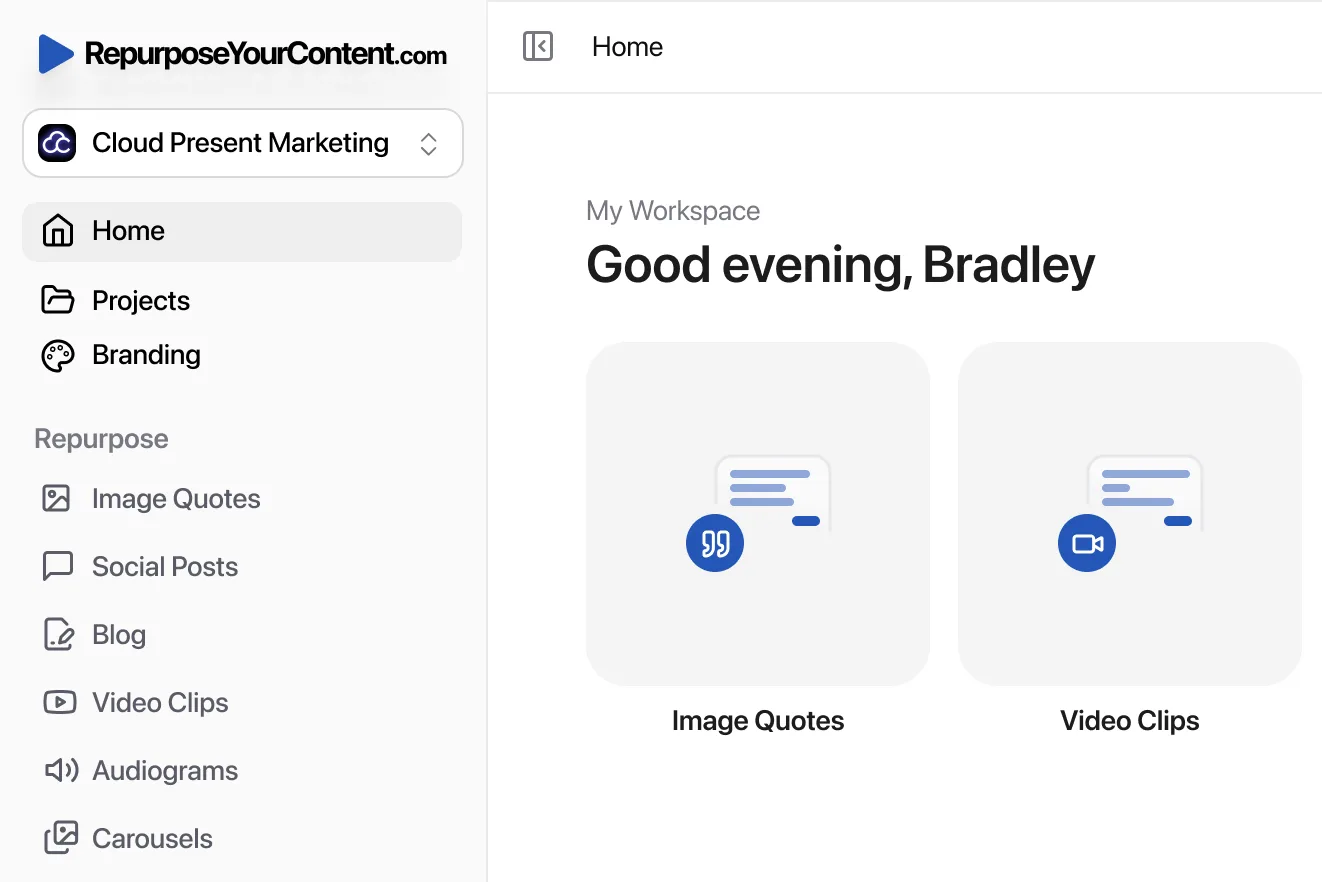
RepurposeYourContent's YouTube integration supports this kind of system. It turns one webinar source into multiple downstream assets, including clips, blog drafts, social posts, audiograms, image quotes, newsletters, LinkedIn carousels, and timestamps.
The practical value is not volume for its own sake. It is consistency. A B2B team can turn each webinar into a repeatable set of YouTube assets, then build an evergreen library around recurring buyer problems instead of treating every event as a one-week campaign.
A working production flow usually looks like this:
- Upload the webinar recording or source link.
- Choose the outputs for that campaign.
- Review the suggested clips and topic clusters.
- Approve timestamps, titles, and draft copy.
- Publish the YouTube assets, then distribute the related blog and social derivatives.
The trade-off is simple. More automation speeds throughput, but weak review standards can flood the channel with generic clips. The better approach is to automate first-pass production, keep human review on packaging and prioritization, and publish fewer videos with clearer search intent.
That is how webinar content starts compounding on YouTube. One event produces a replay, several searchable long-form clips, supporting short-form assets, and written derivatives that keep sending qualified viewers back into your funnel over time.
Measuring the Pipeline Impact of Your YouTube Content
Views matter, but they don't answer the fundamental question. The fundamental question is whether webinar-derived YouTube content creates qualified interest and helps move buyers forward.

Most repurposing guides focus on making assets, not attributing business impact across YouTube, LinkedIn, and website paths. That measurement gap is called out in ContentFries' webinar content repurposing guide.
What to track first
Start with metrics that show commercial movement, not platform vanity.
Track these as a minimum:
- Traffic to owned properties from YouTube descriptions, end screens, and linked resources
- Topic-level performance by clip, not just channel-wide totals
- Search-led discovery for key educational videos
- Assisted conversions where viewers later convert through the site
- Content-to-webinar feedback loops that influence future event topics
A practical measurement model
Use three layers.
Channel layer tracks overall watch patterns, subscription trends, and repeat topic demand in YouTube Studio.
Asset layer tracks which specific clips drive site visits, demo interest, content downloads, or replay views.
Pipeline layer connects those visits to CRM stages using campaign naming, consistent UTM rules, and clean source grouping. Teams that need a stronger reporting model can review this guide to content marketing ROI measurement.
Measurement rule: Don't ask whether YouTube generated pipeline in general. Ask which webinar-derived topics created qualified actions.
What good analysis changes
Analytics should shape the next webinar calendar.
If Q&A clips outperform polished intros, create more FAQ-led sessions. If one category keeps driving search traffic, build a playlist around it. If short teaser content gets attention but no site movement, tighten the connection between Shorts and longer topic clips.
That's how YouTube stops being an awareness side project. It becomes part of the demand engine.
If the goal is to turn webinar recordings into a structured YouTube library, try RepurposeYourContent and start building the workflow around clips, chapters, posts, and cross-channel assets from each session.
Tags: