7 Best Podcast Clip Formats for TikTok
Compare the best podcast clip formats for TikTok, with ideal lengths, editing tips, posting cadence, and conversion guidance.

Longer TikTok clips can outperform ultra-short snippets, with clips over 60 seconds delivering at least 43.2% more reach and 63.8% more watch time in a 2025 analysis. The three most reliable podcast formats remain hot-take talking heads, storytime arcs, and question-hook openers, because hot takes tend to generate comments, storytimes tend to hold completion, and question hooks tend to earn shares and saves.
Your best recording may be buried in the middle. A strong guest answer often arrives after the polished introduction, the sponsor read, and several minutes of setup.
The practical problem is extraction. Finding the moment, editing it, captioning it, formatting it vertically, and posting it can take 2 to 3 hours per recording for a small team. That cost makes consistency difficult, even when the source material is strong.
The first edit matters most. Open mid-sentence at the sharpest line. Put the stakes in the first-frame text. Add a punch-in or cut within the first second. Make the voice arrive within the first half second.
TikTok content needs to feel native. A podcast clip shouldn't look like radio placed on a phone screen. It needs visual movement, crisp audio, readable captions, and a complete idea.
These seven best podcast clip formats for TikTok cover reach, retention, shares, saves, and authority. They also include a weekly production workflow, cadence guidance, and an honest view of TikTok-to-listener conversion. Teams looking to repurpose podcast episodes can use the same system for interviews, keynotes, sales calls, livestreams, and courses.
1. Hot-Take Talking Head With Bold Captions
Hot-take talking-head clips are the strongest format for comment activity. One speaker makes an arguable claim, then supports it with a concise explanation. Disagreement creates replies. Strong agreement creates shares.
A founder saying, “Most startup advice is wrong,” creates an immediate position. A marketer claiming that cold email outperforms paid ads creates a reason to challenge the speaker. A guest declaring that an MBA is a waste of money gives viewers a clear argument to accept or reject.
The ideal length is 15 to 45 seconds, depending on how much proof the claim needs. The 15 to 30 second range recorded the highest engagement rate at 6.00% in separate 2026 benchmark data, ahead of 0 to 15 seconds at 5.90%. Socialinsider's TikTok video length analysis also reports that clips over 54 seconds reached 6.7% engagement, compared with 6.0% for clips under 10 seconds. Those results point to two useful modes, tight claims and fuller arguments.
Edit the disagreement into the opening
Don't begin with the speaker clearing their throat or explaining the topic. Start when the claim lands. Use large, high-contrast captions and highlight the most provocative words.
Word-by-word captions help muted viewers follow the argument. Keep each caption chunk short enough to scan, with guidance recommending 3 to 7 words per chunk. Caption timing and visual pacing guidance recommends a hook in the first 0 to 3 seconds, multiple camera angles, and cuts every 3 to 7 seconds.
- Audio: Normalize loudness for phone speakers, remove low rumble, and keep speech slightly forward.
- Visuals: Add two or three punch-ins or color shifts across a longer clip.
- CTA: Ask a direct question, such as “Disagree? Explain why.”
- Measurement: Track the comment-to-view ratio for a month on the same account.
The captions should support the argument, not cover the speaker's face. Teams can use this guide on how to add captions to video clips when standardizing the edit.

2. Storytime Arc With a Setup and Payoff
Storytime clips work because viewers want to know what happened. The speaker starts with a problem, builds tension, and ends with a clear lesson. The clip must complete the story. A teaser without a payoff usually feels like an advertisement.
A salesperson might explain how a deal nearly collapsed, then reveal the question that saved it. A founder might describe the moment the company nearly shut down, then explain the decision that changed its direction. A marketer might recount a campaign failure, then give the lesson that shaped the next launch.
The most useful length is 30 to 45 seconds. TikTok-specific podcast guidance commonly places strong clips around 21 to 34 seconds, while broader guidance positions hot takes around 30 to 45 seconds and context-heavy clips around 50 to 80 seconds. Platform-optimized podcast clip guidance warns that retention can fall sharply past roughly 90 seconds, so longer stories need a strong payoff.
Protect the narrative rhythm
The setup should move quickly. Keep it within roughly 10 to 12 seconds when possible. Remove silence and breaths at the opening. The first spoken word should arrive within half a second.
Caption the emotional beats more heavily than filler language. “I lost the client” deserves more visual emphasis than a transitional phrase. Jump cuts, B-roll, and controlled punch-ins can prevent a static hold from slowing the story.
Practical rule: If the story needs a second clip to explain the ending, the first clip isn't complete enough.
Audio quality matters because emotional stories lose force when speech sounds distant. Normalize the voice, remove rumble, and keep dialogue crisp. Use this long-form video repurposing workflow to mark complete problem-to-lesson segments during episode review.
Don't assign a format-specific completion target without baseline data. Instead, compare storytime completion against the other formats on the same account. Completion rate is the main signal, while saves and shares show whether the lesson had lasting value.
3. Question-Hook Opener That Answers the Viewer
Question-hook clips open on the exact question the segment answers. That structure creates a clear contract. The viewer knows what the clip promises and stays to collect the answer.
Examples include, “What's the best cold email subject line?” followed by a practical explanation. A founder can answer, “How do you know when a startup is ready to fundraise?” A growth marketer can respond to, “What's the fastest way to get your first customers?” Each clip should deliver a complete answer, not stop before the useful part.
The ideal length is usually 20 to 45 seconds. A direct question may need only 20 seconds. A framework, checklist, or example may need more. The 15 to 30 second engagement benchmark supports short answer-driven clips, but longer clips can work when the answer requires context.
Put the question on screen immediately
The question should appear in the first frame. Use a readable font, high contrast, and enough space around the lower TikTok interface. Captions should follow the spoken rhythm and remain visible long enough to read. Guidance recommends subtitle timing of about 1.2 to 2.0 seconds, while other recommendations place the usual sweet spot at 2 to 3 seconds. TikTok subtitle timing guidance provides both timing considerations.
Don't open with “In this episode, we asked.” That delays the answer. Start with the question, then deliver the clearest response. End on the takeaway rather than cutting away mid-explanation.
- Best source moment: A host question followed by a complete guest answer.
- Best visual treatment: Speaker close-up, question text, word-timed captions.
- Best CTA: “Save this framework” or “Send this to someone solving this problem.”
- Best metric: Shares and saves per view.
Question hooks work especially well for B2B content because buyers often search for practical answers. Teams can package the same segment using these podcast clips for social media principles without turning the clip into a full episode replacement.

4. Split-Screen Reaction or Debate Moment
Split-screen debate clips create movement through interaction. Two speakers react, disagree, or challenge an assumption. The format feels less scripted than a prepared monologue, especially when the reaction begins immediately.
A host and guest debating a sales tactic can work well. So can two founders reacting to a market development, or a skeptic and believer arguing about remote work, artificial intelligence, or another contested topic. The subject matters less than the visible tension.
The reaction should arrive within the first 3 seconds. Open on the interruption, raised eyebrow, sharp disagreement, or unexpected answer. Don't spend the opening setting up the debate.
Make vertical composition do the work
A split-screen layout must remain readable on a phone. Keep both faces large enough to identify. Speaker names or roles should sit in consistent positions, with different caption colors or sides for each person.
Audio balance matters more than decorative design. Normalize each speaker separately if one voice is quieter. Remove room rumble and avoid music that competes with fast dialogue.

The background should look consistent across both frames. Poor cropping, mismatched lighting, or tiny faces make the clip feel accidental. A clean vertical composition supports the argument and helps viewers track who is speaking.
The following example shows how a debate moment can carry the clip visually:
This format often generates comments because viewers choose sides. That doesn't make it a universal winner. Debate can increase discussion while producing fewer saves than a useful answer. Track comments, shares, and profile visits separately.
5. Expert Tip in a Rapid-Fire Format
Rapid-fire expert clips deliver one actionable idea in 15 to 30 seconds. They fit practical guests, tactical interviews, and founder conversations. Focus each clip on one narrow problem, such as a hiring mistake or weak cold-email opening.
A useful opener could be, “The biggest hiring mistake is skipping this interview question.” The speaker names the question, gives the action, and explains why it matters. Another option is, “Stop sending cold emails like this,” followed by one replacement framework.
Keep one tip intact
Cut the setup. Keep the reasoning that makes the tip actionable. Viewers need to understand the problem, the action, and the reason behind it.
In rapid-fire clips, let the bold on-screen text carry the tip so the caption can stay minimal. One line per beat is enough. Time each text change to the speaker's delivery, especially when the clip moves from the problem to the instruction.
- Opening: State the problem or consequence.
- Middle: Give the exact action.
- Ending: Repeat the memorable tip or invite a save.
- Audio: Keep speech crisp and slightly forward.
- Visuals: Use a small punch-in when the instruction lands.
A caption CTA such as “Save this before the next interview” matches the format. It points viewers toward a practical next step.
The video podcast repurposing workflow can help teams tag tactical moments during editing. Mark the problem, action, and explanation while reviewing the episode, then cut each complete tip into its own clip. This reduces sorting time without forcing several ideas into one edit.
Production is efficient because the format needs little narrative setup. It may produce fewer comments than a controversial claim, while generating stronger save or share signals. Track saves, shares, profile visits, and branded search separately, since conversion rates vary by audience.
6. Surprising Stat or Contrarian Data Point
A surprising statistic can stop a TikTok scroll, but only when viewers can understand and verify it quickly. Unverified statistics damage credibility more than a sloppy cut would. Confirm the source before recording captions or scheduling the post.
One usable opening is 73% of B2B marketers identify recordings as their top source of quality leads, while only 1 in 3 teams have a scalable repurposing process. The tension speaks directly to teams already producing podcasts, interviews, and keynotes. Keep the claim tied to a practical implication, such as improving content operations or reviewing how recorded conversations become usable clips.
Aim for 20 to 40 seconds. Show the number in large text during the first frame, then explain what it means in plain language. Add the source on screen when external research supports the claim. Use one statistic per clip so viewers have time to process it, especially those watching with sound off.
Make the evidence easy to verify
Captions should match the spoken claim. Do not introduce a second version of the number or stack several findings into one edit. A founder can use a verified customer insight to question a growth assumption. A host can follow the statistic with, “Did this change how you see the problem?” That question invites interpretation without forcing a debate.
- First frame: Show the number and its implication.
- Audio: State the claim clearly.
- Context: Identify the source when applicable.
- Ending: Ask a question or invite a save.
- Measurement: Track shares per view and profile visits.
A companion graphic can follow an image quote creation guide, but the TikTok edit should stay video-first. Keep charts simple enough to read while scrolling. Plan the clip within a standard 48-hour turnaround if it is part of the standard production workflow, including source checking, captions, review, and export.
This format can build authority and shares, but conversion rates vary by audience. Track profile visits separately from leads, and never publish an invented benchmark or unsupported conversion claim.

7. Before-and-After Transformation Moment
Transformation clips show a shift from one state to another. The speaker starts with the problem, explains the change, and ends with the new belief, process, or outcome.
A founder can describe pre-product-market-fit chaos, then explain the operational clarity that followed. A marketer can compare a failed cold email approach with a more systematic process. A guest can explain how a belief changed after confronting evidence.
The format works because contrast creates structure. Viewers understand where the speaker started and why the change matters. The clip shouldn't circle back to the problem after reaching the conclusion.
Let the contrast register
Open with the “before” state and its emotional weight. A line such as “We were losing deals because every salesperson used a different process” creates a concrete problem. Add a short pause before the “after” state, then change the speaker's pacing or energy.
Use simple labels such as Before and After when they clarify the story. B-roll can show the contrast, but it shouldn't distract from the speaker. Keep the final sentence focused on the new state or lesson.
The format usually suits 30 to 45 seconds when the contrast needs context. Shorter versions can work when the transformation is obvious from one sentence. Longer versions require a stronger payoff, because TikTok viewing behavior varies by structure rather than length alone.
Track saves and shares alongside completion. Transformation stories can create useful reference content, but they may not attract debate. The right outcome depends on whether the clip is meant to build trust, teach a process, or drive listeners to the full episode.
7-Format Comparison: Podcast Clips for TikTok
| Format | Implementation complexity | Resource requirements | Expected outcomes | Ideal use cases | Key advantages |
|---|---|---|---|---|---|
| Hot-Take Talking Head with Bold Captions | Low–Medium, single angle, punchy edits | Minimal gear; careful audio mix; bold caption timing | Very high reach & comment volume; fast completion; ~2–4% conversion | Controversial opinions, engagement spikes, viral hooks | Maximizes debate and shareability with low production overhead |
| Storytime Arc (Setup‑Payoff Narrative) | Medium, tight pacing, narrative assembly, possible B-roll | More editing time; audio normalization; optional B-roll | Highest completion rates; quality engagement (saves/follows); ~3–6% conversion | Relatable lessons, founder stories, case studies | Strong retention and memorable payoff that drives follows |
| Question‑Hook Opener (Answer‑Driven Format) | Low, trim and overlay question, deliver full answer | Clean audio; on‑screen question text; caption sync | High shares & saves; self‑contained value; ~2–5% conversion | Q&A clips, how‑to frameworks, quick reference content | Easily shareable, cross‑platform, and simple to batch produce |
| Split‑Screen Reaction or Debate Moment | Medium–High, compositing and sync, two sources | Two clean cameras/mics; audio balancing; speaker IDs | Strong reach and comment replication; ~2–4% conversion | Debates, pushback moments, reaction highlights | Authentic visual variety and tension that boosts algorithmic lift |
| Expert Tip or Actionable Insight (Rapid‑Fire) | Low, short focused edits | Clear tip content; bold overlay; crisp audio | High completion and saves; authority building; ~3–5% conversion | Quick tactics, professional communities, batch tips | Fast to produce, highly usable, builds perceived expertise |
| Surprising Stat or Contrarian Data Point | Low–Medium, stat overlay and verification | Verified source attribution; bold graphics; captions | High shareability and credibility when accurate; ~2–4% conversion | Trend alerts, data‑driven content, authority signals | Scroll‑stopping novelty that signals expertise if sourced properly |
| Before‑and‑After or Transformation Moment | Medium, pacing transition, may need B‑roll | Editing time; visuals/B‑roll to show contrast; captions | High emotional resonance and saves/shares; ~3–6% conversion | Testimonials, case studies, personal growth stories | Motivating contrast that drives engagement and loyalty |
Build a Weekly TikTok Clip System Without the Editing Queue
A weekly system starts during recording, not after export. The host, producer, or marketer should mark seven moment types while reviewing the episode: hot takes, complete stories, direct questions, reactions, actionable tips, verified data points, and transformations.
A practical workflow looks like this:
- Mark moments during the episode: Spend 15 to 20 minutes flagging potential clips while reviewing the recording.
- Select complete segments: Choose moments that deliver a full idea, usually within 15 to 45 seconds.
- Edit for vertical viewing: Use a 9:16 frame at 1080×1920, the standard format recommended for TikTok creative. TikTok ad creative guidance also places the hook decision in the first 3 seconds.
- Fix the audio: Normalize loudness for phone speakers, remove low rumble, trim opening breaths, and keep speech crisp.
- Caption for muted viewers: Use word-timed captions, short chunks, and safe placement above the lower interface.
- Publish consistently: Post two to three clips on selected days, then rotate formats.
- Review one month of data: Compare completion rate, comments, shares, saves, profile visits, and listener actions.
For a 30-second clip, a useful structure is 2 to 4 seconds for the hook, 20 to 24 seconds for value, and 3 to 5 seconds for the CTA, based on TikTok video structure guidance. A 2025 analysis of 5,000 TikTok videos found that 86% were under one minute, while clips longer than 60 seconds delivered at least 43.2% more reach and 63.8% more watch time than shorter clips. The full TikTok length analysis supports testing both tight clips and longer narrative moments.
TikTok-to-listener conversion rates vary by audience, topic, profile, CTA, and how clearly the next step is presented. No universal conversion rate should be treated as a guarantee. TikTok rewards native viewing behavior, while podcast listening requires an additional action. Measure profile visits, link clicks, landing-page sessions, and attributable listens separately.
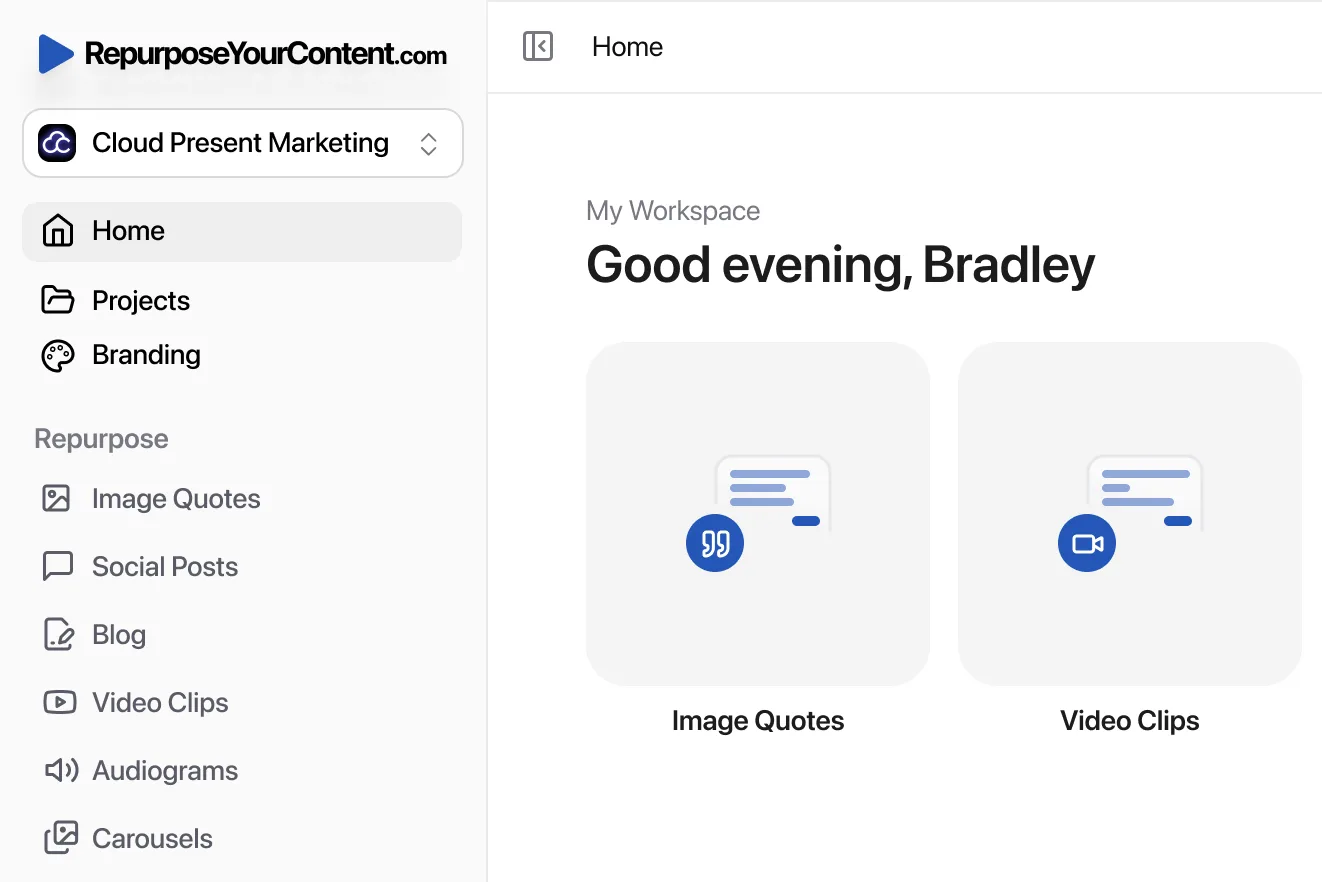
RepurposeYourContent offers a done-for-you weekly option. Clients send one podcast, interview, keynote, sales call, livestream, course, or other long-form recording. The team returns 20 to 30 finished assets in 72 hours, including TikTok-ready video clips, LinkedIn posts, quote graphics, carousels, audiograms, and a blog post.
The assets are written and edited in the client's brand voice, with unlimited revisions. Client time is about 15 minutes. Pricing can be as little as $14 per finished asset, and the 72-hour turnaround guarantee means the client doesn't pay if the deadline is missed. One 45-minute recording can become 30 assets without creating another production queue.
If weekly TikTok clips would help turn podcast episodes into a consistent discovery channel, book a call or request a sample from RepurposeYourContent.
Tags: