Content Marketing Outsourcing That Saves Time
Content marketing outsourcing explained — models, costs, ROI, vendor checklist and workflow to turn one recording into 30 assets in 72 hours.

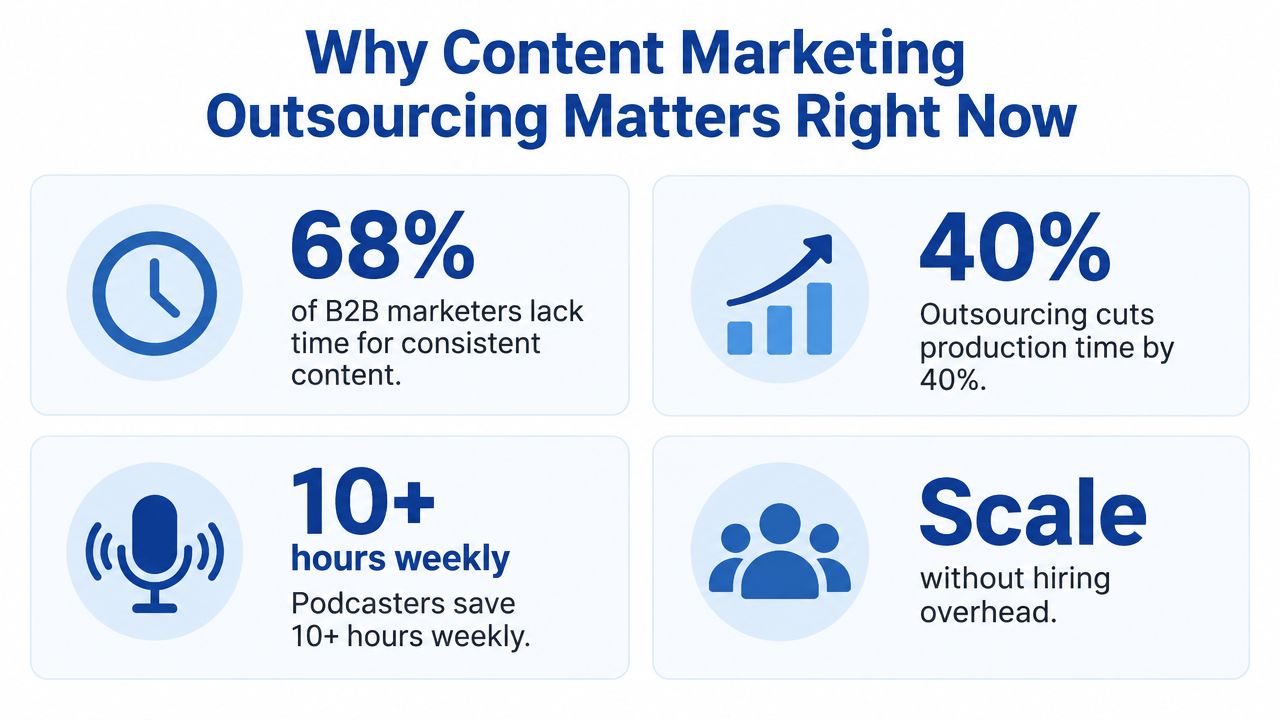
B2B content marketers spend an average of 33 hours each week creating content, equal to about 82% of their work hours. ContentGrip reports that this workload can consume the week before editing, design, distribution, or measurement begins.
Content marketing outsourcing moves repeatable production to external specialists. Your team keeps strategy, positioning, and sensitive customer knowledge in-house, while a freelancer, agency, or productized service handles defined execution. The right model gives founders, podcasters, and B2B marketers more publishing capacity without turning every recording into another internal project.
Why Content Marketing Outsourcing Matters Right Now
A founder records a podcast interview on Monday. By Friday, the file still sits untouched because someone must transcribe it, find useful moments, edit clips, write posts, design graphics, and prepare the blog version. The recording created valuable knowledge, but the team lacks enough production capacity to distribute it.
That is the operational problem outsourcing solves. It doesn't create the original expertise. It turns existing expertise into finished content while internal leaders focus on customers, sales, product decisions, and positioning.
The bottleneck starts before publishing
A 33-hour weekly creation load leaves little room for distribution planning. It also encourages one-and-done publishing. A podcast episode becomes a single feed entry, a keynote becomes a recording link, and a sales call never becomes useful public education.
A practical scaling approach separates expertise capture, editorial decisions, and asset production. The Narrareach scaling guide offers useful context for building that separation around repeatable systems.
Content marketing outsourcing has also moved beyond occasional writing help. A 2017 summary found that marketers outsourced 18% of content on average, while writing and design were the most commonly outsourced functions, at 44% and 41% respectively. Curata's industry summary shows that teams were already externalizing specialized production while retaining important internal responsibilities.
Practical rule: Keep the thinking that differentiates the brand. Externalize the production that repeats.
The decision isn't whether to outsource. It's which parts of the content engine should remain close to the brand, and which parts should become a reliable external workflow. A useful guide to scaling content production without hiring can help teams define that boundary.
What Content Marketing Outsourcing Really Means
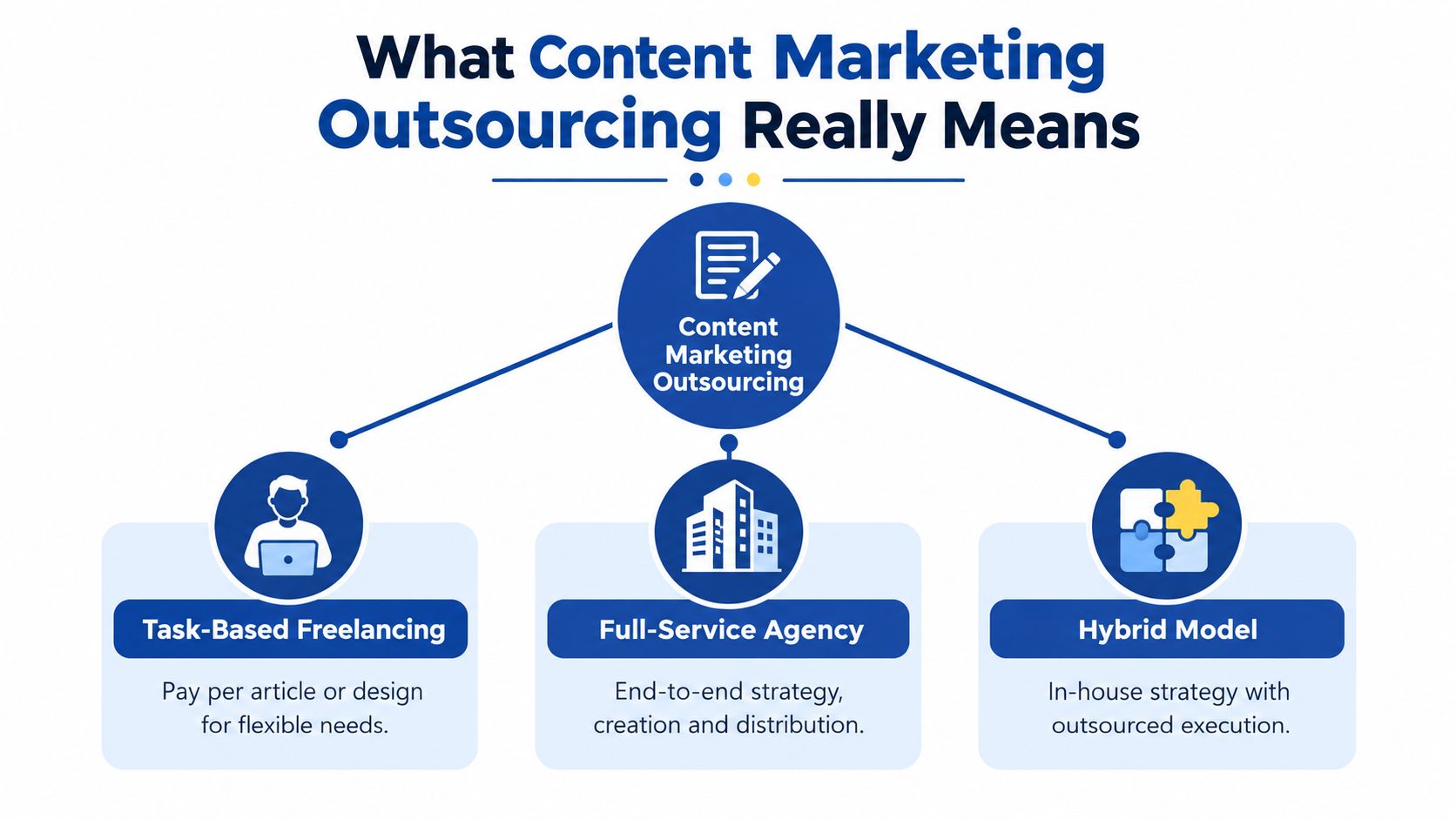
Content marketing outsourcing means hiring an external person or team to perform defined content work. That work might include writing, editing, design, video production, social distribution, SEO formatting, or repurposing one long-form recording into multiple assets.
The buyer isn't only paying for words or edited footage. The buyer is paying for specialist execution, process capacity, and predictable delivery.
Think of the content system as a kitchen. Internal leaders choose the menu, ingredients, and standards. External specialists prepare repeatable dishes according to those standards. The restaurant owner still controls the concept, but doesn't need to personally chop every ingredient.
Three operating models
Task-based freelancing works for defined, irregular needs. A company might hire a writer for a blog post, a designer for a carousel, or an editor for a podcast clip. This model offers flexibility, but the client usually manages briefs, coordination, quality checks, and deadlines.
A full-service agency takes broader responsibility. The agency may handle strategy, editorial planning, writing, design, distribution, and reporting. This suits teams that want an external marketing department, but the engagement can become expensive when the scope includes many services.
A hybrid model keeps strategy and brand decisions internal while outsourcing execution. A marketing leader might choose the themes, approve messaging, and speak with customers, while an external team turns recordings into clips, posts, graphics, and articles.
The hybrid model often fits B2B teams with strong subject-matter expertise but limited production bandwidth. It preserves internal authority without forcing the same people to edit video, format carousels, draft social copy, and manage publishing.
A 2017 industry benchmark found that about two-thirds of marketers outsourced less than one-third of total content creation. That pattern supports selective outsourcing rather than automatic full delegation. The guide to outsourcing content repurposing provides a practical way to evaluate which production tasks are suitable for external support.
Benefits Trade Offs and When to Keep Work In House
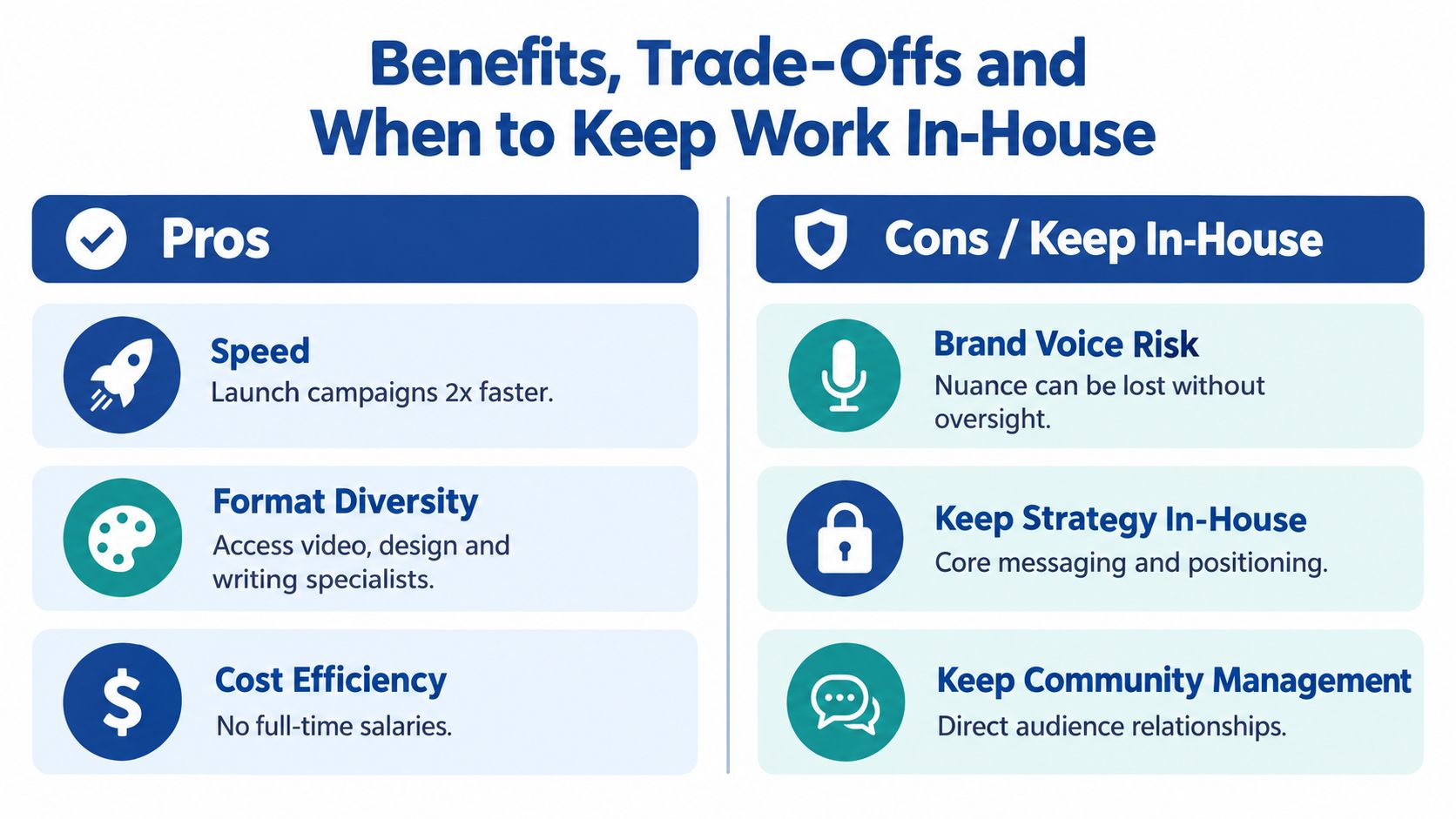
Outsourcing creates value when the work has clear specifications and frequent repetition. Repurposing a recorded interview is a strong example. The source file, brand kit, target channels, formats, and review rules can all be defined before production starts.
The trade-off appears when an external provider receives vague direction. Without source context, examples, and approval rules, the output may sound generic or miss important nuances. Outsourcing doesn't remove the need for ownership. It makes ownership more important.
What external specialists handle well
By 2024, 48% of content marketing was outsourced to agencies or third-party companies, and 55% of B2C marketers outsourced content marketing overall, according to Forbes Advisor's content marketing statistics. The same source lists graphic design at 47%, video design or animation at 43%, and copywriting at 37% among commonly outsourced work.
That mix matters. Outsourcing now covers video, visual design, and written content together. A provider can create channel-specific assets from one interview instead of leaving the internal team to coordinate several specialists.
Externalize work when it is:
- Repeatable: The same production steps happen for every recording.
- Specification-driven: Formats, dimensions, tone, and delivery rules are documented.
- Easy to review: An editor or marketing lead can approve the final asset against clear criteria.
- Capacity-heavy: The work consumes hours but doesn't require executive judgment.
- Specialized: It needs editing, design, transcription, or platform knowledge.
What should stay internal
Keep strategic work close to the people who understand the business well. Positioning, product claims, sensitive customer information, executive opinions, and final campaign priorities usually need internal ownership.
Community management also benefits from direct internal involvement. Replies often require context, judgment, and relationship history that an outside producer won't have.
The strongest boundary is simple:
Keep brand differentiation and strategic judgment inside. Productize repeatable execution and format adaptation outside.
Teams considering a self-managed workflow can compare the operational burden in this content repurposing agency versus DIY tools guide. The important question isn't whether internal staff can perform the work. They probably can. The question is whether that work deserves the hours it consumes.
How Much Content Marketing Outsourcing Costs and How ROI Works
Content marketing outsourcing has no fixed price. The engagement model sets the fee, scope, and coordination time your team must provide. For a portfolio decision, compare each cost with the repurposing speed and asset volume it creates.
Freelancers may charge $0.10 to $1.00 or more per word. Agencies often charge $2,000 to $20,000 or more per month. Project-based work can range from $1,500 to $25,000 or more per project, according to WebFX's outsourcing cost guide.
| Engagement Model | Typical Cost Range | Best For |
|---|---|---|
| Freelancer by word | $0.10 to $1.00+ per word | Occasional writing and editing |
| Agency retainer | $2,000 to $20,000+ per month | Ongoing multi-service marketing |
| Project engagement | $1,500 to $25,000+ per project | Defined campaigns or content packages |
| Dedicated outsourced team | $24,000 to $60,000 | Broad production and marketing support |
Neowork's content marketing outsourcing guide reports an immediate to 2-week ramp-up time. That speed matters when you need production capacity before recruiting, onboarding, and training an internal hire.
The hidden cost of DIY
A recording-to-assets workflow includes more than editing. A manual process can consume the following time:
- Transcription and review: 1 to 2 hours to scan the recording and mark useful passages.
- Clip selection: 1 to 2 hours to find complete moments with strong openings.
- Video editing: 2 to 3 hours per recording for captions, framing, audio, and exports.
- Social writing: 1 to 2 hours for platform-specific posts and hooks.
- Design: 2 to 4 hours for quote graphics and carousels.
- Blog drafting and editing: 3 to 5 hours for one structured article.
- Coordination and QA: 1 to 2 hours for file naming, feedback, revisions, and scheduling.
That workflow can turn one recording into several production queues. The hours describe labor, not expertise. A new editor may need longer, while a senior marketer may work faster but lose time for positioning, sales support, or campaign decisions.
A better ROI calculation
Compare the external fee with the value of internal hours released. Then measure the output from each source recording. A provider's price should be judged against:
- Hours returned: How much production and coordination disappears?
- Asset yield: How many finished assets come from each recording?
- Revision load: How much internal correction remains?
- Publishing consistency: Does the team distribute the work?
- Pipeline influence: Do assets support conversations, leads, or sales activity?
The economics improve when the workflow is standardized and the vendor receives clear production rules. Offshore specialist rates may range from $10 to $70 per hour, compared with $50 to $300 or more in major onshore markets. Equivalent deliverables are indexed at 100 in India versus 300 to 450 in markets such as the United States, United Kingdom, and Australia, according to NicoDigital's outsourcing benchmark.
Use a content repurposing cost guide to compare output-based packages with hourly or project pricing. The right choice is the one that keeps strategic judgment internal while giving repeatable production enough volume and speed to justify its fee.
How to Choose a Vendor and Hand Off Work Without Losing Voice
A vendor should make your brand easier to recognize, not blur its edges. Test that before signing a long engagement. The selection decision is also a portfolio choice: keep positioning, sensitive claims, and final judgment in-house, then productize repeatable editing and formatting for outside production.
Start with a handoff brief built around one source recording. Include the audience, offer, approved and prohibited claims, preferred phrases, visual identity, target channels, and examples your team already approves. Add the internal reviewer, feedback deadline, file format, and publishing owner.
Six checks before choosing a provider
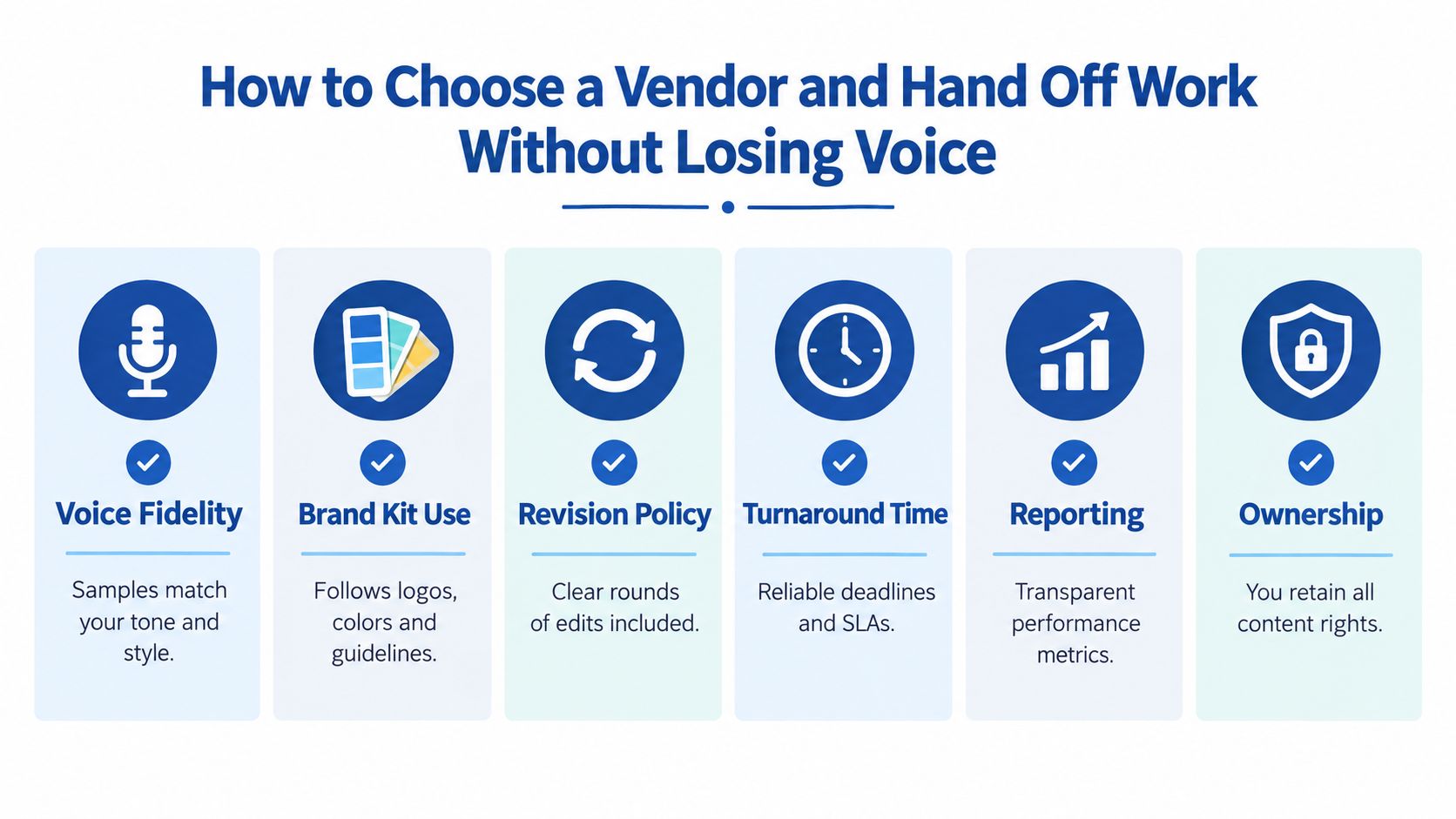
- Voice fidelity: Review work for brands with similar audiences, subject complexity, and buying context.
- Brand kit use: Confirm that the team follows your logos, colors, fonts, and visual rules.
- Revision policy: Get the number and type of included revisions in writing.
- Turnaround time: Check whether deadlines are contractual or only expected.
- Reporting: Ask what delivery, quality, and performance information you receive.
- Ownership: Confirm that you retain rights to finished content and source-derived assets.
A paid sample shows production judgment more clearly than a polished portfolio. Send one short recording and the same brief you would use after approval. Check whether the clips preserve meaning, the copy sounds natural, and the visuals fit the brand. Note how many minutes your reviewer spends correcting each asset. That time becomes part of the vendor decision.
A handoff workflow that reduces rework
Step 1: Send the recording, brand kit, audience description, content priorities, and one-page voice brief.
The voice brief can include 3 approved phrases and 3 prohibited phrases, plus examples of acceptable claims and claims that require review.
Step 2: The production team identifies themes, strong moments, claims, and suitable platform formats.
Step 3: Editors create the first asset set. Writers adapt the ideas instead of copying spoken language without judgment.
Step 4: A quality reviewer checks captions, names, claims, audio, design, formatting, and voice.
Step 5: Review one defined batch. Return consolidated feedback rather than scattered comments.
Step 6: The provider revises, delivers final files, and records recurring preferences for the next batch.
Document file naming, feedback deadlines, approval status, and publishing ownership. The content operations best practices guide from TheContentMap offers process context for formalizing these handoffs.
Compare responsibilities rather than headline fees alone, since full-service engagements vary widely by deliverables. For teams comparing providers, a content repurposing agency guide can clarify the difference between specialist production and broader marketing support.
KPIs Reporting and Quality Control That Keep Outsourcing Accountable
Outsourcing works when the client can verify both production quality and business usefulness. A dashboard should show whether the provider delivered the agreed work, whether the assets required excessive correction, and whether the content supports the wider marketing system.
Start with leading indicators. These reveal workflow problems before they affect campaigns.
- On-time delivery: Track whether each agreed batch arrives by its deadline.
- Revision rate: Record how often assets return for changes and why.
- Asset yield: Count finished assets created from each recording.
- Approval time: Measure how long internal review takes.
- Format coverage: Check whether the delivery matches the planned channel mix.
- Brand QA: Review captions, claims, visuals, links, and tone.
A high revision rate usually points to a weak brief, unclear examples, or inconsistent review standards. It doesn't automatically prove the vendor lacks skill.
Separate output from business impact
Output metrics show production capacity. They don't prove that content influenced demand.
Lagging indicators can include organic traffic, qualified conversations, pipeline influence, content-assisted opportunities, and consistency across owned channels. The reporting window should match the content type. A sales-call clip and an SEO article may support different parts of the buying process.
Use a simple monthly review:
- Confirm delivered assets and deadlines.
- Identify repeated quality errors.
- Compare planned channels with published channels.
- Review audience response and sales feedback.
- Update the brief with approved examples and exclusions.
- Choose the next recordings based on business priorities.
A posting playbook keeps execution visible. It should state what to publish, where it belongs, who approves it, and which call to action applies. That structure prevents a large asset package from becoming another unused folder.
Quality control should stay lightweight. One trained reviewer can check a defined sample against a fixed checklist. If the same error appears repeatedly, the process needs a clearer rule rather than more manual inspection.
Common Pitfalls and the Done For You Alternative
Most outsourcing failures begin with a mismatch between the source material and the requested output. A strong recording can still produce weak content when the provider ignores platform context, brand nuance, or review ownership.
Four problems and practical fixes
- Platform mismatch: A thoughtful LinkedIn post gets treated like a video caption. Fix: define the job of each format before production.
- Generic AI output: Automated drafts flatten opinions and remove useful specificity. Fix: require human editorial review and source-based writing.
- Unclear ownership: Nobody knows who approves claims or controls final files. Fix: name one internal owner and confirm rights in the agreement.
- Slow feedback loops: Assets wait in scattered messages for approval. Fix: use one review location and consolidate feedback.
Enterprise adoption shows that outsourcing is not an edge case. 73% of B2B enterprise marketers outsourced content creation, with writing and design among the most frequently outsourced functions, according to the Content Marketing Institute enterprise benchmark.
A monthly planning system can help teams decide which recordings support upcoming campaigns. The monthly content planning guide offers useful planning context, especially when several channels compete for the same source material.
The done-for-you alternative
A productized service makes the input and output explicit. The client sends one podcast, interview, keynote, sales call, livestream, course session, or meeting recording. The provider returns 20 to 30 ready-to-publish assets in 72 hours, including:
- Video clips
- LinkedIn posts
- Quote graphics
- Carousels
- Audiograms
- One blog post
The assets should follow the client's brand voice and include a defined revision process. The stated client time is about 15 minutes. For a 45-minute recording, the workflow can produce 30 assets, with a 72-hour turnaround guarantee or the client doesn't pay, and pricing from $14 per finished asset.
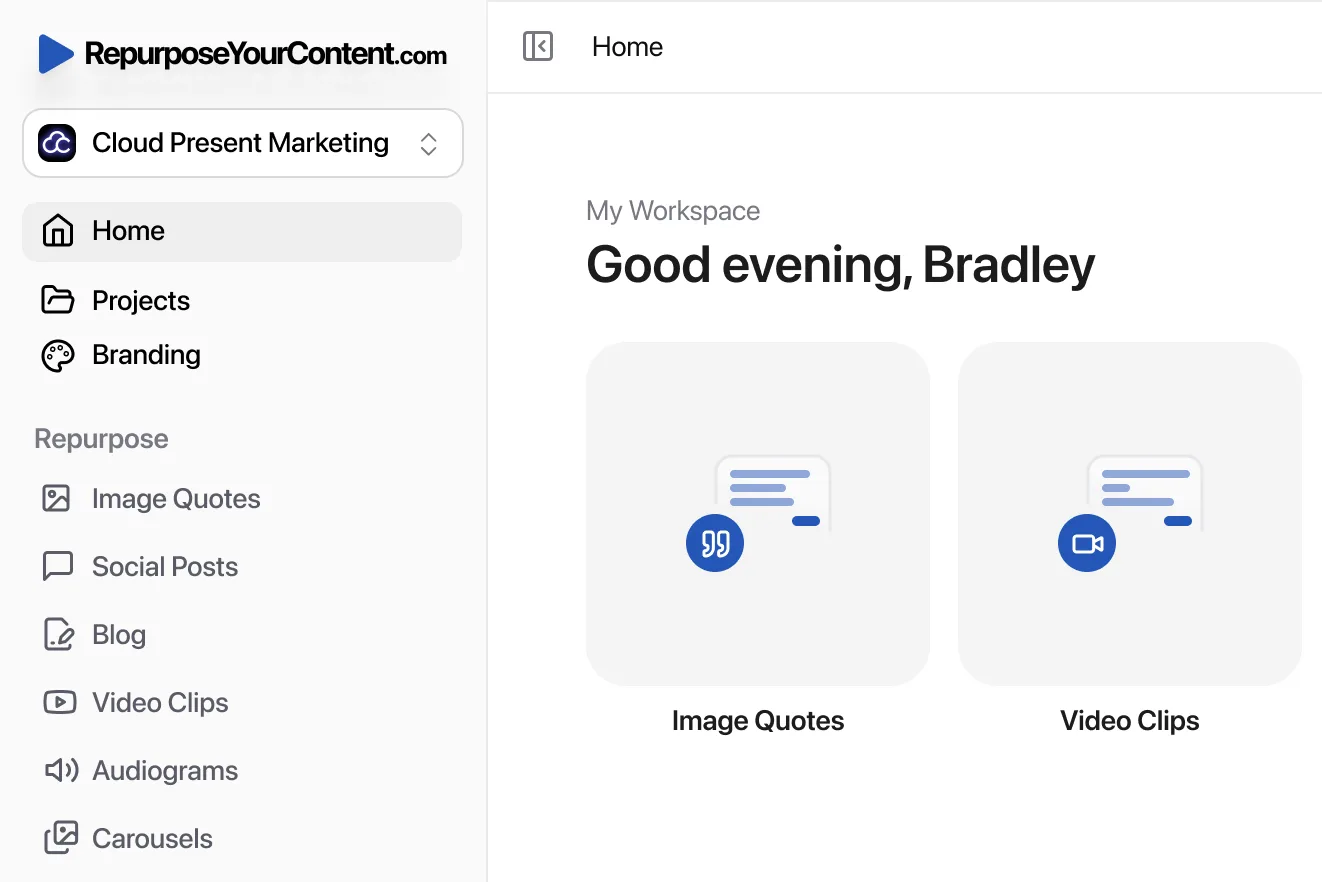
RepurposeYourContent is one example of this model. It accepts a long-form recording and delivers finished, on-brand content for publication rather than asking the client to manage production software.
The strategic decision is clear. Keep customer insight, positioning, and final judgment internal. Productize the repetitive work that turns recorded expertise into channel-specific assets.
Founders, podcasters, and B2B marketing teams can book a call or request a sample from one recording. Send the source file, brand kit, and preferred audience, then review how much finished content can return within 72 hours.
Tags: