Content Repurposing Examples: 50 Ideas from One Webinar
Discover content repurposing examples 50 ideas from one webinar. This guide shows you how to transform a single webinar into video, blogs, social media, & more.

Your last webinar is hiding far more content than many businesses ever publish. A 45-minute session can become clips, quote cards, blog posts, carousels, email follow-ups, sales assets, and more. Many B2B organizations post the replay, cut a handful of clips, then move on. The rest sits in the recording, transcript, and chat log.
That's a costly habit. In the UK, LinkedIn reported more than 40 million users in 2024, which makes it one of the strongest professional distribution channels for webinar-derived content like clips, carousels, posts, and email follow-ups, as noted in Cloud Present's overview of webinar content repurposing. One webinar can feed that channel for weeks if the team treats the event as raw material, not a one-time campaign.
Busy marketers don't need more theory. They need concrete inspiration they can ship. This guide gives exactly that. It's a practical list of content repurposing examples 50 ideas from one webinar, organised into the formats B2B teams use. It keeps the focus on outputs that can support reach, nurture, search, and sales at the same time.
A simple workflow helps. Pull the transcript. Mark the strongest moments. Group them by format. Then publish across channels where buyers already spend time with video, posts, and longer educational content. For teams looking at broader business growth content strategies, this turns one event into a full month of distribution.
1. Short-Form Video Clips (15 to 60 seconds)
A single webinar usually contains far more clip-worthy moments than teams think. Ten clips is a sensible starting point from a 45-minute recording. That gives enough variety for LinkedIn, YouTube Shorts, paid retargeting, and sales follow-up.

The good clips don't start mid-thought. They open with a sharp point, a clear objection, or a useful answer. Weak clips often fail because the editor chooses a technically neat section instead of a complete idea.
10 clip ideas
- Clip 1 Hook clip: Use the webinar's boldest opening statement as a standalone LinkedIn video.
- Clip 2 Myth-busting clip: Pull the moment where the speaker corrects a common industry assumption.
- Clip 3 Tactical tip clip: Isolate one practical step, such as how to structure a campaign brief.
- Clip 4 Objection-handling clip: Cut the answer to a hard audience question.
- Clip 5 Tool walkthrough clip: Show one part of a process inside a platform or dashboard.
- Clip 6 Mistake clip: Turn the “what not to do” section into a short lesson.
- Clip 7 Trend reaction clip: Use a section where the host explains a current market shift qualitatively.
- Clip 8 Framework clip: Condense a three-step framework into a punchy edit with captions.
- Clip 9 Quote-led clip: Lead with a memorable sentence over branded text overlays.
- Clip 10 CTA clip: End with the strongest invitation to watch the full session or book a demo.
Practical rule: If the clip needs the previous two minutes for context, it isn't a clip yet.
For a stronger distribution plan, pair these with a short-form video strategy for B2B. The best teams cut multiple versions of the same moment. One square for LinkedIn. One vertical for Shorts. One clean edit for sales outreach.
2. SEO-Optimised Blog Posts (1,500 to 2,500 words)
Five blog posts from one webinar is realistic when the source material is rich enough. The transcript does the heavy lifting. It contains questions, examples, objections, definitions, and step-by-step advice that already exists. The work is in organising it.
Teams often stop at one recap post. That's usually a mistake. One recap is broad but shallow. Multiple focused posts match more search intents and are easier to read.
5 blog post ideas
- Post 1 Full webinar recap: Turn the agenda into a structured article with takeaways, timestamps, and next steps.
- Post 2 Problem-solution article: If the webinar addressed a pain point, build a blog post around that single challenge.
- Post 3 Process article: Convert the webinar's method into a “how to” piece.
- Post 4 Q&A article: Use audience questions as section headings and write direct answers.
- Post 5 Comparison article: If the speaker discussed options, build a comparison post around those trade-offs.
A webinar on lead handoff, for example, could become a recap, a post on fixing SDR and marketing misalignment, a guide to routing rules, a Q&A article from attendee objections, and a comparison of manual versus automated follow-up.
What works in practice
Transcript-led repurposing is the most defensible workflow because transcripts can be mined for Q&A moments, practical tips, process steps, and FAQ-style content, as explained in Univid's webinar repurposing workflow. That matters because it cuts extra recording time. The content already exists. It just needs shaping.
A tool like webinar to blog post conversion helps teams skip the blank page and move straight to editing. That's the difference between publishing one article and publishing a search cluster.
3. LinkedIn Native Posts and Threads
Not every webinar moment should become video. Some ideas land better as text. LinkedIn native posts work well when the insight is clear enough to stand alone without slides, motion, or speaker energy.
Eight native posts from one webinar is easy if the team pulls distinct opinions, lessons, and takeaways. The strongest posts feel written for LinkedIn, not copied from the webinar page.
8 LinkedIn post ideas
- Post 1 Bold claim post: Open with the strongest contrarian point from the session.
- Post 2 Three-takeaway post: Summarise the webinar in three useful bullets.
- Post 3 Mistake post: List avoidable errors discussed in the session.
- Post 4 Behind-the-scenes post: Share what the team learned while preparing or running the webinar.
- Post 5 Question-led post: Use a strong audience question as the opening line.
- Post 6 Framework thread: Break a process into short, scannable sections.
- Post 7 Quote-plus-commentary post: Pair one speaker line with a practical explanation.
- Post 8 Follow-up discussion post: Ask readers whether they agree with a specific webinar point.
A webinar on customer onboarding could yield one post about the most common onboarding bottleneck, another on three warning signs, another on the question every success team should ask in week one, and so on.
What usually fails is overstuffed posts. If a post tries to summarise the whole webinar, it becomes mush. One point per post is enough.
4. Email Nurture Sequences
Three email sequences from one webinar can support different audiences without inventing new material. One for attendees. One for no-shows. One for hand-raisers or high-intent leads. Same source, different framing.
That's more useful than sending one generic “thanks for attending” email and hoping for the best.
3 sequence ideas
- Sequence 1 Attendee follow-up: Send the replay, then the top lesson, then a related CTA.
- Sequence 2 No-show recovery: Lead with the key insight they missed, then send a clip, then the replay or summary.
- Sequence 3 Sales-ready nurture: Use the strongest business pain, answer a likely objection, then invite a call.
A practical workflow example
Step 1. Export the transcript and highlight three themes. Usually one strategic, one tactical, one objection-led.
Step 2. Map each theme to an audience. Attendees often want recap and implementation. No-shows need a fast reason to care. High-intent leads need proof that the problem is worth solving.
Step 3. Write each sequence with one job only. Don't stuff recap, nurture, and sales CTA into a single email.
The fastest webinar email sequences are built from the best three moments, not the whole event.
A webinar email engine works better when the content blocks are generated first, then assembled into flows. Teams can speed that up with a webinar email nurture sequence guide. The manual version drags because every email starts from scratch.
5. Branded Quote Graphics
Quote cards are easy to overproduce and easy to get wrong. Eight is a strong number from one webinar, but only if each quote says something specific. Generic inspiration doesn't travel well in B2B.
The best quote graphics package a clear viewpoint. They also work when a busy buyer only glances for two seconds.

8 quote card ideas
- Quote 1 Contrarian statement: “Stop measuring this first.”
- Quote 2 Tactical reminder: “Your first follow-up should do one thing.”
- Quote 3 Process line: “If the handoff is vague, revenue slows.”
- Quote 4 Customer insight: “Buyers don't need more content. They need clearer proof.”
- Quote 5 Planning quote: Pull a line about priorities, sequencing, or timing.
- Quote 6 Team alignment quote: Use a moment on sales and marketing coordination.
- Quote 7 Objection quote: Turn a skeptical audience question into a visual.
- Quote 8 Closing line: Use the webinar's strongest summary sentence.
A webinar on campaign planning might produce a card that says the campaign didn't fail because of creative. It failed because nobody agreed on the conversion step. That's a quote worth sharing. “Be consistent and keep learning” usually isn't.
Shorter is stronger. Twelve words often beats twenty-five.
6. Podcast Episodes and Audio Content
A webinar doesn't need to stay as video. If the discussion is strong enough without slides, it can become audio. That's especially useful when the guest explains processes, stories, or opinions that still make sense with no screen.
Three audio outputs from one webinar is a practical target. One cleaned podcast episode. One shorter “best answers” episode. One private audio summary for internal or customer use.
3 audio ideas
- Audio 1 Full cleaned episode: Remove filler, intro housekeeping, and dead air. Publish the conversation as a standard episode.
- Audio 2 Q&A episode: Extract the best audience questions and stitch them into a tighter audio cut.
- Audio 3 Private feed summary: Create an internal enablement audio asset for sales or customer success teams.

Audio works best when the webinar topic isn't too dependent on dense slides. A product tour with many visuals rarely survives as a podcast. A discussion on positioning, demand generation, hiring, or pipeline strategy often does.
Buyers already consume video and other digital formats heavily across social platforms in the UK, which supports a multi-format repurposing approach rather than relying on a single replay page, as discussed in Wistia's guide to repurposing webinar content. Audio earns its place because some people want the ideas without another screen.
7. LinkedIn Carousels and Image Slide Decks
Five carousels from one webinar is often the sweet spot. More than that can create repetition unless the webinar covered several separate themes. Less than that usually means the team didn't mine the transcript properly.
Carousels work best when the webinar contains sequences, frameworks, comparisons, or “do this, then that” logic. They fail when the team tries to force a conversational webinar into a slide deck with no shape.
5 carousel ideas
- Carousel 1 Key takeaways deck: One lesson per slide with a strong hook cover.
- Carousel 2 Step-by-step process: Turn a framework into five to seven slides.
- Carousel 3 Mistakes deck: One avoidable mistake per slide.
- Carousel 4 Q&A deck: Use the top audience questions as slide headlines.
- Carousel 5 Sales summary deck: Create a version that sales reps can share after calls.
A webinar on attribution could become a carousel on common reporting mistakes, another on a cleaner measurement process, another on what to ask before choosing a model, and another on questions from the live chat.
Where teams waste time
They design before they outline. That slows everything down. Draft the headline of each slide first. Then decide which points need icons, screenshots, or diagrams.
For production speed, how to create LinkedIn carousels is the right workflow to automate. Carousels feel heavy when built manually. They become manageable when the transcript already supplies the slide order and copy.
8. Audiograms
Audiograms are useful when the voice carries the message. Three from one webinar is enough to support Stories, paid social tests, and email embeds without flooding the calendar.
These work especially well when the speaker says something with energy. Flat delivery kills them. Strong audio moments sound like spoken content, not paragraphs being read aloud.
3 audiogram ideas
- Audiogram 1 Opinion clip: Use a sharp statement from the speaker over waveform animation.
- Audiogram 2 Answer clip: Pull the cleanest answer from the Q&A section.
- Audiogram 3 CTA clip: Use a short result-oriented takeaway with a clear next step.
A webinar on sales enablement might yield an audiogram where the guest explains why reps don't need more decks. They need better follow-up messages. That sounds natural in audio and works well with captions.
Spoken language matters here. If it reads well but sounds awkward, don't turn it into an audiogram.
Teams often make these too long. Short wins. Attention drops quickly when the waveform keeps moving but the idea never lands.
9. Infographics and Data Visualisations
Two infographics from one webinar is usually enough. The first should simplify a process. The second should visualise a comparison, checklist, or decision path.
This format only works when the webinar includes structure. If the session was mostly opinion and discussion, forcing an infographic out of it creates fluff.
2 infographic ideas
- Infographic 1 Process map: Turn a framework into a vertical visual for blogs, PDF sharing, or sales follow-up.
- Infographic 2 Comparison visual: Show old process versus improved process, or manual workflow versus automated workflow.
A webinar on lifecycle marketing could become one infographic that maps the nurture sequence stages and another that compares weak follow-up against stronger segmentation logic.
The main trade-off is effort. Infographics take longer to design than social posts or clips. They're worth it when the same visual can live in blog content, decks, newsletters, and sales material.
10. Sales Enablement Assets
Most repurposing guides ignore sales. That's a miss. Five sales assets from one webinar can often create more downstream value than another batch of social posts.
The best sales pieces aren't generic promotional summaries. They answer real buyer questions in a format reps can send quickly.
5 sales asset ideas
- Asset 1 One-page summary: Turn the webinar into a short PDF reps can share after discovery calls.
- Asset 2 Objection handling sheet: Pull the toughest webinar questions and turn them into short answers.
- Asset 3 Follow-up email templates: Write three sales emails using webinar insights and proof points.
- Asset 4 Call prep brief: Summarise the webinar's main issues for reps before meetings.
- Asset 5 Customer-facing recap deck: Build a lightweight slide deck reps can send to buying groups.
A webinar on CRM cleanup can produce a sales one-pager on common data issues, an objection sheet for “we can handle this manually”, follow-up copy for stalled deals, a prep brief for AEs, and a deck for post-demo nurturing.
What actually gets used
Reps use assets that save them time. They ignore anything that feels like marketing theatre.
That means short summaries beat polished ebooks in most sales workflows. Clear objection answers beat abstract thought leadership. If the asset helps a rep reply faster, it gets shared.
How RepurposeYourContent helps
A single webinar can feed an entire month of distribution. The constraint is production capacity, not idea count.
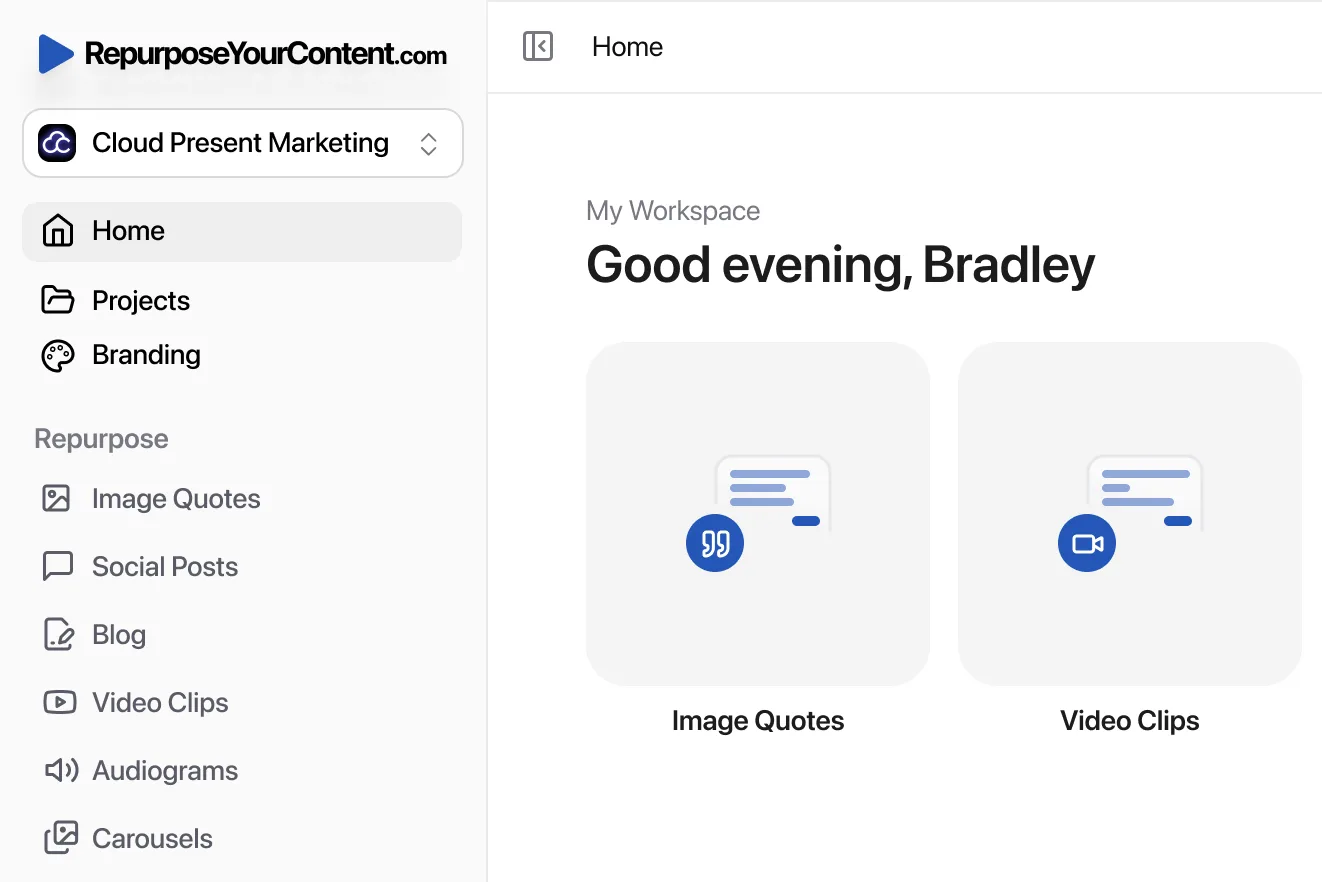
RepurposeYourContent turns one recording into a structured asset batch. It helps teams generate short clips, blog drafts, LinkedIn posts, email copy, quote graphics, audiograms, carousels, and timestamps from the same source file. That matters because fifty outputs only sound useful if a lean B2B team can successfully ship them.
The practical value is volume with control. Teams choose the formats, set the count for each one, and review drafts before anything goes live. That is a better fit for webinar repurposing than a loose workflow spread across editing tools, docs, and design requests.
A typical workflow looks like this:
- Upload the webinar. Add the recording or paste the webinar link.
- Choose the asset types. Select the formats that match the campaign goal.
- Set the output count. Request three clips, two blog drafts, five LinkedIn posts, or a larger batch.
- Generate first drafts. The platform identifies usable segments and applies brand settings where relevant.
- Review and publish. Tighten the copy, approve the visuals, and send assets to the right channels.
The trade-off is straightforward. Automation cuts production time, but it does not remove editorial judgment. Teams still need to decide which webinar moments deserve promotion, which claims need tightening, and which assets belong in demand gen versus sales follow-up.
That is the point of this playbook. It is not a list of abstract repurposing ideas. It is a system for producing a high volume of specific assets from one webinar without adding a week of manual work.
For teams that want the wider operating model, the guide to maximising content from one webinar covers the workflow in more detail.
11. On-Demand Webinar Landing Pages and Full Recording Hosting
The full webinar still matters. It just shouldn't be the only asset. A good on-demand page becomes the hub that supports all the other derivative content.
Too many teams upload a replay with no structure, no timestamps, and no useful next step. That wastes a high-intent visitor.
2 landing page asset ideas
- Landing page 1 Resource-centre version: Host the full replay with summary copy, timestamps, a transcript excerpt, and related assets.
- Landing page 2 Campaign version: Build a tighter page with one strong CTA, supporting clips, and a follow-up resource.
A webinar on forecasting could have a resource-centre page for long-term discovery and a campaign page tied to a current outbound push. Same recording. Different job.
For teams building a proper replay experience, repurpose webinar content for on-demand pages is the right operational model. The best pages don't just host the recording. They package the recording with context.
15 Webinar Repurposing Formats Compared
Busy teams do better with a ranking system than a long idea list. The question is not which format sounds good. The question is which format fits the webinar, the team, and the goal.
This comparison keeps the scope tight. It only includes the 11 formats covered in the article so the playbook stays consistent and usable. Use it as a production planning sheet after the webinar is recorded and before the repurposing queue starts.
| Format | Effort | Best use | Primary outcome | What to watch |
|---|---|---|---|---|
| Short-Form Video Clips (15 to 60 seconds) | Low to medium | Fast distribution across LinkedIn, paid social, and nurture touchpoints | Reach, engagement, replay clicks | Strong clips depend on one clear point per segment. Weak source delivery creates weak clips. |
| SEO-Optimised Blog Posts (1,500 to 2,500 words) | Medium to high | Turning the webinar transcript into evergreen search content | Organic traffic, authority, assisted conversion | This takes editorial judgment. A transcript pasted into a blog post rarely performs well. |
| LinkedIn Native Posts and Threads | Low | Pulling sharp opinions, contrarian points, and useful how-to moments into social copy | B2B engagement, profile reach, discussion | Good for speed. Limited depth unless paired with links, comments, or a carousel. |
| Email Nurture Sequences | Medium | Following up with attendees, no-shows, and matched segments | Clicks, meetings, pipeline progression | Requires segmentation and message discipline. One generic sequence underperforms fast. |
| Branded Quote Graphics | Low | Reusing strong one-line insights from the speaker or Q&A | Shares, saves, visual consistency | Easy to make. Easy to overproduce. Use only lines with real specificity. |
| Podcast Episodes and Audio Content | Medium | Reaching audiences who prefer listening over watching | Extended consumption, audience reuse | Audio quality matters more here than in the webinar itself. Poor cleanup hurts completion. |
| LinkedIn Carousels and Image Slide Decks | Medium | Breaking a process, framework, or comparison into teachable steps | Saves, shares, click-through, authority | Works best when the webinar contains a clear structure, not just discussion. |
| Audiograms | Low to medium | Promoting a useful soundbite in feeds and story placements | Attention, awareness, replay interest | Better for promotion than education. Pick clips with a strong verbal hook. |
| Infographics and Data Visualisations | Medium to high | Summarising benchmarks, workflows, or research-heavy sections | Comprehension, embeds, social sharing | Design time rises fast if the webinar data is messy or unsupported. |
| Sales Enablement Assets | Medium to high | Turning webinar insights into one-pagers, objection handling, follow-up content, and decks | Sales velocity, message consistency, post-demo support | Sales teams use these when they are short, current, and tied to real objections. |
| On-Demand Webinar Landing Pages and Full Recording Hosting | Medium | Housing the replay and giving all derivative assets a home | Long-tail discovery, lead capture, asset hub | Good pages need structure, timestamps, and a next step. Uploading the raw replay is not enough. |
A practical way to use this table is to score each format against three filters:
- Audience fit. Where will this audience consume the content?
- Source quality. Does the webinar contain strong quotes, clean teaching moments, data, or objections?
- Production cost. Can the team produce it well this week, not someday?
That trade-off matters. A data-heavy webinar can support a strong blog post, carousel, infographic, and sales one-pager from the same transcript. A panel discussion with loose structure may be better suited to clips, quote graphics, LinkedIn posts, and an edited replay page.
If the goal is volume, system beats effort. RepurposeYourContent helps teams tag strong moments, turn transcripts into usable draft assets, and move one webinar into a repeatable production flow. That is what makes a 50-asset plan realistic instead of aspirational.
Stop Leaving Content on the Table
One webinar can cover far more of the calendar than many teams expect. The problem usually isn't shortage of material. It's weak extraction. A team runs a strong session, posts the replay, cuts a few clips, then goes back to scrambling for fresh content three days later. Meanwhile, the transcript still holds unanswered questions, useful examples, clean quotes, objection-handling lines, blog structures, and sales follow-up copy.
That's why systematic repurposing beats one-off recycling. A 45-minute webinar already contains multiple layers of value. There's the obvious layer, which is the full replay. Then there's the derivative layer, where the same material becomes clips, carousels, blog posts, newsletters, and audio. Then there's the operational layer, where sales and customer teams use the same insights in follow-ups, decks, one-pagers, and internal briefs.
Teams often stop at the first layer. Stronger teams work through all three.
The practical ceiling is much higher than people assume. Many marketers think they've stretched the session once they've published the replay, pulled a recap post, and shared a few social clips. They haven't. They've only taken the easiest pieces. The richer outputs usually come from the transcript, the Q&A, the strongest objections, and the moments where the speaker explained a process clearly enough to be reformatted.
That's also where trade-offs matter. Not every webinar deserves every format. Dense product demos often create good help content and sales assets but weak podcast episodes. Panel discussions can produce strong quote cards and social posts but messy blog posts unless someone cleans the structure. A tactics-heavy session may be perfect for carousels and process articles. A trend discussion may work better as clips, commentary posts, and newsletters.
The point isn't to force every format every time. The point is to stop treating the webinar as finished once the live event ends.
A better operating model is simple. Start with the transcript. Pull the strongest moments. Group them by use case. Prioritise by distribution value. Build once, then slice by format. That's how one webinar becomes a campaign instead of a replay link.
RepurposeYourContent makes that model practical. It helps teams create video clips, blog posts, social posts, audiograms, image quotes, newsletters, LinkedIn carousels, and timestamps from one recording without turning the process into a production bottleneck. That changes the economics of webinar marketing. The team gets more output from work it already did. The message stays more consistent across channels. The gap between “good idea” and “published asset” gets much smaller.
For busy B2B marketers, that's the ultimate win. More reach from the same event. More nurture from the same expertise. More sales support from the same recording. Less wasted effort.
Stop treating webinars like one-day events. Start treating them like source material for the next month of marketing.
Try RepurposeYourContent and turn one webinar into clips, blog posts, social posts, carousels, emails, audiograms, quotes, and more in minutes.
Tags: