Content Repurposing Workflow That Scales in 2026
Build a content repurposing workflow that turns long-form recordings into 20-30 ready-to-publish assets per week with clear roles, SOPs, and metrics.
A content repurposing workflow turns one long-form recording into channel-ready assets. The practical model is simple: capture the source, extract its strongest ideas, adapt each idea for a specific channel, review every asset, then publish and measure the results.
The economics explain why this matters. A 2023 ReferralRock survey found that 94% of marketers repurpose content, while 46% called it the single best-performing content marketing strategy. The same survey found that 65% viewed repurposing as the most cost-effective tactic, and 48% said it delivered the best results with the least time spent (ReferralRock survey data).
The problem isn't knowing that repurposing works. The problem is turning a podcast, interview, keynote, sales call, livestream, course, or meeting recording into finished assets without consuming an entire week.
Why Most Teams Still Repurpose Once and Forget
Only 29% of marketers have a systematic content repurposing process, according to a 2026 industry summary (content repurposing ROI statistics). That gap matters because many teams already produce valuable recordings. They publish the original episode, share a couple of posts, and move on.
The common assumption is that more tools will solve the problem. They won't. The bottleneck is the missing operating system that assigns ownership, defines formats, sets deadlines, and controls approvals.
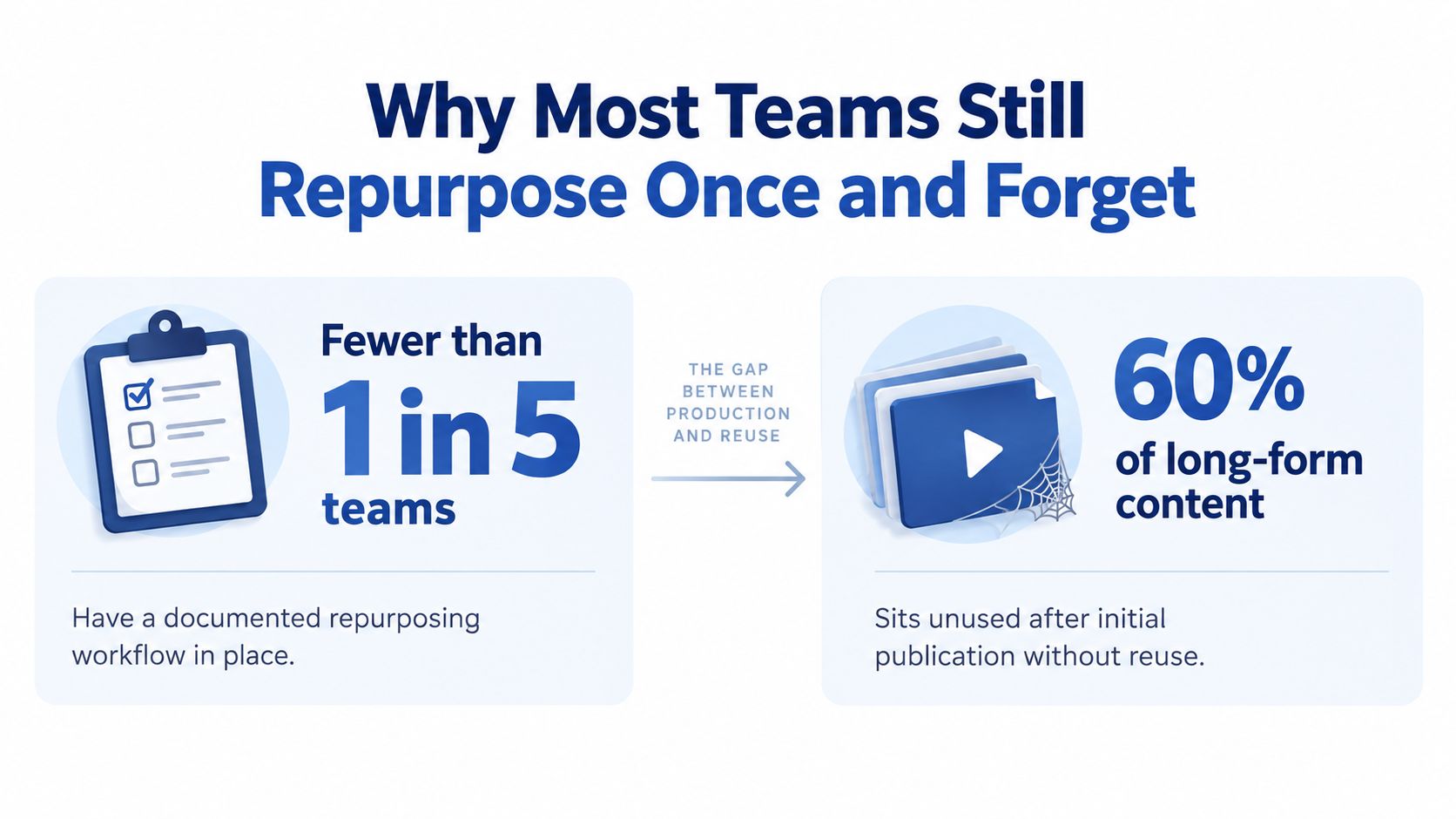
A recording creates raw material, not a publishing system. Someone still needs to identify usable moments, mark timecodes, edit clips, write native captions, design graphics, check claims, schedule posts, and report performance.
The production gap is operational
Recent research identifies adaptation as a major challenge for 38% of creative professionals. Maintaining brand consistency affects 36%, while 36% cite limited time or resources and 35% struggle to find the right assets quickly (MarketingProfs research on repurposing challenges).
The same research points to workflow failures. Disorganized file structures affect 34% of respondents, while content spread across locations and weak version control each affect 33%. Those problems don't appear during ideation. They appear during handoffs.
Practical rule: Every stage needs a named owner, a defined output, and a deadline.
A strong workflow treats each recording as an anchor asset. The team decides what the recording can produce before editing begins. A podcast might generate clips, LinkedIn posts, quote graphics, a carousel, an audiogram, and an article. A sales call might produce objection-led posts and a customer education piece, provided client confidentiality and permissions are handled correctly.
Teams that want a deeper benchmark can review these content repurposing statistics for 2026. The useful question isn't whether a recording contains ideas. It's whether the team has a repeatable path from those ideas to approved assets.
What a Scalable Content Repurposing Workflow Actually Includes
A scalable workflow has six components. If one is missing, work slows or quality drops.
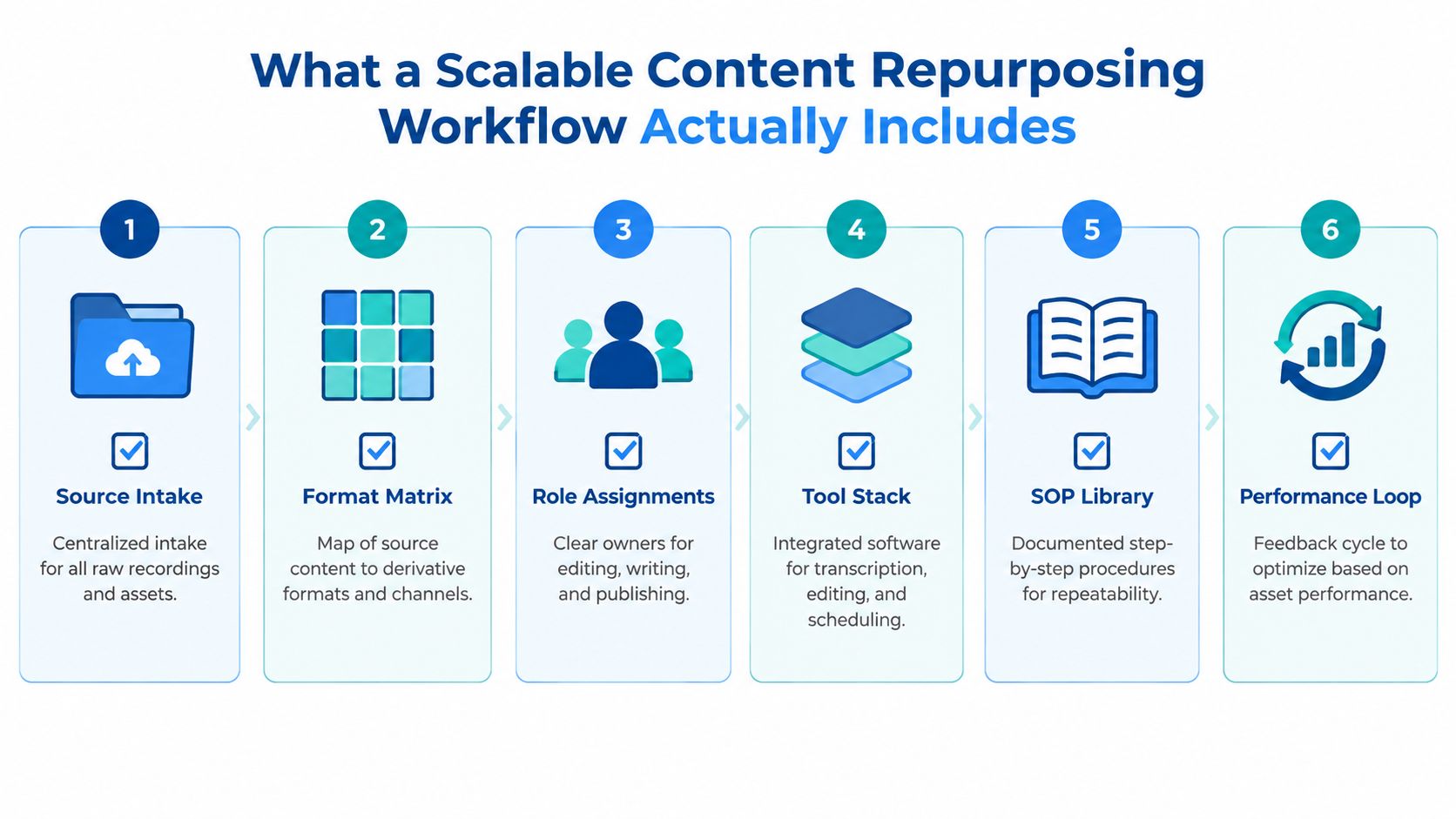
Source intake
Raw recordings need one central intake point. The intake record should capture the speaker, topic, date, intended audience, permissions, brand files, and desired channels. A producer shouldn't spend time searching email threads for the latest file or guessing which logo belongs on a graphic.
Format matrix
The format matrix maps each source type to its derivative assets. It might connect a podcast to short clips, LinkedIn posts, quote graphics, an audiogram, and an SEO article. It should also define which ideas suit each channel.
A clip needs a strong opening and clear visual pacing. A LinkedIn post needs a different hook and structure. A carousel needs a sequence that makes sense without the original audio.
Role assignments
Assign editing, writing, design, publishing, and approval separately when possible. One person can hold several roles on a small team, but the responsibilities still need names.
Tool stack
A practical stack may include transcription, video editing, graphic design, project management, cloud storage, and scheduling. Tools can reduce repetitive work, but they don't replace editorial judgment. Resources such as TransClipper repurposing can help teams understand how transcription and derivative creation fit into the wider process.
SOP library
The SOP library stores the repeatable instructions. Include clip criteria, caption patterns, brand rules, file naming, approval steps, and quality checks. New contributors should be able to follow the process without rebuilding it from memory.
Performance loop
Performance data must influence future choices. Track impressions, engagement, conversions, and asset-level results. If a source consistently produces strong clips but weak quote graphics, the next matrix should reflect that.
A useful content repurposing workflow diagram template can help teams map these handoffs. Score each component as documented, partly documented, or missing. The missing components reveal the operational risk faster than another list of content ideas.
Build, Buy, or Outsource the Content Repurposing Workflow
There are four sensible operating models. Each works for a different team profile.
| Model | Monthly Cost | Weekly Output | Turnaround | Best For |
|---|---|---|---|---|
| In-house team | $8,000 to $20,000 | High, depending on headcount | Days to weeks | Larger teams needing close control |
| Freelance stack | $2,000 to $5,000 | Flexible | Several days to weeks | Teams comfortable managing contractors |
| AI tools only | $200 to $500 | High draft volume | Fast drafts, slower review | Operators with strong editing skills |
| Done-for-you service | $1,500 to $4,000 | 20 to 30 finished assets | Consistent weekly delivery | Lean teams needing finished output |
The in-house model offers control and brand familiarity. It also assigns expensive internal capacity to clipping, formatting, file management, and revisions. That can make sense for a large marketing department with steady recording volume.
A freelance stack costs less than full-time hiring and adds flexibility. The weakness is coordination. One freelancer edits, another writes, and a third designs. If one disappears, the workflow breaks at the handoff.
AI tools reduce draft time, not ownership
AI tools can transcribe, summarize, suggest clips, and draft captions. A human still needs to check the transcript, reject weak hooks, verify claims, adapt the copy, inspect every clip, and approve the final assets. Teams that buy software without assigning this work create a faster queue of drafts.
A structured faster podcast editing workflow can help a team tighten production before derivative content begins. It won't remove the need for channel adaptation or quality assurance.
Decision rule: Choose the operating model based on who owns the handoffs, not the advertised speed of the software.
Solo creators should usually keep the source recording and brand direction internal, then outsource repetitive production when post-production starts competing with sales or client work. A small B2B team often benefits from a done-for-you service because it keeps strategic control while removing editing and scheduling work. A 50-person department may prefer an internal content operation with external overflow support.
Teams comparing providers should also review the practical case for outsourcing content repurposing. The right model is the one that delivers consistent, approved assets without turning the recording owner into a project manager.
The Seven Stages From Recording to Published Assets
A 45-minute recording can demand 10 to 16 hours of manual repurposing work before approvals, scheduling, and revisions, according to this manual content repurposing workflow. A strong recording does not remove the production queue. It only gives the team better raw material.
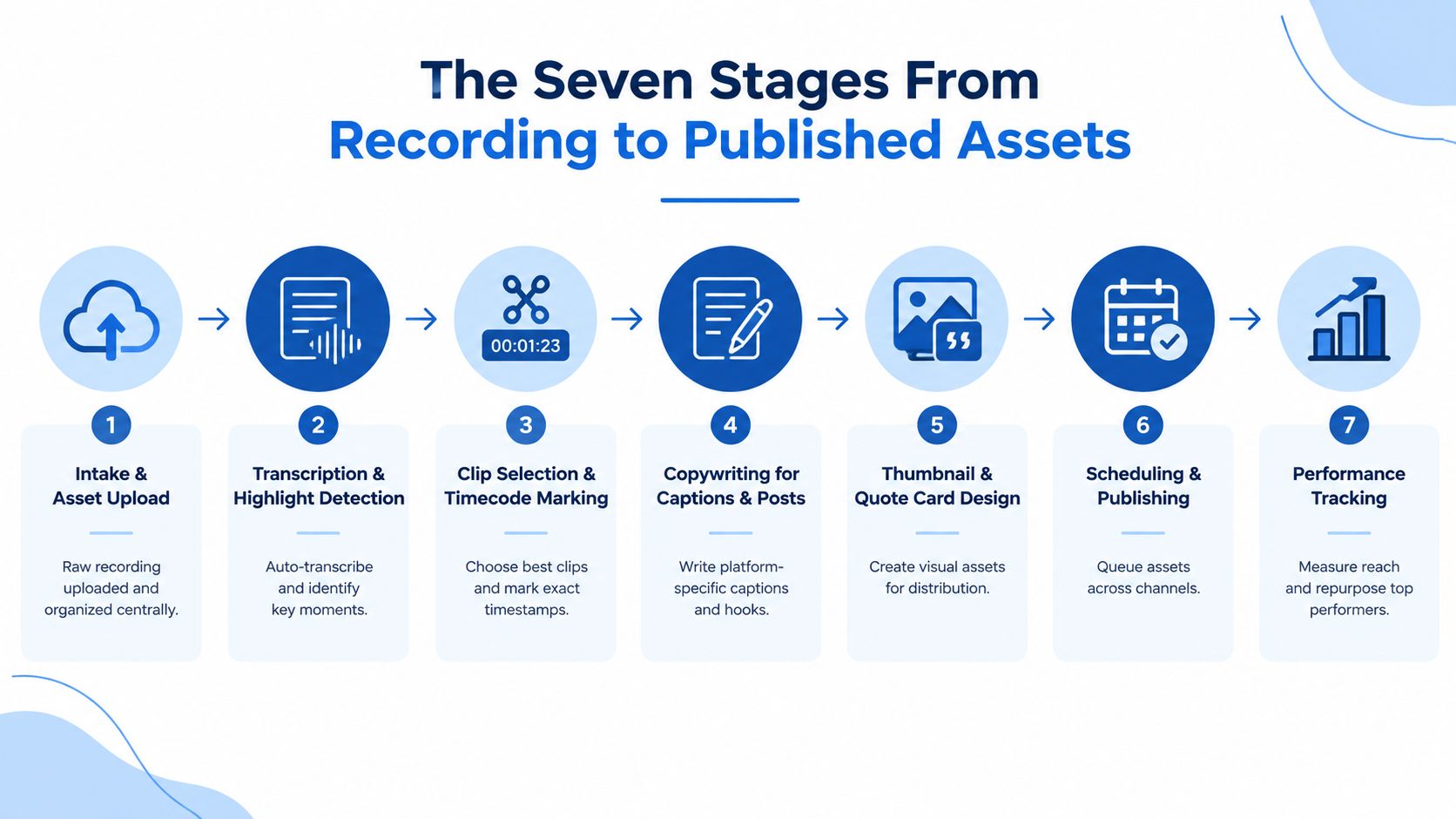
1. Intake and asset upload
The recording owner supplies the file, speaker details, brand kit, target audience, and publishing priorities. Allow 15 to 30 minutes when files are organized. An incomplete brief creates the first delay, so confirm that the source opens, permissions work, and every required brand file is available.
2. Transcription and highlight detection
The producer creates a transcript, then reviews explanations, objections, stories, and quotable lines. A 45-minute recording can require 1 to 2 hours of manual review. Preserve speaker labels and timecodes. Teams building a transcript pipeline should make those fields part of the standard output, not a later correction.
This handoff replaces a week of scattered post-production only when the transcript gives editors and writers usable context.
3. Clip selection and timecode marking
The editor chooses strong moments, removes dead space, and marks exact start and end points. Manual clipping and editing can take 3 to 4 hours. Include enough surrounding context for the editor to preserve the point. A cut without its preceding sentence may sound polished and still fail.
4. Copywriting for captions and posts
The writer adapts each idea to its channel. Captions and social posts can take 2 to 3 hours, because every asset needs a distinct hook, structure, call to action, and format. Provide the selected clip, transcript context, audience, and approval notes together. That package prevents repeated questions and shortens revision cycles.
5. Thumbnail and quote graphic design
A designer turns approved ideas into thumbnails, quote cards, carousels, and audiograms. Graphics and carousels can take 2 to 4 hours. Copy and visual direction must agree before design starts. Otherwise, the designer builds assets around wording that the writer later changes.
6. Scheduling and publishing
The publisher prepares files, captions, links, tags, and dates inside the scheduling system. The time depends on channel count and approval speed. Store approved copy, final media, and publishing instructions together. A done-for-you service takes over here when the team no longer wants to coordinate separate editing, writing, design, and scheduling handoffs.
7. Quality assurance and reporting
The final reviewer checks spelling, claims, captions, cropping, audio, links, brand consistency, and channel fit. Reporting connects performance to the source asset and format, so future selections improve. Without that feedback, the workflow remains a production line.
How AI content repurposing works explains where automation supports extraction and drafting. Use it to accelerate production, not to remove human approval. The practical replacement for a week of DIY post-production is a defined handoff, complete source context, and one owner for the final gate.
A Real Workflow Example From One 45-Minute Recording
Consider a 45-minute B2B sales podcast episode. The guest explains qualification mistakes, buying committee friction, and how sales teams should handle stalled opportunities.
The producer starts with the transcript, identifies the strongest moments, and creates 12 short video clips with distinct hooks. The writer then turns the episode into 10 quote posts, one LinkedIn carousel, one newsletter snippet, and a package for YouTube Shorts and Reels.
A skilled freelancer may need roughly six to eight hours of focused work for this production run. A host handling every stage personally can spend far longer once context switching, revisions, scheduling, and approvals enter the process.
| Asset | Channel | Spec | DIY Time |
|---|---|---|---|
| Short video clips | LinkedIn, YouTube Shorts, Reels | 12 clips, each built around one sales lesson | 3 to 4 hours |
| Quote posts | LinkedIn and social feeds | 10 text-led posts with adapted hooks | 2 to 3 hours |
| LinkedIn carousel | One structured lesson with visual slides | 2 to 4 hours | |
| Newsletter snippet | One concise takeaway and call to action | Part of writing block | |
| Shorts and Reels package | YouTube and Instagram | Captions, exports, titles, and descriptions | Part of editing block |
| SEO article | Blog | Search-led article from the transcript | 2 to 3 hours |
The output can reach 20 to 30 finished assets, depending on the final mix. The point isn't to force every recording into the same package. The point is to decide the package before production begins.
The handoff that saves the week
The host should not receive twelve unfinished clips, ten rough captions, and a folder of unnamed graphics. The host should receive a review-ready batch with clear labels, suggested publishing channels, and one approval path.
That handoff turns content atomization from scattered extraction into a controlled production system. Teams wanting a related framework can examine this content atomization strategy, then adapt the formats for podcasts, interviews, keynotes, sales calls, and other spoken sources.
The Done-for-You Alternative for Time-Poor Teams
Once a team produces regular long-form recordings, the operational work becomes the constraint. The recording is already done. Internal staff still need to review it, find moments, edit clips, write copy, design assets, schedule posts, and report results.
A done-for-you service takes ownership of that production layer. The client keeps brand direction, approvals, publishing access, and final editorial control. The service handles intake, transcription, clip selection, copywriting, design, scheduling support, and reporting.
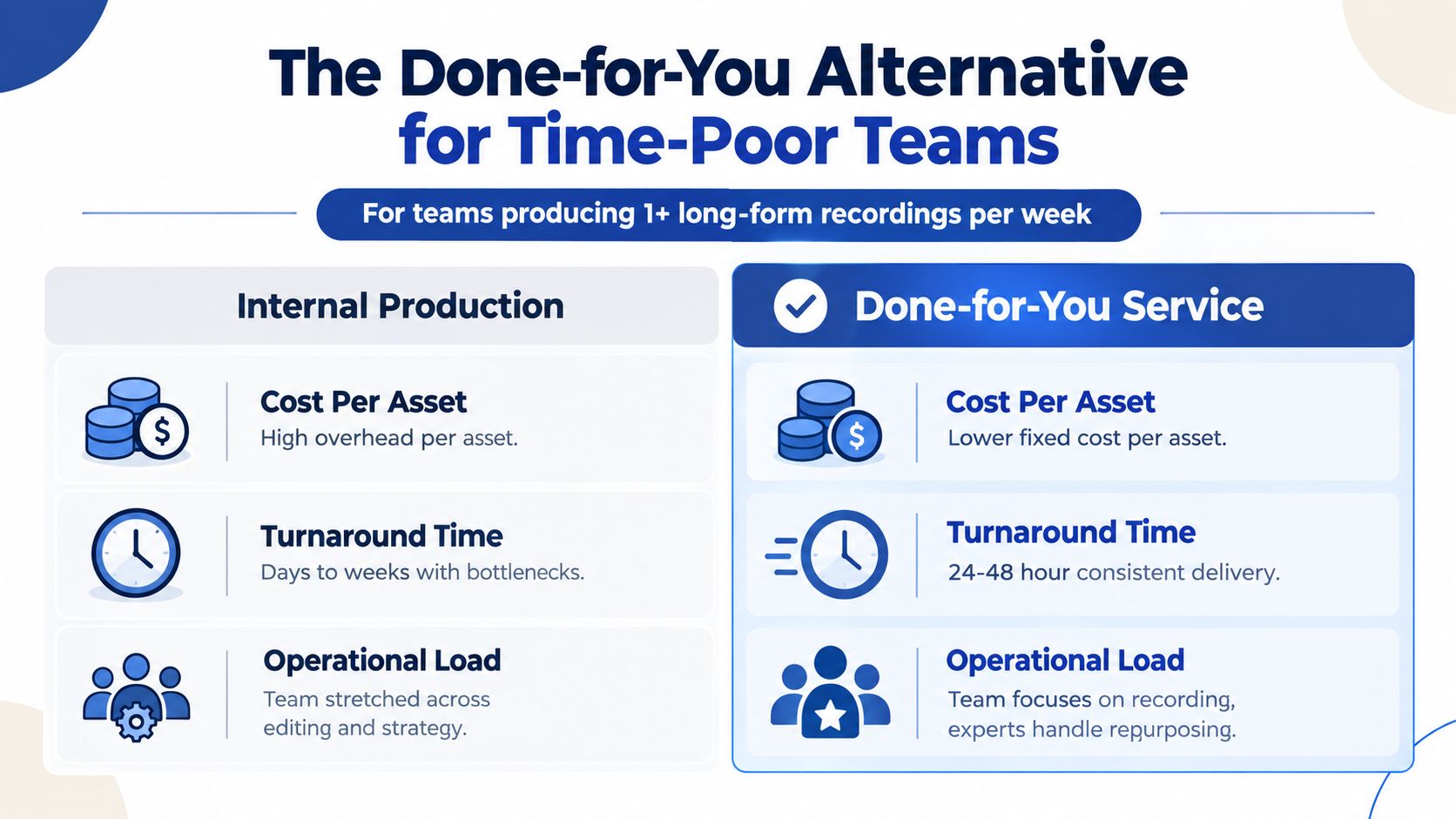
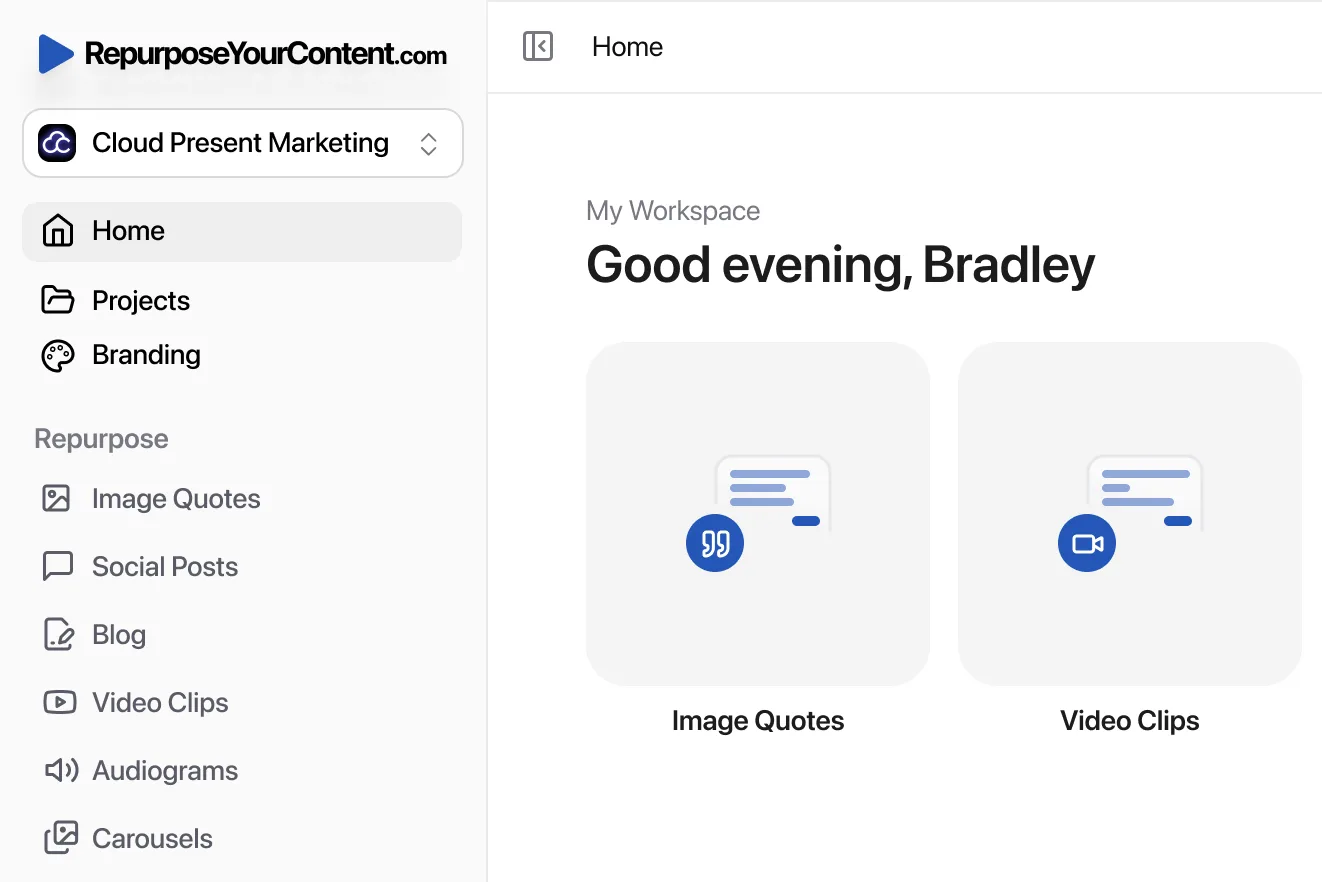
RepurposeYourContent is one example of this model. Clients send a podcast, interview, keynote, sales call, livestream, course, or meeting recording, and receive 20 to 30 ready-to-publish assets in 72 hours, including video clips, LinkedIn posts, quote graphics, carousels, audiograms, and a blog post. The service states that the client's time is about 15 minutes, with revisions included.
Why the economics change
Independent workflow guidance reports that teams can reduce production to 4 to 6 hours per piece, with costs of $50 to $200 per asset (repurposing workflow costs). Another benchmark describes a workflow producing 10 platform-specific outputs in about 90 minutes of human time, compared with 15 to 20 hours per week for the same volume when handled manually (content repurposing calculator).
The service model works best for founders who record weekly, lean B2B marketing teams, podcasters, speakers, and creators who would otherwise spend ten hours a week on post-production. It also suits teams that have enough source material but lack reliable editors, writers, designers, or publishing coordinators.
A credible provider should state the asset count, revision policy, delivery window, and ownership terms clearly. RepurposeYourContent advertises a 72-hour turnaround guarantee, or the client doesn't pay, pricing from $14 per finished asset, and a benchmark where one 45-minute recording becomes 30 assets.
The client's job is to provide the expertise once. The production partner's job is to make that expertise travel.
Metrics, SOPs, and Your Next Step to Scale
A healthy workflow needs operating metrics, not vague claims about consistency. Track these five measures for every source recording:
- Assets per recording: Shows whether the team extracts enough value from each source.
- Turnaround time: Measures the time between recording receipt and approval-ready delivery.
- Cost per asset: Reveals whether internal labor or outsourcing is financially sustainable.
- Publish rate: Shows how many approved assets reach their intended channels.
- Downstream engagement: Connects derivative content to impressions, engagement, and conversions.
The SOP library should stay practical. A one-page pipeline map, role checklist, clip selection rubric, and QA scoring sheet are enough to start. The documentation must tell contributors what “ready” means at every handoff.
A structured benchmark playbook says systematic execution can target 5x or greater reach, with one benchmark describing 5x to 8x reach for standard efforts (content repurposing playbook). Treat that as an operating target, not a promise. Measurement still needs to identify which source, format, channel, and hook produced the result.
Independent marketing statistics compiled in 2026 report that repurposing can save 60% to 80% of creation time, increase overall output by about 40%, and reduce production costs by up to 60% to 65% (content repurposing benchmarks). Those figures support a clear recommendation: stop treating repurposing as leftover work after publication.
Book a 20-minute call with RepurposeYourContent to audit the current workflow, or request a sample pack from a recent episode. Send one recording, see what the finished handoff looks like, and decide whether the service fits the team's publishing needs.
Tags: