Fractional Content Team: A Practical Guide for 2026
Fractional content team explained: what it is, who it fits, costs vs in-house, and how to pick one. Built for busy B2B marketers, founders, and podcasters.

A fractional content team is a small, recurring outsourced pod that turns one long-form recording into a month of ready-to-publish assets, typically billed monthly from around $999. One 45-minute recording can become roughly 30 finished assets, delivered within 72 hours, while the client spends about 15 minutes reviewing the work.
That model matters because content production usually fails after the recording ends. A founder records a podcast, interview, keynote, livestream, sales call, or course lesson. The original asset gets published once. Then the team returns to unrelated work while the strongest insights sit unused in a transcript.
A fractional content team fixes the production gap with a repeatable input and a defined operating system. It doesn't replace strategic judgment. It turns existing expertise into short-form video, LinkedIn posts, carousels, quote graphics, email copy, and search-ready articles without requiring a full internal department.
The broader fractional workforce is no longer a niche concept. A 2026 fractional workforce market report estimates the global fractional executive market at US$5.7 billion, growing at 14% CAGR, with the active professional base doubling from 60,000 in 2022 to 120,000 in 2024. LinkedIn profiles using fractional roles rose from 2,000 in 2022 to 110,000 in 2024, according to the same report.
For content buyers, that visibility changes the conversation. Senior, on-demand expertise now feels familiar. The practical question is whether the team owns strategy, production, distribution, or all three.
What a Fractional Content Team Actually Does
Long-form recordings often contain the most useful material a B2B company produces. Founders explain hard problems. Customers describe buying decisions. Sales teams hear objections in plain language. Podcasters capture expert insights that would take weeks to recreate as written content.
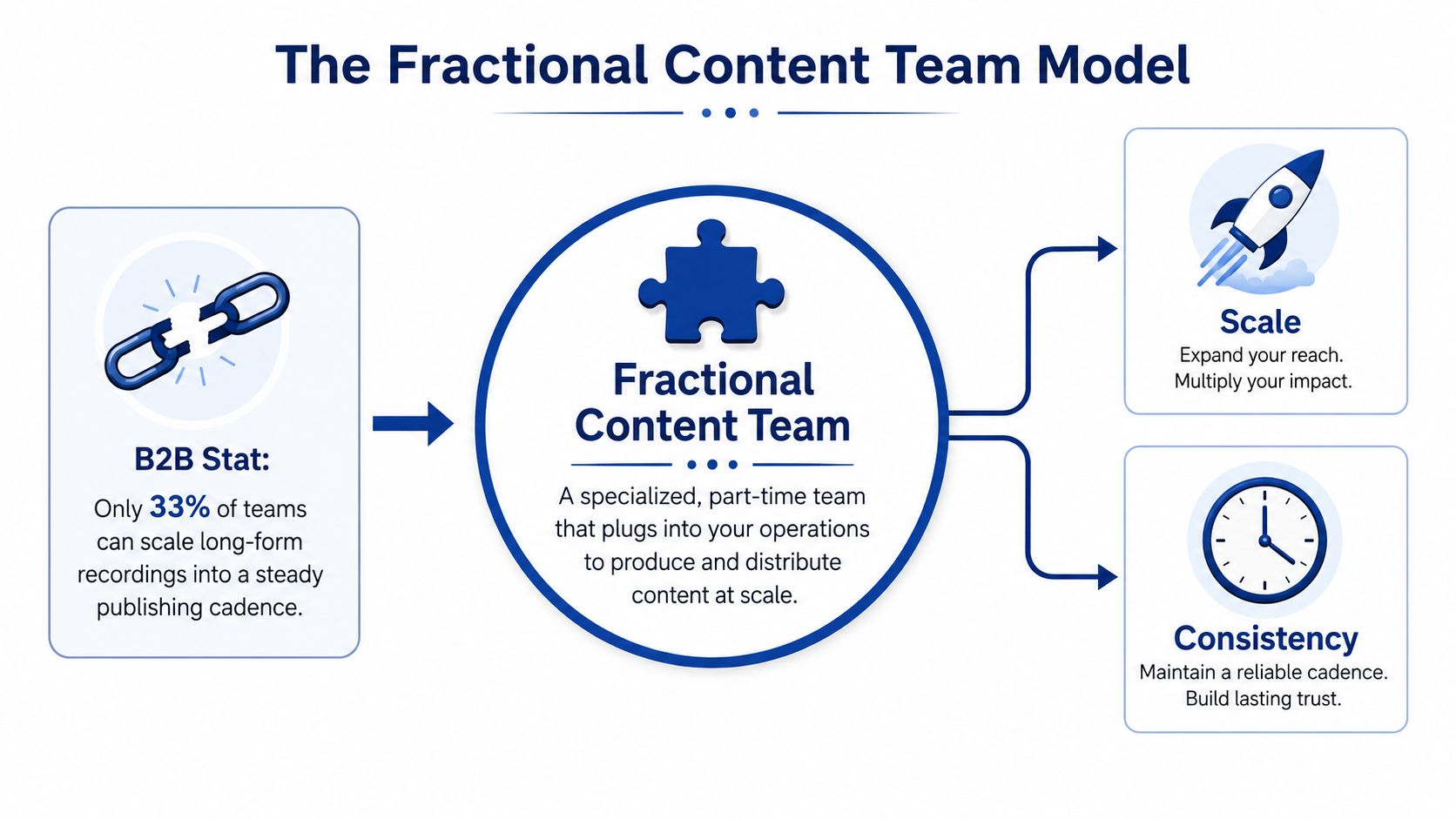
The problem is consistency. Many teams can record strong conversations, but few have a reliable system for converting those recordings into a steady publishing cadence. Independent workflow benchmarks show that a 1-person content team typically produces 3 to 10 posts monthly, while a 2 to 3 person team produces 6 to 20 posts monthly, depending on maturity and workflow discipline (content production velocity benchmarks).
A fractional content team is a recurring outsourced pod of strategists, editors, writers, designers, and distribution specialists. The pod plugs into the company's existing workflow, follows its brand system, and delivers finished content against a recurring schedule.
The input stays simple
The strongest operating model starts with one repeatable source asset. That source might be a podcast episode, founder interview, keynote, customer conversation, livestream, sales call, or course recording.
The team then handles four jobs:
- Define the model. Clarify which roles, deliverables, and approvals belong in the pod.
- Compare the alternatives. Assess fractional support against hiring internally or using a traditional agency.
- Price the work accurately. Compare monthly fees with the time required for DIY repurposing.
- Evaluate providers. Check turnaround, voice control, revisions, ownership, and publishing readiness.
The useful promise isn't “more content” in the abstract. It's a production system where one 45-minute recording becomes roughly 30 assets across short-form video, social posts, carousels, blog content, and email. The client sends the recording, answers limited questions, reviews the finished set, and publishes.
A guide to content repurposing services can help buyers distinguish between raw editing, strategic repurposing, and a complete outsourced content operation. Those services aren't interchangeable. A clip editor can make a video shorter. A fractional pod decides which moment deserves a clip, which idea deserves a post, and which argument should become an article.
Practical rule: Treat the recording as the production input, not the finished marketing output.
Who Is on a Fractional Content Team
A useful fractional pod resembles a small content operating department. It isn't one virtual assistant handling every task. The work usually sits across 3 to 6 specialists, with each person accountable for a different asset type.
The strategist acts like a part-time content COO. This person owns the monthly plan, channel mix, editorial priorities, and repurposing decisions. The strategist decides whether a recording should emphasize demand generation, customer education, founder authority, search visibility, or sales enablement.
The media editor takes ownership of the spoken material. From one recording, that specialist identifies strong moments, creates short-form clips, writes hooks, adds captions, and reframes the content for vertical viewing. A defined production brief prevents editors from choosing clips only because they look visually clean.
Each seat needs a clear output
The writer works from the transcript and the strategist's angle map. Typical outputs include LinkedIn posts, X threads, newsletter copy, and a long-form SEO article. The writer shouldn't merely paste transcript sentences into social channels. Each format needs a different opening, rhythm, and level of context.
The designer translates ideas into visual assets. Carousels, quote graphics, thumbnails, and blog banners should follow the company's fonts, colors, layout rules, and image treatment. Brand templates matter because repeated design decisions slow production when nobody owns them.
The distribution owner handles the final operational layer. That includes scheduling, posting windows, captions, alt text, platform formatting, and identifying strong performers for future reuse. Without this role, finished content can remain in a shared folder instead of reaching an audience.
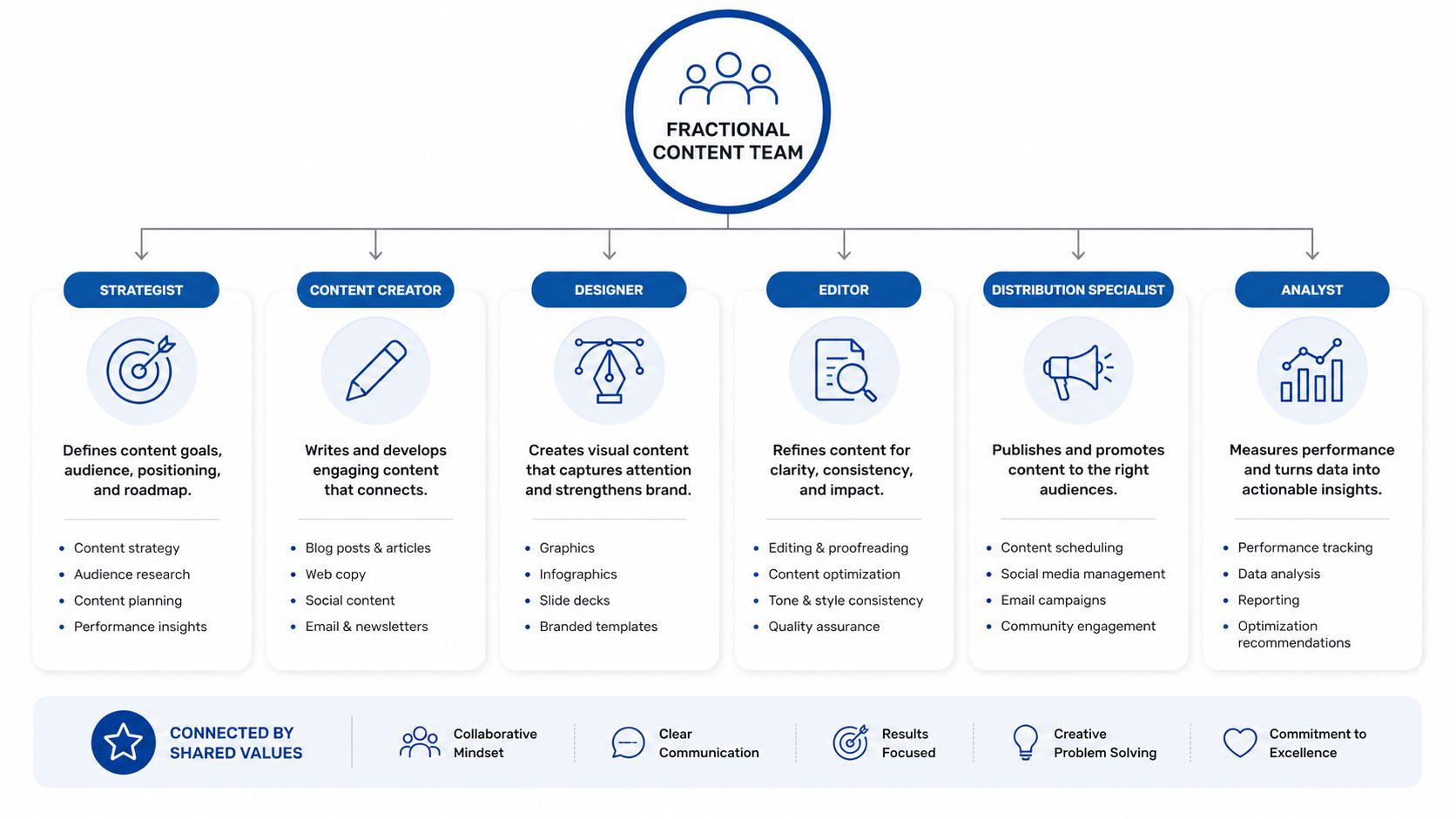
A practical B2B content operations playbook should map ownership before production starts. The mapping can stay simple:
- Strategist: monthly plan, angles, channel priorities, approvals.
- Clip editor: short-form video, captions, reframed hooks, exports.
- Writer: LinkedIn posts, threads, email copy, SEO blog.
- Designer: carousels, quote graphics, thumbnails, banners.
- Distribution owner: scheduling, metadata, publishing, performance notes.
The value comes from the handoffs. Each specialist receives a defined input and produces a defined output. That structure makes quality easier to review and prevents the founder from becoming the project manager.
Fractional vs In-House vs Agency
The three models solve different problems. A fractional pod suits recurring production without full-time headcount. An internal hire offers maximum control but requires enough demand to keep that person productive. An agency provides broad capacity, though external approval cycles can slow delivery.
| Dimension | Fractional Content Team | In-House | Agency |
|---|---|---|---|
| Monthly cost | Roughly $1,500 to $4,000 for a full pod | Roughly $8,000 to $12,000 for one fully loaded hire | Roughly $3,000 to $15,000+ |
| Speed | One recording into a month of assets within 72 hours | Fast for ad hoc requests, slower at sustained volume | Often 2 to 4 weeks |
| Control | Shared voice system and approval process | Highest day-to-day control | Lowest direct control |
| Skill depth | Multiple specialists who repurpose daily | Depends on one hire's range | Broad specialist access |
The fractional model generally sits between internal control and agency capacity. A pod can include editorial strategy, video editing, writing, design, and distribution without asking one employee to master every discipline.
The fractional workforce benchmark estimates about 150,000 fractional professionals currently work in the United States. It also reports that finance, marketing, and engineering represent nearly 60% of fractional demand, while 53% of engagements are fully remote and 50% of fractional professionals manage 2 to 3 clients. Those operating patterns fit content production, where remote collaboration and multi-client delivery are already normal.
The practical verdict
- Pre-product-market fit or low volume: Fractional support usually fits best. The company gains production capacity without committing to a department.
- Series A or later with steady demand: In-house leadership starts making more sense. Internal context, approvals, and channel ownership become more valuable.
- One-off campaign: An agency can work when there's no ongoing recording cadence.
Fractional support breaks down when buyers expect a full internal function at a low retainer. It works when scope, input frequency, approval ownership, and output quality are explicit.
The Real Cost of DIY Repurposing
DIY repurposing looks manageable until the full workflow is listed. A competent generalist needs 8 to 14 hours per 45-minute recording, while a founder working between sales calls can spend 15 to 22 hours (content repurposing workflow benchmarks).
| Step | Tool | Time, Generalist | Time, Founder |
|---|---|---|---|
| Ingest and transcription | Descript or Riverside | 45 to 60 minutes | 60 to 90 minutes |
| Clip selection and rough cuts | Descript or editor | 2 to 3 hours | 3 to 5 hours |
| Captions and vertical formatting | Video editor | 45 to 90 minutes | 1.5 to 2.5 hours |
| Social writing | LinkedIn or X drafts | 2 to 4 hours | 4 to 6 hours |
| Carousels and quote graphics | Canva | 1 to 2 hours | 2 to 3 hours |
| Scheduling and CMS publishing | Social schedulers and CMS | 30 to 60 minutes | 1 to 2 hours |
| Final QA | Brand guide and link check | 30 minutes | 1 hour |
The first bottleneck is selection. Rewatching a recording to find 8 to 12 usable moments takes longer than exporting the clips. The second is adaptation. A sentence that works in a conversation may need a stronger hook, more context, or a different conclusion on LinkedIn.
Captapi's repurposing tips are useful for structuring the extraction stage before editing begins. A documented workflow still carries real labor. One structured solo process estimates roughly 90 minutes per repurposing session, including extraction, drafting, review, publishing, and inventory updates (structured repurposing workflow).
Four recordings monthly create a serious time commitment. The benchmarked DIY range translates into roughly $2,000 to $5,500 in founder time, before opportunity cost, according to the supplied content repurposing cost analysis (content repurposing cost guide).
The work isn't technically mysterious. It's relentless. That makes it a strong candidate for a fractional pod, provided the company has enough useful recordings and a defined audience.
The Done-for-You Workflow in 72 Hours
A done-for-you fractional content team starts when the client sends one recording. The source can be a podcast, interview, keynote, livestream, sales call, course lesson, or meeting recording. The team handles extraction, editing, writing, design, quality assurance, and delivery.
The workflow below shows how the 72-hour production clock works.
Hour 0 to 2, ingest and process. The team receives the recording, creates a transcript, logs timestamps, and adds the asset to a project tracker. A short brief captures the audience, offer, key message, and publishing channels.
Hour 2 to 12, map the strongest ideas. The strategist identifies useful moments, drafts hooks, assigns clip concepts, and separates tactical insights from stories, objections, and contrarian points.
Hour 12 to 36, edit the video. Editors produce 12 to 20 short-form clips, add burned-in captions, and export versions in 9:16, 1:1, and 16:9 formats.
Hour 24 to 48, write in parallel. The writer creates 4 to 6 LinkedIn posts, 8 to 12 tweets, one newsletter, and one 1,200-word blog with internal links.
Hour 36 to 60, design the visual layer. The designer creates 3 to 5 carousels and quote graphics using the established brand template.
Hour 60 to 66, run quality assurance. The team checks voice, links, captions, formatting, filenames, and platform requirements.
Hour 66 to 72, review and deliver. The client typically spends about 15 minutes giving feedback. Final assets arrive in a shared folder, with an optional walkthrough.
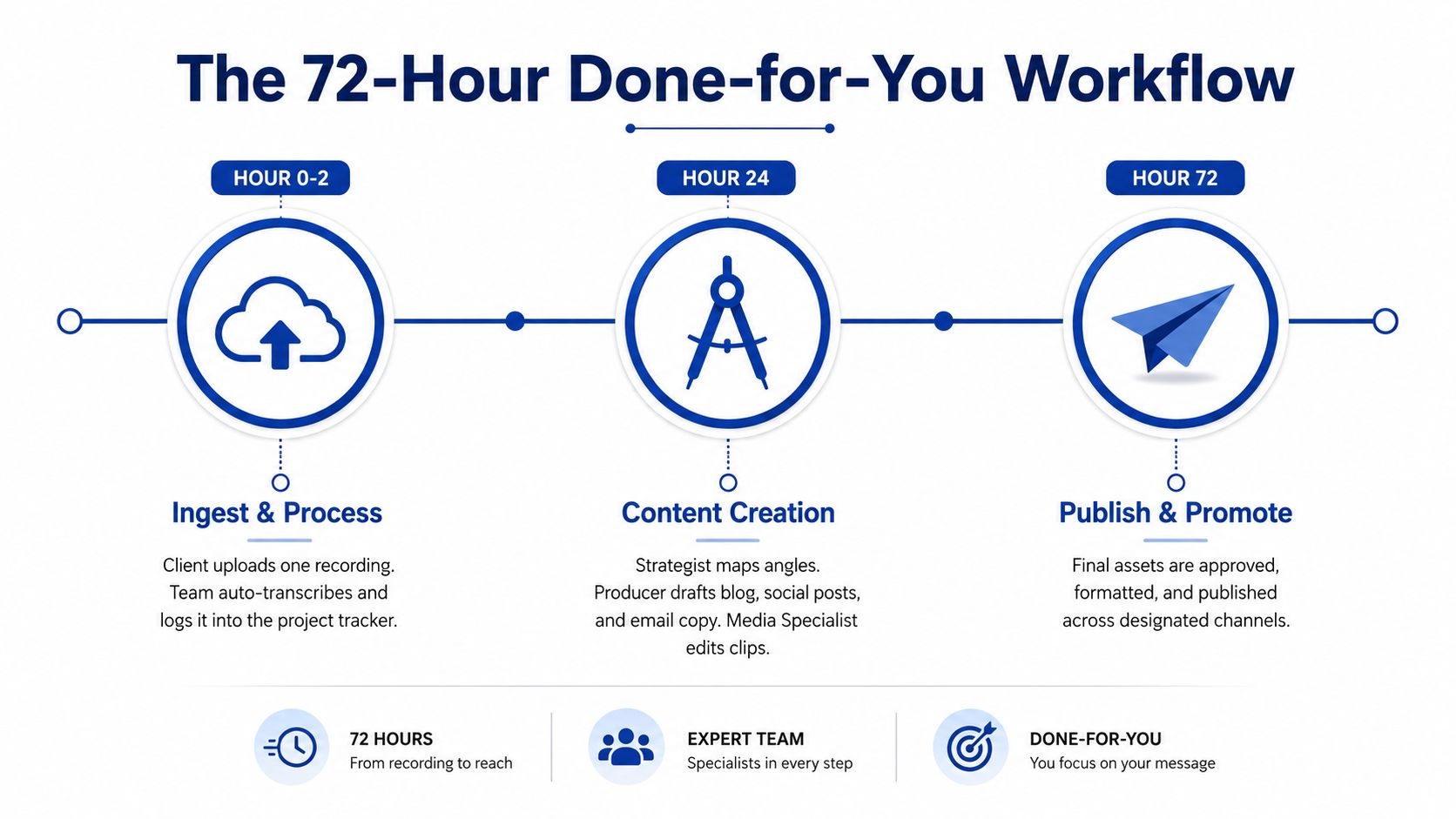
Teams comparing operating models can browse content workflow articles for additional process detail. The important distinction is ownership. The client supplies expertise once. The pod turns that expertise into finished assets.
A guide to turning webinars into podcast episodes shows how one source can support adjacent formats. The same principle applies beyond webinars. A strong interview can support video, text, audio, email, and search content without forcing the founder to repeat the original conversation.
Pricing, ROI, and Per-Asset Cost
Fractional content pricing should be judged by finished assets, not by vague promises of support. A low monthly fee can become expensive when it excludes captions, revisions, design, or formatting.
| Tier | Monthly Price | Recordings / Month | Finished Assets | Cost per Asset |
|---|---|---|---|---|
| Entry | Around $999 | 1 | 20 to 25 | $40 to $50 |
| Mid | $1,499 to $1,799 | 2 | 35 to 50 | $30 to $40 |
| Premium | Around $2,499 | 3 to 4 | 60 to 100 | $25 to $42 |
These ranges reflect the supplied 2026 pricing framework. The publisher's service model also states from $14 per finished asset, depending on plan and output volume. Buyers should compare the actual deliverables behind that figure, including whether the scope covers editing, writing, design, revisions, and publishing support.
The ROI calculation starts with distribution. One recording can feed a month of LinkedIn, email, blog, short-form video, and visual content. If a single LinkedIn post generates one inbound lead that becomes a $3,000 retainer, that contract covers a month of the mid-tier package in the stated pricing range.
Four recordings annually can produce roughly 240 to 400 assets, based on the supplied output model. That volume should be compared with a fully loaded internal hire costing $85,000 to $110,000, whose total output depends on workflow, skills, approvals, and channel scope.
Buyers should still define exclusions before signing. Paid distribution, lead nurturing, and deep SEO audits aren't automatically part of a production retainer. A content marketing ROI measurement guide can help separate output metrics from business metrics.
Creators should also budget for legitimate production inputs, such as licensed music or stock footage. A resource that helps teams find a plan for creators can be useful when production requires additional media licensing.
How to Choose a Fractional Content Team
A provider should be evaluated like an operating partner, not a freelance marketplace listing. The team needs to show how recordings become approved, publish-ready assets.
Six checks prevent most avoidable failures
- Turnaround guarantee: Look for a fixed SLA in hours, not “a few business days.” The contract should state what happens when the provider misses it. A 72-hour turnaround guarantee, or you don't pay, is materially clearer than an informal estimate.
- Brand voice system: Ask how the team captures tone, vocabulary, preferred claims, and banned phrases. A one-page voice document should exist before the first delivery.
- Revision policy: Two included rounds are reasonable. Three or more may indicate weak briefing, unclear positioning, or poor review standards.
- Asset ownership: Confirm that the client owns raw files, edits, exported assets, and any AI prompts used during production. The agreement should include written intellectual property terms.
- Posting playbook: Require captions, alt text, hashtags, filenames, and platform-specific aspect ratios. Raw exports alone create more work for the client.
- Sample-brief test: Send one recording and request two clips, one carousel, and one LinkedIn post. Score the work against brief adherence, voice match, and turnaround.
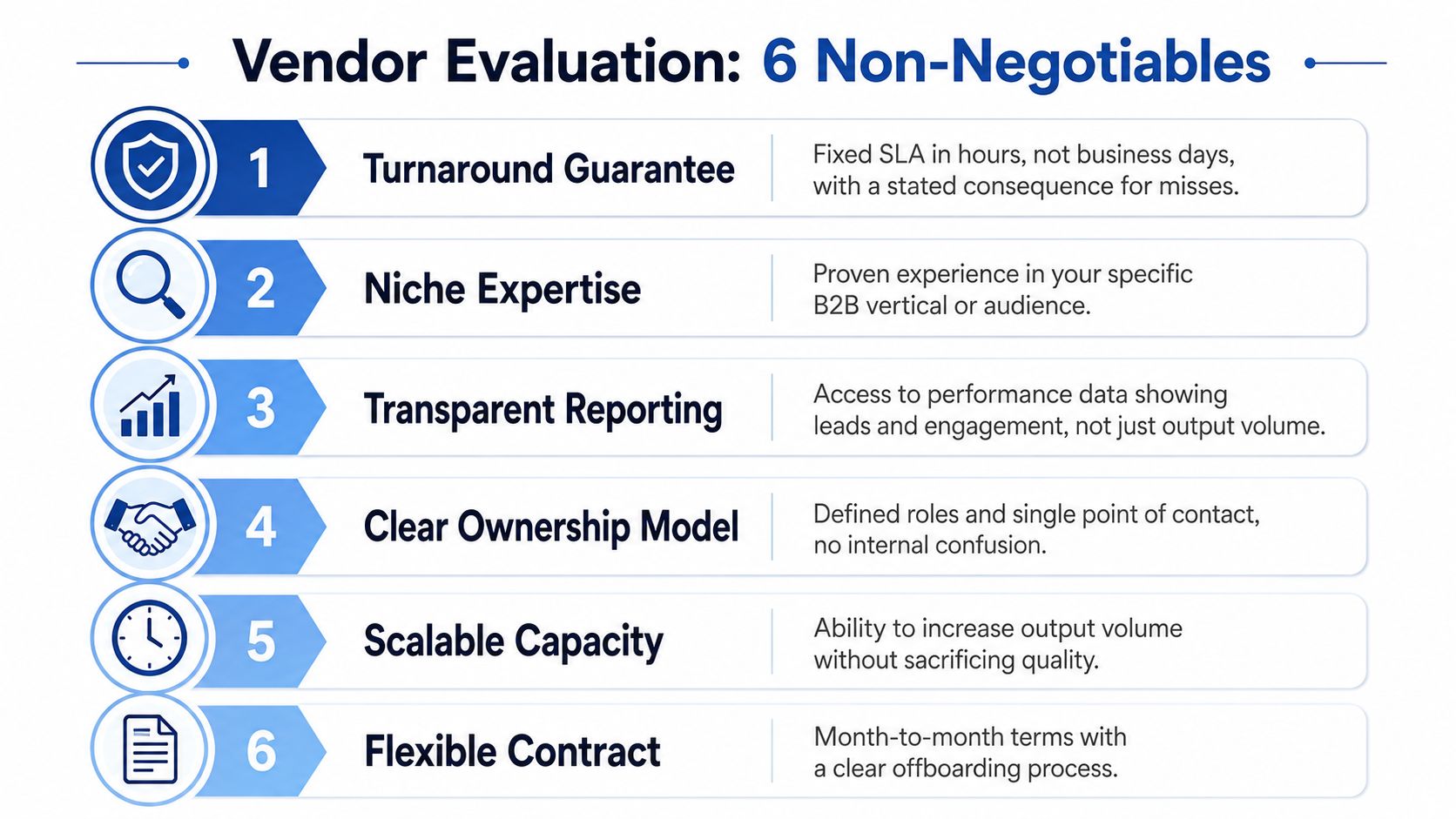
Niche experience matters, but it shouldn't replace operational proof. A provider may understand B2B content while still missing deadlines, hiding setup charges, or delivering captions as an extra fee.
Buyer standard: Walk away if delivery slips beyond five business days or pricing hides setup, stock footage, or captioning fees.
The sample should be paid, clearly scoped, and judged against the same standards as the recurring engagement. Free trials encourage vague expectations. A paid sample reveals how the team works.
When the Model Breaks and What to Do Next
A fractional content team can't fix every marketing problem. It multiplies the quality and clarity of the material it receives. Weak positioning, thin recordings, and unrealistic budgets create predictable failure.
The first failure is a pre-brand with no audience or positioning. The output may look polished while sounding generic. The fix is a positioning sprint first, or a setup-heavy retainer that defines the audience, message, proof points, and editorial boundaries before production begins.
The second failure is missing raw material. If the founder won't record one useful session each week, the system has no fuel. The team then stretches weak ideas, repeats old points, or adds filler. That damages trust faster than publishing less often.
The third failure is a sub-$1,000 monthly budget paired with expectations for more than 20 assets weekly. The math fails. Quality drops, revisions increase, and the relationship often ends within 60 days. The practical choices are simple: reduce the volume target or raise the budget toward the $1,500 floor for a functioning pod.
The model works when three conditions exist:
- A defined audience.
- At least one useful recording each week.
- A budget aligned with the requested asset volume.
If those conditions are in place, B2B founders, podcasters, and marketing teams can book a 20-minute scoping call to request a paid sample brief and per-asset quote. Send one recording, receive finished clips, posts, graphics, and an article, then judge the work against the brand voice and turnaround promise.
If the raw-input habit doesn't exist yet, build that habit first. Once a weekly recording is reliable, request a sample and assess whether the provider can deliver 20 to 30 ready-to-publish assets in 72 hours.
Book a call with RepurposeYourContent to send one podcast, interview, keynote, sales call, livestream, course, or meeting recording and receive a specific paid sample plan, per-asset quote, and 72-hour delivery guarantee.
Tags: