How to Make Viral Podcast Clips That Actually Get Shared
Learn how to make viral podcast clips with proven hooks, editing tactics, and platform specs. Turn one episode into 30 shareable assets in 72 hours.

Short-form video now accounts for 43% of all social media content consumed, and short-form posts generate about 2.5 times more engagement than long-form video according to 2026 short-form video benchmarks. That changes how podcasters should think about clips. A podcast clip isn't just a trailer for the full episode. It may be the first, and sometimes only, chance a new listener gets to encounter the show.
To learn how to make viral podcast clips, start with the moment, not the editing software. Choose a specific claim, build an immediate hook, add accurate burned-in captions, and adapt the cut to its platform. Then publish enough strong candidates to give the format a fair chance.
Why Podcast Discovery Now Starts With Short Video
A 2026 video-podcast roundup reports that 58% of podcast discovery now comes from short-form video, while an industry summary says shows posting clips to TikTok, YouTube Shorts, or Instagram Reels see an average 65% growth rate in audience reach. Those figures come from video podcast growth statistics, and they point to a major workflow change.
Listeners increasingly discover podcasts in feeds before they search for them in podcast apps. They see a guest react, a founder challenge a familiar belief, or a host deliver a sharp answer. The clip earns the first click. The full episode earns the deeper attention later.
Short-form content also carries a clear engagement advantage. Benchmark comparisons report about 2.5 times more engagement than long-form video, with one methodology recording 3.70% engagement per follower for TikTok and 5.91% for YouTube Shorts. The same comparison places Instagram Reels much lower, showing why platform-specific decisions matter rather than treating every vertical feed alike.

Clips are distribution assets
Many teams still cut one safe excerpt, add a logo, and call the job complete. That approach wastes the recording. A strong episode contains several distinct entry points, including a disagreement, an unexpected story, a useful claim, and a moment of visible emotion.
A better operating model treats one recording as a source library. The producer selects multiple candidates, creates platform-native versions, and publishes consistently each week. Virality remains uncertain, but consistent output creates more opportunities for the right moment to meet the right audience.
Practical rule: The clip should stand alone before it sends anyone to the full episode.
Creators wanting additional background can review Aicut's guide to podcast clipping, then apply the same principle to a broader short-form video strategy for B2B. The key distinction is strategic. The clip isn't an afterthought attached to the episode. It is a primary discovery format built from the episode.
Spotting Moments That Actually Travel
An interesting sentence isn't automatically a shareable clip. The strongest candidates usually combine a specific arguable claim, visible conviction, little or no required context, and a payoff inside 30 seconds.
The selection process should happen before editing. A polished version of the wrong moment still underperforms.
The three-pass mining process
Step 1, scan the transcript. Mark every important claim, number, story beat, surprising comparison, and change in emotion. Don't highlight only the guest's most polished answer. Casual phrasing often carries more personality than prepared talking points.
Step 2, apply the shareability filter. Ask whether someone would tag a colleague, challenge the statement, or send it to prove a point. A line such as “Most B2B teams don't have a content problem, they have a distribution problem” creates tension. “Content marketing requires consistency” doesn't create enough friction.
Step 3, run the two-second hook test. Remove the setup and begin at the strongest sentence or reaction. If the clip still makes sense and creates curiosity, keep it. If the viewer needs the host's question or several seconds of background, find a different entry point.

The candidate checklist
A practical transcript pass should produce 8 to 12 candidates per episode, rather than one supposed winner. Each candidate should answer these questions:
- Claim: Does the first sentence make a clear, arguable point?
- Context: Can a new viewer understand the premise without hearing the question?
- Tension: Is there disagreement, contradiction, risk, surprise, or a strong point of view?
- Emotion: Can viewers see conviction, amusement, frustration, disbelief, or excitement?
- Payoff: Does the clip reach a satisfying conclusion inside 30 seconds?
- Share trigger: Would someone tag a friend or argue in the comments?
- Hook: Does the strongest material appear immediately?
Moments that fail two or more checks usually become ordinary social posts, not priority clips. A calm explanation may still be useful, but it shouldn't consume the same production effort as a moment with natural tension.
Automated discovery can accelerate transcript review, especially for large recording libraries. StreamGen's AI approach to clip discovery offers useful background on that workflow. Human judgment still decides whether the moment fits the speaker's reputation and the show's audience.
For interview-led shows, the same selection logic works across expert interview content repurposing. The producer isn't searching for completeness. The producer is searching for a compact idea people want to discuss.
Editing Hooks That Stop the Scroll
A viewer decides quickly whether a clip deserves attention. One benchmark reports that 71% decide whether to continue within the first three seconds, while clips with 3-second retention above 65% receive 4 to 7 times more impressions than clips that lose viewers immediately. Those findings are summarized in viral hook formulas for short video.
Start by cutting anything that delays the point: logo stings, greetings, long pauses, broad introductions, and the host's question when the answer can stand alone. The first edit is a selection decision as much as a trimming task. Test several openings from the same moment before choosing the version that earns attention fastest.
Build the opening in layers
Use this sequence:
- Seconds 0 to 3: Start mid-thought with the clearest claim or strongest reaction.
- Seconds 3 to 5: Make the value or conflict obvious.
- Middle: Deliver the explanation, example, or reversal.
- Ending: Add a short call to action, such as inviting viewers to watch the full episode.
CapCut's guide to first-three-second hook patterns supports this opening sequence. Pair movement with language. A visual change, speaker reaction, camera crop, or purposeful gesture can keep a static opening from feeling passive. If the strongest sentence arrives later, move it forward and rebuild the context around it.
One retention summary identifies 70% to 85% retention as a strong benchmark for sub-60-second clips, with 85% or higher considered exceptional in that source's methodology. It also reports that combined visual and verbal hooks achieve about 62% completion, compared with about 49% for text-only openings. The supporting benchmark appears in YouTube Shorts retention guidance.

Keep the cut compact and readable
A final cut of 15 to 45 seconds suits many podcast moments better than a complete conversational excerpt. Another benchmark reports that videos under 90 seconds retain about 50% of viewers on average, while 30% of short videos reach 81% or higher completion. Cut toward the payoff instead of preserving every sentence.
Sound-off viewing makes captions part of the edit, not a finishing touch. One captioning source estimates that 70% to 85% of short-form views happen without sound, and recommends 2 to 5 words per screen with 95% to 99% transcription accuracy. Best practices for podcast clip captions provides the underlying guidance. For the production workflow, use this guide to add captions to video clips.
Burned-in captions should emphasize meaning rather than reproduce a dense transcript. Correct names, industry terms, and overlapping speech manually. Keep text away from faces and important gestures, following caption placement and accuracy guidance.
Manual production takes longer than teams often budget. Finding candidates can take about an hour per recording, while cutting selected moments can take 2 to 3 hours. Caption correction, reframing, thumbnails, exports, and publishing add more work. Rushing those steps usually sacrifices the hook selection and testing that determine whether the finished clip travels.
Adapting Clips for Each Platform
The same moment can serve different goals on different feeds. TikTok is built for discovery and can produce the largest raw-reach spikes. YouTube Shorts often converts more naturally into durable subscribers because viewers are close to the full episode. LinkedIn may produce smaller absolute numbers, but it can generate the strongest business inquiries for a B2B show.
The right question isn't “Which platform is best?” It is “What outcome should this clip produce?”
| Platform | Ideal Length | Hook Style | Primary Goal |
|---|---|---|---|
| TikTok | 15 to 45 seconds | Direct claim, reaction, or disagreement in the opening frame | Discovery and raw reach |
| YouTube Shorts | 15 to 45 seconds | Strong statement with a searchable title | Subscribers and full-episode conversion |
| Instagram Reels | 15 to 45 seconds | Visual reaction with concise on-frame text | Shares, saves, and audience growth |
| 30 to 60 seconds | Business implication, contrarian insight, or executive opinion | Qualified conversation and inquiries |
These ranges are editorial targets, not guarantees. The clip should end when the idea lands. Padding a moment to match a template weakens pacing.
Change the packaging, not the idea
For TikTok, retain natural speech and visible reaction. Avoid making the clip feel like a corporate advertisement. A bold first-frame statement can create enough friction for a viewer to stop.
For YouTube Shorts, write a title that states the idea clearly. The on-screen text still matters, but the title can help viewers understand the clip before they watch. The short should also point naturally toward the full episode.
Instagram Reels benefits from clean visual framing and readable captions. LinkedIn needs a sharper business frame. A founder discussing hiring, pricing, or positioning may need an opening line that explains the consequence for operators.
A practical guide to turning podcast clips into TikTok Shorts can help producers think through platform-specific formatting. The same source moment should receive different captions, titles, and opening text rather than identical exports everywhere.
For broader distribution, cross-platform content repurposing offers a useful planning reference. The workflow should preserve the speaker's core point while changing the packaging around it.
Testing Hooks and Thumbnails Before You Commit
Virality is a numbers game, but random publishing wastes useful feedback. A practical testing system changes one visible variable while keeping the underlying moment consistent.
Start with a clip that already passes the selection checklist. Create two versions with different first-frame text. One might state the contrarian claim. The other might frame the consequence or question.
A simple testing workflow
- Choose one moment. Keep the edit, captions, and speaker performance consistent.
- Create two hook variants. Change the opening text, first frame, or title, not everything at once.
- Use the platform's native behavior. Test titles on YouTube Shorts. Test on-frame hook lines on TikTok and Instagram Reels.
- Stagger carefully. On the same platform, publish the second version a week apart. Across platforms, compare versions without treating the audiences as identical.
- Review meaningful signals. Compare completion rate, shares, comments, and comment sentiment. Views alone don't show whether the idea traveled.
- Record the result. Add the hook, topic, format, platform, and outcome to a hook log.
A thumbnail matters most where the platform gives it meaningful visibility. On Shorts, titles and opening frames deserve attention. On Reels and TikTok, the first on-frame line usually carries more weight than a traditional thumbnail.
Turn results into templates
The hook log should track patterns, not just winners. Note whether claims, questions, warnings, reactions, or “you've been told this wrong” openings attract stronger completion and sharing.
A producer can then build repeatable formats for future episodes. That doesn't mean every clip should sound identical. It means the team stops guessing about which kinds of openings deserve another test.
Measurement rule: Compare completion and shares before celebrating view volume.
The Done-for-You Alternative to DIY Clipping
DIY clipping looks simple until the full workflow appears. A producer must scan the recording, review the transcript, select 8 to 12 candidates, cut the footage, correct captions, reframe speakers, create platform versions, write copy, design supporting assets, and publish everything.
Clipping alone can take 2 to 3 hours per recording. Caption correction, formatting, thumbnail work, post writing, and quality control extend the production block further. The hidden cost isn't only editing time. It is the weekly decision fatigue that causes strong recordings to sit unused.
A practical delivery workflow
- Step 1: The client sends one podcast, interview, keynote, sales call, livestream, course, or meeting recording.
- Step 2: The production team reviews the transcript and identifies claims, tension, stories, reactions, and useful supporting points.
- Step 3: Editors create short video clips with platform-ready framing and burned-in captions.
- Step 4: Writers and designers produce LinkedIn posts, quote graphics, carousels, audiograms, and a blog post in the client's brand voice.
- Step 5: The client reviews the set, requests unlimited revisions, and receives finished assets ready to publish.
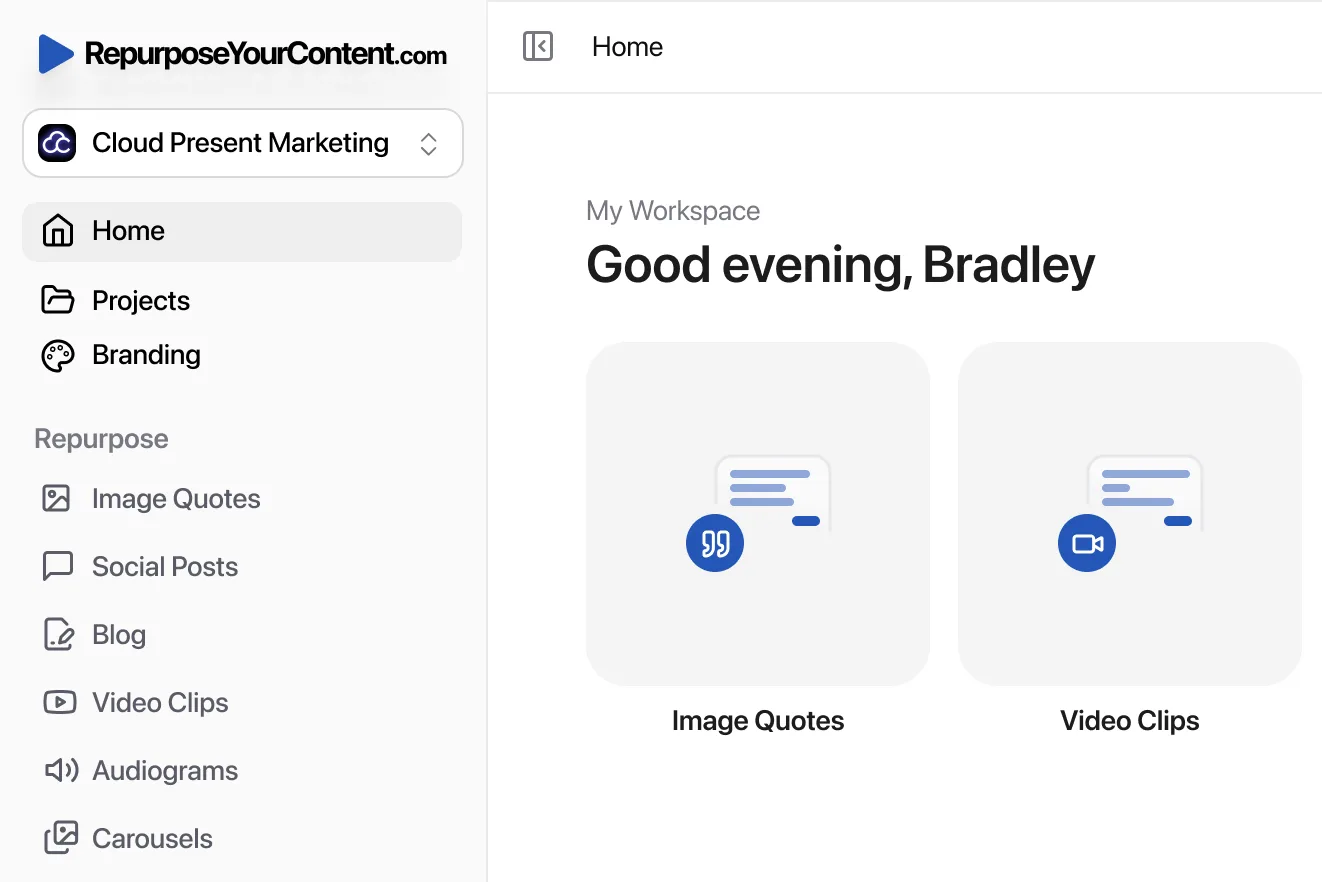
RepurposeYourContent is one done-for-you option for this workflow. A client sends one recording and receives 20 to 30 ready-to-publish assets within 72 hours, including video clips, LinkedIn posts, quote graphics, carousels, audiograms, and a blog post. The service uses the client's brand voice, includes unlimited revisions, and takes about 15 minutes of client time per recording.
The service positions the production cost from $14 per finished asset, and its 72-hour turnaround guarantee means the client doesn't pay if the deadline isn't met. A related overview of done-for-you podcast content production explains the broader workflow.
That model suits teams that know what they want to publish but don't want to become full-time editors. The next step is practical. Book a call with RepurposeYourContent or request a sample from a recent recording, then judge the selection quality, captions, brand fit, and turnaround before committing to a recurring workflow.
Book a call or request a sample from RepurposeYourContent using a recent podcast episode, interview, keynote, or other recording. Send one source file, and see how a 45-minute conversation can become 20 to 30 finished content assets without your team spending the week editing.
Tags: