How to Promote a Podcast on Social Media
Learn how to promote a podcast on social media with platform-specific tactics for TikTok, Reels, Shorts, LinkedIn, and X. Realistic time budgets included.

35% of podcast listeners discovered a new show through social media, and most podcasters still waste that channel by posting the same episode link everywhere with no native content attached source. How to promote a podcast on social media comes down to this, stop announcing episodes and start packaging them. If the feed only sees a link drop, it has nothing to stop for, and listeners have nothing to sample.
Why Most Podcast Social Promotion Fails
The biggest mistake is not lack of effort. It's format mismatch. A podcast episode is long, rich, and conversational. A social feed wants a fast hook, a clear point, and something that feels native to the scroll.
That's why the usual promo post flops. A host writes, “New episode is live,” pastes a link, adds a few hashtags, then repeats the same post on every channel. The audience sees repetition. The platform sees thin distribution. Neither responds well.
Practical rule: if the post looks like an announcement, it will usually perform like an announcement.
Social discovery now works because people meet the episode before they ever commit to it. Strong podcast promotion gives them a clip, a quote, a sharp opinion, or a useful takeaway first. The episode link comes after interest is created, not before.
The source data is clear on the volume needed. Research-oriented podcast marketing guidance recommends publishing about 10–15 social pieces per episode and posting 3–5 times per week to keep momentum podcast social promotion guide. That is not busywork. It is how a single recording becomes repeated exposure across TikTok, Instagram, LinkedIn, YouTube Shorts, and X.
For a cleaner framework, compare native promotion with link dumping in this breakdown of native content versus repurposed content. The difference is simple. Native content earns attention first. Links ask for attention before they deserve it.
The Per-Episode Workflow With Realistic Time Costs
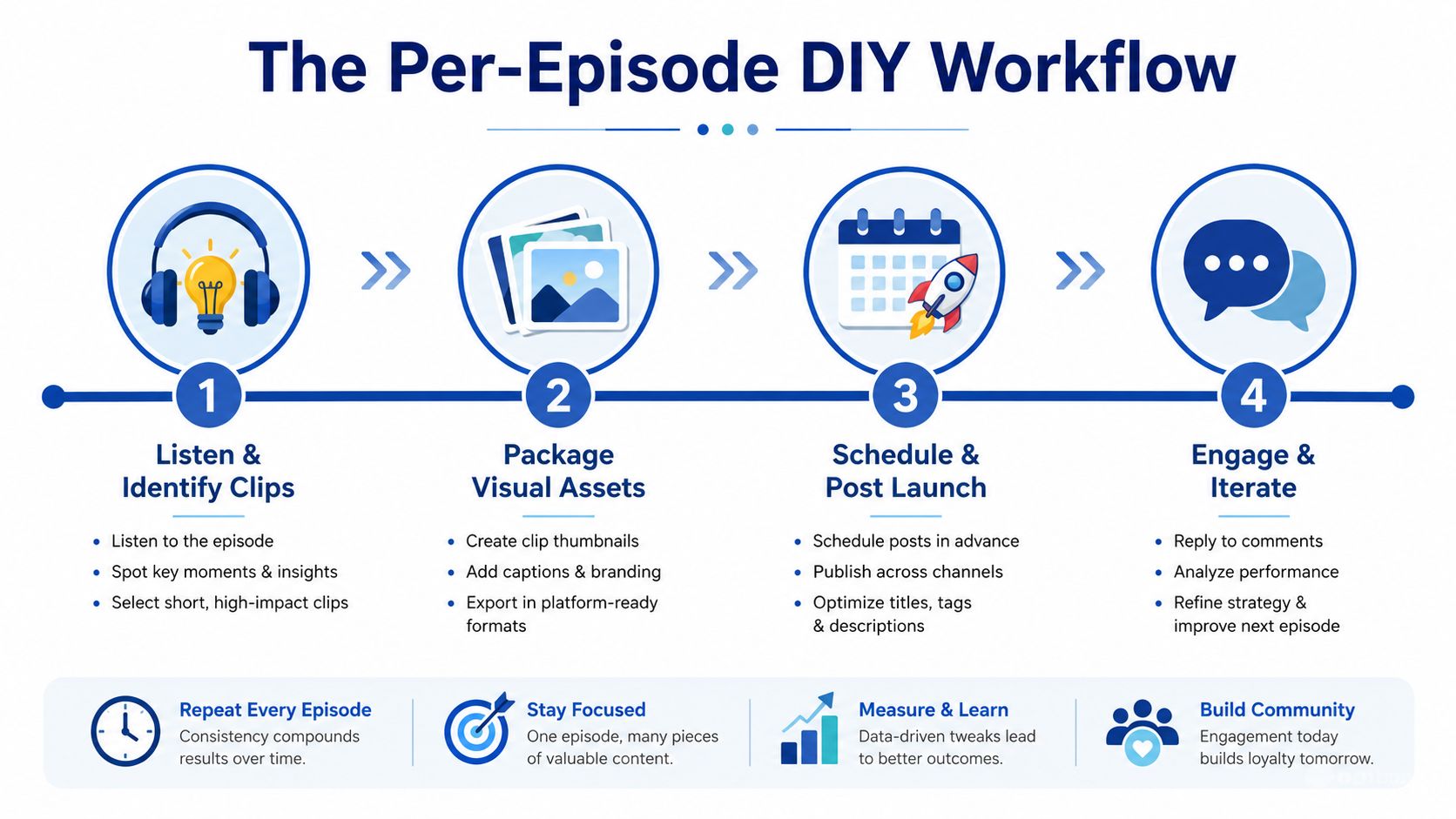
A strong social system starts while the episode is still being edited. The practical workflow is simple. First, identify clip-worthy moments. Then package visuals. Then post at launch. Then recycle the strongest moments later with fresh hooks.
Step 1, Find the moments worth clipping
Manual clipping takes real time. For one episode, expect 2 to 3 hours just to find usable moments, cut them cleanly, and export them in the right lengths. The goal is not to clip everything. The goal is to find sharp opinions, quick stories, and lines that can stand alone in a feed.
Step 2, Turn one recording into a content kit
After clipping, the work shifts into captions, quote cards, and platform-specific variants. That often takes another 2 to 4 hours when done solo, especially if visuals are being designed from scratch. Add scheduling, post copy, and basic comment engagement, and the total climbs fast.
One episode can look small on paper and still eat half a workday once captions, crops, graphics, and exports are counted.
The earlier planning guidance says a single episode should become 10–15 social pieces podcast social promotion guide. That number makes sense only if the episode is treated like source material, not like a finished asset. A practical team turns the episode into a reusable kit during editing, then posts the first round on launch day and repurposes evergreen clips later, which matches the workflow advice in this podcast social promo process.
Step 3, Launch with assets ready
Launch day is where many solo hosts lose the thread. The episode goes live, but the promo assets are still unfinished. That's backward. Buffer's podcast promotion guidance says to record 3–5 episodes before launch and expect 2–4 days for iTunes to show the show after submission Buffer's podcast promotion guide. That lead time exists for a reason. Social content should already be staged.
Step 4, Reuse the back catalog
The best shows don't stop after the release window. When a topic becomes timely, old clips can be resurfaced with new framing. That's how the feed stays active without forcing the team to create from zero every week. It also explains why many podcasters eventually give up on posting the episode link once and walking away. The math is too heavy.
For show-level packaging, the episode notes matter too. A practical reference on how to create podcast show notes from recordings fits into the same production chain.
Platform Playbook TikTok, Reels, Shorts, LinkedIn, and X
Different platforms reward different cuts of the same episode. That's the part many podcasters miss. They make one promo asset, then blame the channel when it underperforms. The problem is usually that the content never matched the feed in the first place.
What each platform wants
| Platform format cheat sheet for podcast promotion | Best clip length | Hook style | Caption approach | Cadence |
|---|---|---|---|---|
| TikTok | 15 to 45 seconds | Fast visual hook in the first 2 seconds | Bold, short, direct | Frequent, native, not link-heavy |
| Instagram Reels | 15 to 45 seconds | Strong first frame, bold captions | Captioned, visual, scannable | Consistent, with stories and carousels mixed in |
| YouTube Shorts | 30 to 60 seconds | Fast start, clear payoff | Minimal text, clear title | Regular posting from a clip bank |
| 60 to 90 seconds | One sharp professional point, often contrarian | Thoughtful, context-rich | Steady, not spammy | |
| X | Text-first hook with native video as support | Listener problem or contrarian claim | Short, pointed, easy to reply to | Repeatable, conversation-led |
That table lines up with the broader playbook in podcast clips for social media. The common thread is simple. Native content beats a link drop on every platform. The first line matters more than hashtags.
TikTok and Reels usually reward the fastest cuts. A host speaking directly to camera, with bold captions and a visible point, tends to fit the feed better than a static square with a title card. YouTube Shorts can hold slightly longer edits, so the same insight can breathe a little more. LinkedIn wants the opposite. A clear professional stance, especially a contrarian one, tends to work better than a generic highlight reel.
X behaves differently again. Text still matters most there. A strong first line can pull attention, while the video supports the claim. The mistake is posting the episode title as if that alone carries interest. It doesn't.
Start on One Platform and Nail It First
The fastest way to get overwhelmed is to start everywhere. The better move is to pick one platform where current listeners already spend time, then build a repeatable format there before adding another channel. That keeps execution clean and avoids the half-finished promo problem.
Spotify's creator guidance gives the bio structure that works. The profile should succinctly describe the podcast and include a clear CTA like “Listen to the latest episode” with a link to the show Spotify's creator guidance. That small change matters because the bio should convert curiosity, not just identify the show.
A practical launch sequence
- Record ahead of launch. Buffer recommends 3–5 episodes before launch so the promo machine has content ready Buffer's podcast promotion guide.
- Set the bio before posting. Use a short show description and a direct episode CTA.
- Publish one strong opener. Post the best clip or teaser first, not the episode link.
- Message the list on launch day. Buffer also recommends building an email or outreach list before launch, then using it when the show goes live Buffer's podcast promotion guide.
- Keep the cadence steady. After launch, post consistently instead of disappearing for a week.
The show also needs a realistic indexing buffer. iTunes can take 2–4 days to show the podcast after submission Buffer's podcast promotion guide. That means launch promotion should be planned before the show is public, not after people ask where to find it.
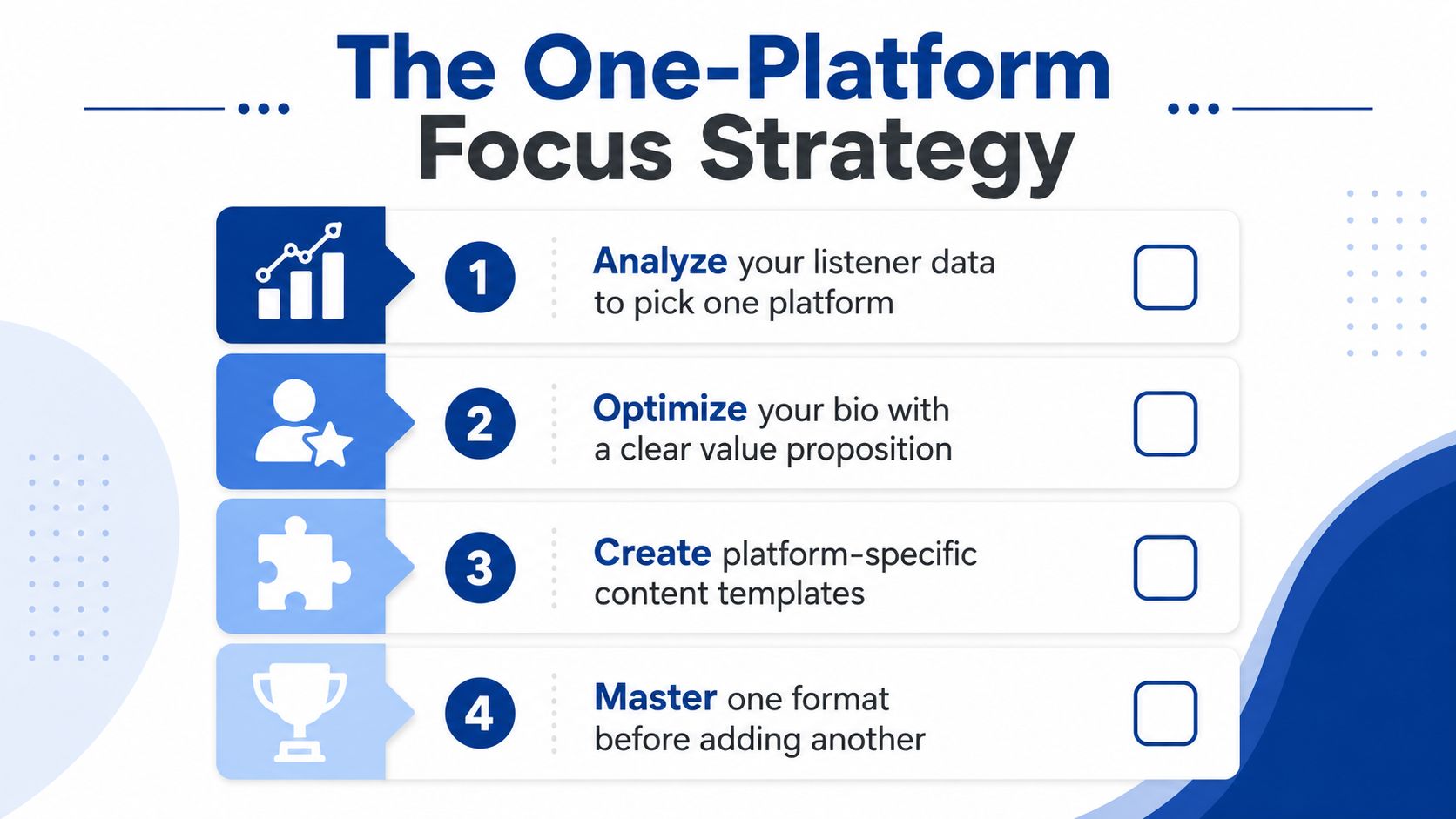
The other useful rule is boring but true. Start with one platform, master the format, then expand. Broad but shallow promotion usually burns time without building a real audience.
The One-Asset-Per-Day Posting Cadence That Works
A daily cadence works because variety makes the show feel active without sounding repetitive. One asset per day is enough when the formats rotate. The problem is not frequency. The problem is posting the same episode link five times and hoping it feels fresh.
A simple weekly rhythm
- Monday, Clip: Open with the strongest insight from the episode.
- Tuesday, Quote Graphic: Pull a sharp line that can stand alone.
- Wednesday, Carousel: Turn the episode's takeaways into a swipeable summary.
- Thursday, Clip: Use a different moment, not the same cut as Monday.
- Friday, Text Post: Lead with a question or contrarian point.
That schedule gives the audience variety. It also prevents the feed from reading like a broken record. For LinkedIn specifically, a practical content mix often works better than pure episode promotion. The published advice recommends 40% podcast-related content, 40% industry takes or current thoughts, and 20% behind-the-scenes content LinkedIn promotion guidance. That mix keeps the account useful even when an episode is not fresh.
Rule of thumb: five posts that look different will outperform five posts that say the same thing.
The content buckets are easy to understand in practice. The podcast-related bucket is a clip, a quote, or a carousel from the episode. The industry-takes bucket is a short opinion tied to the show's theme. The behind-the-scenes bucket is a setup shot, a guest prep moment, or a recording-day note.
The same LinkedIn source also recommends mixing in a reel or recap, a guest or topic angle, and some personal or setup content so the feed does not turn into a stream of episode announcements LinkedIn promotion guidance. That advice is sound beyond LinkedIn too. The first line of each post still matters more than hashtags.
A strong hook beats a generic announcement every time. “Most podcasters quit at episode 7, here is why” will usually beat “New episode!” because it creates a real point of view. Question hooks that name the listener's exact problem work better than vague curiosity. That's the difference between a post people scroll past and one they stop on.
One Episode Becomes a Full Week of Posts
A single 45-minute episode can carry a full week if the cuts are planned properly. The trick is to let each platform see a different angle. The content is the same. The framing changes.
A worked week from one recording
Monday, LinkedIn clip. Use a 60 to 90 second insight clip where the host or guest makes one sharp professional point. Hand-editing this kind of clip can take about 20 minutes once the source moment is known.
Tuesday, Instagram quote graphic. Pull one blunt line from the episode and turn it into a clean visual. That can take 30 to 45 minutes if the design is being done manually.
Wednesday, LinkedIn carousel. Turn the top takeaways into a swipe post. Expect an hour or more if each slide is being written and designed from scratch.
Thursday, TikTok and Reels clip. Cut a 15 to 45 second segment with a strong visual hook and bold captions. This is often the fastest-performing format, but it still takes time to crop, caption, and export.
Friday, X text post. Write a contrarian hook, then attach a native video or a short quote. That takes less design time, but it still needs a strong first line.
Saturday, teaser for next week. Share a guest teaser or a coming-soon angle. This keeps the account moving between releases.
Sunday, behind-the-scenes still. Post a studio frame, setup shot, or prep note. It adds texture and keeps the feed human.
A 45-minute episode can be repackaged into clips, quote cards, captions, and teasers instead of being posted once and forgotten. That is the historical shift from “publish an episode” to launch a content bundle podcast social promotion guide. The same source says active social clip promotion can drive 3–5x more downloads in the first 72 hours podcast social promotion guide, which is why the launch window deserves real attention.
The Done-for-You Alternative That Saves 15 Hours Per Episode
DIY promotion can work, but the time cost piles up fast. Once clipping, captions, graphics, scheduling, and engagement are counted, the burden lands in the 15 to 20 hour range for many solo creators. That is why many shows stall after a few strong episodes.
A done-for-you podcast-to-social-media service changes the math. One recording, whether it is a podcast, interview, keynote, webinar, panel, livestream, or meeting, can be turned into 20–30 ready-to-publish assets in 48 to 72 hours. That package usually includes 8–12 short-form clips, 6–8 social posts, 4–6 quote graphics, 1–3 carousels, and an SEO-ready blog post. The client time is about 15 minutes per recording, because the heavy production is handled elsewhere.
The practical difference is not just speed. It's consistency. The episode gets adapted into platform-native variants, so the LinkedIn cut is not the TikTok cut and the quote graphic is not the carousel. That matches the platform rules covered above.
An internal walkthrough of the podcast-to-social-media service shows how this kind of production fits into weekly publishing. The numbers matter here too. Plans start at $999/month for one recording, which works out to roughly $14 per finished asset. The service also carries a 72-hour turnaround guarantee, or you don't pay.
For teams that want the weekly content engine handled, RepurposeYourContent is one option in that category. The process is straightforward. Send one recording, get back brand-aligned content, and move on to the next episode without losing a day to post-production.
If the goal is to promote a podcast on social media without living inside an editing timeline, book a call or request a sample.
Tags: